Loading...
This comparison has not been analyzed yet.
One-time AI generation (~1 minute). Scores and timeline are already available below.
Charles I of Anjou vs John I of Portugal
Charles I of Anjou leads by 3.3 pts · 2 figures compared
…
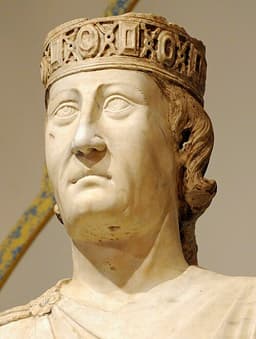
Charles I of Anjou
Emperor · Medieval
63.6Total
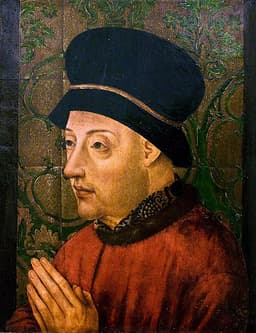
John I of Portugal
Emperor · Medieval
60.3Total
Basic Information
Born
1227
1357
Died
1285
1433
Era
Medieval
Medieval
Nationality
France
Portugal
Occupation
Emperor
Emperor
Civilization
Western
Western
Score Comparison
Military (10%)
82.0
65.0
Political (20%)
68.0
55.0
Influence (20%)
62.0
56.7
Legacy (20%)
52.0
58.0
Leadership (15%)
67.0
72.0
Strategy (15%)
66.3
60.7
TOTAL
63.6
60.3
Charles I of Anjou — Complete Timeline
1266 AD
Conquest of the Kingdom of SicilyWar◆ Major
Charles I of Anjou defeated Manfred of Hohenstaufen at the Battle of Benevento, conquering the Kingdom of Sicily. He was crowned king in Rome with papal support, establishing Angevin rule in southern Italy.
ConquestSicilyAngevin
Impact: regional
1268 AD
Battle of TagliacozzoWar◆ Major
Charles I defeated Conradin of Hohenstaufen at the Battle of Tagliacozzo, ending Hohenstaufen claims to Sicily. Conradin was captured and later executed, solidifying Angevin control and earning Charles a reputation for ruthlessness.
BattleHohenstaufenExecution
Impact: regionaldestructive
1270 AD
Planned crusade against the Byzantine EmpirePolitical Action◆ Major
Charles I negotiated with the Pope and other powers to launch a crusade against the Byzantine Empire, aiming to restore the Latin Empire. He used Sicily as a base for naval preparations, but the plan was delayed by the Eighth Crusade.
CrusadeByzantineDiplomacy
Impact: regional
1282 AD
Sicilian VespersWar◆ Major
A popular uprising in Palermo, known as the Sicilian Vespers, expelled Angevin rule from Sicily. The revolt was supported by Peter III of Aragon, leading to a war that cost Charles control of the island and weakened his power.
RevoltSicilyAragon
Impact: regionaldestructive
1285 AD
Death and collapse of Angevin ambitionsOther◆ Major
Charles I died at Foggia, leaving his son Charles II a reduced kingdom. The loss of Sicily and the ongoing war with Aragon ended his dreams of a Mediterranean empire, and the Angevin dynasty never recovered its former power.
DeathAngevinDecline
Impact: regionaltragic
John I of Portugal — Complete Timeline
1385 AD
Battle of AljubarrotaWar
John I led Portuguese forces to a decisive victory over the Castilian army at Aljubarrota. This battle secured Portuguese independence and solidified John's claim to the throne.
BattleIndependenceCastile
Impact: regionalconstructive
Accession to the thronePolitical Action
John I became King of Portugal after the 1383-1385 Crisis, being elected by the Cortes of Coimbra. His accession ended the Burgundian dynasty and founded the House of Aviz.
SuccessionDynastyAviz
Impact: nationalconstructive
1386 AD
Treaty of WindsorPolitical Action◆ Major
John I signed the Treaty of Windsor with England, establishing a perpetual alliance between Portugal and England. This alliance, the oldest in the world, has endured to the present day.
TreatyAllianceEngland
Impact: globalconstructive
1415 AD
Conquest of CeutaWar◆ Major
John I led the conquest of Ceuta in North Africa, marking the beginning of Portuguese overseas expansion. The capture of the city opened the era of European colonialism.
ConquestColonialismNorth Africa
Impact: global
This comparison has not been analyzed yet.
One-time AI generation (~1 minute). Scores and timeline are already available below.
Rankings
🥇
Charles I of AnjouLeader
Mil: 82.0Pol: 68.0Inf: 62.0
63.6
🥈
John I of Portugal
Mil: 65.0Pol: 55.0Inf: 56.7
60.3
+3.3 behind
How This Comparison Works
Algorithm
Each figure is scored on 6 dimensions (0—100 scale) based on structured historical data: Military (10%), Political (20%), Influence (20%), Legacy (20%), Leadership (15%), Strategy (15%). The weighted total produces the final ranking.
Data Sources
Scores are computed from structured sub-indicators in the database. Scale factors adjust for era (Ancient ×0.85, Modern ×1.0) and civilization size (Eastern ×1.05, Other ×0.80) to account for differences in population and military scale.
Maximum 3 Figures
Comparisons are limited to 2—3 figures to ensure readability and statistical meaningfulness.
Error Margins
±5 points per dimension — Sub-scores are derived from historical records with inherent uncertainty. Two figures within 5 points on a dimension should be considered roughly equivalent in that area.
Total Score Accuracy
±3 points overall — The weighted combination of 6 dimensions produces a total score with approximately ±3 points of uncertainty. Differences of less than 3 points are not statistically significant— the figures are effectively tied.
Known Limitations
- Historical records are incomplete and uneven across civilizations
- Figures from oral-tradition societies may be underrepresented
- Occupation labels can misclassify multi-role figures
- Scores measure capability and impact, not moral character
- Quantitative scoring is a comparison tool, not absolute truth
Capability Radar
Military (10%) — Battles & Warfare
Battles
75
65
Win Rate
70
70
Expansion
80
60
Political (20%) — Governance & Reform
Reform
55
70
Diplomacy
50
75
Economy
60
70
Influence (20%) — Cultural & Global Reach
Cultural
45
60
Global
55
55
Legacy (20%) — Historical Impact
Historical
60
65
Longevity
50
60
Leadership (15%) — Power & Stability
Tenure
60
75
Stability
30
65
Strategy (15%) — Tactics & Innovation
Strategy
78
65
Tactics
72
60
Reform
65
55
Similar Comparisons
Comments & Discussion
No comments yet. Be the first to share your thoughts!