Loading...
Charles I of Anjou vs Napoleon Bonaparte
Napoleon Bonaparte leads by 7.3 pts · 2 figures compared
…
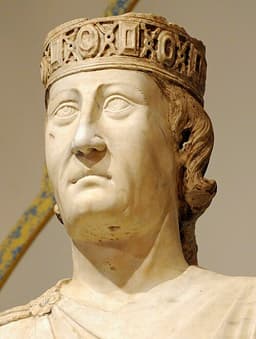
Charles I of Anjou
Emperor · Medieval
63.6Total

Napoleon Bonaparte
General · Modern
70.9Total
Basic Information
Born
1227
1769
Died
1285
1821
Era
Medieval
Modern
Nationality
France
France
Occupation
Emperor
General
Civilization
Western
Western
Score Comparison
Military (10%)
82.0
94.0
Political (20%)
68.0
72.0
Influence (20%)
62.0
40.0
Legacy (20%)
52.0
80.0
Leadership (15%)
67.0
78.0
Strategy (15%)
66.3
90.0
TOTAL
63.6
70.9
Charles I of Anjou — Complete Timeline
1266 AD
Conquest of the Kingdom of SicilyWar◆ Major
Charles I of Anjou defeated Manfred of Hohenstaufen at the Battle of Benevento, conquering the Kingdom of Sicily. He was crowned king in Rome with papal support, establishing Angevin rule in southern Italy.
ConquestSicilyAngevin
Impact: regional
1268 AD
Battle of TagliacozzoWar◆ Major
Charles I defeated Conradin of Hohenstaufen at the Battle of Tagliacozzo, ending Hohenstaufen claims to Sicily. Conradin was captured and later executed, solidifying Angevin control and earning Charles a reputation for ruthlessness.
BattleHohenstaufenExecution
Impact: regionaldestructive
1270 AD
Planned crusade against the Byzantine EmpirePolitical Action◆ Major
Charles I negotiated with the Pope and other powers to launch a crusade against the Byzantine Empire, aiming to restore the Latin Empire. He used Sicily as a base for naval preparations, but the plan was delayed by the Eighth Crusade.
CrusadeByzantineDiplomacy
Impact: regional
1282 AD
Sicilian VespersWar◆ Major
A popular uprising in Palermo, known as the Sicilian Vespers, expelled Angevin rule from Sicily. The revolt was supported by Peter III of Aragon, leading to a war that cost Charles control of the island and weakened his power.
RevoltSicilyAragon
Impact: regionaldestructive
1285 AD
Death and collapse of Angevin ambitionsOther◆ Major
Charles I died at Foggia, leaving his son Charles II a reduced kingdom. The loss of Sicily and the ongoing war with Aragon ended his dreams of a Mediterranean empire, and the Angevin dynasty never recovered its former power.
DeathAngevinDecline
Impact: regionaltragic
Napoleon Bonaparte — Complete Timeline
1799 AD
Coup of 18 BrumaireOther◆ Major
Napoleon Bonaparte, with support from his brother Lucien and key political figures, overthrew the Directory in a bloodless coup. He established the Consulate with himself as First Consul, effectively becoming the ruler of France. This event ended the French Revolution's most unstable period.
French RevolutionCoupRise to Power
Impact: regional
1804 AD
Promulgation of the Napoleonic CodeOther◆ Major
Napoleon enacted the Civil Code of the French, known as the Napoleonic Code, a comprehensive set of laws that replaced the fragmented feudal legal systems. The code established legal equality, protected property rights, and secularized law. It became the basis for legal systems in many European and world countries.
Legal ReformNapoleonic CodeCivil Law
Impact: globalconstructive
1805 AD
Battle of AusterlitzWar◆ Major
Napoleon's Grande Arm
Napoleonic WarsBattleDecisive Victory
Impact: global
1812 AD
Invasion of RussiaWar◆ Major
Napoleon led the Grande Arm
Napoleonic WarsInvasionDisaster
Impact: globaldestructive
1815 AD
Battle of WaterlooWar◆ Major
Napoleon's French army was defeated by the combined forces of the Duke of Wellington's Anglo-Allied army and Gebhard Leberecht von Bl
Napoleonic WarsBattleFinal Defeat
Impact: globaldestructive
Expert Analysis
charles-i-of-anjou-vs-napoleon-bonaparte
# The Conqueror’s Gambit: Napoleon and Charles of Anjou
On a June morning in 1815, Napoleon Bonaparte stood on a muddy ridge near Waterloo, watching his elite Imperial Guard march into the maw of British cannon fire. Six hundred years earlier, in February 1266, another Frenchman, Charles of Anjou, had ridden through the snow at Benevento, his knights cutting down the golden-haired Manfred of Hohenstaufen. Both men reached for the same prize—the mastery of Europe—but their stories ended in starkly different keys: one in a blaze of final glory and exile, the other in a slow, bitter erosion of everything he had won. Why did Napoleon, who lost everything, become an immortal legend, while Charles, who held his conquests for nearly two decades, faded into a footnote?
Origins
Napoleon was born in 1769 on Corsica, an island of rugged independence that had just passed from Genoa to France. His family were minor nobles, proud and penurious. From the start, he was an outsider—Italian-speaking, ambitious, and burning with resentment against the French establishment that would later worship him. Charles of Anjou, born in 1227, was the opposite: the youngest brother of King Louis IX of France, the sainted crusader. He was born into the very heart of power, a prince of the Capetian dynasty, but also into its shadow. While Louis ruled, Charles had to carve out his own dominion, and the Mediterranean became his theater.
Their eras shaped them profoundly. Napoleon came of age in the chaos of the French Revolution, when old hierarchies collapsed and a young artillery officer could become emperor. Charles lived in a world of Christendom and crusade, where legitimacy came from blood and papal blessing, not from the will of the people or the thunder of cannon.
Rise to Power
Napoleon’s ascent was a series of explosions. In 1793, at age twenty-four, he drove the British out of Toulon with a brilliant use of artillery. By 1796, he commanded the Army of Italy and turned a ragged force into a conquering legion, smashing the Austrians and carving out the Cisalpine Republic. Each victory fed the next: Egypt in 1798, the coup of 18 Brumaire in 1799, and the imperial coronation in 1804. He did not inherit power; he seized it, step by step, with the bayonet and the ballot.
Charles of Anjou’s rise was slower, more diplomatic. In 1246, his brother Louis granted him the county of Provence. For two decades, he consolidated, married well, and positioned himself as the Pope’s champion against the Hohenstaufen dynasty, which held Sicily and threatened papal lands. In 1266, Pope Clement IV formally invested him with the Kingdom of Sicily. Charles marched south, and at the Battle of Benevento, he killed Manfred and took the crown. Two years later, at Tagliacozzo in 1268, he crushed the young Conradin, the last Hohenstaufen heir. Where Napoleon gambled on genius, Charles gambled on patience and papal favor.
Leadership & Governance
Napoleon governed with a restless energy that reshaped Europe. His Napoleonic Code standardized law, abolished feudalism, and enshrined merit over birth. He built roads, founded banks, and reformed education. As a military commander, he was a genius of movement and concentration—his victory at Austerlitz in 1805 remains a masterpiece of deception and timing. Yet his political wisdom had limits: he could not stop conquering, and he could not share power. He centralized everything in himself, and when he fell, the system collapsed.
Charles of Anjou ruled Sicily as a conqueror and a tax collector. He moved his capital to Naples, built a fleet, and turned the kingdom into a base for Mediterranean ambition. He planned a crusade against the Byzantine Empire in 1270, aiming to restore the Latin Empire of Constantinople. But his governance was harsh—heavy taxes, French officials, and little respect for Sicilian nobles or the local church. He was a capable administrator but a rigid one. Where Napoleon inspired devotion, Charles inspired fear.
Triumph & Tragedy
Napoleon’s greatest moment was Austerlitz, where the sun rose over a frozen battlefield and the combined armies of Russia and Austria shattered before him. His greatest tragedy was the invasion of Russia in 1812—600,000 men marched east, fewer than 100,000 returned. The retreat through the snow, the Cossacks harrying the stragglers, the Grand Army dissolving into a rabble—this was the beginning of the end. Waterloo in 1815 was the final act, a close-run thing that turned on a muddy ridge and a Prussian arrival.
Charles’s triumph was Tagliacozzo, where he defeated Conradin and ended the Hohenstaufen line. His tragedy came not from a single battle but from a single night: March 30, 1282, the Sicilian Vespers. At the sound of church bells in Palermo, the Sicilians rose and massacred the French garrison. Within weeks, the island was lost. Peter of Aragon landed with a fleet, and Charles spent his remaining years trying and failing to reclaim what he had taken in a day.
Character & Destiny
Napoleon was a creature of will. “Impossible is a word to be found only in the dictionary of fools,” he said. He trusted his star, his intelligence, and his ability to bend events to his desire. This confidence gave him victories but also blinded him to limits. He could not stop, and he could not delegate. His character was his destiny: a man who rose by breaking rules and fell by breaking them once too often.
Charles of Anjou was harder to love. He was pious, capable, and relentless, but also cold and proud. He believed in order, hierarchy, and the right of the strong. The Sicilian Vespers was a rebellion against his character as much as his taxes. He never understood that the people he ruled might prefer their own tyrants to a foreign one. His destiny was the slow death of a dream—dying at Foggia in 1285, still planning a reconquest that would never happen.
Legacy
Napoleon’s legacy is everywhere. The Napoleonic Code still shapes law in Europe and beyond. His military tactics are studied in every war college. He remade the map of Europe and inspired nationalism across the continent. Even his defeat gave birth to the modern balance of power. He is remembered as a titan, flawed but magnificent.
Charles of Anjou left a smaller mark. He is remembered mainly by specialists—the man who brought the Angevins to Italy, who fought the Hohenstaufens, who lost Sicily. His legacy is a cautionary tale: that conquest without consent is a house built on sand. The Sicilian Vespers became a symbol of resistance against oppression, but Charles himself is a shadow.
Conclusion
Napoleon and Charles both reached for the same star—dominion over Europe—but they moved through different worlds. Napoleon’s world was one of revolution, where a man could remake reality with will and gunpowder. Charles’s world was one of dynastic chess, where kings moved slowly and the Pope held the board. Napoleon’s story is a tragedy of hubris; Charles’s is a tragedy of rigidity. One burned out in a final, spectacular failure; the other faded into the gray of unfinished business. Perhaps the difference lies not in what they achieved, but in how they failed. Napoleon failed grandly, and the world watched. Charles failed quietly, and the world moved on.
Rankings
🥇
Napoleon BonaparteLeader
Mil: 94.0Pol: 72.0Inf: 40.0
70.9
🥈
Charles I of Anjou
Mil: 82.0Pol: 68.0Inf: 62.0
63.6
+7.3 behind
How This Comparison Works
Algorithm
Each figure is scored on 6 dimensions (0—100 scale) based on structured historical data: Military (10%), Political (20%), Influence (20%), Legacy (20%), Leadership (15%), Strategy (15%). The weighted total produces the final ranking.
Data Sources
Scores are computed from structured sub-indicators in the database. Scale factors adjust for era (Ancient ×0.85, Modern ×1.0) and civilization size (Eastern ×1.05, Other ×0.80) to account for differences in population and military scale.
Maximum 3 Figures
Comparisons are limited to 2—3 figures to ensure readability and statistical meaningfulness.
Error Margins
±5 points per dimension — Sub-scores are derived from historical records with inherent uncertainty. Two figures within 5 points on a dimension should be considered roughly equivalent in that area.
Total Score Accuracy
±3 points overall — The weighted combination of 6 dimensions produces a total score with approximately ±3 points of uncertainty. Differences of less than 3 points are not statistically significant— the figures are effectively tied.
Known Limitations
- Historical records are incomplete and uneven across civilizations
- Figures from oral-tradition societies may be underrepresented
- Occupation labels can misclassify multi-role figures
- Scores measure capability and impact, not moral character
- Quantitative scoring is a comparison tool, not absolute truth
Capability Radar
Military (10%) — Battles & Warfare
Battles
75
95
Win Rate
70
90
Expansion
80
95
Political (20%) — Governance & Reform
Reform
55
95
Diplomacy
50
80
Economy
60
85
Influence (20%) — Cultural & Global Reach
Cultural
45
85
Global
55
90
Legacy (20%) — Historical Impact
Historical
60
95
Longevity
50
90
Leadership (15%) — Power & Stability
Tenure
60
85
Stability
30
70
Strategy (15%) — Tactics & Innovation
Strategy
78
95
Tactics
72
98
Reform
65
92
Similar Comparisons
Comments & Discussion
The Anjou Avenger6/17/2026
Comparing Charles to Napoleon is like comparing a baron to a bulldozer. Charles won at Benevento through tactical butchery—his heavy cavalry slaughtered Manfred’s mercenaries in a snowstorm. Napoleon redefined warfare entirely. Charles conquered a kingdom; Napoleon reshaped a continent. One is a footnote because he lacked vision beyond the sword. The other is immortal because he understood that power needs a story, not just a victory. Charles was a conqueror; Napoleon was an epoch.
数据铁匠6/17/2026
把拿破仑和查理一世放在一起比数据,纯属关公战秦琼。拿破仑横扫欧洲时,动员了数百万军队,靠的是民族国家觉醒和现代后勤。查理的兵力顶多几万人,靠的是教皇撑腰和雇佣兵。查理在位将近二十年,但领地从未真正稳固,意大利叛乱不断。拿破仑十年帝国,却永久改变了欧洲政治版图。论影响力,查理是地方事件,拿破仑是全球现象。别拿小池塘的鱼和鲨鱼比。
The Sicilian Skeptic6/17/2026
Let's get this straight: Charles actually held his conquests for 18 years. Napoleon had 10. Charles expanded his realm, built a fleet, and nearly created a Mediterranean empire. Napoleon died on a rock in the Atlantic. Yes, Napoleon's legend is bigger, but that's because he lost more dramatically—exile and memoirs sell better than quiet decline. Charles faded because he didn't have a Waterloo or a St. Helena. History loves a tragic fall, not a slow, steady grip. Give me the guy who kept his thro
西西里之狼6/17/2026
拿破仑的失败是史诗,查理的失败是悲歌。但别搞错:查理在贝内文托之战后清洗了霍亨斯陶芬家族,把曼弗雷德的尸体扔在战场上喂乌鸦,狠辣程度不输任何枭雄。他后来输给西西里晚祷起义,是因为横征暴敛,把王国榨干了。拿破仑也压榨欧洲,但至少带来了法典和改革。查理只带来法国官员和高税赋。论统治质量,拿破仑完胜。查理的王国是个高压锅,迟早要炸。
The Broken Crown6/17/2026
Both men overreached, but here's the rub: Charles's ambition was medieval—kingdoms, titles, papal favors. Napoleon's was modern—nationalism, meritocracy, a new order. Charles won at Benevento because his knights were better armored and Manfred's timing was off. Napoleon won at Austerlitz because he outthought an entire coalition. Charles's crusade against Byzantium failed because he was stuck in the past. Napoleon failed in Russia because he overextended the future. Charles is a curious antique;