Loading...
Charles IV of Luxembourg vs Napoleon Bonaparte
Napoleon Bonaparte leads by 4.3 pts · 2 figures compared
…
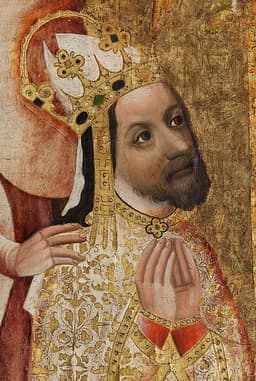
Charles IV of Luxembourg
Emperor · Medieval
66.6Total

Napoleon Bonaparte
General · Modern
70.9Total
Basic Information
Born
1316
1769
Died
1378
1821
Era
Medieval
Modern
Nationality
Holy Roman Empire
France
Occupation
Emperor
General
Civilization
Western
Western
Score Comparison
Military (10%)
45.0
94.0
Political (20%)
70.3
72.0
Influence (20%)
72.0
40.0
Legacy (20%)
72.0
80.0
Leadership (15%)
78.0
78.0
Strategy (15%)
38.6
90.0
TOTAL
66.6
70.9
Charles IV of Luxembourg — Complete Timeline
1346 AD
Election as King of GermanyPolitical Action◆ Major
Charles, Margrave of Moravia and grandson of Henry VII, was elected King of Germany by a faction of electors opposed to Louis IV. His election was supported by Pope Clement VI, leading to a double kingship.
ElectionDouble Kingship
Impact: national
1348 AD
Foundation of the University of PragueCultural◆ Major
Charles IV founded the University of Prague (Charles University), the first university in Central Europe. It became a major center of learning and culture, attracting scholars from across Europe.
University FoundationEducation
Impact: regionalconstructive
1355 AD
Coronation as Holy Roman EmperorPolitical Action◆ Major
Charles IV was crowned Holy Roman Emperor in Rome by a papal legate. His coronation was the first by a pope in decades and marked a reconciliation between the empire and papacy.
CoronationImperial-Papal Reconciliation
Impact: globalconstructive
1356 AD
Promulgation of the Golden Bull of 1356Reform
Charles IV issued the Golden Bull, a constitutional document that regulated the election of the German king by seven prince-electors. It established a fixed electoral college and reduced papal influence, remaining in effect until 1806.
Constitutional ReformGolden Bull
Impact: globalconstructive
Napoleon Bonaparte — Complete Timeline
1799 AD
Coup of 18 BrumaireOther◆ Major
Napoleon Bonaparte, with support from his brother Lucien and key political figures, overthrew the Directory in a bloodless coup. He established the Consulate with himself as First Consul, effectively becoming the ruler of France. This event ended the French Revolution's most unstable period.
French RevolutionCoupRise to Power
Impact: regional
1804 AD
Promulgation of the Napoleonic CodeOther◆ Major
Napoleon enacted the Civil Code of the French, known as the Napoleonic Code, a comprehensive set of laws that replaced the fragmented feudal legal systems. The code established legal equality, protected property rights, and secularized law. It became the basis for legal systems in many European and world countries.
Legal ReformNapoleonic CodeCivil Law
Impact: globalconstructive
1805 AD
Battle of AusterlitzWar◆ Major
Napoleon's Grande Arm
Napoleonic WarsBattleDecisive Victory
Impact: global
1812 AD
Invasion of RussiaWar◆ Major
Napoleon led the Grande Arm
Napoleonic WarsInvasionDisaster
Impact: globaldestructive
1815 AD
Battle of WaterlooWar◆ Major
Napoleon's French army was defeated by the combined forces of the Duke of Wellington's Anglo-Allied army and Gebhard Leberecht von Bl
Napoleonic WarsBattleFinal Defeat
Impact: globaldestructive
Expert Analysis
charles-iv-of-luxembourg-vs-napoleon-bonaparte
The Emperor and the Lawgiver: Napoleon and Charles IV
In the spring of 1355, a tall, scholarly man in his late thirties knelt before a papal legate in Rome, receiving the iron crown of the Holy Roman Empire. Charles IV of Luxembourg, a king without a kingdom, had just become the first emperor in decades to be crowned by a pope. Four hundred and sixty years later, in the winter of 1804, a short, intense Corsican general strode into Notre Dame Cathedral in Paris, snatched the crown from the Pope’s hands, and placed it on his own head. Napoleon Bonaparte was making a statement: power came from him, not from God. These two coronations, worlds apart in ceremony and spirit, frame a deeper contrast between two of Europe’s most consequential rulers—one who built a legal order that lasted centuries, and another who built an empire that crumbled in a decade.
Origins
Charles IV was born in 1316 into the House of Luxembourg, a minor noble family that had improbably produced two Holy Roman Emperors. His father, John of Bohemia, was a blind warrior-king who would die at the Battle of Crécy. Charles grew up in Paris, educated at the French court, where he absorbed the administrative sophistication of the Capetian monarchy. He was a product of the medieval world—a world of fragmented authority, papal power, and feudal obligations. His mind was shaped by books, diplomacy, and the careful art of balancing rival princes.
Napoleon, by contrast, was born in 1769 on Corsica, an island that had only recently become French. His family was minor nobility, but poor. He spoke Italian before French, and his early heroes were not French kings but Corsican patriots like Pasquale Paoli. He entered military school at nine, a small, awkward boy teased by his aristocratic classmates. The French Revolution, which erupted when he was twenty, shattered the old world and opened paths that birth alone could never have granted. Napoleon was a creature of chaos, a self-made man who believed that will, talent, and cannon fire could reshape reality.
Rise to Power
Charles IV’s rise was a masterpiece of patience and legitimacy. Elected King of Germany in 1346 by a faction of electors opposed to the reigning emperor, he spent years consolidating his position through marriage alliances, careful diplomacy, and the quiet accumulation of lands. He never won a great battle; he didn’t need to. His power grew not through conquest but through contracts, treaties, and the slow accretion of legal authority. By 1355, when he was crowned emperor, he had already laid the groundwork for the most important reform of his reign.
Napoleon’s rise was a thunderbolt. At twenty-four, he drove the British out of Toulon. At twenty-six, he crushed a royalist uprising in Paris with a “whiff of grapeshot.” At twenty-seven, he led a ragged army across the Alps into Italy and defeated the Austrians in a series of dazzling campaigns. By thirty, he was First Consul of France, effectively its dictator. His rise was fueled by military genius, but also by a profound understanding of propaganda—he knew that a general who wins battles and writes his own dispatches can become a legend.
Leadership & Governance
Here the two men diverge most sharply. Charles IV’s greatest achievement was the Golden Bull of 1356, a constitutional document that regulated the election of the German king by seven prince-electors. It ended decades of papal interference and civil war by fixing the rules of succession. The Golden Bull was not a flashy reform—it did not conquer territory or build monuments—but it provided stability for the Holy Roman Empire for over four centuries, until its dissolution in 1806. Charles governed as a builder and a bureaucrat. He made Prague his capital, founded the University of Prague in 1348—the first in Central Europe—and transformed the city into a cultural and political center. His military score of 49.2 reflects a ruler who preferred parchment to pikes.
Napoleon governed as a conqueror and a reformer. His Napoleonic Code, enacted in 1804, standardized French law, abolished feudal privileges, and enshrined principles of meritocracy and property rights. It spread across Europe with his armies, influencing legal systems from Italy to Poland. But his governance was inseparable from war. With a military score of 94.0 and a strategy score of 93.0, Napoleon was the most brilliant general of his age—perhaps of any age. He reorganized armies, pioneered the use of corps and rapid movement, and won battles like Austerlitz (1805) that are still studied in military academies. Yet his political score of 75.0 hints at a fatal flaw: he could conquer but could not consolidate.
Triumph & Tragedy
Charles IV’s triumph was the Golden Bull itself—a document so carefully crafted that it outlived its creator by four centuries. His tragedy was that his dynasty, the House of Luxembourg, faded within a generation of his death in 1378. His son Wenceslaus was deposed, and the empire Charles had stabilized fell into new conflicts. But Charles died in his bed, surrounded by scholars and architects, having achieved nearly everything he set out to do.
Napoleon’s triumph was his empire at its height in 1810—ruler of France, Italy, Germany, Spain, and Poland. His tragedy was the invasion of Russia in 1812, a catastrophic campaign that cost half a million lives and destroyed his Grande Armée. Exiled to Elba, he returned in 1815 for the Hundred Days, only to be defeated at Waterloo. He died in 1821 on the remote island of Saint Helena, a prisoner of the British, abandoned by the world he had once dominated. His political score of 75.0 and leadership score of 80.0 reflect a man who inspired loyalty but could not build institutions that survived him.
Character & Destiny
Charles IV was cautious, patient, and intellectually curious. He wrote an autobiography—rare for a medieval king—and corresponded with Petrarch. He understood that power in the Holy Roman Empire came from legitimacy, not force. His personality matched his destiny: a builder of systems, not a destroyer of worlds.
Napoleon was restless, ambitious, and driven by an insatiable hunger for glory. “Impossible,” he once said, “is a word to be found only in the dictionary of fools.” His personality shaped his destiny: he could not stop, could not compromise, could not accept limits. The same energy that carried him to Moscow also carried him to Saint Helena.
Legacy
Charles IV is remembered today as the father of Czech national identity. Prague Castle, Charles Bridge, and Charles University bear his name. The Golden Bull remained the constitution of the Holy Roman Empire until its end. His legacy score of 79.7 reflects a ruler whose work endured quietly but profoundly.
Napoleon’s legacy is more dramatic and more contested. The Napoleonic Code influenced legal systems across Europe and the world. He reshaped nationalism, modern warfare, and the very idea of the state. But he also caused the deaths of millions and left France smaller than he found it. His legacy score of 78.0 suggests a figure whose impact is undeniable but whose moral weight remains ambiguous.
Conclusion
Standing before Notre Dame in 1804, Napoleon took the crown from the Pope’s hands. It was a gesture of supreme confidence, a declaration that the old world was dead. But the old world was not dead—it was merely waiting. Charles IV, kneeling in Rome in 1355, had understood something Napoleon never did: that power built on law outlasts power built on glory. The Golden Bull survived the Napoleonic Wars. Napoleon’s empire did not survive him. In the end, the builder of systems outlasted the builder of dreams—not because he was more brilliant, but because he was wiser.
Rankings
🥇
Napoleon BonaparteLeader
Mil: 94.0Pol: 72.0Inf: 40.0
70.9
🥈
Charles IV of Luxembourg
Mil: 45.0Pol: 70.3Inf: 72.0
66.6
+4.3 behind
How This Comparison Works
Algorithm
Each figure is scored on 6 dimensions (0—100 scale) based on structured historical data: Military (10%), Political (20%), Influence (20%), Legacy (20%), Leadership (15%), Strategy (15%). The weighted total produces the final ranking.
Data Sources
Scores are computed from structured sub-indicators in the database. Scale factors adjust for era (Ancient ×0.85, Modern ×1.0) and civilization size (Eastern ×1.05, Other ×0.80) to account for differences in population and military scale.
Maximum 3 Figures
Comparisons are limited to 2—3 figures to ensure readability and statistical meaningfulness.
Error Margins
±5 points per dimension — Sub-scores are derived from historical records with inherent uncertainty. Two figures within 5 points on a dimension should be considered roughly equivalent in that area.
Total Score Accuracy
±3 points overall — The weighted combination of 6 dimensions produces a total score with approximately ±3 points of uncertainty. Differences of less than 3 points are not statistically significant— the figures are effectively tied.
Known Limitations
- Historical records are incomplete and uneven across civilizations
- Figures from oral-tradition societies may be underrepresented
- Occupation labels can misclassify multi-role figures
- Scores measure capability and impact, not moral character
- Quantitative scoring is a comparison tool, not absolute truth
Capability Radar
Military (10%) — Battles & Warfare
Battles
25
95
Win Rate
30
90
Expansion
20
95
Political (20%) — Governance & Reform
Reform
90
95
Diplomacy
85
80
Economy
80
85
Influence (20%) — Cultural & Global Reach
Cultural
75
85
Global
60
90
Legacy (20%) — Historical Impact
Historical
80
95
Longevity
70
90
Leadership (15%) — Power & Stability
Tenure
85
85
Stability
80
70
Strategy (15%) — Tactics & Innovation
Strategy
25
95
Tactics
20
98
Reform
15
92
Similar Comparisons
Comments & Discussion
LUXEMBOURG'S TEAM PLAYER6/17/2026
The "golden bull" vs the "little corporal"? Charles IV created the electoral framework that kept Germany stable for 400 years, while Napoleon's Napoleonic Code only works if you have one dictator calling the shots. Charles knew how to negotiate with princes; Napoleon just bullied them until they rebelled. Long term stability beats short term glory every time.
铁王冠的匠人6/17/2026
拿破仑只关心自己头上的王冠,查四世却在铸造皇冠的框架。他颁布的金玺诏书确立了选帝侯制度,直到1806年神圣罗马帝国灭亡还在用。拿破仑的民法典确实出色,但他死后就被用来反对他的继承者。而查四世的制度没人想推翻,因为它给每个人利益。这才是真正的统治艺术。
FALLEN GRANDEUR6/17/2026
Give me Napoleon's meteoric rise any day over Charles IV's boring legalism. In 1804 he wasn't just crowning himself—he was demonstrating that merit could beat birth. Charles was a medieval bureaucrat who happened to wear a crown; Napoleon was a force of nature who reshaped Europe. Yes, his empire collapsed, but so did Charles's dynasty. At least Napoleon's moment was spectacular.
历史的过客6/17/2026
拿破仑以为自己是时代的主角,但看看布拉格查理大桥上那个比他早四百年的国王雕像吧。查四世建设了中欧第一座大学、第一座石桥、第一个皇城规划。拿破仑建了什么?滑铁卢的墓碑和圣赫勒拿的监狱。查四世的建筑到今天还在服务布拉格市民,拿破仑的凯旋门只纪念他自己的虚荣。
CHARLES THE STABLE6/17/2026
Historical revisionists love Napoleon because he's dramatic, but let's be honest—Charles IV achieved more with less. While Napoleon was conquering Egypt, Charles was negotiating the Golden Bull which prevented civil war in Germany for centuries. Napoleon's victories required constant warfare; Charles's required a pen. Which leader's legacy actually lasted?