Loading...
Charles of Anjou vs Napoleon Bonaparte
Napoleon Bonaparte leads by 11.4 pts · 2 figures compared
…
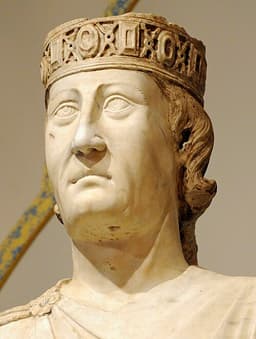
Charles of Anjou
Emperor · Medieval
59.5Total

Napoleon Bonaparte
General · Modern
70.9Total
Basic Information
Born
1227
1769
Died
1285
1821
Era
Medieval
Modern
Nationality
France
France
Occupation
Emperor
General
Civilization
Western
Western
Score Comparison
Military (10%)
82.0
94.0
Political (20%)
48.5
72.0
Influence (20%)
56.7
40.0
Legacy (20%)
52.0
80.0
Leadership (15%)
68.0
78.0
Strategy (15%)
66.3
90.0
TOTAL
59.5
70.9
Charles of Anjou — Complete Timeline
1266 AD
Battle of BeneventoWar◆ Major
Charles of Anjou defeated Manfred of Hohenstaufen at Benevento. Manfred was killed in the battle, allowing Charles to take control of the Kingdom of Sicily. This victory established the Angevin dynasty in southern Italy.
Angevin ConquestHohenstaufenItaly
Impact: regional
1268 AD
Battle of TagliacozzoWar◆ Major
Charles of Anjou defeated Conradin, the last Hohenstaufen claimant, at Tagliacozzo. Conradin was captured and later executed in Naples. This victory secured Charles's control over Sicily and ended Hohenstaufen claims.
HohenstaufenExecutionItaly
Impact: regionaldestructive
1282 AD
Sicilian VespersWar
A rebellion broke out in Palermo against Angevin rule, leading to the massacre of French officials and soldiers. The revolt spread across Sicily, resulting in the loss of the island to Peter III of Aragon. This event ended Charles's control of Sicily.
RevoltAragonSicily
Impact: regionaldestructive
1284 AD
Crusade against AragonWar
Pope Martin IV declared a crusade against Peter III of Aragon, and Charles of Anjou led the campaign. The French invasion of Aragon failed, and Charles's fleet was defeated. This crusade drained Angevin resources and weakened his position.
CrusadeAragonFailure
Impact: regionaldestructive
Napoleon Bonaparte — Complete Timeline
1799 AD
Coup of 18 BrumaireOther◆ Major
Napoleon Bonaparte, with support from his brother Lucien and key political figures, overthrew the Directory in a bloodless coup. He established the Consulate with himself as First Consul, effectively becoming the ruler of France. This event ended the French Revolution's most unstable period.
French RevolutionCoupRise to Power
Impact: regional
1804 AD
Promulgation of the Napoleonic CodeOther◆ Major
Napoleon enacted the Civil Code of the French, known as the Napoleonic Code, a comprehensive set of laws that replaced the fragmented feudal legal systems. The code established legal equality, protected property rights, and secularized law. It became the basis for legal systems in many European and world countries.
Legal ReformNapoleonic CodeCivil Law
Impact: globalconstructive
1805 AD
Battle of AusterlitzWar◆ Major
Napoleon's Grande Arm
Napoleonic WarsBattleDecisive Victory
Impact: global
1812 AD
Invasion of RussiaWar◆ Major
Napoleon led the Grande Arm
Napoleonic WarsInvasionDisaster
Impact: globaldestructive
1815 AD
Battle of WaterlooWar◆ Major
Napoleon's French army was defeated by the combined forces of the Duke of Wellington's Anglo-Allied army and Gebhard Leberecht von Bl
Napoleonic WarsBattleFinal Defeat
Impact: globaldestructive
Expert Analysis
Napoleon Bonaparte vs Charles of Anjou
# Two Frenchmen Who Shaped Europe: Napoleon and Charles of Anjou
On a June morning in 1815, Napoleon Bonaparte stood on a muddy field near Waterloo, watching his Imperial Guard march into a storm of British cannon fire. Six hundred years earlier, in February 1266, another French commander had ridden through the snow outside Benevento, Italy, watching his cavalry cut down the German king Manfred. Both men were French, both sought to dominate Italy and beyond, but their fates could not have been more different. One became a global legend; the other remains a footnote. Why?
Origins
Napoleon was born in 1769 on the island of Corsica, a place recently annexed by France. His family were minor nobles of Italian origin, speaking Corsican dialect at home. The young Napoleon was awkward, short-tempered, and fiercely ambitious—a provincial outsider in a rigidly hierarchical French society. He attended military school on scholarship, where classmates mocked his accent. That sense of being an outsider would fuel a hunger for recognition that never left him.
Charles of Anjou, born in 1227, was the opposite: a prince of the blood, youngest brother of King Louis IX of France (the future Saint Louis). He grew up in the glittering court of Paris, surrounded by crusading zeal and dynastic ambition. Where Napoleon had to claw his way up, Charles was handed a kingdom—Provence, through marriage—and told to make something of it. He was a man born to rule, not to prove himself.
Rise to Power
Napoleon’s ascent was a masterpiece of opportunism. In 1793, at age 24, he recaptured the port of Toulon from British forces with a brilliant artillery plan. By 1796, he commanded the French army in Italy, where his lightning campaigns humiliated the Austrians and made him a national hero. In 1799, he seized power in a coup d’état, becoming First Consul. By 1804, he crowned himself Emperor. His rise took fifteen years of constant risk-taking, from the sands of Egypt to the streets of Paris.
Charles of Anjou’s path was slower but more secure. In 1246, his brother Louis gave him Provence. For two decades, Charles consolidated power, built a fleet, and waited for opportunity. It came in 1263, when Pope Urban IV offered him the Kingdom of Sicily, then held by the Hohenstaufen dynasty. Charles accepted, raised an army with papal money, and marched south. At the Battle of Benevento in 1266, he defeated and killed King Manfred. Two years later, at Tagliacozzo in 1268, he crushed Conradin, the last Hohenstaufen claimant, and had the sixteen-year-old executed in Naples’ marketplace. Charles’s rise was a family affair, backed by the Church and French royal power.
Leadership & Governance
Napoleon was a military genius, scoring a 93 in strategy and 94 in military acumen. His campaigns—Austerlitz in 1805, Jena in 1806, Wagram in 1809—are still studied in war colleges. He moved armies faster than any commander before him, living off the land, striking at enemy flanks, and exploiting confusion. But he was also a reformer: the Napoleonic Code standardized French law, abolished feudal privileges, and spread Enlightenment ideals across Europe. He established the Bank of France, reformed education, and built roads and canals. His political score of 75 reflects a man who could govern as well as conquer, though his authoritarian streak grew with power.
Charles of Anjou’s leadership score of 85 is surprisingly high for a figure often dismissed as a brute. He was an able administrator who built a centralized state in Naples, reformed the coinage, and patronized the arts. He sponsored Thomas Aquinas and built the Castel Nuovo in Naples. But his military and strategic scores—61 and 63—reveal a commander competent but not brilliant. He won at Benevento and Tagliacozzo through sheer determination and superior numbers, not tactical genius. His governance was harsh: heavy taxes to fund his Mediterranean ambitions alienated his subjects, particularly in Sicily.
Triumph & Tragedy
Napoleon’s greatest moment came in December 1805, when he crushed the combined armies of Austria and Russia at Austerlitz, a battle so perfect that it became a synonym for military mastery. His tragedy was hubris: the invasion of Russia in 1812, where 600,000 men marched east and fewer than 100,000 returned. Exiled to Elba in 1814, he escaped in 1815, only to meet final defeat at Waterloo. He died in 1821 on Saint Helena, a prisoner of the British, aged 51.
Charles of Anjou’s triumph was the conquest of Sicily itself—by 1268, he ruled the entire Mezzogiorno and dreamed of a Mediterranean empire. His tragedy came in 1282 with the Sicilian Vespers, a rebellion that erupted in Palermo when a French soldier insulted a local woman. Within weeks, the entire island rose, massacring French officials and soldiers. The revolt spread, drawing in the King of Aragon, and Charles spent his remaining years fighting a losing war. He died in 1285, aged 58, his empire shrinking.
Character & Destiny
Napoleon was driven by an insatiable ego. “I am not a man, but a thing,” he once said. “My life is a spark that must set fire to the world.” He believed in destiny, in his own star. That confidence made him unstoppable—until it made him reckless. He could not stop, could not compromise, could not share power. His character was a force of nature, and like a force of nature, it eventually consumed itself.
Charles of Anjou was colder, more calculating. He was pious in the medieval manner—he went on crusade, built churches, and saw himself as God’s instrument. But he was also ruthless: executing Conradin shocked Europe, even in a brutal age. His character was that of a builder, not a conqueror. He wanted to construct a stable kingdom, but his methods—high taxes, French officials, heavy-handed rule—sowed the seeds of rebellion. He lacked Napoleon’s charisma and Napoleon’s fatal grandiosity.
Legacy
Napoleon’s legacy is enormous. The Napoleonic Code influences civil law across Europe and the Americas. He reshaped national borders, inspired nationalism in Germany and Italy, and sold Louisiana to the United States. His reputation is a battlefield itself: some see him as a tyrant who caused millions of deaths, others as a modernizer who broke the old order. His influence score of 82 reflects a man whose shadow still falls across two centuries.
Charles of Anjou left less. The Angevin dynasty he founded ruled Naples for two centuries, but his harsh rule made Sicily permanently hostile to French influence. His crusade against Aragon in 1284 failed, and his dream of Mediterranean dominance died with him. He is remembered mainly by specialists, a cautionary tale of how a competent ruler can destroy his own achievement through arrogance. His legacy score of 66 is modest, and rightly so.
Conclusion
Why did Napoleon become a world-historical figure while Charles of Anjou remains a footnote? Timing is part of the answer: Napoleon rode the wave of the French Revolution, which shattered old structures and created opportunities for talent over birth. Charles was a creature of the medieval world, where dynastic legitimacy mattered more than personal brilliance. But character mattered too. Napoleon’s genius was matched by his ambition—he thought on a continental scale, while Charles thought regionally. Napoleon’s tragedy was that he could not limit his ambition; Charles’s tragedy was that he could not expand his vision. Both were French conquerors who tried to master Italy and failed, but one failed so spectacularly that he became immortal. There is a lesson there, though it is not a comfortable one: sometimes the most dazzling failures are the ones we remember best.
Rankings
🥇
Napoleon BonaparteLeader
Mil: 94.0Pol: 72.0Inf: 40.0
70.9
🥈
Charles of Anjou
Mil: 82.0Pol: 48.5Inf: 56.7
59.5
+11.4 behind
How This Comparison Works
Algorithm
Each figure is scored on 6 dimensions (0—100 scale) based on structured historical data: Military (10%), Political (20%), Influence (20%), Legacy (20%), Leadership (15%), Strategy (15%). The weighted total produces the final ranking.
Data Sources
Scores are computed from structured sub-indicators in the database. Scale factors adjust for era (Ancient ×0.85, Modern ×1.0) and civilization size (Eastern ×1.05, Other ×0.80) to account for differences in population and military scale.
Maximum 3 Figures
Comparisons are limited to 2—3 figures to ensure readability and statistical meaningfulness.
Error Margins
±5 points per dimension — Sub-scores are derived from historical records with inherent uncertainty. Two figures within 5 points on a dimension should be considered roughly equivalent in that area.
Total Score Accuracy
±3 points overall — The weighted combination of 6 dimensions produces a total score with approximately ±3 points of uncertainty. Differences of less than 3 points are not statistically significant— the figures are effectively tied.
Known Limitations
- Historical records are incomplete and uneven across civilizations
- Figures from oral-tradition societies may be underrepresented
- Occupation labels can misclassify multi-role figures
- Scores measure capability and impact, not moral character
- Quantitative scoring is a comparison tool, not absolute truth
Capability Radar
Military (10%) — Battles & Warfare
Battles
75
95
Win Rate
70
90
Expansion
80
95
Political (20%) — Governance & Reform
Reform
60
95
Diplomacy
68
80
Economy
65
85
Influence (20%) — Cultural & Global Reach
Cultural
50
85
Global
45
90
Legacy (20%) — Historical Impact
Historical
60
95
Longevity
55
90
Leadership (15%) — Power & Stability
Tenure
70
85
Stability
55
70
Strategy (15%) — Tactics & Innovation
Strategy
78
95
Tactics
72
98
Reform
65
92
Similar Comparisons
Comments & Discussion
BATTERY_HORSE6/16/2026
People keep romanticizing Napoleon’s “provincial origin story” like it makes him a man of the people. Meanwhile, Charles of Anjou literally got a kingdom as a wedding gift and still managed to get himself kicked out of Sicily within twenty years. Napoleon crawled out of Corsican obscurity, crushed every army in Europe for a decade, and his dynasty only died because he got greedy with Russia. Charles? He had Saint Louis’s blood, the Pope’s blessing, and an entire crusade army—and still lost Sicil
西西里的炮灰6/16/2026
别跟我扯什么拿破仑是天才战争家。查理一世在贝内文托战役里用战术把曼弗雷德的德国骑士切成碎片,那叫一个干净利落。拿破仑呢?滑铁卢那天他连格鲁希在哪儿都不知道,靠赌运气打仗。查理用方阵步兵对抗德国重骑兵,这叫实战创新。拿破仑只是站在大革命军改的肩膀上摘果子。没那些骁勇的法国士兵,他算什么军事奇才?|
TWO_SICILIES_MAN6/16/2026
Yeah, Napoleon is flashy, but Charles of Anjou was the one who actually understood medieval power structures. Napoleon thought he could outlast Europe by marrying an Austrian princess and printing paper money. Charles built his power on gold—bank loans from Florence and papal tithes. When Manfred blocked his supply lines before Benevento, Charles didn’t panic; he had reserves. Napoleon at Waterloo was begging Grouchy to show up. Charles planned three moves ahead. There’s a reason his Angevin emp
只谈数据6/16/2026
历史不是选秀节目,不是谁的故事更好听谁就赢。拿破仑的军靴踩遍欧洲证明了法兰西的陆战霸权,但查理一世在南意大利的统治展示了什么叫可持续征服。拿破仑在埃及的大军最后被英国人饿死在阿克城下;查理一世在塔利亚科佐战役后通过联姻和外交巩固了对西西里的控制。拿破仑赢了战役输了战争,查理输了战役但赢了制度。谁更成功,取决于你的时间尺度。|
FRENCH_KING_50006/16/2026
Two ambitious Frenchmen, but only one actually improved French government. Charles of Anjou was a reactionary—he turned Naples into a tax farm for crusading wars and alienated his subjects so badly they all cheered when the Sicilian Vespers began. Napoleon gave France the Code, the lycées, the prefects—a functional modern state. You can argue about his ego, but Charles was just a medieval warlord with a papal stamp of approval. Napoleon changed France forever. Charles just changed who collected