Loading...
Charles the Bold vs Napoleon Bonaparte
Napoleon Bonaparte leads by 13.0 pts · 2 figures compared
…
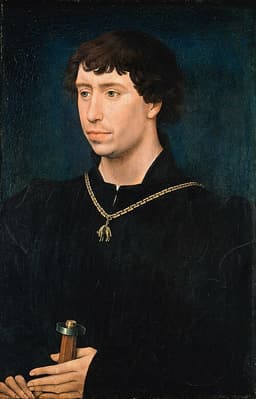
Charles the Bold
Emperor · Medieval
57.9Total

Napoleon Bonaparte
General · Modern
70.9Total
Basic Information
Born
1433
1769
Died
1477
1821
Era
Medieval
Modern
Nationality
Burgundy
France
Occupation
Emperor
General
Civilization
Western
Western
Score Comparison
Military (10%)
52.5
94.0
Political (20%)
68.0
72.0
Influence (20%)
59.0
40.0
Legacy (20%)
49.2
80.0
Leadership (15%)
65.7
78.0
Strategy (15%)
55.0
90.0
TOTAL
57.9
70.9
Charles the Bold — Complete Timeline
1467 AD
Inherited the Burgundian LandsPolitical Action◆ Major
Charles succeeded his father Philip the Good as Duke of Burgundy. He inherited a wealthy and powerful state comprising the Burgundian Netherlands, Franche-Comt
SuccessionBurgundian State
Impact: regionalconstructive
1468 AD
War with France and the Treaty of PéronneWar◆ Major
Charles forced King Louis XI of France to sign the Treaty of P
TreatyFranco-Burgundian ConflictDiplomacy
Impact: regional
1474 AD
Siege of NeussWar◆ Major
Charles besieged the imperial city of Neuss for nearly a year, defying the Holy Roman Emperor Frederick III. The siege ended inconclusively when an imperial army approached. This conflict alienated the German princes and weakened Charles's political position.
SiegeImperial ConflictBurgundian Wars
Impact: regionaldestructive
1476 AD
Battle of GrandsonWar◆ Major
Charles's army was defeated by the Swiss Confederacy at Grandson. The Burgundians abandoned their camp, which was looted. The defeat was a major setback, shattering the myth of Burgundian invincibility and encouraging further Swiss resistance.
BattleSwiss ConfederacyDefeat
Impact: regionaltragic
Battle of MoratWar◆ Major
Charles suffered a second devastating defeat by the Swiss at Morat. His army was routed, and he lost much of his artillery and baggage. The defeat effectively ended Burgundian ambitions in Switzerland and left Charles's state vulnerable.
BattleSwiss ConfederacyDefeat
Impact: regionaltragic
1477 AD
Battle of Nancy and DeathWar
Charles was killed in battle at Nancy while fighting the Swiss and the Duke of Lorraine. His body was found mutilated. His death ended the Burgundian state as an independent power, and his lands were divided between France and the Habsburgs through his daughter Mary.
BattleDeathEnd of Burgundy
Impact: regionaltragic
Napoleon Bonaparte — Complete Timeline
1799 AD
Coup of 18 BrumaireOther◆ Major
Napoleon Bonaparte, with support from his brother Lucien and key political figures, overthrew the Directory in a bloodless coup. He established the Consulate with himself as First Consul, effectively becoming the ruler of France. This event ended the French Revolution's most unstable period.
French RevolutionCoupRise to Power
Impact: regional
1804 AD
Promulgation of the Napoleonic CodeOther◆ Major
Napoleon enacted the Civil Code of the French, known as the Napoleonic Code, a comprehensive set of laws that replaced the fragmented feudal legal systems. The code established legal equality, protected property rights, and secularized law. It became the basis for legal systems in many European and world countries.
Legal ReformNapoleonic CodeCivil Law
Impact: globalconstructive
1805 AD
Battle of AusterlitzWar◆ Major
Napoleon's Grande Arm
Napoleonic WarsBattleDecisive Victory
Impact: global
1812 AD
Invasion of RussiaWar◆ Major
Napoleon led the Grande Arm
Napoleonic WarsInvasionDisaster
Impact: globaldestructive
1815 AD
Battle of WaterlooWar◆ Major
Napoleon's French army was defeated by the combined forces of the Duke of Wellington's Anglo-Allied army and Gebhard Leberecht von Bl
Napoleonic WarsBattleFinal Defeat
Impact: globaldestructive
Expert Analysis
charles-the-bold-vs-napoleon-bonaparte
### The Duke Who Lost Everything and the Emperor Who Almost Won It All
On a frozen January morning in 1477, the body of Charles the Bold was pulled from a muddy pond near Nancy, his face so badly gnawed by wolves that only a scarred hand and a missing tooth confirmed his identity. Just over three centuries later, on a June evening in 1815, Napoleon Bonaparte watched his Imperial Guard crumble on a rain-soaked field at Waterloo, then fled to Paris, his empire dissolving like morning mist. Both men reached for the sun and burned—but one of them nearly grasped it. Why did Napoleon, born a Corsican outsider, conquer Europe and reshape its laws, while Charles, heir to the richest duchy in Christendom, died in a ditch? The answer lies not in their ambition—both had plenty—but in the different worlds that forged them and the different ways they understood power.
### Origins
Napoleon and Charles entered history on opposite sides of a great divide. Charles the Bold was born in 1433 into the House of Valois-Burgundy, inheriting a domain that stretched from the Low Countries to the Swiss border—wealthier than the French crown itself. His father, Philip the Good, had built a court of splendor, patronizing artists like Jan van Eyck and ruling through chivalric ceremony. Charles grew up breathing the air of medieval knighthood: honor, lineage, the glory of personal combat. He was trained to lead men in armor, to storm walls, to die with a sword in hand.
Napoleon, by contrast, was born in 1769 on the island of Corsica, a year after France bought the island from Genoa. His family were minor nobles, but they spoke Italian and resented French rule. Young Napoleon was sent to military school in mainland France, where he was mocked for his accent and small stature. He devoured books on artillery, history, and the Enlightenment—Caesar, Frederick the Great, Rousseau. Where Charles inherited a throne, Napoleon inherited a revolution. The medieval world was dying; a new one of merit, law, and nationalism was being born. Charles fought to preserve the old order; Napoleon rode the new one like a storm.
### Rise to Power
Charles’s path was predetermined. In 1467, his father died, and he became Duke of Burgundy. The title came with lands, armies, and a treasury that could fund decades of war. His rise was not a climb but an assumption—and with it came the weight of expectations. He immediately set out to turn his loose collection of territories into a true kingdom, defying both the King of France and the Holy Roman Emperor.
Napoleon’s ascent was a ladder of fire. In 1793, at age twenty-four, he drove the British out of Toulon with a brilliant artillery plan, earning promotion to brigadier general. By 1796, he commanded the Army of Italy, where he smashed Austrian armies in lightning campaigns and dictated peace terms. In 1799, he overthrew the corrupt Directory in a coup, making himself First Consul. By 1804, he crowned himself Emperor in Notre Dame, taking the crown from the Pope’s hands and placing it on his own head. Every step was earned through audacity, calculation, and sheer ruthlessness. Charles inherited his throne; Napoleon tore his from history.
### Leadership & Governance
Here the contrast becomes stark. Charles the Bold was a warrior duke, not a statesman. He governed through feudal loyalty and personal presence. He could inspire men to follow him into a breach—but he could not build institutions. His military campaigns were spectacular in ambition but catastrophic in execution. At the Siege of Neuss in 1474, he spent nearly a year battering a single imperial city, defying the Emperor, while his enemies gathered. He won the Treaty of Péronne in 1468 by humiliating King Louis XI, but he could not turn that victory into lasting power. He was a brilliant tactician of the battlefield, but he had no strategy for peace.
Napoleon was the opposite. He was a military genius—his 94 and 93 for military and strategy speak for themselves—but he also understood that war was an instrument of politics, not an end. He reformed French law with the Napoleonic Code, creating a uniform system that abolished feudal privileges and enshrined merit. He centralized the state, built schools, and established the Bank of France. He knew that a conqueror must also be a legislator. When he won a battle, he imposed treaties that reshaped borders and alliances. He thought in terms of systems, not just victories.
Yet both shared a fatal weakness: they could not stop. Charles, driven by pride and a vision of a Burgundian kingdom, refused to compromise. He fought the Swiss—poor farmers with pikes—and lost twice, at Grandson and Morat in 1476, each time because he underestimated his enemy and overestimated his own chivalric code. Napoleon, after conquering most of Europe, invaded Russia in 1812. He, too, underestimated his enemy and overestimated his own system. Both men were destroyed by overreach—but Napoleon’s fall took longer and left a deeper mark.
### Triumph & Tragedy
Charles’s greatest moment came at Péronne in 1468, when he trapped Louis XI and forced the French king to kneel. It was a triumph of personal will and feudal power. But his tragedy was Nancy. In January 1477, he fought the Swiss and the Duke of Lorraine with a small, exhausted army. He was killed, his body stripped and left in the ice. The Burgundian state was carved up by France and the Habsburgs. His dream died with him.
Napoleon’s greatest moment was Austerlitz in 1805, where he destroyed a combined Russian and Austrian army, ending the Holy Roman Empire. His tragedy came in two acts: the Russian winter of 1812, which annihilated his Grande Armée, and Waterloo in 1815, where his gamble failed. But unlike Charles, Napoleon was not killed. He was exiled—first to Elba, then to Saint Helena, where he dictated his memoirs and shaped his own legend.
### Character & Destiny
Charles was a man of the Middle Ages: stubborn, honor-bound, incapable of subtlety. He believed in the power of the sword and the sanctity of his bloodline. He could not adapt because adaptation seemed dishonorable. Napoleon was a man of the modern age: pragmatic, manipulative, a master of propaganda. He understood that perception was power. He could retreat, regroup, and return—as he did from Elba in 1815. But even he could not escape the trap of his own ambition. Both were destroyed by what made them great: Charles by his rigid honor, Napoleon by his relentless drive.
### Legacy
Charles the Bold is remembered as a footnote—a brilliant failure who lost everything. His legacy is the Burgundian treasure scattered across museums and the lesson that medieval chivalry could not survive the rise of centralized states. His scores—65 military, 63 political, 45 leadership—are the numbers of a man who tried to hold back a tide.
Napoleon’s legacy is stamped on the world. The Napoleonic Code governs law across Europe and beyond. His military innovations—mass conscription, the corps system, the emphasis on speed and artillery—are studied in war colleges. His scores—94 military, 75 political, 93 strategy—reflect a man who changed the rules of the game. But his final legacy is a warning: that even the greatest genius cannot defy the limits of human power.
### Conclusion
Stand at the pond near Nancy, where Charles’s body was found, and you feel the cold silence of a failed dream. Stand at Waterloo, where Napoleon’s Guard made its last charge, and you feel the thunder of a world ending. Both men reached for the impossible. One was swallowed by the past; the other helped create the future. The difference was not in their courage—both had that in abundance. It was in their ability to understand the world they lived in. Charles fought for a world that was already dying. Napoleon tried to build a new one—and came closer than anyone before or since. In the end, history rewards not just ambition, but vision. And vision requires seeing not what you want, but what is.
Rankings
🥇
Napoleon BonaparteLeader
Mil: 94.0Pol: 72.0Inf: 40.0
70.9
🥈
Charles the Bold
Mil: 52.5Pol: 68.0Inf: 59.0
57.9
+13.0 behind
How This Comparison Works
Algorithm
Each figure is scored on 6 dimensions (0—100 scale) based on structured historical data: Military (10%), Political (20%), Influence (20%), Legacy (20%), Leadership (15%), Strategy (15%). The weighted total produces the final ranking.
Data Sources
Scores are computed from structured sub-indicators in the database. Scale factors adjust for era (Ancient ×0.85, Modern ×1.0) and civilization size (Eastern ×1.05, Other ×0.80) to account for differences in population and military scale.
Maximum 3 Figures
Comparisons are limited to 2—3 figures to ensure readability and statistical meaningfulness.
Error Margins
±5 points per dimension — Sub-scores are derived from historical records with inherent uncertainty. Two figures within 5 points on a dimension should be considered roughly equivalent in that area.
Total Score Accuracy
±3 points overall — The weighted combination of 6 dimensions produces a total score with approximately ±3 points of uncertainty. Differences of less than 3 points are not statistically significant— the figures are effectively tied.
Known Limitations
- Historical records are incomplete and uneven across civilizations
- Figures from oral-tradition societies may be underrepresented
- Occupation labels can misclassify multi-role figures
- Scores measure capability and impact, not moral character
- Quantitative scoring is a comparison tool, not absolute truth
Capability Radar
Military (10%) — Battles & Warfare
Battles
65
95
Win Rate
40
90
Expansion
60
95
Political (20%) — Governance & Reform
Reform
65
95
Diplomacy
45
80
Economy
60
85
Influence (20%) — Cultural & Global Reach
Cultural
50
85
Global
35
90
Legacy (20%) — Historical Impact
Historical
55
95
Longevity
40
90
Leadership (15%) — Power & Stability
Tenure
55
85
Stability
30
70
Strategy (15%) — Tactics & Innovation
Strategy
55
95
Tactics
60
98
Reform
70
92
Similar Comparisons
Comments & Discussion
THE\_POND\_DETECTIVE6/17/2026
Let's be real: comparing Charles the Bold to Napoleon is like comparing a high-stakes poker player to a chess grandmaster. Charles gambled everything on personal glory and feudal loyalty—which worked great until the Swiss pikes showed up. Napoleon built systems. The Civil Code, the lycées, the prefectoral system—that’s why his legacy endured beyond Waterloo. Charles’s only lasting achievement was getting his face eaten by wolves in a frozen swamp. The man spent his entire career losing to Confed
铁匠与皇帝6/17/2026
拿铁锤的瑞士农民教会了勃艮第公爵什么叫做“战争不是骑士比武”。查理的整个军事生涯就是一部贵族傲慢史:他穿着镀金铠甲冲锋,却不懂得后勤为何物。1476年的格朗松战役,他的骑兵在瑞士长矛方阵前像稻草一样倒下,而敌人还在用干草叉当备用武器。反观拿破仑,他精简补给线,重视炮兵,懂得地形。查理还活在中世纪,拿破仑早已跨入现代。笨死的贵族和聪明的皇帝,就这么简单。
THE\_REALIST\_QUANT6/17/2026
You can't seriously rank these two on the same power curve without adjusting for inflation. Napoleon commanded armies of 500,000 across an entire continent; Charles could barely field 20,000 without emptying his gold mines. The "enduring legacy" people tout for Napoleon—the Code, the administrative reforms—those are institutional outputs. What did Charles leave? A lot of gorgeous illuminated manuscripts and a very messy corpse. Let's stats-check this: Napoleon fought 60+ battles. Charles fought
古今对照官6/17/2026
罗马的凯撒、法国的拿破仑、瑞典的古斯塔夫——这些人才配叫“改变战争的人”。查理的骑兵战术早被瑞士山民用长矛破解了,他还不思悔改。看看1476年的莫拉特战役,一万勃艮第士兵阵亡,查理本人差点被砍死。这就是固守旧制者的下场。而拿破仑创立了集团军体系、军需制度、参谋部模型,至今仍是现代军队的蓝本。一个是复古的堂吉诃德,一个是时代的缔造者。谁更伟大?用脚趾都能想明白。
CLASSICS\_&\_CHARISMA6/17/2026
Oh, the irony: Charles the Bold died because he couldn't read the room—literally. He failed to understand that Swiss pikemen were the new legionaries, and feudal cavalry was obsolete. Napoleon, however, studied his Caesar and Hannibal and adapted. When faced with the Austrian square, he didn't charge in plate armor; he rolled up cannons. Charles was a failed medieval re-enactor; Napoleon was a classical strategist reborn. One chased chivalric fantasies