Loading...
Charles V vs Stephen the Great
Charles V leads by 12.6 pts · 2 figures compared
…

Charles V
Emperor · Medieval
74.2Total
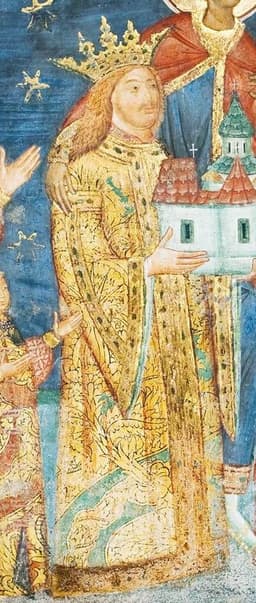
Stephen the Great
Emperor · Medieval
61.6Total
Basic Information
Born
1500
1433
Died
1558
1504
Era
Medieval
Medieval
Nationality
Holy Roman Empire
Moldavia
Occupation
Emperor
Emperor
Civilization
Western
Western
Score Comparison
Military (10%)
74.0
67.3
Political (20%)
70.3
59.3
Influence (20%)
71.0
55.0
Legacy (20%)
80.0
55.0
Leadership (15%)
78.0
78.0
Strategy (15%)
68.0
68.1
TOTAL
74.2
61.6
Charles V — Complete Timeline
1519 AD
Elected Holy Roman EmperorPolitical Action
Charles V was elected Holy Roman Emperor, defeating Francis I of France through extensive bribery of the prince-electors. This election united the Habsburg lands in Spain, Austria, the Netherlands, and the Holy Roman Empire under his rule.
ElectionHabsburg EmpireImperial Title
Impact: global
1521 AD
Diet of WormsPolitical Action
Charles V presided over the Diet of Worms, where Martin Luther was summoned to recant his teachings. Luther refused, and Charles issued the Edict of Worms, declaring Luther an outlaw and banning his writings, escalating the Protestant Reformation.
ReformationLutherImperial Diet
Impact: global
1525 AD
Battle of PaviaWar◆ Major
Imperial forces under Charles V defeated and captured Francis I of France at Pavia in Italy. This victory secured Spanish dominance in Italy and forced Francis to sign the Treaty of Madrid, though he later repudiated it.
Italian WarsBattleCapture of Francis I
Impact: regional
1527 AD
Sack of RomeWar◆ Major
Mutinous imperial troops under Charles V sacked Rome, looting the city and besieging Pope Clement VII in Castel Sant'Angelo. This event shocked Europe and forced the Pope to align more closely with Charles, leading to the coronation of Charles as Holy Roman Emperor by the Pope in 1530.
Italian WarsSackPapacy
Impact: regionaldestructive
1556 AD
Abdication and Division of the EmpirePolitical Action
Charles V abdicated his thrones, dividing his empire between his son Philip II (Spain, Netherlands, Italy) and his brother Ferdinand I (Holy Roman Empire). This division reflected the administrative challenges of ruling a vast, multi-ethnic empire.
AbdicationEmpire DivisionHabsburg
Impact: global
Stephen the Great — Complete Timeline
1470 AD
Construction of Fortresses and ChurchesCultural◆ Major
Stephen the Great commissioned the construction of numerous fortresses, including those at Suceava, Neam
ArchitectureFortificationsOrthodox Church
Impact: nationalconstructive
1475 AD
Battle of VasluiWar
Stephen the Great led a Moldavian army of about 40,000 men against an Ottoman force of up to 120,000 under Had
BattleOttoman EmpireMoldavia
Impact: regional
1476 AD
Battle of Valea AlbăWar◆ Major
Stephen the Great suffered a major defeat at Valea Alb
BattleMehmed IIDefeat
Impact: regionaltragic
1489 AD
Treaty with the Ottoman EmpirePolitical Action◆ Major
Stephen the Great signed a treaty with Sultan Bayezid II, agreeing to pay an annual tribute to the Ottoman Empire in exchange for peace. The treaty recognized Moldavia's autonomy and ended decades of warfare, though it placed Moldavia in a vassal relationship with the Ottomans.
TreatyVassalageBayezid II
Impact: regional
Expert Analysis
Origins
**Charles V** was born in 1500 in Ghent, Flanders, to Duke Philip the Handsome of Burgundy and Joanna of Castile. He inherited a vast collection of territories: from his father, the Burgundian Netherlands; from his mother, the crowns of Castile and Aragon (including their American colonies); and from his grandfather Maximilian I, the Habsburg lands and the claim to the Holy Roman Empire. His upbringing was Flemish, and he was tutored by Adrian of Utrecht (later Pope Adrian VI). He learned French, Dutch, Spanish, and some Latin, but never German. His multiple inheritances made him the most powerful ruler in Europe.
**Stephen the Great** (Ștefan cel Mare) was born around 1433 in Borzești, Moldavia, the son of Prince Bogdan II of Moldavia. His early life was marked by instability: his father was murdered when Stephen was a child, and he spent years as a hostage in the Ottoman court and later in Hungary. He returned to Moldavia in 1457 and seized the throne with the help of Vlad Țepeș (Vlad the Impaler) of Wallachia. His formative experiences were shaped by constant warfare against the Ottoman Empire and internal rivals.
Rise to Power
Charles V's rise was a matter of inheritance and election. He became Duke of Burgundy in 1506 at age six, King of Spain in 1516 (as Charles I), and in 1519 he was elected Holy Roman Emperor, defeating Francis I of France with massive bribes to the prince-electors (spending over 850,000 florins). The election united the Habsburg, Burgundian, and Spanish lands, creating an empire that spanned Europe and the Americas. His key turning point was the Diet of Worms in 1521, where he confronted Martin Luther and issued the Edict of Worms, outlawing Luther and his followers.
Stephen the Great rose by assassinating his uncle Petru Aron in 1457, with military support from Vlad Țepeș. He then consolidated power by defeating rival boyars and securing recognition from Poland-Lithuania and Hungary. His first major test came in 1467 when King Matthias Corvinus of Hungary invaded Moldavia; Stephen defeated him at the Battle of Baia, forcing a peace treaty. This victory established Stephen as a formidable ruler.
Leadership & Governance
Charles V ruled a sprawling, multi-ethnic empire through a combination of viceroys, regents, and personal travel. He spent much of his reign journeying between Spain, Germany, the Netherlands, and Italy, trying to keep his domains together. His governance was challenged by the Reformation, which he opposed but could not suppress, and by the constant need for funds, which he raised from American silver and loans from German bankers like the Fuggers. He famously said, "I speak Spanish to God, Italian to women, French to men, and German to my horse." His political score of 70.3 reflects his ability to manage a complex empire, but his strategy score of 68.0 shows limitations in dealing with the Reformation and Ottoman threats.
Stephen the Great ruled a small principality, Moldavia, but governed with a focus on military defense and religious patronage. He built a network of fortresses (Suceava, Neamț, Hotin) and churches (over 40, many now UNESCO sites). He maintained a centralized state, curbing the power of the boyars (nobility). His leadership score of 78.0 is high for a medieval ruler, reflecting his ability to inspire loyalty and maintain independence against larger powers. His political score of 59.3 is lower, partly because he eventually had to accept Ottoman suzerainty.
Triumph & Tragedy
Charles V's greatest triumph was the Battle of Pavia in 1525, where his forces captured Francis I of France, securing Spanish dominance in Italy. He also expanded the Spanish Empire in the Americas, with conquistadors like Cortés and Pizarro bringing vast territories under his rule. His greatest failure was his inability to stop the spread of Protestantism; the Peace of Augsburg in 1555 recognized Lutheranism, effectively ending his dream of a unified Catholic empire. He also failed to capture Algiers in 1541, and his armies were often unpaid, leading to events like the Sack of Rome in 1527, where mutinous troops looted the city.
Stephen the Great's greatest triumph was the Battle of Vaslui in 1475, where he defeated an Ottoman army of up to 120,000 with only 40,000 men. This victory earned him praise from Pope Sixtus IV as "Athleta Christi" (Champion of Christ). His greatest tragedy was the Battle of Valea Albă in 1476, where Sultan Mehmed II personally led an invasion and defeated Stephen's army. Moldavia was devastated, and Stephen was forced to pay tribute to the Ottomans in 1487, ending his effective independence. Despite his military score of 67.3, his strategy score of 68.1 shows he was a competent commander but ultimately overwhelmed by Ottoman resources.
Character & Destiny
Charles V was a pragmatic, devout Catholic who believed in his divine right to rule but was often indecisive. He abdicated in 1556, exhausted by the burdens of empire, and retired to a monastery in Yuste, Spain. His decision to divide the empire between his son Philip II (Spain, Netherlands, Italy) and his brother Ferdinand I (Holy Roman Empire) shaped European politics for centuries. His character—diligent, but prone to procrastination—led to missed opportunities, such as failing to act decisively against the Ottomans in Hungary.
Stephen the Great was a determined, ruthless ruler who personally led his troops in battle. He was known for his piety, building churches after every victory, and for his cruelty towards enemies. He died in 1504, still ruling, and was canonized by the Romanian Orthodox Church in 1992. His character—unyielding and strategic—allowed him to resist the Ottomans for decades, but his refusal to accept vassalage earlier cost him many lives.
Legacy
Charles V's legacy is immense: he was the last emperor to be crowned by the Pope, and his reign saw the beginning of the Spanish Golden Age. His empire set the stage for the Habsburg domination of Europe, and his division of the empire created the Spanish and Austrian branches of the family. His legacy score of 80.0 reflects his enduring impact on European history, from the Reformation to colonialism.
Stephen the Great's legacy is primarily national: he is a symbol of Moldavian resistance against the Ottomans and a saint of the Romanian Orthodox Church. His fortresses and churches remain cultural landmarks. His influence score of 55.0 is lower because his impact was largely limited to his region.
Conclusion
Charles V had a greater historical impact than Stephen the Great. With a total score of 74.2 vs 61.6, Charles's empire shaped the course of Europe and the Americas. Stephen's achievements were remarkable for a small state, but his influence was confined to Eastern Europe. Charles V's legacy endures in the political and religious divisions of Europe, while Stephen's is remembered primarily in Romania. Thus, Charles V is the more significant figure in world history.
Rankings
🥇
Charles VLeader
Mil: 74.0Pol: 70.3Inf: 71.0
74.2
🥈
Stephen the Great
Mil: 67.3Pol: 59.3Inf: 55.0
61.6
+12.6 behind
How This Comparison Works
Algorithm
Each figure is scored on 6 dimensions (0—100 scale) based on structured historical data: Military (10%), Political (20%), Influence (20%), Legacy (20%), Leadership (15%), Strategy (15%). The weighted total produces the final ranking.
Data Sources
Scores are computed from structured sub-indicators in the database. Scale factors adjust for era (Ancient ×0.85, Modern ×1.0) and civilization size (Eastern ×1.05, Other ×0.80) to account for differences in population and military scale.
Maximum 3 Figures
Comparisons are limited to 2—3 figures to ensure readability and statistical meaningfulness.
Error Margins
±5 points per dimension — Sub-scores are derived from historical records with inherent uncertainty. Two figures within 5 points on a dimension should be considered roughly equivalent in that area.
Total Score Accuracy
±3 points overall — The weighted combination of 6 dimensions produces a total score with approximately ±3 points of uncertainty. Differences of less than 3 points are not statistically significant— the figures are effectively tied.
Known Limitations
- Historical records are incomplete and uneven across civilizations
- Figures from oral-tradition societies may be underrepresented
- Occupation labels can misclassify multi-role figures
- Scores measure capability and impact, not moral character
- Quantitative scoring is a comparison tool, not absolute truth
Capability Radar
Military (10%) — Battles & Warfare
Battles
85
72
Win Rate
70
78
Expansion
90
65
Political (20%) — Governance & Reform
Reform
75
75
Diplomacy
80
80
Economy
70
70
Influence (20%) — Cultural & Global Reach
Cultural
85
65
Global
90
55
Legacy (20%) — Historical Impact
Historical
90
70
Longevity
85
60
Leadership (15%) — Power & Stability
Tenure
85
85
Stability
60
75
Strategy (15%) — Tactics & Innovation
Strategy
85
80
Tactics
75
75
Reform
80
70
Similar Comparisons
Comments & Discussion
No comments yet. Be the first to share your thoughts!