Loading...
Charles VI of France vs Napoleon Bonaparte
Napoleon Bonaparte leads by 31.0 pts · 2 figures compared
…
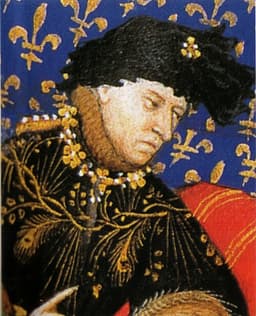
Charles VI of France
Emperor · Medieval
39.9Total

Napoleon Bonaparte
General · Modern
70.9Total
Basic Information
Born
1368
1769
Died
1422
1821
Era
Medieval
Modern
Nationality
France
France
Occupation
Emperor
General
Civilization
Western
Western
Score Comparison
Military (10%)
10.2
94.0
Political (20%)
32.1
72.0
Influence (20%)
50.2
40.0
Legacy (20%)
45.0
80.0
Leadership (15%)
38.1
78.0
Strategy (15%)
45.0
90.0
TOTAL
39.9
70.9
Charles VI of France — Complete Timeline
1392 AD
Onset of Mental IllnessOther
Charles VI suffered his first major episode of madness while on a military campaign in Brittany. He killed several of his own knights in a fit of frenzy. This began a lifelong pattern of intermittent insanity that crippled royal authority.
Mental IllnessCapetian
Impact: nationaltragic
1407 AD
Armagnac-Burgundian Civil WarWar◆ Major
Charles VI's reign saw the outbreak of a civil war between the Armagnac and Burgundian factions, who fought for control of the mad king. This internal conflict weakened France and allowed Henry V of England to conquer much of the kingdom.
Civil WarHundred Years' WarCapetian
Impact: nationaldestructive
1420 AD
Treaty of TroyesPolitical Action
Charles VI signed the Treaty of Troyes, which disinherited his son, the future Charles VII, and recognized Henry V of England as his heir. This treaty was forced by the Burgundian faction and effectively made France a dual monarchy with England.
TreatyHundred Years' WarCapetian
Impact: globaltragic
Napoleon Bonaparte — Complete Timeline
1799 AD
Coup of 18 BrumaireOther◆ Major
Napoleon Bonaparte, with support from his brother Lucien and key political figures, overthrew the Directory in a bloodless coup. He established the Consulate with himself as First Consul, effectively becoming the ruler of France. This event ended the French Revolution's most unstable period.
French RevolutionCoupRise to Power
Impact: regional
1804 AD
Promulgation of the Napoleonic CodeOther◆ Major
Napoleon enacted the Civil Code of the French, known as the Napoleonic Code, a comprehensive set of laws that replaced the fragmented feudal legal systems. The code established legal equality, protected property rights, and secularized law. It became the basis for legal systems in many European and world countries.
Legal ReformNapoleonic CodeCivil Law
Impact: globalconstructive
1805 AD
Battle of AusterlitzWar◆ Major
Napoleon's Grande Arm
Napoleonic WarsBattleDecisive Victory
Impact: global
1812 AD
Invasion of RussiaWar◆ Major
Napoleon led the Grande Arm
Napoleonic WarsInvasionDisaster
Impact: globaldestructive
1815 AD
Battle of WaterlooWar◆ Major
Napoleon's French army was defeated by the combined forces of the Duke of Wellington's Anglo-Allied army and Gebhard Leberecht von Bl
Napoleonic WarsBattleFinal Defeat
Impact: globaldestructive
Expert Analysis
charles-vi-of-france-vs-napoleon-bonaparte
# The Crown and the Sword: Why Napoleon Built an Empire While Charles VI Lost a Kingdom
On a summer morning in 1815, Napoleon Bonaparte stood before his army at Waterloo, the sun rising over a field that would seal his fate. He was forty-six, still at the height of his powers, and yet within hours his dream of European domination would crumble. Four centuries earlier, another French ruler had watched his kingdom slip through his fingers—not in a single cataclysmic battle, but through decades of madness and civil war. Charles VI, the Mad King, died in 1422 having signed away his son’s birthright to the enemy. Two French sovereigns, two catastrophes, but entirely different trajectories. Why did one rise to conquer Europe while the other presided over its dismemberment?
Origins
Napoleon Bonaparte was born in 1769 on the island of Corsica, a year after France had purchased it from Genoa. His family belonged to the minor nobility, but they were outsiders—Italian-speaking, fiercely independent, and resentful of French rule. This marginality forged in Napoleon a burning ambition to prove himself. He enrolled in military school at nine, reading voraciously about Alexander and Caesar, and emerged into a world where the French Revolution had shattered the old order. Opportunity, not birth, would define his rise.
Charles VI inherited the French throne in 1380 at the age of eleven. He was born into the most powerful monarchy in Europe, the Valois dynasty at its zenith. His father, Charles V the Wise, had driven the English back during the Hundred Years’ War, and the kingdom was rich, stable, and respected. Young Charles was crowned at Reims with all the sacred pomp of medieval kingship. He was not an outsider striving for greatness; he was the anointed vessel of a thousand-year tradition. That difference—one man forged by struggle, the other by privilege—would shape everything that followed.
Rise to Power
Napoleon’s ascent was meteoric and improbable. In 1793, at twenty-four, he drove the British out of Toulon with a brilliant artillery plan. By 1796, he commanded the Army of Italy, leading ragged soldiers across the Alps to stunning victories against Austria. Each triumph was a stepping stone: the Egyptian campaign in 1798, the coup of 18 Brumaire in 1799 that made him First Consul, and finally his coronation as Emperor in 1804. He did not inherit power; he seized it, one battlefield at a time.
Charles VI took the throne as a child, under the regency of his uncles, who squabbled over power. When he assumed personal rule in 1388, he showed promise—expelling his uncles, restoring royal authority, and negotiating peace with England. But in 1392, while riding through a forest in Brittany, a sudden madness seized him. He drew his sword and killed several of his own knights before being wrestled to the ground. The onset of mental illness was a turning point that no military genius could reverse. For the next thirty years, Charles suffered episodes of psychosis, believing he was made of glass, forgetting his wife and children, wandering the palace in filth. His rise was not a climb; it was a collapse.
Leadership & Governance
Napoleon ruled with a combination of iron discipline and visionary reform. He centralized the French state, created the Bank of France, and established the Napoleonic Code—a legal system that enshrined equality before the law, property rights, and secular governance. His military genius, with a strategy score of 93, was legendary: he could read a battlefield like a chessboard, striking at the enemy’s flank, dividing their forces, and crushing them with overwhelming speed. Austerlitz in 1805 was his masterpiece, where he destroyed a combined Russian-Austrian army with a feigned retreat that lured them into a trap.
Charles VI governed through a fog of madness. The kingdom fell into the hands of rival factions: the Armagnacs, loyal to the king’s brother, and the Burgundians, led by John the Fearless. In 1407, their rivalry erupted into open civil war. Paris became a battleground of assassinations and street violence. The king, when lucid, signed decrees he could not enforce and pardoned murders he could not prevent. His leadership score of 44.6 reflects a reign where the crown was a hollow ornament. While Napoleon issued laws that still shape Europe today, Charles watched his realm tear itself apart.
Triumph & Tragedy
Napoleon’s greatest moment came at Austerlitz in December 1805, where he defeated the Third Coalition and forced Austria to sue for peace. The sun shone brilliantly over the frozen battlefield—Napoleon’s Sun, his soldiers called it. He was at the pinnacle of power, emperor of a continent. But his tragedy was hubris: the invasion of Russia in 1812, where he lost over 400,000 men to winter, disease, and guerrilla warfare. He never recovered. Exiled to Elba, he returned for the Hundred Days, only to meet final defeat at Waterloo in June 1815. He died in 1821 on Saint Helena, a prisoner of the British.
Charles VI’s tragedy was slower and more intimate. In 1420, he signed the Treaty of Troyes, which disinherited his own son—the future Charles VII—and recognized Henry V of England as heir to the French throne. It was the ultimate humiliation: a French king giving his kingdom to the enemy. Charles died two years later, in 1422, in a state of wretched confusion. His son would eventually reclaim the throne, thanks to Joan of Arc, but the damage was done. The Hundred Years’ War dragged on for another three decades, and France was scarred for generations.
Character & Destiny
Napoleon was a man of boundless will. He slept four hours a night, dictated letters to multiple secretaries simultaneously, and believed that “impossible is a word to be found only in the dictionary of fools.” His ambition was both his engine and his undoing—he could not stop, could not consolidate, could not share power. He once said, “Power is my mistress. I have worked too hard at her conquest to allow anyone to take her from me.” That relentless drive built an empire, but it also destroyed it.
Charles VI was a man broken by biology. Medieval medicine had no name for his illness—perhaps schizophrenia, perhaps bipolar disorder—but it left him a prisoner in his own mind. His character was gentle when lucid, but his destiny was shaped by forces he could not control. He was not a tyrant or a fool; he was a tragedy of nature. Where Napoleon’s flaws were choices, Charles’s were afflictions.
Legacy
Napoleon’s legacy is colossal. The Napoleonic Code influenced legal systems across Europe and the Americas. He reorganized German states, sparked nationalism in Italy and Poland, and sold Louisiana to the United States. His military tactics are still studied at Sandhurst and West Point. He is remembered as both a liberator and a tyrant—a man who spread revolutionary ideals while crushing them under his boots.
Charles VI is remembered as the Mad King, a cautionary tale of royal incompetence. His reign is a footnote in the Hundred Years’ War, a period of shame that French historians prefer to gloss over. His legacy score of 59.5 reflects a ruler who left chaos, not order. Yet his story is essential: it reminds us that leadership is not just about skill, but about health, stability, and the cruel lottery of fate.
Conclusion
Napoleon and Charles VI occupy opposite poles of French history. One seized the world with his bare hands; the other let it slip through his fingers. Yet both ended in tragedy—Napoleon on a remote island, Charles in a madhouse of his own mind. Their stories teach us that power is fragile, that the line between triumph and disaster is razor-thin. One man conquered Europe; the other lost his kingdom. But both were shaped by forces larger than themselves: ambition, illness, war, and the relentless march of time. In the end, history judges not only what we achieve, but what we cannot control.
Rankings
🥇
Napoleon BonaparteLeader
Mil: 94.0Pol: 72.0Inf: 40.0
70.9
🥈
Charles VI of France
Mil: 10.2Pol: 32.1Inf: 50.2
39.9
+31.0 behind
How This Comparison Works
Algorithm
Each figure is scored on 6 dimensions (0—100 scale) based on structured historical data: Military (10%), Political (20%), Influence (20%), Legacy (20%), Leadership (15%), Strategy (15%). The weighted total produces the final ranking.
Data Sources
Scores are computed from structured sub-indicators in the database. Scale factors adjust for era (Ancient ×0.85, Modern ×1.0) and civilization size (Eastern ×1.05, Other ×0.80) to account for differences in population and military scale.
Maximum 3 Figures
Comparisons are limited to 2—3 figures to ensure readability and statistical meaningfulness.
Error Margins
±5 points per dimension — Sub-scores are derived from historical records with inherent uncertainty. Two figures within 5 points on a dimension should be considered roughly equivalent in that area.
Total Score Accuracy
±3 points overall — The weighted combination of 6 dimensions produces a total score with approximately ±3 points of uncertainty. Differences of less than 3 points are not statistically significant— the figures are effectively tied.
Known Limitations
- Historical records are incomplete and uneven across civilizations
- Figures from oral-tradition societies may be underrepresented
- Occupation labels can misclassify multi-role figures
- Scores measure capability and impact, not moral character
- Quantitative scoring is a comparison tool, not absolute truth
Capability Radar
Military (10%) — Battles & Warfare
Battles
10
95
Win Rate
10
90
Expansion
5
95
Political (20%) — Governance & Reform
Reform
10
95
Diplomacy
10
80
Economy
10
85
Influence (20%) — Cultural & Global Reach
Cultural
20
85
Global
20
90
Legacy (20%) — Historical Impact
Historical
40
95
Longevity
30
90
Leadership (15%) — Power & Stability
Tenure
40
85
Stability
5
70
Strategy (15%) — Tactics & Innovation
Strategy
5
95
Tactics
5
98
Reform
5
92
Similar Comparisons
Comments & Discussion
LEGIONARY_WORKS6/17/2026
The Napoleon-Charlie comparison is a false binary. One was a strategic visionary who built nationalism from scratch; the other was a symptom of feudal decay, not a cause. Give me Napoleon’s logistical genius—his Grande Armée system—over Charles’s court of psychics and regents any day. Waterloo was a tactical loss, but his legacy redefined modern states. Charles’s reign was a slow hemorrhage that only set France back a century.
战场上的洛可可6/17/2026
把疯王和拿破仑放一起比,完全是现代人不懂中世纪。查理六世不是无能,是患了精神分裂——当时的人称之为“玻璃妄想”,他真以为自己是玻璃做的。1420年的特鲁瓦条约不是懦弱,是勃艮第-英格兰同盟压境下的妥协。拿破仑输在战场,查理输在基因。您觉得哪个更悲剧?
DATA_GAUNTLET6/17/2026
Correlation is not causation, but the metrics here are wildly rigged. Napoleon’s supposed “Empire” lasted a decade; Charles’s nominal rule spanned 42 chaotic years. If you measure by GDP per capita or territorial stability, Napoleon’s France actually shrank more dramatically after 1815 than Valois France under the Mad King. The real outlier? Napoleon’s propaganda win. He invented the narrative of rise and fall, while Charles’s mental health records remain understudied.
红色鸢尾花6/17/2026
我选查理六世。不是因为同情疯子,而是他像个真实的君主——被疾病、贵族和宿命玩弄。拿破仑是启蒙运动的工具人,一个披着罗马袍子的暴发户。查理至少代表了中世纪法蘭西的悲剧美:失序、疯狂、但诚实。拿破仑的滑铁卢不过是教科书上的插曲,而查理的疯癫在凡尔赛皇宫里的每面镜子里都能看到投影。
ISLANDS_AND_ASH6/17/2026
The real mistake is framing this as a comparison of personal failure. Charles VI was a puppet king in a culture where ritual and regency defined rule—his madness was a political variable, not a character flaw. Napoleon, by contrast, was a self-made emperor whose entire system collapsed because he couldn’t delegate. Waterloo wasn’t bad luck; it was hubris. One was a symptom, the other a design flaw. Different eras, same narcissism.