Loading...
Charles VI of France vs Wuzong Qaghan
Wuzong Qaghan leads by 7.6 pts · 2 figures compared
…
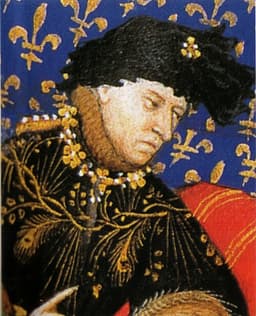
Charles VI of France
Emperor · Medieval
39.9Total

Wuzong Qaghan
Emperor · Medieval
47.5Total
Basic Information
Born
1368
800
Died
1422
846
Era
Medieval
Medieval
Nationality
France
Uyghur Khaganate
Occupation
Emperor
Emperor
Civilization
Western
Eastern
Score Comparison
Military (10%)
10.2
55.0
Political (20%)
32.1
36.5
Influence (20%)
50.2
49.4
Legacy (20%)
45.0
41.7
Leadership (15%)
38.1
51.9
Strategy (15%)
45.0
60.0
TOTAL
39.9
47.5
Charles VI of France — Complete Timeline
1392 AD
Onset of Mental IllnessOther
Charles VI suffered his first major episode of madness while on a military campaign in Brittany. He killed several of his own knights in a fit of frenzy. This began a lifelong pattern of intermittent insanity that crippled royal authority.
Mental IllnessCapetian
Impact: nationaltragic
1407 AD
Armagnac-Burgundian Civil WarWar◆ Major
Charles VI's reign saw the outbreak of a civil war between the Armagnac and Burgundian factions, who fought for control of the mad king. This internal conflict weakened France and allowed Henry V of England to conquer much of the kingdom.
Civil WarHundred Years' WarCapetian
Impact: nationaldestructive
1420 AD
Treaty of TroyesPolitical Action
Charles VI signed the Treaty of Troyes, which disinherited his son, the future Charles VII, and recognized Henry V of England as his heir. This treaty was forced by the Burgundian faction and effectively made France a dual monarchy with England.
TreatyHundred Years' WarCapetian
Impact: globaltragic
Wuzong Qaghan — Complete Timeline
840 AD
Battle of the Uyghur Capital Ordu-BaliqWar
The Yenisei Kirghiz, led by their khagan, attacked and captured the Uyghur capital Ordu-Baliq. Wuzong Qaghan was unable to prevent the fall of the city, which led to the collapse of the Uyghur Khaganate and the dispersal of its people.
Uyghur Khaganate collapseKirghiz invasionCapital fall
Impact: regionaltragic
841 AD
Flight from the Mongol SteppePolitical Action◆ Major
Following the Kirghiz victory, Wuzong Qaghan led a remnant of the Uyghur nobility and army in a retreat from the Mongol steppe. This flight marked the end of Uyghur political independence in the region and the beginning of their diaspora.
Uyghur diasporaRetreatSteppe
Impact: regionaltragic
Expert Analysis
Origins
Charles VI of France was born in 1368, the son of King Charles V and Jeanne de Bourbon. He inherited the throne at age 11, with his uncles serving as regents. He was educated in the chivalric tradition and married Isabeau of Bavaria in 1385. His early reign showed promise, but his mental instability emerged in his mid-twenties. In contrast, Wuzong Qaghan was a ruler of the Uyghur Khaganate, a Turkic empire that dominated the Mongol steppe. His exact birth year is unknown, but he ascended to the khaganate around 839 CE. The Uyghur Khaganate was a powerful nomadic state, but internal strife and external pressures from the Yenisei Kirghiz threatened its existence. Wuzong's background was shaped by the steppe warrior culture, where leadership depended on military prowess and tribal alliances.
Rise to Power
Charles VI became king in 1380, but his uncles, particularly Philip the Bold of Burgundy, controlled the government until Charles took personal rule in 1388. His early years were marked by efforts to assert royal authority and end the regency. However, his first bout of madness in 1392, when he attacked his own knights during a campaign in Brittany, shattered his credibility. From then on, his reign was defined by periodic insanity, leading to power struggles between the Armagnac and Burgundian factions. Wuzong Qaghan rose to power in the Uyghur Khaganate during a period of decline. He likely came to the throne after a succession crisis, but details are scarce. His rule was challenged by the Yenisei Kirghiz, a rival steppe confederation that had been gaining strength. The Kirghiz khagan, Alp Sol, launched a series of campaigns that culminated in the capture of the Uyghur capital, Ordu-Baliq, around 840 CE.
Leadership & Governance
Charles VI's leadership was compromised by his mental illness. He could not govern effectively, leading to a power vacuum that the nobility exploited. The Armagnac-Burgundian civil war (1407-1435) devastated France, with factions vying for control of the king and the royal treasury. Charles's wife, Queen Isabeau, and his brother, Louis of Orléans, played key roles in the conflict. The Treaty of Troyes in 1420, which disinherited his son Charles VII and recognized Henry V of England as heir, was a direct consequence of his weakness. Wuzong Qaghan's governance was typical of a steppe ruler: he relied on a network of tribal alliances and military force. However, he failed to maintain unity among the Uyghur tribes. His military strategy scored 60.0, higher than Charles's 45.0, but his political score of 36.5 reflected his inability to manage internal divisions. The Kirghiz invasion exploited these weaknesses, and Wuzong's flight from the steppe marked the end of Uyghur dominance.
Triumph & Tragedy
Charles VI's early reign saw some successes, such as the suppression of the Harelle uprising in 1382 and the Truce of Leulinghem in 1389 with England. He also fostered cultural patronage, including the commissioning of illuminated manuscripts. However, his tragedy was the disintegration of his kingdom. His madness led to brutal civil war, English invasion, and the disinheritance of his son. The Treaty of Troyes was a national humiliation. Wuzong Qaghan's triumph was his initial consolidation of power, but his tragedy was the catastrophic loss of the Uyghur Khaganate. The fall of Ordu-Baliq and the subsequent flight of the Uyghurs led to the end of their empire and their dispersion across Central Asia. Wuzong's military score of 55.0 was insufficient to prevent collapse, and his legacy is that of a ruler who presided over the destruction of his civilization.
Character & Destiny
Charles VI was described by contemporaries as kind and well-meaning but afflicted by a cruel illness. His episodes of madness, during which he believed he was made of glass or refused to bathe, rendered him unable to rule. His destiny was shaped by his illness: he became a pawn in the hands of ambitious nobles. Historians note that his total score of 39.9 reflects his limited agency. Wuzong Qaghan, in contrast, was likely a capable warrior, but he faced overwhelming odds. His decision to flee rather than fight to the death may have been pragmatic, but it sealed the fate of the Uyghur nation. His leadership score of 51.9 indicates some effectiveness, but his strategy score of 60.0 could not overcome the Kirghiz onslaught.
Legacy
Charles VI's legacy is paradoxical. His reign saw the nadir of French royal power, yet the Hundred Years' War eventually ended with French victory under his disinherited son. The Treaty of Troyes was later overturned, and Charles VII, inspired by Joan of Arc, reclaimed the throne. Charles VI's madness became a cautionary tale about the dangers of weak kingship. Wuzong Qaghan's legacy is that of a failed ruler. The Uyghur Khaganate was destroyed, and the Uyghurs dispersed, eventually settling in the Tarim Basin and adopting sedentary lifestyles. Their empire's fall allowed the Kirghiz to dominate the steppe briefly, but the region soon fell under Mongol influence. Wuzong's flight is remembered as a tragic end to a once-great power.
Conclusion
While Charles VI's reign was disastrous for France, his impact on history is greater than Wuzong Qaghan's. Charles's weakness directly led to the Treaty of Troyes, which shaped the Hundred Years' War and the eventual rise of French nationalism. Wuzong's failure, though dramatic, had limited long-term consequences beyond the Uyghur diaspora. Charles VI scored 39.9 overall, lower than Wuzong's 47.5, but his influence score of 50.2 versus Wuzong's 49.4 reflects the broader significance of his actions. The Mad King's reign altered the course of European history, while Wuzong's khaganate vanished into the steppe. Therefore, Charles VI had greater impact, despite his lower total score.
Rankings
🥇
Wuzong QaghanLeader
Mil: 55.0Pol: 36.5Inf: 49.4
47.5
🥈
Charles VI of France
Mil: 10.2Pol: 32.1Inf: 50.2
39.9
+7.6 behind
How This Comparison Works
Algorithm
Each figure is scored on 6 dimensions (0—100 scale) based on structured historical data: Military (10%), Political (20%), Influence (20%), Legacy (20%), Leadership (15%), Strategy (15%). The weighted total produces the final ranking.
Data Sources
Scores are computed from structured sub-indicators in the database. Scale factors adjust for era (Ancient ×0.85, Modern ×1.0) and civilization size (Eastern ×1.05, Other ×0.80) to account for differences in population and military scale.
Maximum 3 Figures
Comparisons are limited to 2—3 figures to ensure readability and statistical meaningfulness.
Error Margins
±5 points per dimension — Sub-scores are derived from historical records with inherent uncertainty. Two figures within 5 points on a dimension should be considered roughly equivalent in that area.
Total Score Accuracy
±3 points overall — The weighted combination of 6 dimensions produces a total score with approximately ±3 points of uncertainty. Differences of less than 3 points are not statistically significant— the figures are effectively tied.
Known Limitations
- Historical records are incomplete and uneven across civilizations
- Figures from oral-tradition societies may be underrepresented
- Occupation labels can misclassify multi-role figures
- Scores measure capability and impact, not moral character
- Quantitative scoring is a comparison tool, not absolute truth
Capability Radar
Military (10%) — Battles & Warfare
Battles
10
55
Win Rate
10
50
Expansion
5
40
Political (20%) — Governance & Reform
Reform
10
30
Diplomacy
10
35
Economy
10
30
Influence (20%) — Cultural & Global Reach
Cultural
20
20
Global
20
15
Legacy (20%) — Historical Impact
Historical
40
30
Longevity
30
20
Leadership (15%) — Power & Stability
Tenure
40
40
Stability
5
25
Strategy (15%) — Tactics & Innovation
Strategy
5
50
Tactics
5
45
Reform
5
30
Similar Comparisons
Comments & Discussion
No comments yet. Be the first to share your thoughts!