Loading...
Chen Yi vs Kenji Doihara
Chen Yi leads by 15.7 pts · 2 figures compared
…
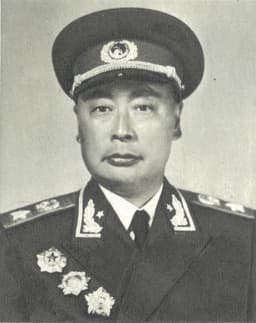
Chen Yi
General · Modern
57.5Total

Kenji Doihara
General · Modern
41.8Total
Basic Information
Born
1901
1883
Died
1972
1948
Era
Modern
Modern
Nationality
China
Japan
Occupation
General
General
Civilization
Eastern
Eastern
Score Comparison
Military (10%)
52.5
50.0
Political (20%)
68.0
32.2
Influence (20%)
57.2
48.6
Legacy (20%)
50.0
39.2
Leadership (15%)
62.0
33.5
Strategy (15%)
60.0
50.0
TOTAL
57.5
41.8
Chen Yi — Complete Timeline
1945 AD
Commander of the Third Field Army in the Chinese Civil WarWar◆ Major
Chen Yi commanded the Third Field Army, which played a key role in the Huaihai Campaign and the capture of Nanjing and Shanghai. His forces were instrumental in the Communist victory in eastern China.
Chinese Civil WarMilitary Campaign
Impact: nationaldestructive
1949 AD
First Mayor of Communist ShanghaiPolitical Action◆ Major
Chen Yi was appointed the first mayor of Shanghai after the Communist takeover. He oversaw the transition of China's largest city from Nationalist to Communist control, implementing economic stabilization and political consolidation.
GovernmentShanghaiCommunist China
Impact: nationalconstructive
1955 AD
Appointed Marshal of the People's Liberation ArmyPolitical Action◆ Major
Chen Yi was appointed as one of the ten marshals of the People's Liberation Army. This honor recognized his military leadership during the civil war and his role in the Communist victory.
Military HonorPLA
Impact: nationalconstructive
1958 AD
Minister of Foreign Affairs of the People's Republic of ChinaPolitical Action◆ Major
Chen Yi was appointed Minister of Foreign Affairs, serving until 1972. He represented China at international conferences, including the Geneva Conference on Laos, and advocated for the Bandung principles of non-alignment.
DiplomacyForeign Policy
Impact: global
Kenji Doihara — Complete Timeline
1931 AD
Mukden IncidentWar◆ Major
Doihara, as a senior intelligence officer in the Kwantung Army, was involved in the Mukden Incident, a staged explosion on a Japanese railway that served as a pretext for the Japanese invasion of Manchuria. This event led to the establishment of Manchukuo.
ManchuriaWorld War IIEspionage
Impact: regionaldestructive
1948 AD
Executed as War CriminalOther◆ Major
Doihara was tried by the International Military Tribunal for the Far East for war crimes, including conspiracy to wage aggressive war and atrocities against civilians. He was found guilty and executed by hanging in Sugamo Prison.
War CrimesExecutionTokyo Trial
Impact: globaltragic
Expert Analysis
Origins
Chen Yi was born on August 26, 1901, in Lezhi, Sichuan, China, into a moderately wealthy landowning family. He studied in France under a work-study program from 1919 to 1921, where he was exposed to socialist ideas. After returning to China, he joined the Chinese Communist Party (CCP) in 1923 and participated in the Northern Expedition. Kenji Doihara was born on August 8, 1883, in Okayama Prefecture, Japan, into a military family. He graduated from the Imperial Japanese Army Academy in 1904 and later attended the Army War College, graduating in 1912. Doihara was assigned to intelligence roles early in his career, serving in China and learning Mandarin.
Rise to Power
Chen Yi rose through the CCP's military ranks during the Chinese Civil War. He became commander of the New Fourth Army in 1941 after the Wannan Incident, and later commanded the East China Field Army (renamed Third Field Army in 1949). His forces were instrumental in the Huaihai Campaign (November 1948-January 1949), a decisive victory that led to the capture of Nanjing and Shanghai. In May 1949, Chen Yi became the first mayor of communist Shanghai, overseeing the city's transition. Kenji Doihara's rise came through intelligence and espionage. He served as a senior intelligence officer in the Kwantung Army, and was a key figure in the Mukden Incident of September 18, 1931, which Japan used as a pretext to invade Manchuria. Doihara helped establish the puppet state of Manchukuo in 1932, and was later appointed commander of the Japanese 14th Army in 1941. However, his role in atrocities and war crimes led to his arrest after World War II.
Leadership & Governance
Chen Yi's leadership style was pragmatic and diplomatic. As mayor of Shanghai from 1949 to 1958, he stabilized the economy, curbed inflation, and integrated the city into the new communist system. He was known for his ability to work with former Nationalist officials and business elites. As Foreign Minister (1958-1972), he represented China at the Geneva Conference (1954) and Bandung Conference (1955), advocating for peaceful coexistence. His political score of 68.0 reflects his effectiveness in governance. In contrast, Doihara's leadership was characterized by manipulation and coercion. His political score of 32.2 indicates his reliance on subversive methods. As a commander, he was involved in the Nanking Massacre (1937) and other atrocities, though his direct role remains debated. His leadership score of 33.5 reflects his failure to command effectively or ethically.
Triumph & Tragedy
Chen Yi's greatest triumph was his role in the Huaihai Campaign, where his Third Field Army, alongside other communist forces, defeated Nationalist armies numbering over 500,000 troops. This victory sealed the CCP's control of eastern China. His tragedy came during the Cultural Revolution (1966-1976), when he was criticized and purged by Mao Zedong for his moderate policies and connections to the "capitalist roaders." He died in 1972, largely rehabilitated. Doihara's triumph was his successful intelligence operations that facilitated Japan's expansion into Manchuria. His tragedy was his conviction and execution as a Class-A war criminal in 1948 by the International Military Tribunal for the Far East. He was hanged on December 23, 1948, for conspiracy to wage aggressive war and crimes against humanity.
Character & Destiny
Chen Yi was known for his cultural refinement—he was a poet and calligrapher—and his ability to balance military decisiveness with political diplomacy. His character helped him navigate the treacherous environment of communist politics, though it ultimately made him a target during the Cultural Revolution. Doihara was known as the "Lawrence of Manchuria" for his espionage skills, but his character was ruthless and manipulative. His destiny was sealed by his involvement in Japan's war of aggression; he was among the seven executed war criminals. Historical assessments often highlight Chen Yi's contributions to China's unification and foreign relations, while Doihara is remembered as a war criminal.
Legacy
Chen Yi's legacy is multifaceted. He is remembered as one of the ten marshals of the People's Liberation Army, and his tenure as mayor of Shanghai helped shape modern China's largest city. His foreign policy work laid the groundwork for China's diplomatic engagement with the developing world. His total score of 57.5 reflects his balanced contributions. Doihara's legacy is entirely negative. He is remembered as a master spy and war criminal, his actions condemned by history. His total score of 41.8 reflects his limited positive impact and the ignominy of his execution.
Conclusion
Chen Yi had a greater impact than Kenji Doihara. Chen Yi's scores are higher in every category: military (52.5 vs 50.0), political (68.0 vs 32.2), influence (57.2 vs 48.6), legacy (50.0 vs 39.2), leadership (62.0 vs 33.5), and strategy (60.0 vs 50.0). His total score of 57.5 is 15.7 points higher than Doihara's 41.8. Chen Yi's contributions to China's unification and governance had lasting positive effects, while Doihara's actions led to suffering and his own execution. The data clearly supports Chen Yi as the more significant figure.
Rankings
🥇
Chen YiLeader
Mil: 52.5Pol: 68.0Inf: 57.2
57.5
🥈
Kenji Doihara
Mil: 50.0Pol: 32.2Inf: 48.6
41.8
+15.7 behind
How This Comparison Works
Algorithm
Each figure is scored on 6 dimensions (0—100 scale) based on structured historical data: Military (10%), Political (20%), Influence (20%), Legacy (20%), Leadership (15%), Strategy (15%). The weighted total produces the final ranking.
Data Sources
Scores are computed from structured sub-indicators in the database. Scale factors adjust for era (Ancient ×0.85, Modern ×1.0) and civilization size (Eastern ×1.05, Other ×0.80) to account for differences in population and military scale.
Maximum 3 Figures
Comparisons are limited to 2—3 figures to ensure readability and statistical meaningfulness.
Error Margins
±5 points per dimension — Sub-scores are derived from historical records with inherent uncertainty. Two figures within 5 points on a dimension should be considered roughly equivalent in that area.
Total Score Accuracy
±3 points overall — The weighted combination of 6 dimensions produces a total score with approximately ±3 points of uncertainty. Differences of less than 3 points are not statistically significant— the figures are effectively tied.
Known Limitations
- Historical records are incomplete and uneven across civilizations
- Figures from oral-tradition societies may be underrepresented
- Occupation labels can misclassify multi-role figures
- Scores measure capability and impact, not moral character
- Quantitative scoring is a comparison tool, not absolute truth
Capability Radar
Military (10%) — Battles & Warfare
Battles
55
10
Win Rate
60
10
Expansion
40
20
Political (20%) — Governance & Reform
Reform
50
10
Diplomacy
55
30
Economy
45
10
Influence (20%) — Cultural & Global Reach
Cultural
40
5
Global
35
15
Legacy (20%) — Historical Impact
Historical
50
20
Longevity
40
5
Leadership (15%) — Power & Stability
Tenure
60
20
Stability
50
5
Strategy (15%) — Tactics & Innovation
Strategy
55
30
Tactics
50
35
Reform
30
5
Similar Comparisons
Comments & Discussion
No comments yet. Be the first to share your thoughts!