Loading...
Cheng Tang of Shang vs Napoleon Bonaparte
Napoleon Bonaparte leads by 12.6 pts · 2 figures compared
…
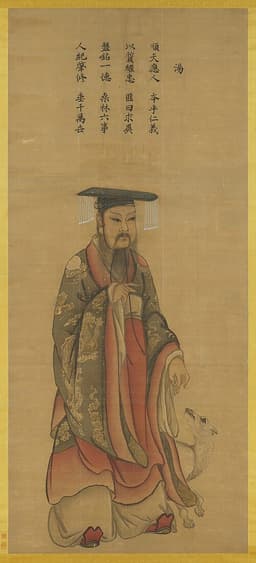
Cheng Tang of Shang
Emperor · Ancient
58.3Total

Napoleon Bonaparte
General · Modern
70.9Total
Basic Information
Born
-1675
1769
Died
-1646
1821
Era
Ancient
Modern
Nationality
Shang China
France
Occupation
Emperor
General
Civilization
Eastern
Western
Score Comparison
Military (10%)
63.3
94.0
Political (20%)
68.0
72.0
Influence (20%)
57.2
40.0
Legacy (20%)
58.0
80.0
Leadership (15%)
53.2
78.0
Strategy (15%)
50.0
90.0
TOTAL
58.3
70.9
Cheng Tang of Shang — Complete Timeline
1675 BC
Battle of MingtiaoWar
Cheng Tang led a coalition of tribes against the Xia dynasty at Mingtiao. The Shang forces defeated the Xia army, leading to the overthrow of King Jie. This battle established Cheng Tang as the first king of the Shang dynasty.
Founding BattleDynastic ChangeXia-Shang Transition
Impact: regional
Establishment of Shang Capital at BoPolitical Action◆ Major
After defeating the Xia, Cheng Tang established his capital at Bo (near modern-day Shangqiu, Henan). This city became the political and ritual center of the early Shang state, consolidating control over the Central Plains.
Capital FoundationState Building
Impact: regionalconstructive
Promulgation of Tang's EdictPolitical Action◆ Major
Cheng Tang issued a public edict justifying the overthrow of the Xia dynasty, accusing King Jie of moral depravity and misrule. This document established the concept of the 'Mandate of Heaven' as a justification for dynastic change.
Political PhilosophyMandate of HeavenPropaganda
Impact: regionalconstructive
1660 BC
Institution of Ritual ReformsCultural
Cheng Tang implemented new state rituals and sacrifices to Shangdi (the high god) and ancestral spirits. These reforms standardized religious practices across the Shang domain, reinforcing the king's role as chief priest.
ReligionRitualState Religion
Impact: regionalconstructive
Napoleon Bonaparte — Complete Timeline
1799 AD
Coup of 18 BrumaireOther◆ Major
Napoleon Bonaparte, with support from his brother Lucien and key political figures, overthrew the Directory in a bloodless coup. He established the Consulate with himself as First Consul, effectively becoming the ruler of France. This event ended the French Revolution's most unstable period.
French RevolutionCoupRise to Power
Impact: regional
1804 AD
Promulgation of the Napoleonic CodeOther◆ Major
Napoleon enacted the Civil Code of the French, known as the Napoleonic Code, a comprehensive set of laws that replaced the fragmented feudal legal systems. The code established legal equality, protected property rights, and secularized law. It became the basis for legal systems in many European and world countries.
Legal ReformNapoleonic CodeCivil Law
Impact: globalconstructive
1805 AD
Battle of AusterlitzWar◆ Major
Napoleon's Grande Arm
Napoleonic WarsBattleDecisive Victory
Impact: global
1812 AD
Invasion of RussiaWar◆ Major
Napoleon led the Grande Arm
Napoleonic WarsInvasionDisaster
Impact: globaldestructive
1815 AD
Battle of WaterlooWar◆ Major
Napoleon's French army was defeated by the combined forces of the Duke of Wellington's Anglo-Allied army and Gebhard Leberecht von Bl
Napoleonic WarsBattleFinal Defeat
Impact: globaldestructive
Expert Analysis
cheng-tang-of-shang-vs-napoleon-bonaparte
# The Conqueror and the Founder
On a windswept plain in Belgium, June 18, 1815, Napoleon Bonaparte watched his Imperial Guard march to their deaths. On a battlefield in ancient China, nearly three and a half millennia earlier, Cheng Tang of Shang led a coalition of tribes against a tyrant whose name would become synonymous with evil. One man sought to conquer the world; the other sought to redeem it. Both succeeded, and both failed, in ways that reveal the deepest currents of their civilizations.
Origins
Napoleon was born in 1769 on the island of Corsica, a place that had become French only the year before. His family were minor nobility, but they were not French—they spoke Italian, resented Paris, and dreamed of independence. This outsider status shaped everything. He was small, intense, and hungry for recognition in a society that still measured men by birth. The French Revolution, which erupted when he was twenty, shattered the old hierarchies and opened a door for talent. Napoleon walked through it.
Cheng Tang was born around 1675 BCE into a world already ancient. The Shang were a tribe on the eastern plains of China, vassals to the Xia dynasty, which claimed descent from the legendary sage-kings. The Xia ruler, Jie, was said to have sunk into debauchery and tyranny—building towers of jade, drowning ministers who criticized him, and abandoning the sacred rituals that kept heaven and earth in harmony. Tang grew up hearing these stories. He knew that a ruler's mandate was not a birthright but a trust.
Rise to Power
Napoleon's ascent was meteoric. At twenty-four, he drove the British out of Toulon. At twenty-six, he crushed a royalist uprising in Paris with a "whiff of grapeshot." At twenty-seven, he took command of the army of Italy and crossed the Alps in winter, achieving victories that stunned Europe. Each success fed the next. He was not merely a general; he was a phenomenon, a force of nature that seemed to bend history to his will.
Cheng Tang's rise was slower and more deliberate. For years, he built alliances among the eastern tribes, offering protection and justice where the Xia offered only oppression. He cultivated a reputation for virtue: when a hunter showed him a net designed to catch every bird, Tang ordered three sides opened, saying, "If you want to go left, go left; if you want to go right, go right." The story spread. Men came to him not because they feared his sword, but because they trusted his heart.
Leadership & Governance
Napoleon governed through genius and will. He reformed French law into the Napoleonic Code, establishing equality before the law and protecting property rights—principles that still shape Europe. He built roads, standardized education, and created a meritocracy where talent could rise. But he also centralized power in himself, suppressed dissent, and crowned himself emperor in 1804, taking the crown from the Pope's hands and placing it on his own head. His military strategy was aggressive, brilliant, and ultimately unsustainable: he believed that victory always followed audacity.
Cheng Tang governed through ritual and example. After defeating Jie at the Battle of Mingtiao in 1675 BCE, he did not destroy the Xia people or seize their lands for himself. Instead, he issued an edict explaining that he had acted not for ambition but to restore the moral order. He established his capital at Bo, near modern-day Shangqiu, and instituted new state rituals to Shangdi, the high god, and to ancestral spirits. These reforms were not mere ceremony; they were the foundation of a political philosophy that would endure for millennia: the ruler must be virtuous, or heaven will withdraw its mandate.
Triumph & Tragedy
Napoleon's greatest triumph was Austerlitz in 1805, where he destroyed the combined armies of Russia and Austria. His greatest tragedy was the invasion of Russia in 1812—a catastrophic miscalculation that cost half a million men. He was exiled to Elba, returned, and was finally defeated at Waterloo in 1815. He died in 1821 on Saint Helena, a prisoner of the British, dictating memoirs that would transform his defeats into legend.
Cheng Tang's triumph was the founding of the Shang dynasty, which would rule for over five hundred years. His tragedy was that his successors did not always remember his lessons. Later Shang kings fell into the same decadence that had destroyed the Xia, and the dynasty eventually fell to the Zhou, who invoked the same Mandate of Heaven that Tang had used to justify his own rise. The wheel turned.
Character & Destiny
Napoleon was driven by an insatiable hunger for glory. "I live only for posterity," he once said. "Death is nothing, but to live defeated and without glory is to die every day." This hunger made him great and destroyed him. He could not stop, could not consolidate, could not share power. He needed enemies to conquer and audiences to impress. His character was his destiny.
Cheng Tang was driven by a sense of moral duty. He acted not for himself but for heaven. "If the people have faults, let me bear them," he declared. "If I have faults, let them not fall on the people." This humility gave his rule legitimacy. He understood that power was a burden, not a prize. His character was also his destiny—but it was a destiny that built, not destroyed.
Legacy
Napoleon's legacy is paradoxical. He spread the ideals of the French Revolution across Europe—equality before the law, religious tolerance, modern administration—but he also inspired nationalism and militarism. His name became synonymous with both genius and hubris. Today, he is remembered as a titan who reshaped the world, for better and worse.
Cheng Tang's legacy is quieter but deeper. He established the concept of the Mandate of Heaven, which would define Chinese political thought for three thousand years. Every rebel who overthrew a corrupt dynasty, every emperor who feared heaven's judgment, every peasant who hoped for a just ruler—all walked in the shadow of Cheng Tang. He is remembered not as a conqueror, but as a founder.
Conclusion
Two men, separated by thirty-four centuries and half a world, each changed history forever. Napoleon conquered with steel and law; Cheng Tang conquered with ritual and virtue. One built an empire that collapsed within a generation; the other built a dynasty that lasted half a millennium and a political philosophy that endured for millennia. The difference was not in their ambition—both wanted power—but in what they believed power was for. Napoleon believed power was an end in itself. Cheng Tang believed it was a trust from heaven. In the end, the trust outlasted the ambition, as it always does.
Rankings
🥇
Napoleon BonaparteLeader
Mil: 94.0Pol: 72.0Inf: 40.0
70.9
🥈
Cheng Tang of Shang
Mil: 63.3Pol: 68.0Inf: 57.2
58.3
+12.6 behind
How This Comparison Works
Algorithm
Each figure is scored on 6 dimensions (0—100 scale) based on structured historical data: Military (10%), Political (20%), Influence (20%), Legacy (20%), Leadership (15%), Strategy (15%). The weighted total produces the final ranking.
Data Sources
Scores are computed from structured sub-indicators in the database. Scale factors adjust for era (Ancient ×0.85, Modern ×1.0) and civilization size (Eastern ×1.05, Other ×0.80) to account for differences in population and military scale.
Maximum 3 Figures
Comparisons are limited to 2—3 figures to ensure readability and statistical meaningfulness.
Error Margins
±5 points per dimension — Sub-scores are derived from historical records with inherent uncertainty. Two figures within 5 points on a dimension should be considered roughly equivalent in that area.
Total Score Accuracy
±3 points overall — The weighted combination of 6 dimensions produces a total score with approximately ±3 points of uncertainty. Differences of less than 3 points are not statistically significant— the figures are effectively tied.
Known Limitations
- Historical records are incomplete and uneven across civilizations
- Figures from oral-tradition societies may be underrepresented
- Occupation labels can misclassify multi-role figures
- Scores measure capability and impact, not moral character
- Quantitative scoring is a comparison tool, not absolute truth
Capability Radar
Military (10%) — Battles & Warfare
Battles
60
95
Win Rate
70
90
Expansion
60
95
Political (20%) — Governance & Reform
Reform
60
95
Diplomacy
55
80
Economy
50
85
Influence (20%) — Cultural & Global Reach
Cultural
55
85
Global
50
90
Legacy (20%) — Historical Impact
Historical
70
95
Longevity
65
90
Leadership (15%) — Power & Stability
Tenure
65
85
Stability
55
70
Strategy (15%) — Tactics & Innovation
Strategy
65
95
Tactics
55
98
Reform
50
92
Similar Comparisons
Comments & Discussion
LEGIONARY'S GHOST6/17/2026
Napoleon lost because he forgot what Tang knew: legitimacy matters more than glory. At Waterloo, Napoleon's veterans fought like demons, but Wellington's mixed-nationality army held because they believed in coalition, not one man's ambition. Tang overthrew Jie with careful diplomacy and virtue, not just conquest. Napoleon had no Mandate of Heaven—he had only marshals who betrayed him in 1814. Blazing glory burns out; slow fires warm the nation.
天命研究员6/17/2026
比较根本就是错的。商汤是"革命"——讨伐暴君以正天道;拿破仑是"篡位"——为了个人野心颠覆欧洲秩序。商汤灭夏后废除了夏桀的酷刑,减轻赋税;拿破仑加冕时自己戴皇冠,等于公开嘲弄教皇和传统。一个是重建文明,一个是自我神化。两千年前孟子就说:"闻诛一夫纣矣,未闻弑君也。"拿破仑就是一个等着被诛的独夫。
SKEPSIS MAXIMUS6/17/2026
Both "conquerors" are overrated by nationalistic historians. Tang's victory over Jie is based on texts written centuries later—the Bamboo Annals even claims Jie was a competent ruler slandered by Shang propagandists. Napoleon's "genius" owes more to revolutionary France's population advantage and centralized logistics than any tactical brilliance. Waterloo was lost partly because Grouchy failed to march to the guns—a communication error, not divine mandate. Let's keep our idols out of ancient mi
龙蛇辩6/17/2026
拿破仑十五岁上巴黎军校,学的是炮兵和新式战术;商汤的谋士伊尹是厨子出身,两人一起用"扬汤止沸"之计瓦解夏的盟友。一个是理性化的战争机器,一个是隐喻式的政治天才。时代差距太大——拿破仑有地图和望远镜,商汤只有青铜器和占卜。把他们放在一起比,就像比较围棋和国际象棋:规则不同,但都能看透人心。我选商汤,因为他用九鼎定江山,不只是用剑。
THE LAST CARRIAGE6/17/2026
You can't compare a man who read Ossian at St. Helena with a king who consulted oracle bones. Napoleon's tragedy was Romantic—he fell because he couldn't stop. Tang's story is classical—he rose because he knew when to stop. Napoleon wanted to dine at a thousand tables; Tang wanted to set a feast for heaven. One memorized Caesar's campaigns; the other memorized the heart's seasons. Which world do you want to inherit—the echo chamber of ambition, or the quiet hearth of duty?