Loading...
Claude Auchinleck vs Wilhelm Keitel
Claude Auchinleck leads by 9.1 pts · 2 figures compared
…
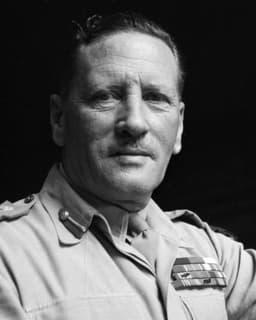
Claude Auchinleck
General · Modern
55.2Total

Wilhelm Keitel
General · Modern
46.1Total
Basic Information
Born
1884
1882
Died
1981
1946
Era
Modern
Modern
Nationality
United Kingdom
Germany
Occupation
General
General
Civilization
Western
Western
Score Comparison
Military (10%)
72.5
55.0
Political (20%)
39.4
29.3
Influence (20%)
61.0
52.5
Legacy (20%)
50.0
42.5
Leadership (15%)
54.2
57.6
Strategy (15%)
61.2
38.3
TOTAL
55.2
46.1
Claude Auchinleck — Complete Timeline
1941 AD
Appointed Commander-in-Chief of India CommandOther◆ Major
Auchinleck was appointed Commander-in-Chief of the Indian Army in January 1941. He oversaw the expansion and training of Indian forces for service in the Middle East, East Africa, and Southeast Asia, building a multi-ethnic army that grew to over two million men.
World War IIIndia
Impact: national
Appointed Commander-in-Chief of Middle East CommandOther◆ Major
Auchinleck replaced Archibald Wavell as Commander-in-Chief of Middle East Command in July 1941. He assumed command of British forces in North Africa, Iraq, and Persia during a critical period when German forces under Rommel were threatening Egypt and the Suez Canal.
World War IINorth Africa
Impact: national
Launched Operation CrusaderOther◆ Major
Auchinleck launched Operation Crusader on November 18, 1941, an offensive to relieve the besieged garrison at Tobruk. After heavy tank battles at Sidi Rezegh, British forces relieved Tobruk on December 10, forcing Rommel to retreat to El Agheila and lifting the 242-day siege.
World War IINorth AfricaVictory
Impact: nationalconstructive
1942 AD
Defeated at the First Battle of El AlameinOther◆ Major
Auchinleck personally took command of the Eighth Army in June 1942 after the fall of Tobruk. He halted Rommel's advance at the First Battle of El Alamein in July 1942, preventing the Axis from reaching Alexandria and the Suez Canal, but failed to destroy the German forces.
World War IINorth AfricaStalemate
Impact: national
Relieved of Command and Replaced by MontgomeryOther◆ Major
Auchinleck was relieved of command in August 1942 by Prime Minister Churchill, who lost confidence in his leadership. He was replaced by General Harold Alexander as Commander-in-Chief and Bernard Montgomery as commander of the Eighth Army, a decision that remains controversial among historians.
World War IINorth AfricaDismissal
Impact: nationaldestructive
1943 AD
Appointed Commander-in-Chief of India Command (Second Term)Other◆ Major
Auchinleck returned as Commander-in-Chief of the Indian Army in June 1943, a position he held until 1947. He oversaw the Burma Campaign, the defense against the Japanese invasion of India, and the post-war demobilization and partition of the Indian Army between India and Pakistan.
World War IIIndiaPartition
Impact: national
Wilhelm Keitel — Complete Timeline
1938 AD
Appointment as Chief of the OKWPolitical Action◆ Major
Keitel was appointed Chief of the Oberkommando der Wehrmacht (OKW), the high command of the German armed forces. In this role, he served as Hitler's primary military advisor and was responsible for coordinating military operations. He became known for his unquestioning loyalty to Hitler.
World War IIMilitary CommandNazi Germany
Impact: global
1941 AD
Signing of the Commissar OrderWar◆ Major
Keitel signed the Commissar Order, which ordered the execution of Soviet political commissars captured during Operation Barbarossa. This order violated international law and contributed to the brutal nature of the war on the Eastern Front.
World War IIWar CrimesEastern Front
Impact: regionaldestructive
Signing of the Night and Fog DecreePolitical Action◆ Major
Keitel signed the Night and Fog Decree, which authorized the disappearance of resistance fighters in occupied territories. Victims were arrested and secretly transported to Germany, where they were executed or imprisoned without trial. This decree was later classified as a war crime.
World War IIWar CrimesOccupation
Impact: regionaldestructive
1945 AD
Surrender of GermanyPolitical Action◆ Major
Keitel signed the unconditional surrender of Germany on May 8, 1945, in Berlin. He represented the German armed forces at the signing ceremony. This act formally ended World War II in Europe.
World War IISurrenderEnd of War
Impact: globaltragic
1946 AD
Nuremberg Trial and ExecutionPolitical Action◆ Major
Keitel was tried at the International Military Tribunal in Nuremberg for conspiracy, crimes against peace, war crimes, and crimes against humanity. He was found guilty on all counts and sentenced to death. He was executed by hanging on October 16, 1946.
Nuremberg TrialsWar CrimesExecution
Impact: globaltragic
Expert Analysis
Origins
Claude Auchinleck was born on June 21, 1884, in Aldershot, England, to a military family. His father was a colonel in the Royal Artillery, but the family had limited means. Auchinleck attended the Royal Military College, Sandhurst, and was commissioned into the Indian Army in 1904. His early career was spent in India and the Middle East, where he learned the intricacies of colonial warfare and logistics.
Wilhelm Keitel was born on September 22, 1882, in Helmscherode, Germany, to a landowning family. He joined the Prussian Army in 1901 and served as a staff officer in World War I. After the war, he remained in the Reichswehr, rising through administrative roles. Keitel was not a frontline commander but a bureaucrat, which shaped his later subservience to Hitler.
Rise to Power
Auchinleck rose through the Indian Army, commanding a brigade in the 1930s and later serving as Deputy Chief of the General Staff in India. In January 1941, he was appointed Commander-in-Chief of India Command, where he expanded and trained Indian forces. His major leap came in July 1941 when he replaced Archibald Wavell as Commander-in-Chief of Middle East Command, overseeing British forces in North Africa.
Keitel's rise was tied to his loyalty to Hitler. In 1938, after the Blomberg-Fritsch affair, Hitler appointed Keitel as Chief of the Oberkommando der Wehrmacht (OKW). Keitel's lack of independent thought and willingness to execute Hitler's orders made him indispensable. He was promoted to field marshal in 1940 after the fall of France.
Leadership & Governance
Auchinleck's leadership was marked by strategic caution and a focus on logistics. He launched Operation Crusader in November 1941, which relieved Tobruk after heavy tank battles at Sidi Rezegh. However, his command style was criticized for being too hands-off; he delegated operational command to subordinates like Neil Ritchie. In June 1942, after the fall of Tobruk, Auchinleck personally took command of the Eighth Army and halted Rommel's advance at the First Battle of El Alamein. His governance of the Middle East command involved coordinating with diverse Allied forces and managing supply lines stretching from Egypt to Iraq.
Keitel's leadership was essentially that of a yes-man. He signed the Commissar Order in June 1941, ordering the execution of Soviet political commissars, and the Night and Fog Decree in December 1941, which authorized the disappearance of resistance fighters. He rarely questioned Hitler's decisions, even when they were militarily unsound. His governance role was administrative, ensuring that Hitler's commands were disseminated and enforced, regardless of their legality or morality.
Triumph & Tragedy
Auchinleck's greatest triumph was stopping Rommel at El Alamein in July 1942, preventing the Axis from capturing Egypt and the Suez Canal. This was a crucial turning point in the North African campaign. His tragedy was being relieved of command in August 1942 by Prime Minister Churchill, who lost confidence in him. Auchinleck was replaced by General Harold Montgomery, who later led the Eighth Army to victory at the Second Battle of El Alamein. Auchinleck's cautious approach and failure to exploit successes led to his dismissal.
Keitel's triumphs were purely administrative: he oversaw the OKW's coordination of major campaigns like the invasion of France and Operation Barbarossa. His tragedies were manifold: he signed orders that led to countless war crimes, and he was convicted at Nuremberg for conspiracy, crimes against peace, war crimes, and crimes against humanity. He was hanged in 1946. Keitel's total score of 46.1 reflects his lack of strategic acumen and moral failure.
Character & Destiny
Auchinleck was known as "the Auk," a reserved and professional officer who cared deeply for his troops but lacked the political savvy to survive Churchill's impatience. His character was shaped by a sense of duty and a belief in methodical planning. His destiny was to be overshadowed by Montgomery, despite his critical role in halting Rommel. Auchinleck scored 61.2 in strategy, reflecting his sound operational planning, but his leadership score of 54.2 indicates his difficulty in inspiring confidence at the highest levels.
Keitel was a classic yes-man, described by historians as a "lackey" and "toady." His subservience to Hitler was his defining trait. He rarely offered independent advice and was complicit in atrocities. His destiny was to be executed as a war criminal. Keitel's strategy score of 38.3 is the lowest, indicating his lack of strategic input; his leadership score of 57.6 is slightly higher but reflects his ability to manage the OKW bureaucracy.
Legacy
Auchinleck's legacy is mixed: he is remembered as the general who stopped Rommel but was replaced before the final victory. His contributions to the Indian Army are significant; he oversaw its expansion from 200,000 to over 2 million men. After the war, he served as Commander-in-Chief of India Command during the partition, a difficult task. He is not as famous as Montgomery, but his role in the North African campaign is recognized by historians. He scored 50.0 in legacy.
Keitel's legacy is entirely negative. He is remembered as a war criminal who facilitated Nazi atrocities. The Commissar Order and Night and Fog Decree are dark symbols of his complicity. His name is synonymous with blind obedience and criminality. He scored 42.5 in legacy, reflecting his infamy.
Conclusion
Claude Auchinleck had a greater impact than Wilhelm Keitel, both in terms of military effectiveness and moral standing. Auchinleck's total score of 55.2 versus Keitel's 46.1 reflects this. Auchinleck's achievement in halting Rommel at El Alamein was strategically vital, buying time for the Allies to build up forces. Keitel, by contrast, was a facilitator of evil, whose actions led to death and destruction. While Auchinleck was not a flawless commander, his legacy is one of professional competence and ethical conduct. Keitel's legacy is one of criminality and subservience. Therefore, Auchinleck is the more significant figure in history.
Rankings
🥇
Claude AuchinleckLeader
Mil: 72.5Pol: 39.4Inf: 61.0
55.2
🥈
Wilhelm Keitel
Mil: 55.0Pol: 29.3Inf: 52.5
46.1
+9.1 behind
How This Comparison Works
Algorithm
Each figure is scored on 6 dimensions (0—100 scale) based on structured historical data: Military (10%), Political (20%), Influence (20%), Legacy (20%), Leadership (15%), Strategy (15%). The weighted total produces the final ranking.
Data Sources
Scores are computed from structured sub-indicators in the database. Scale factors adjust for era (Ancient ×0.85, Modern ×1.0) and civilization size (Eastern ×1.05, Other ×0.80) to account for differences in population and military scale.
Maximum 3 Figures
Comparisons are limited to 2—3 figures to ensure readability and statistical meaningfulness.
Error Margins
±5 points per dimension — Sub-scores are derived from historical records with inherent uncertainty. Two figures within 5 points on a dimension should be considered roughly equivalent in that area.
Total Score Accuracy
±3 points overall — The weighted combination of 6 dimensions produces a total score with approximately ±3 points of uncertainty. Differences of less than 3 points are not statistically significant— the figures are effectively tied.
Known Limitations
- Historical records are incomplete and uneven across civilizations
- Figures from oral-tradition societies may be underrepresented
- Occupation labels can misclassify multi-role figures
- Scores measure capability and impact, not moral character
- Quantitative scoring is a comparison tool, not absolute truth
Capability Radar
Military (10%) — Battles & Warfare
Battles
65
30
Win Rate
55
25
Expansion
50
40
Political (20%) — Governance & Reform
Reform
20
10
Diplomacy
40
20
Economy
15
10
Influence (20%) — Cultural & Global Reach
Cultural
30
10
Global
45
35
Legacy (20%) — Historical Impact
Historical
55
40
Longevity
40
15
Leadership (15%) — Power & Stability
Tenure
30
55
Stability
25
5
Strategy (15%) — Tactics & Innovation
Strategy
75
30
Tactics
70
20
Reform
60
15
Similar Comparisons
Comments & Discussion
No comments yet. Be the first to share your thoughts!