Loading...
Claudius vs Napoleon Bonaparte
Napoleon Bonaparte leads by 16.5 pts · 2 figures compared
…
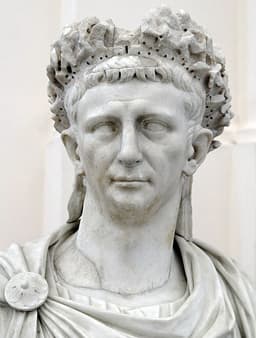
Claudius
Emperor · Ancient
54.4Total

Napoleon Bonaparte
General · Modern
70.9Total
Basic Information
Born
-10
1769
Died
54
1821
Era
Ancient
Modern
Nationality
Roman Empire
France
Occupation
Emperor
General
Civilization
Western
Western
Score Comparison
Military (10%)
50.0
94.0
Political (20%)
68.0
72.0
Influence (20%)
54.9
40.0
Legacy (20%)
49.2
80.0
Leadership (15%)
53.2
78.0
Strategy (15%)
51.7
90.0
TOTAL
54.4
70.9
Claudius — Complete Timeline
41 AD
Accession as EmperorPolitical Action◆ Major
After Caligula's assassination, Claudius was found hiding and proclaimed emperor by the Praetorian Guard. The Senate reluctantly accepted him, marking the first time the Guard directly chose an emperor.
SuccessionPraetorian GuardImperial Rule
Impact: global
42 AD
Construction of the Port of OstiaOther◆ Major
Claudius initiated the construction of a new harbor at Ostia to improve Rome's grain supply. The project included a large artificial basin and a lighthouse, facilitating trade and food imports.
InfrastructureGrain SupplyRome
Impact: nationalconstructive
43 AD
Conquest of BritainWar
Claudius ordered the invasion of Britain, sending four legions under Aulus Plautius. He later visited the island to accept the surrender of the British tribes, incorporating southern Britain into the Roman Empire.
ConquestBritainExpansion
Impact: regionalconstructive
48 AD
Expansion of Roman CitizenshipReform◆ Major
Claudius extended Roman citizenship to certain provincial communities, particularly in Gaul. He also admitted Gauls into the Senate, promoting integration of the empire's elites.
CitizenshipIntegrationProvincial Policy
Impact: regionalprogressive
49 AD
Marriage to Agrippina the YoungerPolitical Action◆ Major
Claudius married his niece Agrippina the Younger, who then maneuvered to have her son Nero adopted as Claudius's heir. This marriage led to Claudius's eventual poisoning and Nero's succession.
MarriageSuccessionNero
Impact: nationaldestructive
Napoleon Bonaparte — Complete Timeline
1799 AD
Coup of 18 BrumaireOther◆ Major
Napoleon Bonaparte, with support from his brother Lucien and key political figures, overthrew the Directory in a bloodless coup. He established the Consulate with himself as First Consul, effectively becoming the ruler of France. This event ended the French Revolution's most unstable period.
French RevolutionCoupRise to Power
Impact: regional
1804 AD
Promulgation of the Napoleonic CodeOther◆ Major
Napoleon enacted the Civil Code of the French, known as the Napoleonic Code, a comprehensive set of laws that replaced the fragmented feudal legal systems. The code established legal equality, protected property rights, and secularized law. It became the basis for legal systems in many European and world countries.
Legal ReformNapoleonic CodeCivil Law
Impact: globalconstructive
1805 AD
Battle of AusterlitzWar◆ Major
Napoleon's Grande Arm
Napoleonic WarsBattleDecisive Victory
Impact: global
1812 AD
Invasion of RussiaWar◆ Major
Napoleon led the Grande Arm
Napoleonic WarsInvasionDisaster
Impact: globaldestructive
1815 AD
Battle of WaterlooWar◆ Major
Napoleon's French army was defeated by the combined forces of the Duke of Wellington's Anglo-Allied army and Gebhard Leberecht von Bl
Napoleonic WarsBattleFinal Defeat
Impact: globaldestructive
Expert Analysis
claudius-vs-napoleon-bonaparte
# The Reluctant Emperor and the Ambitious General
In the summer of 43 AD, a limping, stammering man in his fifties stood on the shores of Britain, watching Roman legions secure a province that would transform the empire. Eighteen centuries later, in the winter of 1812, a diminutive figure in a gray coat watched his Grand Army retreat from Moscow, a catastrophe that would unravel his dominion. Claudius and Napoleon Bonaparte—one mocked as a fool who became a builder, the other hailed as a genius who became a destroyer—offer a study in how character, circumstance, and the thirst for power produce radically different destinies.
Origins
Claudius was born Tiberius Claudius Drusus in 10 BC, into the heart of the Julio-Claudian dynasty. But nature dealt him a cruel hand. He suffered from what historians now suspect was cerebral palsy or Tourette's syndrome: a limp, a tremor, a stammer, and a tendency to drool. His own mother called him "a monster of a man, not finished by nature." The family hid him from public view, and he spent his youth in scholarly obscurity, writing histories of Carthage and Etruria while his relatives murdered one another for the throne.
Napoleon, born in 1769 on the island of Corsica, was the opposite: healthy, restless, and burning with ambition. His family were minor nobles in a backwater recently annexed by France. He spoke French with a thick Italian accent, and his schoolmates mocked him as a "Corsican upstart." Where Claudius retreated into books, Napoleon devoured military history and plotted his ascent. If Claudius was shaped by exclusion, Napoleon was forged by resentment.
Rise to Power
Claudius came to power not through ambition but through sheer accident. In 41 AD, Emperor Caligula was assassinated by his own guards. As the Praetorians rampaged through the palace, they found Claudius cowering behind a curtain, trembling. According to the historian Suetonius, he fell at their feet and begged for his life. Instead, they hailed him emperor—partly because they needed a figurehead, partly because they thought him too weak to be dangerous. The Senate, horrified, had no choice but to acquiesce. Claudius had never sought power; power had stumbled upon him.
Napoleon's path was the opposite—a relentless climb driven by will. He emerged from the chaos of the French Revolution, a young artillery officer who crushed a royalist uprising in Paris in 1795. By 1796, at just twenty-six, he commanded the Army of Italy and won stunning victories against Austria. In 1799, he staged a coup and made himself First Consul. By 1804, he crowned himself Emperor of the French. He did not wait for history to find him; he seized it by the throat.
Leadership & Governance
As emperor, Claudius surprised everyone. The man who trembled before guards proved a shrewd administrator. He reformed the Roman bureaucracy, creating departments for finance and petitions that outlasted him. He initiated the construction of the Port of Ostia in 42 AD, a massive harbor to secure Rome's grain supply—a project that required dredging, breakwaters, and a lighthouse modeled on the Pharos of Alexandria. He also extended Roman citizenship to provincial elites in Gaul in 48 AD, a bold move that integrated the empire's periphery into its core. His military score of 47.6 reflects that he rarely led troops personally—he delegated the conquest of Britain in 43 AD to General Aulus Plautius—but his leadership score of 87.9 speaks to his ability to govern through others.
Napoleon governed through sheer force of personality and intellect. He reorganized France's legal system with the Napoleonic Code, which enshrined equality before the law but also restricted women's rights and restored slavery. He centralized education, created the Bank of France, and built roads and canals that knit the nation together. But his genius was military: his campaigns in Italy, Egypt, and Austria rewrote the rules of war. He used speed, massed artillery, and the *corps* system to crush enemies who still fought in linear formations. His military score of 94 and strategy score of 93 place him among history's greatest commanders.
Yet there was a crucial difference. Claudius built institutions that could survive him. Napoleon built a system that depended on him—and when he fell, it crumbled.
Triumph & Tragedy
Claudius's greatest triumph was the conquest of Britain in 43 AD. He arrived personally to accept the surrender of native tribes and oversee the foundation of a province that would last for nearly four centuries. His tragedy came from his own family. His marriage to Agrippina the Younger in 49 AD, driven by political calculation and perhaps affection, proved fatal. Agrippina maneuvered to have her son Nero adopted as heir, and when Claudius began to waver, she poisoned him—according to tradition, with a plate of mushrooms in 54 AD.
Napoleon's triumphs were dizzying: Austerlitz in 1805, where he destroyed a combined Russian-Austrian army; Jena in 1806, where he shattered Prussia; the Grand Empire that stretched from Spain to Poland. But his tragedy was equally vast: the invasion of Russia in 1812, where 600,000 men marched east and fewer than 100,000 returned. The disaster broke his aura of invincibility, and by 1814, he was exiled to Elba. He returned for a final, desperate gambit in 1815—the Hundred Days—only to meet defeat at Waterloo on June 18. Exiled to Saint Helena, he died in 1821, a prisoner of the British.
Character & Destiny
Claudius was a scholar who became an emperor by accident. He was cautious, methodical, and aware of his limitations. He surrounded himself with capable advisors and focused on what he could control: infrastructure, law, and administration. His personality—stammering, nervous, but intellectually sharp—shaped a reign of consolidation.
Napoleon was a conqueror who became an emperor by design. He was restless, arrogant, and convinced of his own destiny. "Impossible is a word to be found only in the dictionary of fools," he once said. That confidence drove him to unprecedented heights—and to catastrophic overreach. His personality—brilliant, domineering, incapable of stopping—shaped a reign of expansion and collapse.
Legacy
Claudius left behind a more stable empire, a harbor at Ostia, and a precedent for integrating provincials into Roman citizenship. His conquest of Britain gave the empire a new frontier. Yet he is often remembered as the stuttering fool who stumbled into power—an unfair judgment that reflects how history treats the unglamorous.
Napoleon left behind the Napoleonic Code, a model of modern statecraft, and a legend of military genius. He reshaped Europe's borders, spread nationalism, and inspired dictators from Hitler to Mussolini. His legacy is a paradox: a liberator who became a tyrant, a revolutionary who crowned himself emperor.
Conclusion
Standing at opposite ends of history, Claudius and Napoleon embody two paths to power. One was thrust upon a reluctant man who governed with quiet competence; the other was seized by a relentless man who ruled with explosive brilliance. Claudius built what lasted; Napoleon built what dazzled. In the end, the stammering emperor who hid behind a curtain may have understood something the Corsican conqueror never did: that power, like a harbor, is best measured not by how far it reaches, but by how long it endures.
Rankings
🥇
Napoleon BonaparteLeader
Mil: 94.0Pol: 72.0Inf: 40.0
70.9
🥈
Claudius
Mil: 50.0Pol: 68.0Inf: 54.9
54.4
+16.5 behind
How This Comparison Works
Algorithm
Each figure is scored on 6 dimensions (0—100 scale) based on structured historical data: Military (10%), Political (20%), Influence (20%), Legacy (20%), Leadership (15%), Strategy (15%). The weighted total produces the final ranking.
Data Sources
Scores are computed from structured sub-indicators in the database. Scale factors adjust for era (Ancient ×0.85, Modern ×1.0) and civilization size (Eastern ×1.05, Other ×0.80) to account for differences in population and military scale.
Maximum 3 Figures
Comparisons are limited to 2—3 figures to ensure readability and statistical meaningfulness.
Error Margins
±5 points per dimension — Sub-scores are derived from historical records with inherent uncertainty. Two figures within 5 points on a dimension should be considered roughly equivalent in that area.
Total Score Accuracy
±3 points overall — The weighted combination of 6 dimensions produces a total score with approximately ±3 points of uncertainty. Differences of less than 3 points are not statistically significant— the figures are effectively tied.
Known Limitations
- Historical records are incomplete and uneven across civilizations
- Figures from oral-tradition societies may be underrepresented
- Occupation labels can misclassify multi-role figures
- Scores measure capability and impact, not moral character
- Quantitative scoring is a comparison tool, not absolute truth
Capability Radar
Military (10%) — Battles & Warfare
Battles
30
95
Win Rate
40
90
Expansion
60
95
Political (20%) — Governance & Reform
Reform
60
95
Diplomacy
55
80
Economy
50
85
Influence (20%) — Cultural & Global Reach
Cultural
45
85
Global
45
90
Legacy (20%) — Historical Impact
Historical
55
95
Longevity
50
90
Leadership (15%) — Power & Stability
Tenure
65
85
Stability
55
70
Strategy (15%) — Tactics & Innovation
Strategy
45
95
Tactics
35
98
Reform
30
92
Similar Comparisons
Comments & Discussion
LimpingLegionnaire6/17/2026
Claudius wasn't a "reluctant" emperor—he was the craftiest survivor in Roman history. While Napoleon burned through Europe like a wildfire, Claudius quietly outlived Caligula, outmaneuvered the Praetorian Guard, and conquered Britain in a single summer. That's not luck; that's strategic patience. Napoleon's 1812 retreat killed more men than Claudius lost in his entire reign. Sometimes the "fool" builds an empire while the "genius" buries one in snow.
历史考据狂6/17/2026
拿克劳狄乌斯跟拿破仑比?这根本是关公战秦琼。克劳狄乌斯征服不列颠靠的是成熟的罗马军团体系和已经运转几百年的帝国机器,而拿破仑是从法国大革命的废墟里白手起家。把克劳狄乌斯扔到1796年的意大利战场,他连三天都活不过。反过来,拿破仑要是在元老院里被卡利古拉那样羞辱,他的反应绝对不可能是躲回书房写书。
DataSkepticDave6/17/2026
Let's talk casualties, shall we? Napoleon's wars killed roughly 3.5 to 6 million people. Claudius's campaigns, even including the brutal British conquest, likely killed tens of thousands at most. The comparison should end right there. One man built roads, aqueducts, and legal reforms that lasted centuries; the other bled Europe white for personal glory. Call me a utilitarian, but I'll take the stammering builder over the Corsican dynamo any day.
帝国唯物论6/17/2026
军事成就不能脱离时代背景独立比较。克劳狄乌斯时代的罗马军队有标准化的后勤、职业化的训练、以及上百年的战术积累。拿破仑的军队虽然战术创新,但本质上是靠民族热情和粮食征发支撑的临时体系。1812年冬天,克劳狄乌斯的军团有永不落败的补给线护身,拿破仑的大军却在俄国的冰原上吃马鞍充饥。这不是个人能力差距,是两千年文明进步带来的系统性碾压。