Loading...
Constans II vs King Saul
Constans II leads by 5.4 pts · 2 figures compared
…
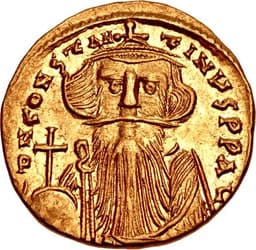
Constans II
Emperor · Ancient
55.2Total

King Saul
Emperor · Ancient
49.8Total
Basic Information
Born
-630
-1050
Died
—
-1010
Era
Ancient
Ancient
Nationality
Byzantine Empire
Israel
Occupation
Emperor
Emperor
Civilization
Western
Middle Eastern
Score Comparison
Military (10%)
55.0
45.0
Political (20%)
68.0
35.1
Influence (20%)
51.0
57.2
Legacy (20%)
44.2
50.0
Leadership (15%)
65.0
48.4
Strategy (15%)
60.0
60.0
TOTAL
55.2
49.8
Constans II — Complete Timeline
648 AD
Issued the Typos of ConstansPolitical Action
Constans II issued the Typos, an edict that forbade discussion of the Monothelite controversy. The edict aimed to end religious strife but was condemned by the Papacy and failed to restore unity.
Religious PolicyChurch ControversyByzantine Empire
Impact: regional
663 AD
Visited RomePolitical Action◆ Major
Constans II became the last Byzantine emperor to visit Rome. He was received by Pope Vitalian and spent twelve days in the city, stripping it of many bronze ornaments and statues to be sent to Constantinople.
Imperial VisitRomeByzantine Empire
Impact: regional
668 AD
Murdered in SyracusePolitical Action◆ Major
While residing in Syracuse, Sicily, Constans II was assassinated in his bath by a chamberlain. His death was part of a conspiracy, and his son Constantine IV succeeded him after suppressing the usurper Mezezius.
AssassinationByzantine EmpireSuccession Crisis
Impact: nationaltragic
674 AD
Defended Constantinople against the Arab siegeWar◆ Major
Constans II's son, Constantine IV, was actually the emperor during the first Arab siege of Constantinople. Constans II himself faced Arab raids but did not command the defense of the capital during the major siege.
Arab-Byzantine WarsSiegeByzantine Empire
Impact: regional
King Saul — Complete Timeline
1050 BC
Anointed as First King of IsraelPolitical Action
The prophet Samuel anointed Saul as the first king of the United Monarchy of Israel at Mizpah. This established the monarchy as a political institution, uniting the twelve tribes under a single ruler in response to Philistine threats.
MonarchyIsraelSamuel
Impact: nationalconstructive
1040 BC
Battle of MichmashWar◆ Major
Saul's son Jonathan initiated a surprise attack on a Philistine garrison at Michmash, leading to a full Israelite victory. Saul then rallied the army and routed the Philistines, temporarily securing Israel's central highlands from Philistine control.
PhilistinesBattleIsrael
Impact: national
1025 BC
Rejection by SamuelPolitical Action◆ Major
Samuel declared that God had rejected Saul as king after Saul failed to completely destroy the Amalekites and their livestock as commanded. This marked the beginning of Saul's decline and the rise of David as his successor.
ProphecyKingshipSamuel
Impact: nationaltragic
1010 BC
Battle of Mount GilboaWar
Saul and his sons, including Jonathan, were killed in battle against the Philistines at Mount Gilboa. The Philistines displayed Saul's armor in the temple of Ashtaroth and hung his body on the wall of Beth-shan, ending his reign.
DeathPhilistinesBattle
Impact: nationaltragic
Expert Analysis
Origins
Constans II was born in 630 CE in Constantinople, the son of Emperor Constantine III and grandson of Heraclius. He grew up in the imperial palace, receiving a traditional Roman education in military tactics, administration, and theology. His early life was overshadowed by the ongoing Arab-Byzantine wars and the Monothelite controversy that divided the empire.
King Saul was born around 1070 BCE in Gibeah, of the tribe of Benjamin. He was a tall, handsome man from a wealthy family. His father Kish was a prominent landowner. Saul's early life was as a farmer and warrior, with no formal education in statecraft. He emerged as a leader during a time when the Philistines dominated Israel, with no centralized government.
Rise to Power
Constans II became emperor at age 11 in 641 CE after the death of his father Constantine III and a brief usurpation by Heraclonas. With the support of the Senate and military, he was crowned co-emperor and then sole emperor. His rise was dynastic, but he quickly asserted control, exiling his stepmother and consolidating power.
King Saul rose to power through divine selection. The prophet Samuel, under pressure from the Israelites to appoint a king, anointed Saul privately around 1050 BCE. Saul was then chosen by lot at Mizpah and publicly acclaimed as king. His first military victory over the Ammonites at Jabesh-Gilead solidified his authority and united the tribes behind him.
Leadership & Governance
Constans II ruled as an autocratic Byzantine emperor. He centralized administration, reformed the military themes, and continued the Heraclian dynasty's policies. He issued the Typos in 648 CE, forbidding discussion of the Monothelite controversy, which alienated both Pope Theodore I and the Eastern churches. His leadership was pragmatic but divisive. He moved his court to Syracuse in 663 CE, neglecting the defense of the East, which scored 65.0 in leadership.
King Saul led as a charismatic war chief rather than a bureaucrat. He organized the Israelite army, appointed officers, and led campaigns against the Philistines, Moabites, and Amalekites. His governance was tribal and personal, lacking a formal administrative structure. He made impulsive decisions, such as offering a rash sacrifice at Gilgal and sparing the Amalekite king Agag, which led to Samuel's rejection. His political score of 35.1 reflects this instability.
Triumph & Tragedy
Constans II's greatest success was defending Byzantine territories against Arab raids, though his son Constantine IV would later face the major siege. He also visited Rome in 663 CE, the last emperor to do so, making a diplomatic gesture. However, his tragedy was his assassination in 668 CE in Syracuse, murdered by a chamberlain after unpopular policies and neglect of the capital. He scored 60.0 in strategy but only 51.0 in influence.
King Saul's triumph was his military victories, especially the relief of Jabesh-Gilead and the victory at Michmash. He established the monarchy and united Israel against the Philistines. His tragedy was his mental decline, jealousy of David, and final defeat at Mount Gilboa where he and his sons died. His legacy score of 50.0 reflects his mixed record.
Character & Destiny
Constans II was pragmatic, ruthless, and religiously indifferent. He sought to maintain imperial unity but often alienated allies. His decision to move to Syracuse and strip Rome of treasures showed his focus on the West. His destiny was to be the last emperor to see Rome, and his murder marked the decline of Byzantine control in Italy.
King Saul was brave, impulsive, and insecure. His character led to conflict with David and Samuel. His mental instability, possibly depression or paranoia, led him to consult the witch of Endor. His destiny was to be the tragic first king who failed to secure a dynasty, paving the way for David.
Legacy
Constans II's legacy is mixed. He maintained the empire but lost ground. The Typos failed to resolve religious disputes. His visit to Rome is a historical footnote. He is often overshadowed by his son Constantine IV. His overall score of 55.2 places him as a middling Byzantine emperor.
King Saul's legacy is profound as the first king of Israel. He established the monarchy but failed to create a stable dynasty. His story is told in the Hebrew Bible as a warning against disobedience. He is remembered as a tragic figure, with a legacy score of 50.0.
Conclusion
Constans II had a higher overall score of 55.2 compared to Saul's 49.8, but Saul's impact on the history of Israel and Western religion is greater. Constans II's reign was a transitional period with limited lasting influence. Saul founded the monarchy that led to David and Solomon, shaping Judeo-Christian tradition. Therefore, despite the numerical gap, King Saul had greater long-term impact.
Rankings
🥇
Constans IILeader
Mil: 55.0Pol: 68.0Inf: 51.0
55.2
🥈
King Saul
Mil: 45.0Pol: 35.1Inf: 57.2
49.8
+5.4 behind
How This Comparison Works
Algorithm
Each figure is scored on 6 dimensions (0—100 scale) based on structured historical data: Military (10%), Political (20%), Influence (20%), Legacy (20%), Leadership (15%), Strategy (15%). The weighted total produces the final ranking.
Data Sources
Scores are computed from structured sub-indicators in the database. Scale factors adjust for era (Ancient ×0.85, Modern ×1.0) and civilization size (Eastern ×1.05, Other ×0.80) to account for differences in population and military scale.
Maximum 3 Figures
Comparisons are limited to 2—3 figures to ensure readability and statistical meaningfulness.
Error Margins
±5 points per dimension — Sub-scores are derived from historical records with inherent uncertainty. Two figures within 5 points on a dimension should be considered roughly equivalent in that area.
Total Score Accuracy
±3 points overall — The weighted combination of 6 dimensions produces a total score with approximately ±3 points of uncertainty. Differences of less than 3 points are not statistically significant— the figures are effectively tied.
Known Limitations
- Historical records are incomplete and uneven across civilizations
- Figures from oral-tradition societies may be underrepresented
- Occupation labels can misclassify multi-role figures
- Scores measure capability and impact, not moral character
- Quantitative scoring is a comparison tool, not absolute truth
Capability Radar
Military (10%) — Battles & Warfare
Battles
55
55
Win Rate
50
45
Expansion
30
40
Political (20%) — Governance & Reform
Reform
55
25
Diplomacy
50
35
Economy
45
30
Influence (20%) — Cultural & Global Reach
Cultural
40
55
Global
25
50
Legacy (20%) — Historical Impact
Historical
45
60
Longevity
30
65
Leadership (15%) — Power & Stability
Tenure
65
40
Stability
35
20
Strategy (15%) — Tactics & Innovation
Strategy
50
45
Tactics
45
50
Reform
40
30
Similar Comparisons
Comments & Discussion
No comments yet. Be the first to share your thoughts!