Loading...
Constantius I vs Napoleon Bonaparte
Napoleon Bonaparte leads by 13.1 pts · 2 figures compared
…
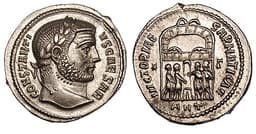
Constantius I
Emperor · Ancient
57.8Total

Napoleon Bonaparte
General · Modern
70.9Total
Basic Information
Born
250
1769
Died
306
1821
Era
Ancient
Modern
Nationality
Roman Empire
France
Occupation
Emperor
General
Civilization
Western
Western
Score Comparison
Military (10%)
50.0
94.0
Political (20%)
68.0
72.0
Influence (20%)
54.9
40.0
Legacy (20%)
50.0
80.0
Leadership (15%)
74.0
78.0
Strategy (15%)
52.5
90.0
TOTAL
57.8
70.9
Constantius I — Complete Timeline
296 AD
Recovery of Britain from Carausius and AllectusWar◆ Major
Constantius I led an invasion to reclaim Britain from the usurper Allectus, who had succeeded Carausius. His forces landed near London and defeated Allectus, restoring Britain to the Roman Empire and ending the breakaway Britannic Empire.
BritainReconquestUsurper
Impact: regionalconstructive
298 AD
Campaign against the AlemanniWar◆ Major
Constantius I defeated the Alemanni at the Battle of Lingones (modern Langres) and later at Vindonissa. These victories secured the Rhine frontier and earned him the title Germanicus Maximus, strengthening his reputation as a capable military commander.
CampaignAlemanniRhine Frontier
Impact: regional
305 AD
Elevation to AugustusPolitical Action◆ Major
Upon the abdication of Diocletian and Maximian, Constantius I became the senior Augustus of the Western Roman Empire as part of the Tetrarchy. He ruled jointly with Galerius in the East, but his reign was short-lived as he died the following year.
TetrarchySuccessionAugustus
Impact: global
306 AD
Death at Eboracum (York)Other◆ Major
Constantius I died at Eboracum (modern York) while on campaign against the Picts in northern Britain. His son Constantine was proclaimed Augustus by the troops, setting the stage for Constantine's eventual rise to sole emperor.
DeathSuccessionConstantine
Impact: global
Toleration of Christians (Edict of Milan precursor)Political Action
Constantius I, unlike his co-emperor Galerius, was tolerant of Christians and did not enforce the Diocletianic persecution in his territories. This policy of religious tolerance foreshadowed the Edict of Milan issued by his son Constantine.
ToleranceChristianityReligion
Impact: regionalconstructive
Napoleon Bonaparte — Complete Timeline
1799 AD
Coup of 18 BrumaireOther◆ Major
Napoleon Bonaparte, with support from his brother Lucien and key political figures, overthrew the Directory in a bloodless coup. He established the Consulate with himself as First Consul, effectively becoming the ruler of France. This event ended the French Revolution's most unstable period.
French RevolutionCoupRise to Power
Impact: regional
1804 AD
Promulgation of the Napoleonic CodeOther◆ Major
Napoleon enacted the Civil Code of the French, known as the Napoleonic Code, a comprehensive set of laws that replaced the fragmented feudal legal systems. The code established legal equality, protected property rights, and secularized law. It became the basis for legal systems in many European and world countries.
Legal ReformNapoleonic CodeCivil Law
Impact: globalconstructive
1805 AD
Battle of AusterlitzWar◆ Major
Napoleon's Grande Arm
Napoleonic WarsBattleDecisive Victory
Impact: global
1812 AD
Invasion of RussiaWar◆ Major
Napoleon led the Grande Arm
Napoleonic WarsInvasionDisaster
Impact: globaldestructive
1815 AD
Battle of WaterlooWar◆ Major
Napoleon's French army was defeated by the combined forces of the Duke of Wellington's Anglo-Allied army and Gebhard Leberecht von Bl
Napoleonic WarsBattleFinal Defeat
Impact: globaldestructive
Expert Analysis
constantius-i-vs-napoleon-bonaparte
# The Eagle and the Tetrarch
On a June morning in 1815, Napoleon Bonaparte watched his Imperial Guard march toward the ridge of Mont-Saint-Jean, their bearskin caps forming a moving wall of blue and white. Less than twenty miles away, the Duke of Wellington waited with his British and Prussian allies. The fate of Europe hung on a few hours of combat. Fifteen centuries earlier, another commander had stood on the northern edge of the Roman world, at Eboracum—modern York—gazing at the misty hills of Pictish territory. Constantius I, a man who had never sought the supreme power he now held, would die in that distant province within a year of his elevation. Both men ruled empires. Both faced existential threats. Their stories, separated by millennia, reveal how character and circumstance write vastly different destinies.
Origins
Napoleon Bonaparte was born in 1769 on the island of Corsica, a place only recently annexed by France. His family, minor Italian nobility, spoke Corsican, not French, and young Napoleon carried a provincial’s resentment of the mainland elite. He entered the military academy at Brienne at age nine, a small, intense boy mocked by wealthier classmates. The Revolution of 1789 upended the old order, and Napoleon—brilliant, ambitious, and utterly without inherited privilege—seized the opportunity. He was a creature of chaos, forged in the fire of revolution.
Constantius I, born around 250, came from a very different world. He was a Roman of Illyrian stock, raised in the Danubian provinces that had produced a generation of soldier-emperors. The Roman Empire of the third century was collapsing under civil war, barbarian invasion, and economic crisis. Constantius’s path was not revolution but restoration. He served under the emperor Diocletian, a reformer who divided the empire into a Tetrarchy—four rulers sharing power. Constantius was chosen not for his ambition but for his competence and loyalty. He was a man of order, built for stability.
Rise to Power
Napoleon’s ascent was a rocket’s trajectory. In 1793, at age twenty-four, he drove the British from Toulon with a brilliant artillery barrage. By 1796, he commanded the Army of Italy, crossing the Alps and smashing Austrian armies in a campaign of breathtaking speed. His victories in Egypt, though ultimately a strategic failure, made him a legend. In 1799, he returned to a France exhausted by war and political chaos, staged a coup, and made himself First Consul. By 1804, he crowned himself Emperor of the French. Every step was a gamble, every promotion a conquest.
Constantius rose through the ranks of the Tetrarchy, a system designed to prevent the very ambition Napoleon embodied. Diocletian appointed him Caesar—junior emperor—of the West in 293. His task was to reclaim Britain from the usurper Carausius and his successor Allectus. In 296, Constantius launched a daring invasion. His forces landed in two separate fleets, one near the Isle of Wight, the other in Kent. The strategy worked: Allectus was killed, and Britain was restored to the empire. Constantius then pacified the Rhine frontier, defeating the Alemanni at the Battle of Lingones in 298. He was a reliable general, not a revolutionary.
Leadership & Governance
Napoleon ruled with a genius for organization and a hunger for control. He reformed French law into the Napoleonic Code, a system that enshrined equality before the law but also centralized power in his hands. He built schools, roads, and a bureaucracy that outlasted his empire. His military campaigns were masterpieces of logistics and maneuver—Austerlitz in 1805, Jena in 1806, Wagram in 1809. He won battles by sheer force of will, often leading from the front. But his governance was personal, not institutional. He appointed family members to thrones, alienated allies, and never built a system that could survive his absence.
Constantius governed as a partner in a fragile coalition. As Caesar, he shared power with Maximian, his Augustus, and with Diocletian and Galerius in the East. He maintained stability through moderation. Unlike his co-emperor Galerius, who enforced the brutal Diocletianic persecution of Christians, Constantius tolerated them. He destroyed no churches, executed no believers. This policy, recorded by the historian Lactantius, would later pave the way for his son Constantine’s Edict of Milan in 313. Constantius’s rule was quiet, competent, and merciful—the opposite of Napoleon’s dazzling, destructive brilliance.
Triumph & Tragedy
Napoleon’s greatest triumph was Austerlitz, where he crushed the combined armies of Russia and Austria in a single day. His greatest tragedy was the invasion of Russia in 1812. He marched 600,000 men into the vastness of the Russian winter; fewer than 100,000 returned. The disaster broke his aura of invincibility. Exiled to Elba in 1814, he escaped and raised another army, only to meet final defeat at Waterloo in 1815. His tragedy was not his enemies but his own inability to stop—he could conquer but never consolidate.
Constantius’s triumph was the recovery of Britain and the stabilization of the West. His tragedy was a quieter one. He never saw the empire he helped restore. Elevated to Augustus in 305 after Diocletian’s abdication, he ruled for only a year. In 306, while campaigning against the Picts in northern Britain, he fell ill and died at Eboracum. His son Constantine was at his side, and the army immediately proclaimed him emperor. Constantius’s death was the end of the Tetrarchy’s peace; his son would fight for twenty years to reunite the empire.
Character & Destiny
Napoleon was driven by an insatiable hunger for glory. “Impossible is not a word in my dictionary,” he once said. He believed he could bend history to his will, and for a time, he did. But his arrogance blinded him to limits—of geography, of resources, of human endurance. He ended his life a prisoner on Saint Helena, dictating memoirs and blaming everyone but himself.
Constantius was a man of duty, not destiny. He served the Tetrarchy faithfully, even when its policies—like the persecution of Christians—clashed with his own beliefs. He was not a visionary; he was a steward. His greatest legacy was his son Constantine, whom he raised in his own court and to whom he passed the empire. Constantius’s character was one of patience and prudence. In a world of chaos, he chose order.
Legacy
Napoleon’s legacy is written in the laws, borders, and institutions of modern Europe. The Napoleonic Code influenced legal systems from France to Brazil. His campaigns reshaped military strategy. He is remembered as a titan, a genius, a tyrant—a figure of endless fascination.
Constantius’s legacy is subtler but no less profound. His tolerance of Christians made possible the Christianization of the Roman Empire. His son Constantine would build Constantinople, transform the empire, and be remembered as “the Great.” Constantius is the quiet root of a mighty tree.
Conclusion
Napoleon and Constantius are mirrors of two archetypes: the revolutionary and the restorer. Napoleon tore down an old world to build a new one, but his empire crumbled with his ambition. Constantius preserved an old world, passing it to his son, who transformed it. One died in exile, the other in his bed, surrounded by his soldiers. Both shaped history, but in opposite ways. Napoleon’s story is a warning about the price of greatness. Constantius’s is a reminder that sometimes the most important work is the work that goes unnoticed—until it is all that remains.
Rankings
🥇
Napoleon BonaparteLeader
Mil: 94.0Pol: 72.0Inf: 40.0
70.9
🥈
Constantius I
Mil: 50.0Pol: 68.0Inf: 54.9
57.8
+13.1 behind
How This Comparison Works
Algorithm
Each figure is scored on 6 dimensions (0—100 scale) based on structured historical data: Military (10%), Political (20%), Influence (20%), Legacy (20%), Leadership (15%), Strategy (15%). The weighted total produces the final ranking.
Data Sources
Scores are computed from structured sub-indicators in the database. Scale factors adjust for era (Ancient ×0.85, Modern ×1.0) and civilization size (Eastern ×1.05, Other ×0.80) to account for differences in population and military scale.
Maximum 3 Figures
Comparisons are limited to 2—3 figures to ensure readability and statistical meaningfulness.
Error Margins
±5 points per dimension — Sub-scores are derived from historical records with inherent uncertainty. Two figures within 5 points on a dimension should be considered roughly equivalent in that area.
Total Score Accuracy
±3 points overall — The weighted combination of 6 dimensions produces a total score with approximately ±3 points of uncertainty. Differences of less than 3 points are not statistically significant— the figures are effectively tied.
Known Limitations
- Historical records are incomplete and uneven across civilizations
- Figures from oral-tradition societies may be underrepresented
- Occupation labels can misclassify multi-role figures
- Scores measure capability and impact, not moral character
- Quantitative scoring is a comparison tool, not absolute truth
Capability Radar
Military (10%) — Battles & Warfare
Battles
45
95
Win Rate
50
90
Expansion
35
95
Political (20%) — Governance & Reform
Reform
45
95
Diplomacy
55
80
Economy
50
85
Influence (20%) — Cultural & Global Reach
Cultural
30
85
Global
40
90
Legacy (20%) — Historical Impact
Historical
55
95
Longevity
60
90
Leadership (15%) — Power & Stability
Tenure
50
85
Stability
55
70
Strategy (15%) — Tactics & Innovation
Strategy
60
95
Tactics
55
98
Reform
40
92
Similar Comparisons
Comments & Discussion
No comments yet. Be the first to share your thoughts!