Loading...
Count Andrassy vs Tuilaepa Sailele Malielegaoi
Count Andrassy leads by 7.7 pts · 2 figures compared
…
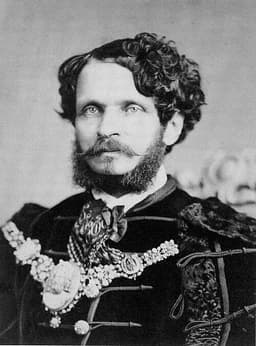
Count Andrassy
Politician · Modern
58.1Total

Tuilaepa Sailele Malielegaoi
Politician · Modern
50.4Total
Basic Information
Born
1823
1945
Died
1890
—
Era
Modern
Modern
Nationality
Austria
Samoa
Occupation
Politician
Politician
Civilization
Western
Other
Score Comparison
Military (10%)
48.9
16.3
Political (20%)
72.0
45.0
Influence (20%)
60.0
55.7
Legacy (20%)
49.2
49.2
Leadership (15%)
72.0
80.0
Strategy (15%)
43.2
38.1
TOTAL
58.1
50.4
Count Andrassy — Complete Timeline
1871 AD
Appointment as Foreign Minister of Austria-HungaryPolitical Action◆ Major
Andrassy was appointed Foreign Minister of Austria-Hungary by Emperor Franz Joseph. He was the first Hungarian to hold this position, reflecting the dual monarchy's structure.
AppointmentForeign PolicyDual Monarchy
Impact: national
1878 AD
Congress of BerlinPolitical Action◆ Major
Andrassy represented Austria-Hungary at the Congress of Berlin, which revised the Treaty of San Stefano. He secured the right to occupy and administer Bosnia and Herzegovina, expanding Habsburg influence in the Balkans.
CongressBalkansTerritorial Expansion
Impact: regionalconstructive
1879 AD
Dual Alliance with GermanyPolitical Action
Andrassy negotiated the Dual Alliance between Austria-Hungary and Germany. This defensive treaty committed both powers to mutual support in case of a Russian attack, forming the core of the Central Powers in World War I.
AllianceGermanyCentral Powers
Impact: regionalconstructive
Resignation as Foreign MinisterPolitical Action◆ Major
Andrassy resigned as Foreign Minister after the Dual Alliance was signed. He cited health reasons and a desire to return to Hungarian politics, but his resignation also reflected tensions within the empire.
ResignationHungaryPolitics
Impact: national
Tuilaepa Sailele Malielegaoi — Complete Timeline
1998 AD
Became Prime Minister of SamoaPolitical Action◆ Major
Malielegaoi succeeded Tofilau Eti Alesana as Prime Minister, becoming the leader of the HRPP. He would go on to serve for 22 years, the longest continuous tenure of any Pacific leader.
Prime MinisterHRPPGovernment Formation
Impact: nationalconstructive
2008 AD
Introduced the Land Titles Registration ActReform◆ Major
Malielegaoi's government passed legislation to register customary land titles, aiming to formalize land ownership and facilitate economic development. The act faced opposition from traditional leaders who saw it as undermining customary systems.
Land ReformCustomary LandLegislation
Impact: national
2009 AD
Switched Samoa from right-hand to left-hand drivingReform◆ Major
Malielegaoi's government implemented a change from driving on the right to driving on the left, aligning Samoa with Australia and New Zealand. The switch aimed to reduce import costs for vehicles and improve road safety.
Traffic ReformInfrastructurePolicy Change
Impact: national
2021 AD
Lost re-election after 22 yearsPolitical Action◆ Major
Malielegaoi's HRPP lost the general election to the FAST party led by Naomi Mataafa. He initially refused to concede, leading to a constitutional crisis that was resolved by the Court of Appeal, ending his long tenure.
Election DefeatConstitutional CrisisPolitical Transition
Impact: national
Expert Analysis
Origins
**Count Gyula Andrassy** was born on March 8, 1823, in Oláhpatak, Hungary (then part of the Austrian Empire), into an aristocratic Hungarian family. His father, Count Károly Andrassy, was a liberal politician, and his mother, Etelka Szapáry, came from a noble family. Andrassy studied law and philosophy at the University of Pest, and later traveled abroad, developing a broad worldview. His early involvement in Hungarian politics led him to support Lajos Kossuth's 1848 revolution against Habsburg rule. After the revolution's defeat, Andrassy was sentenced to death in absentia and fled into exile in Paris and London, where he deepened his diplomatic skills.
**Tuilaepa Sailele Malielegaoi** was born on April 14, 1945, in Lepā, Samoa, into a chiefly family. He studied at the University of Auckland, earning a Master's in Commerce, and later worked as an accountant and economist. Before entering politics, he served as a senior public servant, including as Director of Economic Affairs. His background in economics contrasted sharply with Andrassy's aristocratic and revolutionary upbringing.
Rise to Power
Andrassy returned to Hungary after the 1867 Austro-Hungarian Compromise, which created the dual monarchy. He was appointed Prime Minister of Hungary in 1867, serving until 1871, and then became the Austro-Hungarian Foreign Minister in 1871, the first Hungarian to hold that post. His rise was accelerated by his role in negotiating the Compromise, which granted Hungary equal status within the empire. Key turning points included his appointment as Foreign Minister and his leadership at the Congress of Berlin in 1878, where he secured the right for Austria-Hungary to occupy Bosnia-Herzegovina.
Malielegaoi rose to prominence as a technocrat in the Human Rights Protection Party (HRPP). He became Prime Minister in 1998 after the death of Tofilau Eti Alesana. His rise was smooth, as he was the chosen successor within the dominant party. He consolidated power through a series of electoral victories, winning five consecutive terms. His leadership was marked by a focus on economic development and alignment with Western powers.
Leadership & Governance
Andrassy's governance was characterized by pragmatic diplomacy. As Foreign Minister, he sought to maintain the balance of power in Europe. His greatest achievement was the 1879 Dual Alliance with Germany, a defensive pact that shaped European alliances until World War I. He also pursued a cautious policy in the Balkans, avoiding direct confrontation with Russia. His leadership style was measured and strategic, often prioritizing stability over expansion.
Malielegaoi's governance was transformative for Samoa. He switched driving from right to left in 2009 to align with Australia and New Zealand, a controversial move that cost lives in accidents but aimed to boost ties. He introduced the Land Titles Registration Act to formalize customary land ownership, though it faced opposition from traditional chiefs. His leadership was autocratic; he suppressed dissent and used state media to maintain control. His political score of 45.0 reflects his authoritarian tendencies, while his leadership score of 80.0 indicates his ability to maintain power for 22 years.
Triumph & Tragedy
Andrassy's triumph was the Dual Alliance, which secured Austria-Hungary's position in Europe. He also successfully represented his empire at the Congress of Berlin, expanding influence in the Balkans without war. His tragedy was the long-term consequences of the alliance system: it contributed to the rigid bloc system that led to World War I. His resignation in 1879 after the alliance was partly due to criticism that he had tied Austria-Hungary too closely to Germany.
Malielegaoi's triumph was his long tenure and economic growth: Samoa achieved middle-income status under his rule. He also maintained political stability in a region prone to coups. His tragedy was his refusal to concede the 2021 election, leading to a constitutional crisis and a period of political paralysis. His legacy was tarnished by accusations of corruption and authoritarianism, scoring 49.2 in legacy.
Character & Destiny
Andrassy was a realist, known for his charm and diplomatic skill. He was a Hungarian nationalist who nonetheless served an Austrian emperor, showing pragmatism. His exile shaped his cautious approach. His character led him to seek alliances that would protect his empire, but also trapped it in a rigid system. He scored 72.0 in political skill and 43.2 in strategy, indicating he was more a diplomat than a grand strategist.
Malielegaoi was a determined, sometimes stubborn leader. His economic background made him focus on development, but his desire to control led to democratic backsliding. His character was shaped by his belief in strong leadership; he saw himself as a father figure for Samoa. His refusal to step down after losing the election showed his inability to accept defeat, scoring 38.1 in strategy.
Legacy
Andrassy's legacy is the Dual Alliance, which set the stage for World War I alliances. He is remembered as a skilled diplomat who modernized Hungarian politics within the empire. His influence score of 60.0 reflects his role in shaping European diplomacy. In Hungary, he is celebrated as a statesman who advanced Hungarian interests.
Malielegaoi's legacy is mixed. He transformed Samoa's economy and infrastructure, but his authoritarian rule damaged democratic institutions. The driving switch and land reforms remain controversial. His 22-year tenure is the longest in the Pacific, but his refusal to concede undermined his legacy. He scores 49.2 in legacy, similar to Andrassy.
Conclusion
While Malielegaoi had a higher leadership score (80.0 vs 72.0), Andrassy's impact was more profound globally. The Dual Alliance shaped European geopolitics for decades, leading to the alliance system that contributed to World War I. Andrassy's diplomatic achievements at the Congress of Berlin also had lasting consequences for the Balkans. In contrast, Malielegaoi's impact was largely confined to Samoa, with limited global significance. Andrassy's total score of 58.1 exceeds Malielegaoi's 50.4, and his political skill (72.0) and influence (60.0) outweighed Malielegaoi's leadership. Therefore, Count Andrassy had greater historical impact.
Rankings
🥇
Count AndrassyLeader
Mil: 48.9Pol: 72.0Inf: 60.0
58.1
🥈
Tuilaepa Sailele Malielegaoi
Mil: 16.3Pol: 45.0Inf: 55.7
50.4
+7.7 behind
How This Comparison Works
Algorithm
Each figure is scored on 6 dimensions (0—100 scale) based on structured historical data: Military (10%), Political (20%), Influence (20%), Legacy (20%), Leadership (15%), Strategy (15%). The weighted total produces the final ranking.
Data Sources
Scores are computed from structured sub-indicators in the database. Scale factors adjust for era (Ancient ×0.85, Modern ×1.0) and civilization size (Eastern ×1.05, Other ×0.80) to account for differences in population and military scale.
Maximum 3 Figures
Comparisons are limited to 2—3 figures to ensure readability and statistical meaningfulness.
Error Margins
±5 points per dimension — Sub-scores are derived from historical records with inherent uncertainty. Two figures within 5 points on a dimension should be considered roughly equivalent in that area.
Total Score Accuracy
±3 points overall — The weighted combination of 6 dimensions produces a total score with approximately ±3 points of uncertainty. Differences of less than 3 points are not statistically significant— the figures are effectively tied.
Known Limitations
- Historical records are incomplete and uneven across civilizations
- Figures from oral-tradition societies may be underrepresented
- Occupation labels can misclassify multi-role figures
- Scores measure capability and impact, not moral character
- Quantitative scoring is a comparison tool, not absolute truth
Capability Radar
Military (10%) — Battles & Warfare
Battles
26
19
Win Rate
34
24
Expansion
37
25
Political (20%) — Governance & Reform
Reform
60
60
Diplomacy
75
65
Economy
55
55
Influence (20%) — Cultural & Global Reach
Cultural
40
40
Global
50
35
Legacy (20%) — Historical Impact
Historical
55
50
Longevity
40
45
Leadership (15%) — Power & Stability
Tenure
65
85
Stability
60
70
Strategy (15%) — Tactics & Innovation
Strategy
40
32
Tactics
41
35
Reform
43
38
Similar Comparisons
Comments & Discussion
No comments yet. Be the first to share your thoughts!