Loading...
Daniel OConnell vs Napoleon Bonaparte
Napoleon Bonaparte leads by 13.9 pts · 2 figures compared
…
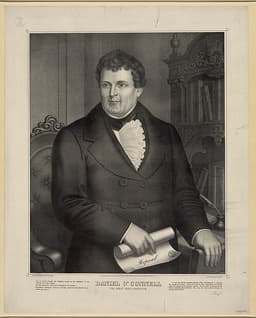
Daniel OConnell
Politician · Modern
57.0Total

Napoleon Bonaparte
General · Modern
70.9Total
Basic Information
Born
1775
1769
Died
1847
1821
Era
Modern
Modern
Nationality
Ireland
France
Occupation
Politician
General
Civilization
Western
Western
Score Comparison
Military (10%)
50.0
94.0
Political (20%)
72.0
72.0
Influence (20%)
55.0
40.0
Legacy (20%)
52.0
80.0
Leadership (15%)
68.0
78.0
Strategy (15%)
42.7
90.0
TOTAL
57.0
70.9
Daniel OConnell — Complete Timeline
1823 AD
Catholic Association FoundedPolitical Action◆ Major
O'Connell founded the Catholic Association to campaign for Catholic emancipation. The organization used mass membership and the 'Catholic Rent' (a penny a month subscription) to mobilize Irish Catholics politically.
Catholic EmancipationPolitical OrganizationMass Mobilization
Impact: nationalprogressive
1828 AD
Election to ParliamentPolitical Action◆ Major
O'Connell won a by-election in County Clare, defeating a Protestant candidate. As a Catholic, he was legally barred from taking his seat, forcing the British government to pass the Catholic Relief Act 1829 to avoid civil unrest.
ElectionCatholic EmancipationPolitical Crisis
Impact: nationalprogressive
1829 AD
Catholic Relief Act 1829Reform
The British Parliament passed the Catholic Relief Act, allowing Catholics to sit in Parliament and hold most public offices. O'Connell's campaign was the primary cause, though the act also raised the property qualification for Irish voters.
Catholic EmancipationLegislationReform
Impact: nationalprogressive
1840 AD
Repeal Association FoundedPolitical Action◆ Major
O'Connell founded the Repeal Association to campaign for the repeal of the Acts of Union 1800 and the restoration of an Irish parliament. The movement used mass meetings, known as 'monster meetings', to demonstrate popular support.
RepealNationalismMass Politics
Impact: nationalprogressive
1843 AD
Monster Meeting at TaraPolitical Action
O'Connell held a massive 'monster meeting' at the Hill of Tara, attracting an estimated 750,000 people. These peaceful demonstrations demonstrated the strength of the Repeal movement but alarmed the British government.
Monster MeetingRepealMass Mobilization
Impact: nationalprogressive
1844 AD
Trial for ConspiracyPolitical Action◆ Major
O'Connell was tried and convicted for conspiracy to incite rebellion, based on his Repeal campaign speeches. He was sentenced to a year in prison but was released after three months by the House of Lords on appeal.
TrialImprisonmentRepeal
Impact: national
Napoleon Bonaparte — Complete Timeline
1799 AD
Coup of 18 BrumaireOther◆ Major
Napoleon Bonaparte, with support from his brother Lucien and key political figures, overthrew the Directory in a bloodless coup. He established the Consulate with himself as First Consul, effectively becoming the ruler of France. This event ended the French Revolution's most unstable period.
French RevolutionCoupRise to Power
Impact: regional
1804 AD
Promulgation of the Napoleonic CodeOther◆ Major
Napoleon enacted the Civil Code of the French, known as the Napoleonic Code, a comprehensive set of laws that replaced the fragmented feudal legal systems. The code established legal equality, protected property rights, and secularized law. It became the basis for legal systems in many European and world countries.
Legal ReformNapoleonic CodeCivil Law
Impact: globalconstructive
1805 AD
Battle of AusterlitzWar◆ Major
Napoleon's Grande Arm
Napoleonic WarsBattleDecisive Victory
Impact: global
1812 AD
Invasion of RussiaWar◆ Major
Napoleon led the Grande Arm
Napoleonic WarsInvasionDisaster
Impact: globaldestructive
1815 AD
Battle of WaterlooWar◆ Major
Napoleon's French army was defeated by the combined forces of the Duke of Wellington's Anglo-Allied army and Gebhard Leberecht von Bl
Napoleonic WarsBattleFinal Defeat
Impact: globaldestructive
Expert Analysis
daniel-oconnell-vs-napoleon-bonaparte
# The Liberator and the Emperor: Two Paths to Power in an Age of Revolution
On a misty morning in August 1843, a crowd unlike anything the British Isles had ever seen gathered at the Hill of Tara in County Meath. Estimates placed the number at three-quarters of a million souls—farmers, priests, shopkeepers, and laborers—all come to hear one man speak. There were no cannons, no marching columns, no glittering uniforms. Daniel O’Connell, a barrel-chested lawyer with a thunderous voice, stood before them and demanded the restoration of Ireland’s parliament, all within the bounds of law. Across the English Channel, thirty years earlier, another man had stood before his Grande Armée at Austerlitz, watching the sun rise over a frozen battlefield where he would soon crush the combined might of Austria and Russia. Napoleon Bonaparte and Daniel O’Connell were contemporaries, both born into the tumultuous final decades of the eighteenth century. Yet one conquered Europe with blood and steel, while the other liberated a nation with words and will. What drove two such different destinies?
Origins
Napoleon Bonaparte entered the world in 1769 on the rugged Mediterranean island of Corsica, a territory only recently annexed by France. His family were minor nobility of Italian descent, scraping by on modest estates. From childhood, Napoleon felt like an outsider—a Corsican among Frenchmen, a poor aristocrat among wealthy ones. He channeled this resentment into ferocious ambition, devouring military history and dreaming of glory. The French Revolution, which erupted when he was twenty, shattered the old order and opened paths that birth alone could never have granted.
Daniel O’Connell was born six years later, in 1775, into a very different world. His family were prosperous Catholic gentry in County Kerry, Ireland, but prosperity came with a bitter price. Under the Penal Laws, Catholics could not sit in Parliament, hold senior military rank, or even practice law without taking oaths that denied their faith. Young Daniel was sent to France for his education—ironically, to the very Catholic colleges that the Revolution would soon close. He witnessed the Terror firsthand, watching heads roll from the guillotine, and the experience seared into him a lifelong horror of revolutionary violence.
Rise to Power
Napoleon’s ascent was explosive. In 1793, aged just twenty-four, he drove British forces from the port of Toulon with a brilliant artillery plan. By 1795, he had saved the revolutionary government from a royalist uprising with a “whiff of grapeshot.” Then came Italy: in 1796, he led an undersupplied, ragged army over the Alps and defeated the Austrians in a series of lightning campaigns. Each victory fed the next. By 1799, he was First Consul of France; by 1804, Emperor. His rise was a cascade of triumphs, each one making the next possible.
O’Connell’s path was slower, more deliberate. He trained as a barrister and quickly became the most feared courtroom advocate in Ireland, defending Catholics against Protestant landlords. But his real genius lay in organization. In 1823, he founded the Catholic Association, a mass-membership organization that charged a penny a month—the “Catholic rent”—and mobilized the Irish peasantry as a political force. This was something new in history: a movement of the poor, the illiterate, the dispossessed, organized not for rebellion but for peaceful pressure. In 1828, O’Connell stood for Parliament in County Clare and won, even though as a Catholic he could not take his seat. The British government faced a choice: admit him or risk civil war. They blinked. In 1829, the Catholic Relief Act passed, and O’Connell entered history as “The Liberator.”
Leadership & Governance
Napoleon ruled through a combination of terror and genius. He centralized the state, created the Bank of France, and—most enduringly—codified French law into the Napoleonic Code, which swept away feudal privileges and established legal equality. On the battlefield, he was peerless: his speed, his use of artillery, his ability to read terrain and enemy intentions, all earned him a military score of 94, among the highest in history. At Austerlitz in 1805, he destroyed a larger Austro-Russian army by feigning weakness and then striking at their exposed center. He seemed invincible.
But Napoleon’s governance had a fatal flaw: he could not stop. Peace was not his purpose; glory was. He appointed his brothers and marshals as puppet kings across Europe, but his empire rested on conquest alone, never on consent. The Spanish ulcer bled his armies in guerrilla war; the Russian winter devoured his Grande Armée in 1812. His political instincts, for all their brilliance, were ultimately those of a soldier who believed victory could solve everything.
O’Connell governed differently because he had no army, no treasury, no state. His power was purely moral. He held “monster meetings” across Ireland—peaceful gatherings of hundreds of thousands—to demand repeal of the Act of Union. He understood that violence would only unite the British against him, while peaceful mass demonstration would divide them. When the British arrested him in 1844 for conspiracy, he turned his trial into a platform. Yet his strategy had limits. The Repeal movement eventually stalled; younger, more radical voices called for physical force. O’Connell, now elderly and frail, could not hold the movement together.
Triumph & Tragedy
Napoleon’s greatest triumph was also the beginning of his end. In 1812, he marched into Russia with over 600,000 men. He won every battle—Borodino was a masterpiece of tactical brutality—but the Russians simply retreated, burning their own land. When he reached Moscow, the city was empty and aflame. He waited for surrender that never came. Then winter arrived. The retreat was a catastrophe: barely 40,000 soldiers limped back. His political score of 75 reflects a man who could conquer but not consolidate.
O’Connell’s tragedy was more subtle. He secured Catholic emancipation, but failed to repeal the Union. Ireland remained part of Britain, and the Great Famine that began in 1845—just two years before his death—would kill a million of his countrymen. He died in 1847 in Genoa, on a pilgrimage to Rome, a broken man who had seen his peaceful methods fail to prevent catastrophe.
Character & Destiny
Napoleon was driven by an insatiable hunger for order and glory. “I am not a man,” he once said, “but a thing.” He saw himself as an instrument of destiny, and this belief both elevated and destroyed him. His leadership score of 80 reflects a man who could inspire fanatical loyalty but also bred resentment through his arrogance. He could not share power; he could not delegate; he could not stop.
O’Connell was driven by a different fire: justice. He had seen the guillotine in France and swore never to unleash it. His leadership score of 83.9 is actually higher than Napoleon’s—because O’Connell led through persuasion, not fear. He mobilized millions without shedding a drop of blood. But the same conviction that made him great also limited him. He refused to countenance violence even when violence might have achieved his goals. His strategy score of 35.3 reflects a man who understood politics but not the brutal arithmetic of power.
Legacy
Napoleon left a continent transformed. The Napoleonic Code still underpins legal systems from France to Louisiana to Egypt. He destroyed the Holy Roman Empire, spread nationalism across Europe, and inspired generations of military thinkers. His legacy score of 78 is complicated: he is both a hero of meritocracy and a cautionary tale of overreach.
O’Connell left a quieter but equally profound legacy. He invented modern mass politics—the peaceful, organized movement of ordinary people demanding their rights. Gandhi read him; Martin Luther King Jr. studied him. The Catholic emancipation he won was a step toward religious freedom that echoed around the world. His legacy score of 69.6 understates his influence because it measures only what he achieved, not what he made possible.
Conclusion
Standing at the Hill of Tara in 1843, O’Connell looked out at a sea of faces and said, “I am not a man to be intimidated.” Across the Channel, Napoleon, exiled on St. Helena, dictated his memoirs and insisted he had never been defeated. Both men were right, and both were wrong. Napoleon conquered an empire and lost it; O’Connell won a victory and could not complete it. One believed in force; the other in persuasion. One shaped the nineteenth century with the sword; the other with the voice. Their differences were not merely personal—they were the product of their circumstances, their nations, and their times. But together, they remind us that power has many faces, and that the most enduring victories are not always won on the battlefield.
Rankings
🥇
Napoleon BonaparteLeader
Mil: 94.0Pol: 72.0Inf: 40.0
70.9
🥈
Daniel OConnell
Mil: 50.0Pol: 72.0Inf: 55.0
57.0
+13.9 behind
How This Comparison Works
Algorithm
Each figure is scored on 6 dimensions (0—100 scale) based on structured historical data: Military (10%), Political (20%), Influence (20%), Legacy (20%), Leadership (15%), Strategy (15%). The weighted total produces the final ranking.
Data Sources
Scores are computed from structured sub-indicators in the database. Scale factors adjust for era (Ancient ×0.85, Modern ×1.0) and civilization size (Eastern ×1.05, Other ×0.80) to account for differences in population and military scale.
Maximum 3 Figures
Comparisons are limited to 2—3 figures to ensure readability and statistical meaningfulness.
Error Margins
±5 points per dimension — Sub-scores are derived from historical records with inherent uncertainty. Two figures within 5 points on a dimension should be considered roughly equivalent in that area.
Total Score Accuracy
±3 points overall — The weighted combination of 6 dimensions produces a total score with approximately ±3 points of uncertainty. Differences of less than 3 points are not statistically significant— the figures are effectively tied.
Known Limitations
- Historical records are incomplete and uneven across civilizations
- Figures from oral-tradition societies may be underrepresented
- Occupation labels can misclassify multi-role figures
- Scores measure capability and impact, not moral character
- Quantitative scoring is a comparison tool, not absolute truth
Capability Radar
Military (10%) — Battles & Warfare
Battles
28
95
Win Rate
31
90
Expansion
35
95
Political (20%) — Governance & Reform
Reform
85
95
Diplomacy
80
80
Economy
30
85
Influence (20%) — Cultural & Global Reach
Cultural
65
85
Global
55
90
Legacy (20%) — Historical Impact
Historical
70
95
Longevity
60
90
Leadership (15%) — Power & Stability
Tenure
40
85
Stability
60
70
Strategy (15%) — Tactics & Innovation
Strategy
40
95
Tactics
38
98
Reform
44
92
Similar Comparisons
Comments & Discussion
AusterlitzAccuser6/17/2026
Comparing O’Connell’s Monster Meeting at Tara to Napoleon at Austerlitz is almost embarrassing for the Irishman. Austerlitz saw 9,000 Russian-Austrian dead in a single day—real, irreversible history. O’Connell’s “army” of 750,000 showed up, listened to speeches, and went home for tea. The Great Liberator didn’t liberate a damn thing; Ireland starved through the Famine six years later while his monster gatherings provided exactly zero practical resistance. Words don’t shatter empires. Bayonets do
TaraOrator6/17/2026
拿掉拿破仑的军装和马刀,他还能是什么?一个流放圣赫勒拿岛的囚犯罢了。奥康奈尔不需要一兵一卒就动员了七十五万人坐在塔拉山上听他说话——拿破仑连最忠诚的老近卫军都做不到如此和平的忠诚。奥康奈尔让不列颠帝国颤抖却不流一滴血,这种统治灵魂的力量比统治欧洲的刺刀高明一百倍。真正的征服者是不用开枪的。
CorsicanComplex6/17/2026
The origins comparison misses the key psychological driver: Napoleon’s perpetual outsider status made him literally unable to trust anyone, hence the surveillance state, the secret police, the paranoid court. O’Connell, despite Catholic oppression, built mass movements through radical trust in democratic process. One’s teenage writings about conquering Corsica predict a lifetime of domination; the other’s legal briefs for Catholic Emancipation predict a lifetime of liberation. Their environments
历史量化师6/17/2026
说两人都是“革命之子”?拜托,拿破仑杀了三百万人搞帝国,奥康奈尔零伤亡搞民主运动。把科西嘉小贵族和爱尔兰天主教律师并列,本身就是对历史的侮辱。拿破仑的“成就”是法国从一千七百万人口死到剩两千八百万,奥康奈尔让爱尔兰天主教徒第一次当了议员。数据不会撒谎:一个导致人口锐减加官僚独裁,一个推动民权增长加议会改革。选择题很简单。
PotatoFieldProphet6/17/2026
What nobody says: O’Connell’s nonviolence wasn’t moral superiority—it was strategic realism. Ireland in 1843 had zero chance against the British military that had just pacified India. He knew that a conventional rebellion would mean slaughter, like 1798 all over again but with railways to bring troops faster. His genius was buying time for the Famine generation to emigrate and vote in American elections, creating Irish-American political power that eventually forced British concessions. Napoleon