Loading...
Decentius vs Napoleon Bonaparte
Napoleon Bonaparte leads by 26.0 pts · 2 figures compared
…
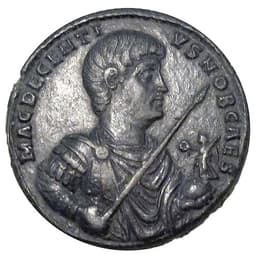
Decentius
Emperor · Ancient
44.9Total

Napoleon Bonaparte
General · Modern
70.9Total
Basic Information
Born
290
1769
Died
353
1821
Era
Ancient
Modern
Nationality
Roman Empire
France
Occupation
Emperor
General
Civilization
Western
Western
Score Comparison
Military (10%)
45.0
94.0
Political (20%)
39.4
72.0
Influence (20%)
56.4
40.0
Legacy (20%)
39.2
80.0
Leadership (15%)
45.0
78.0
Strategy (15%)
38.3
90.0
TOTAL
44.9
70.9
Decentius — Complete Timeline
350 AD
Appointed Caesar by MagnentiusPolitical Action◆ Major
After Magnentius usurped the Western Roman throne, he appointed his brother Decentius as Caesar. Decentius was given command of Gaul and tasked with defending the Rhine frontier against Germanic tribes.
Imperial AppointmentUsurpationMagnentius
Impact: regional
352 AD
Failed to defend Gaul against AlemanniWar◆ Major
Decentius's forces failed to prevent Alemanni incursions into Gaul, leading to significant devastation. This military failure weakened Magnentius's position and undermined confidence in the usurper regime.
Military DefeatGermanic InvasionGaul
Impact: regionaldestructive
353 AD
Committed suicide after Magnentius's defeatOther◆ Major
After Magnentius was defeated by Constantius II at the Battle of Mons Seleucus, Decentius hanged himself. His suicide ended the usurper dynasty and restored the Western Roman Empire to Constantius II's control.
SuicideUsurpationConstantius II
Impact: regionaltragic
Napoleon Bonaparte — Complete Timeline
1799 AD
Coup of 18 BrumaireOther◆ Major
Napoleon Bonaparte, with support from his brother Lucien and key political figures, overthrew the Directory in a bloodless coup. He established the Consulate with himself as First Consul, effectively becoming the ruler of France. This event ended the French Revolution's most unstable period.
French RevolutionCoupRise to Power
Impact: regional
1804 AD
Promulgation of the Napoleonic CodeOther◆ Major
Napoleon enacted the Civil Code of the French, known as the Napoleonic Code, a comprehensive set of laws that replaced the fragmented feudal legal systems. The code established legal equality, protected property rights, and secularized law. It became the basis for legal systems in many European and world countries.
Legal ReformNapoleonic CodeCivil Law
Impact: globalconstructive
1805 AD
Battle of AusterlitzWar◆ Major
Napoleon's Grande Arm
Napoleonic WarsBattleDecisive Victory
Impact: global
1812 AD
Invasion of RussiaWar◆ Major
Napoleon led the Grande Arm
Napoleonic WarsInvasionDisaster
Impact: globaldestructive
1815 AD
Battle of WaterlooWar◆ Major
Napoleon's French army was defeated by the combined forces of the Duke of Wellington's Anglo-Allied army and Gebhard Leberecht von Bl
Napoleonic WarsBattleFinal Defeat
Impact: globaldestructive
Expert Analysis
decentius-vs-napoleon-bonaparte
# The Emperor and the Shadow: Why Napoleon Conquered an Age While Decentius Drowned in Obscurity
On a June morning in 1815, Napoleon Bonaparte stood before the rolling fields of Waterloo, his Grande Armée poised to crush the allied forces of Wellington and Blücher. He was a man who had remade Europe, whose name had become a synonym for ambition itself. Twelve centuries earlier, in a dusty corner of Gaul, a Roman Caesar named Decentius tightened a noose around his own neck. His brother, the usurper Magnentius, had just been slaughtered by the legitimate emperor Constantius II, and Decentius saw no future but the rope. Two men, both granted power through blood and crisis, both facing the collapse of their worlds—yet one shaped the destiny of a continent while the other vanished into a footnote. The difference between them is not merely one of scale, but of character, opportunity, and the cruel arithmetic of history.
Origins
Napoleon was born in 1769 on the island of Corsica, a territory only recently annexed by France. His family was minor nobility, poor but proud, and young Napoleon grew up speaking Italian-accented French in a world that looked down on him. This outsider status forged a relentless drive. He devoured military history, studied the campaigns of Alexander and Caesar, and emerged from the École Militaire in Paris as a second lieutenant of artillery. The French Revolution had shattered the old order, opening paths for talent over birth. Napoleon seized that opening with both hands.
Decentius, by contrast, was a creature of the late Roman Empire, born around 290 into a world of rigid hierarchy and crumbling borders. He was the brother of Magnentius, a general of barbarian descent who had risen through the ranks to seize the Western throne in 350. Decentius was given the title of Caesar—junior emperor—in that same year, not because of his own merits but because Magnentius needed a loyal lieutenant to hold Gaul. His world was one of inherited authority and desperate improvisation, where power flowed from the army’s favor and the emperor’s whim. There was no revolution to remake society, only a slow decay that demanded survival, not transformation.
Rise to Power
Napoleon’s ascent was a masterpiece of calculated risk. In 1793, he distinguished himself at the Siege of Toulon, capturing the city from royalist and British forces at the age of 24. By 1795, he had saved the revolutionary government from a Parisian mob with a “whiff of grapeshot.” His Italian campaign of 1796–1797 turned him into a legend: he outmaneuvered Austrian armies, dictated peace terms, and sent looted art treasures back to Paris. The Egyptian expedition of 1798 failed strategically but burnished his mystique. When he returned to France in 1799, he staged a coup d’état and became First Consul, effectively the ruler of the nation. By 1804, he crowned himself Emperor. Every step was his own.
Decentius’s rise was passive. He was appointed Caesar in 350 because his brother needed a deputy. He had no prior military triumphs, no political base of his own. The key event of his short career was a failure: in 352, his forces could not stop the Alemanni from ravaging Gaul. Where Napoleon turned defeat into opportunity—as at Austerlitz in 1805, where he crushed the combined armies of Russia and Austria—Decentius could only watch as barbarians burned Roman towns. His path to power was not a ladder he climbed but a chair he inherited, and the chair had no legs.
Leadership & Governance
Napoleon governed with a fusion of iron will and enlightened reform. He centralized the French state, created the Bank of France, and most famously, codified the Napoleonic Code in 1804—a legal system that abolished feudal privileges, protected property rights, and spread revolutionary ideals across Europe. His military genius was strategic: he used speed, deception, and the massive corps system to defeat larger armies. At Austerlitz, he lured the allies into a trap and destroyed them. At Jena, he annihilated the Prussian army in a single day. He ruled not by birth but by performance, and he expected the same from his marshals.
Decentius ruled only in name. His military score of 41.5 reflects a commander who could not defend his own province. His political score of 74.1 suggests some administrative competence, but there is no record of laws, reforms, or lasting institutions. He was a caretaker in a failing regime. Where Napoleon built a legal code that still shapes Western law, Decentius left nothing but a suicide note. The contrast is not just in talent but in ambition: Napoleon wanted to remake the world; Decentius merely wanted to survive it.
Triumph & Tragedy
Napoleon’s greatest triumph was the Grand Empire of 1811, stretching from Spain to Poland, with his brothers on thrones and his enemies in flight. His tragedy was the invasion of Russia in 1812. He marched 600,000 men into a frozen abyss; fewer than 100,000 returned. The disaster was self-inflicted—a refusal to compromise, a hubris that believed he could conquer winter itself. His final defeat at Waterloo in 1815 was a close-run thing, but it sealed his fate. He died in exile on Saint Helena in 1821, a prisoner of the British, his empire dissolved.
Decentius’s tragedy was smaller but more absolute. He had no triumphs to speak of, only the hollow dignity of a title. His death in 353 was a hanging, chosen after his brother’s defeat at the Battle of Mons Seleucus. He did not fall in battle or negotiate a surrender; he simply ended himself. Where Napoleon’s fall was epic, Decentius’s was pathetic—a footnote in the story of a usurper who lasted three years.
Character & Destiny
Napoleon was driven by an insatiable hunger for glory. “Impossible is a word to be found only in the dictionary of fools,” he once said. His personality combined genius with arrogance, ambition with paranoia. He trusted no one fully, micromanaged everything, and ultimately overreached because he could not stop. His destiny was to shape history, for better and worse.
Decentius was a man of no recorded personality. His actions suggest loyalty to his brother but little initiative. He did not choose his fate; it was imposed by birth and circumstance. His destiny was to be erased—a cautionary tale about the limits of borrowed power.
Legacy
Napoleon’s legacy is monumental. The Napoleonic Code influenced legal systems from Japan to Brazil. His campaigns are studied in every military academy. He reshaped nationalism, warfare, and governance. His score of 82.4 total reflects a figure who, for all his flaws, cannot be ignored.
Decentius’s legacy is a ghost. His total score of 64.6 is the average of mediocrity. He is remembered only by specialists, and even then as a symbol of failure. He left no laws, no victories, no ideas. His name survives because history is a ledger that records even the smallest debts.
Conclusion
The difference between Napoleon and Decentius is not that one was a genius and the other a fool. It is that one lived in an age of revolution, when a Corsican outsider could climb to the top of the world, while the other lived in an age of decline, when even a Caesar could only hang himself. Napoleon’s ambition was fueled by a world that rewarded talent; Decentius’s was crushed by a world that rewarded only birth. In the end, history remembers the men who shaped their times, not those who were shaped by them—and drowned.
Rankings
🥇
Napoleon BonaparteLeader
Mil: 94.0Pol: 72.0Inf: 40.0
70.9
🥈
Decentius
Mil: 45.0Pol: 39.4Inf: 56.4
44.9
+26.0 behind
How This Comparison Works
Algorithm
Each figure is scored on 6 dimensions (0—100 scale) based on structured historical data: Military (10%), Political (20%), Influence (20%), Legacy (20%), Leadership (15%), Strategy (15%). The weighted total produces the final ranking.
Data Sources
Scores are computed from structured sub-indicators in the database. Scale factors adjust for era (Ancient ×0.85, Modern ×1.0) and civilization size (Eastern ×1.05, Other ×0.80) to account for differences in population and military scale.
Maximum 3 Figures
Comparisons are limited to 2—3 figures to ensure readability and statistical meaningfulness.
Error Margins
±5 points per dimension — Sub-scores are derived from historical records with inherent uncertainty. Two figures within 5 points on a dimension should be considered roughly equivalent in that area.
Total Score Accuracy
±3 points overall — The weighted combination of 6 dimensions produces a total score with approximately ±3 points of uncertainty. Differences of less than 3 points are not statistically significant— the figures are effectively tied.
Known Limitations
- Historical records are incomplete and uneven across civilizations
- Figures from oral-tradition societies may be underrepresented
- Occupation labels can misclassify multi-role figures
- Scores measure capability and impact, not moral character
- Quantitative scoring is a comparison tool, not absolute truth
Capability Radar
Military (10%) — Battles & Warfare
Battles
10
95
Win Rate
5
90
Expansion
0
95
Political (20%) — Governance & Reform
Reform
0
95
Diplomacy
5
80
Economy
0
85
Influence (20%) — Cultural & Global Reach
Cultural
0
85
Global
0
90
Legacy (20%) — Historical Impact
Historical
5
95
Longevity
0
90
Leadership (15%) — Power & Stability
Tenure
5
85
Stability
0
70
Strategy (15%) — Tactics & Innovation
Strategy
5
95
Tactics
10
98
Reform
0
92
Similar Comparisons
Comments & Discussion
WaterlooWonk6/17/2026
Comparing Decentius to Napoleon is like comparing a puddle to the Atlantic. Decentius was never a real emperor—just a puppet for his brother’s failed rebellion who hung himself after a single lost battle. Napoleon lost Waterloo and still shaped Europe’s borders for a century. Give me the Corsican’s artillery tactics over a suicidal footnote any day.
历史的灰烬6/17/2026
Decentius连“皇帝”都算不上,他哥哥Magnentius一死,他就上吊了,前后撑了不到三年。拿破仑就算在滑铁卢输了,他的法典和军事改革还活着。把这两位放在一起比较,就像拿萤火虫去比太阳,根本不配。
DataSkeptic6/17/2026
Let’s be honest: Decentius ruled maybe a scrap of Gaul for a couple years—no independent inscriptions, no coinage with his face alone. Napoleon commanded over half a million men at his peak, rewrote European law, and still has statues. The statistical difference isn’t just scale; it’s existence. One is a historical zero, the other a global outlier.
哥特战旗6/17/2026
Decentius连自己的军队都控制不了,Magnentius刚死,他的高卢军团就散了,连一次像样的野战都没打。拿破仑在滑铁卢虽然败了,但之前他赢了六十多场战役,把欧洲的王冠当棋子摆弄。拿一个连上吊前都没人说“陛下”的人来比,纯属浪费时间。