Loading...
Djoser vs Nectanebo II
Djoser leads by 8.5 pts · 2 figures compared
…
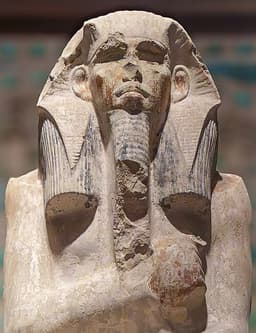
Djoser
Emperor · Ancient
54.0Total

Nectanebo II
Emperor · Ancient
45.5Total
Basic Information
Born
-2670
-360
Died
-2640
-343
Era
Ancient
Ancient
Nationality
Egypt
Egypt
Occupation
Emperor
Emperor
Civilization
Middle Eastern
Middle Eastern
Score Comparison
Military (10%)
10.2
25.0
Political (20%)
68.0
39.4
Influence (20%)
55.0
51.0
Legacy (20%)
55.0
44.2
Leadership (15%)
72.0
48.4
Strategy (15%)
45.0
60.0
TOTAL
54.0
45.5
Djoser — Complete Timeline
2670 BC
Construction of the Step Pyramid at SaqqaraCultural
Djoser commissioned his vizier Imhotep to build a step pyramid at Saqqara, the first monumental stone building in history. The pyramid, a six-tiered structure, served as Djoser's tomb and marked a revolutionary advance in architecture and engineering.
PyramidArchitectureImhotep
Impact: globalconstructive
Nectanebo II — Complete Timeline
350 BC
Suppression of the revolt in the DeltaWar
Nectanebo II suppressed a revolt in the Nile Delta led by local chieftains. The rebellion threatened his authority and required military action to restore order. This event highlighted the internal challenges facing Egypt during his reign.
RevoltDeltaInternal Conflict
Impact: national
Construction of the temple of EdfuCultural◆ Major
Nectanebo II began the construction of the temple of Horus at Edfu, one of the best-preserved temples in Egypt. The temple was completed during the Ptolemaic period. This project demonstrated his commitment to traditional Egyptian religion and architecture.
TempleEdfuArchitecture
Impact: regionalconstructive
343 BC
Battle of Pelusium (343 BC)War◆ Major
Nectanebo II's army was defeated by the Persian forces under Artaxerxes III at Pelusium. The Persians used a superior military strategy and siege tactics. This defeat led to the fall of Egypt to the Achaemenid Empire for the second time, ending native Egyptian rule.
PersiaConquestBattle
Impact: globaltragic
Flight to NubiaPolitical Action◆ Major
After the Persian conquest, Nectanebo II fled to Nubia (Kush) where he continued to resist Persian rule. He may have maintained a court in exile and attempted to rally support for a counter-invasion. His flight marked the end of the last native Egyptian dynasty.
ExileNubiaResistance
Impact: regionaltragic
Expert Analysis
Origins
Djoser, a pharaoh of the Third Dynasty (c. 2670 BCE), was the son of Khasekhemwy and Queen Nimaathap. He inherited a unified Egypt and ruled from Memphis. His reign marked a shift from mudbrick mastabas to stone architecture, driven by his vizier Imhotep. Djoser's early life is obscure, but his royal lineage positioned him as a consolidator of the early dynastic state.
Nectanebo II, born around 380 BCE, was the last native Egyptian pharaoh, ruling from 360 to 343 BCE. He was a descendant of Nectanebo I, founder of the 30th Dynasty. His family hailed from Sebennytos in the Delta. He seized power after his predecessor Teos' failed campaign in Phoenicia. His upbringing was steeped in the military and political turmoil of a declining Egypt, threatened by the Achaemenid Empire.
Rise to Power
Djoser's rise was straightforward: he inherited the throne from his father, Khasekhemwy, who had reunified Egypt after civil strife. Djoser's legitimacy was unquestioned, and he focused on monumental building. His key ally was Imhotep, a polymath who designed the Step Pyramid. This collaboration elevated Djoser's status as a divine builder.
Nectanebo II's ascent was more turbulent. He was a general under Pharaoh Teos, who launched a campaign against Persia. While Teos was in Phoenicia, Nectanebo II was persuaded by the priestly faction to rebel. He returned to Egypt, proclaimed himself pharaoh in 360 BCE, and forced Teos into exile. This coup was supported by the military and clergy, but it alienated the Spartan allies who had aided Teos. Nectanebo II's political score of 39.4 reflects his struggle to maintain power amid internal and external threats.
Leadership & Governance
Djoser's leadership score of 72.0 reflects his effective delegation. He empowered Imhotep to oversee the Step Pyramid project, a massive state endeavor that required organizing labor, quarrying stone, and managing logistics. Djoser's governance was centralized, with the pharaoh as divine intermediary. He likely conducted military campaigns in Sinai, but his primary focus was religious and architectural innovation. His political score of 68.0 indicates stable rule.
Nectanebo II's leadership score of 48.4 and political score of 39.4 show his weaker control. He faced a revolt in the Delta early in his reign, which he suppressed with force. He also invested in temple building, notably the Temple of Edfu, to gain priestly support. However, his military strategy score of 60.0 highlights his competence in defense. He fortified the eastern frontier and allied with Greek mercenaries. Despite this, his reign was plagued by Persian aggression and internal dissent.
Triumph & Tragedy
Djoser's greatest triumph was the Step Pyramid at Saqqara, the first colossal stone structure, standing 62 meters tall. It revolutionized Egyptian architecture and symbolized the pharaoh's divine power. His tragedy is the lack of recorded military or political expansion; his influence was confined to Egypt's borders. His legacy score of 55.0 reflects this.
Nectanebo II's triumph was his initial success in repelling Persian invasions. In 351 BCE, he defeated Artaxerxes III's attempt to reconquer Egypt. He also began the Temple of Edfu, one of the best-preserved temples, showing his patronage of religion. His tragedy was the final defeat at the Battle of Pelusium in 343 BCE, where Persian forces, with Greek mercenaries and superior siege tactics, overwhelmed his army. He fled to Nubia, where he lived in exile, the last native pharaoh. His legacy score of 44.2 is lower due to Egypt's subsequent loss of independence.
Character & Destiny
Djoser is depicted in historical records as a wise and pious ruler, though few personal details survive. His decision to build with stone rather than mudbrick was visionary. His character, combined with Imhotep's genius, shaped Egypt's monumental age. His destiny was to be remembered as a founder of pyramid building.
Nectanebo II was a capable but desperate ruler. He was pragmatic, using propaganda and religion to legitimize his rule. His flight to Nubia shows resilience, but his inability to unite Egypt against Persia sealed his fate. Historical assessments note his military skill but political isolation. He scored 25.0 in military, lower than Djoser's 10.2, but his strategic score of 60.0 reflects his defensive planning.
Legacy
Djoser's legacy is monumental. The Step Pyramid influenced all later pyramids, and his reign set a precedent for state-sponsored construction. He is remembered as the pharaoh who introduced stone architecture, with a legacy score of 55.0. His tomb remains a tourist attraction, and Imhotep was later deified.
Nectanebo II's legacy is that of the last native pharaoh. He became a figure of resistance, and later folklore (like the Alexander Romance) mythologized him as a magician. His temple at Edfu was completed by the Ptolemies, preserving Egyptian religious traditions. However, his political failure led to Persian and then Greek domination. His legacy score of 44.2 reflects his role as a tragic end to an era.
Conclusion
Djoser had a greater impact on Egyptian history. His total score of 54.0 vs Nectanebo II's 45.5 reflects his foundational role. While Nectanebo II fought to preserve Egypt's independence, Djoser's innovations in architecture and statecraft shaped Egypt for millennia. Djoser's leadership score of 72.0 and political score of 68.0 enabled lasting achievements, whereas Nectanebo II's higher military score (25.0 vs 10.2) could not prevent Egypt's fall. Djoser's legacy is tangible and enduring; Nectanebo II's is a poignant footnote. Thus, Djoser is the more significant figure.
Rankings
🥇
DjoserLeader
Mil: 10.2Pol: 68.0Inf: 55.0
54.0
🥈
Nectanebo II
Mil: 25.0Pol: 39.4Inf: 51.0
45.5
+8.5 behind
How This Comparison Works
Algorithm
Each figure is scored on 6 dimensions (0—100 scale) based on structured historical data: Military (10%), Political (20%), Influence (20%), Legacy (20%), Leadership (15%), Strategy (15%). The weighted total produces the final ranking.
Data Sources
Scores are computed from structured sub-indicators in the database. Scale factors adjust for era (Ancient ×0.85, Modern ×1.0) and civilization size (Eastern ×1.05, Other ×0.80) to account for differences in population and military scale.
Maximum 3 Figures
Comparisons are limited to 2—3 figures to ensure readability and statistical meaningfulness.
Error Margins
±5 points per dimension — Sub-scores are derived from historical records with inherent uncertainty. Two figures within 5 points on a dimension should be considered roughly equivalent in that area.
Total Score Accuracy
±3 points overall — The weighted combination of 6 dimensions produces a total score with approximately ±3 points of uncertainty. Differences of less than 3 points are not statistically significant— the figures are effectively tied.
Known Limitations
- Historical records are incomplete and uneven across civilizations
- Figures from oral-tradition societies may be underrepresented
- Occupation labels can misclassify multi-role figures
- Scores measure capability and impact, not moral character
- Quantitative scoring is a comparison tool, not absolute truth
Capability Radar
Military (10%) — Battles & Warfare
Battles
5
45
Win Rate
5
40
Expansion
5
20
Political (20%) — Governance & Reform
Reform
70
30
Diplomacy
50
40
Economy
60
35
Influence (20%) — Cultural & Global Reach
Cultural
80
40
Global
70
25
Legacy (20%) — Historical Impact
Historical
80
45
Longevity
80
30
Leadership (15%) — Power & Stability
Tenure
60
35
Stability
70
25
Strategy (15%) — Tactics & Innovation
Strategy
5
55
Tactics
5
50
Reform
5
30
Similar Comparisons
Comments & Discussion
No comments yet. Be the first to share your thoughts!