Loading...
Du Yu vs Napoleon Bonaparte
Napoleon Bonaparte leads by 14.1 pts · 2 figures compared
…
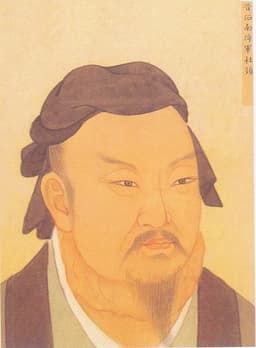
Du Yu
General · Ancient
56.8Total

Napoleon Bonaparte
General · Modern
70.9Total
Basic Information
Born
222
1769
Died
285
1821
Era
Ancient
Modern
Nationality
China
France
Occupation
General
General
Civilization
Eastern
Western
Score Comparison
Military (10%)
77.5
94.0
Political (20%)
43.7
72.0
Influence (20%)
53.3
40.0
Legacy (20%)
47.5
80.0
Leadership (15%)
65.0
78.0
Strategy (15%)
75.0
90.0
TOTAL
56.8
70.9
Du Yu — Complete Timeline
279 AD
Appointed as commander of the Jin invasion of WuPolitical Action◆ Major
Du Yu was appointed as the overall commander of the Jin forces for the invasion of Eastern Wu, following Yang Hu's recommendation. He was given command of the central army group.
Jin DynastyEastern WuMilitary Command
Impact: nationalconstructive
280 AD
Led the conquest of Eastern WuWar
Du Yu's forces captured key Wu cities, including Jiangling, and advanced toward the Wu capital Jianye. The campaign culminated in the surrender of Wu's emperor Sun Hao, ending the Three Kingdoms period.
Conquest of WuJin DynastyUnification
Impact: globalconstructive
Authored the 'Commentary on the Spring and Autumn Annals'Cultural◆ Major
Du Yu wrote a comprehensive commentary on the Confucian classic 'Spring and Autumn Annals', which became a standard reference for later scholars. His work influenced Chinese historiography.
ScholarshipConfucianismHistoriography
Impact: nationalconstructive
Napoleon Bonaparte — Complete Timeline
1799 AD
Coup of 18 BrumaireOther◆ Major
Napoleon Bonaparte, with support from his brother Lucien and key political figures, overthrew the Directory in a bloodless coup. He established the Consulate with himself as First Consul, effectively becoming the ruler of France. This event ended the French Revolution's most unstable period.
French RevolutionCoupRise to Power
Impact: regional
1804 AD
Promulgation of the Napoleonic CodeOther◆ Major
Napoleon enacted the Civil Code of the French, known as the Napoleonic Code, a comprehensive set of laws that replaced the fragmented feudal legal systems. The code established legal equality, protected property rights, and secularized law. It became the basis for legal systems in many European and world countries.
Legal ReformNapoleonic CodeCivil Law
Impact: globalconstructive
1805 AD
Battle of AusterlitzWar◆ Major
Napoleon's Grande Arm
Napoleonic WarsBattleDecisive Victory
Impact: global
1812 AD
Invasion of RussiaWar◆ Major
Napoleon led the Grande Arm
Napoleonic WarsInvasionDisaster
Impact: globaldestructive
1815 AD
Battle of WaterlooWar◆ Major
Napoleon's French army was defeated by the combined forces of the Duke of Wellington's Anglo-Allied army and Gebhard Leberecht von Bl
Napoleonic WarsBattleFinal Defeat
Impact: globaldestructive
Expert Analysis
du-yu-vs-napoleon-bonaparte
# The Conqueror and the Scholar-General
In the winter of 1812, Napoleon Bonaparte watched his Grand Army burn Moscow, only to watch it freeze on the retreat westward. Just over fifteen hundred years earlier, in the spring of 280, Du Yu stood at the gates of Jianye, the capital of Eastern Wu, having completed a campaign so swift and surgical that it barely registered as a war. One man conquered an empire and lost it; the other conquered an empire and went home to write a book. What separates these two fates is not merely time and geography, but something deeper about the nature of ambition itself.
Origins
Napoleon was born in 1769 on the island of Corsica, a place that had only recently become French. His family was minor nobility, poor enough to feel the sting of class but proud enough to resent it. The French Revolution shattered the old order and created a vacuum that a young artillery officer with a hunger for glory could fill. Corsica’s rocky soil and revolutionary chaos taught him that the world was there to be taken.
Du Yu was born in 222, in the twilight of the Han dynasty, when China had already fractured into three warring kingdoms. His family belonged to the scholar-official class that had governed China for centuries. His grandfather served as a minister; his father died young. Du Yu grew up surrounded by books and bureaucratic tradition, not battlefield smoke. The Wei dynasty, and later the Jin, valued men who could write edicts as well as they could read maps.
The difference in their origins is not just one of geography but of worldview. Napoleon saw history as a stage for individual will. Du Yu saw it as a pattern to be understood.
Rise to Power
Napoleon’s rise was meteoric and theatrical. In 1793, at age twenty-four, he recaptured Toulon from royalist rebels and British forces, earning a promotion to brigadier general. By 1796, he commanded the Army of Italy and turned a ragged force into a legend, smashing Austrian armies and dictating peace terms. His 1798 Egyptian campaign was a disaster in military terms—his fleet was destroyed at the Nile—but a masterpiece of propaganda. He returned to France in 1799, overthrew the Directory in the coup of 18 Brumaire, and made himself First Consul. By 1804, he crowned himself Emperor.
Du Yu’s rise was slower and less dramatic. He served as a civil official under the Wei dynasty, then under the Jin after the Sima clan seized power. He was known not for battlefield brilliance but for administrative competence and strategic advice. In 279, at age fifty-seven, he was appointed commander of the Jin invasion of Eastern Wu—not because he was the obvious choice, but because the previous general, Yang Hu, had recommended him. Du Yu had spent decades preparing for this moment, not through glory-seeking but through study.
Leadership & Governance
Napoleon governed like he fought: with energy, speed, and a willingness to break anything that resisted. His Napoleonic Code standardized French law and influenced legal systems across Europe. He reformed education, established the Bank of France, and built roads and canals. But he also centralized power absolutely, suppressed dissent, and treated conquered territories as resources to be exploited. His military genius—scored at 94—was undeniable: he won over sixty battles, from Austerlitz in 1805 to Jena in 1806. But his political score of 75 reflects a ruler who could not stop fighting long enough to consolidate.
Du Yu governed like he wrote: with precision, patience, and a respect for tradition. His conquest of Eastern Wu in 280 was not a series of dramatic battles but a coordinated campaign of sieges and advances. He captured Jiangling, cut off Wu’s supply lines, and marched on Jianye. The Wu emperor surrendered without a major pitched battle. Du Yu’s military score of 79.8 is modest compared to Napoleon’s, but his leadership score of 80.9 is nearly identical. He led by planning, not by charisma.
Triumph & Tragedy
Napoleon’s greatest triumph was Austerlitz in 1805, where he destroyed a larger Russo-Austrian army and forced the Holy Roman Empire to dissolve. His greatest tragedy was the 1812 invasion of Russia, where he lost over 400,000 men to winter, hunger, and guerrilla attacks. He was exiled to Elba in 1814, returned in 1815 for the Hundred Days, and was finally defeated at Waterloo. He died in 1821 on Saint Helena, a prisoner.
Du Yu’s greatest triumph was the conquest of Eastern Wu in 280, which unified China under the Jin dynasty. His greatest tragedy is that he is barely remembered outside of Chinese historiography. He did not die in exile or on a battlefield. He died in 285, at home, having completed his *Commentary on the Spring and Autumn Annals*, a work that became a standard reference for Confucian scholars. His legacy score of 68.3 reflects the quiet fate of a man who succeeded without drama.
Character & Destiny
Napoleon was driven by an insatiable hunger for glory. “I am not a man,” he once said, “I am a thing—a force.” He believed that history was made by great men, and he was determined to be the greatest. That belief gave him the energy to conquer Europe but also the blindness to see his own limits. He could not stop. He could not compromise. He could not share power.
Du Yu was driven by a sense of duty and order. He understood that a successful campaign required preparation, not heroism. He understood that a conquered kingdom needed to be governed, not looted. He understood that a scholar’s work could outlast an emperor’s glory. His personality was suited to his era—a time when China’s unity was fragile and required careful hands.
Legacy
Napoleon’s legacy is immense and contested. He is remembered as a military genius, a reformer, and a tyrant. His name appears on battlefields, codes, and monuments across Europe. His influence score of 82 reflects a man who reshaped the continent.
Du Yu’s legacy is quieter but no less real. His conquest unified China for the Jin dynasty, which lasted another century. His commentary on the *Spring and Autumn Annals* influenced Chinese scholarship for over a thousand years. He is remembered not as a conqueror but as a scholar-general who understood that the pen is mightier than the sword—and that sometimes the sword is best used to clear a path for the pen.
Conclusion
Napoleon and Du Yu represent two poles of human ambition. One wanted to change the world through force; the other wanted to preserve it through wisdom. One ended in exile; the other ended at home. One is a legend; the other is a footnote. But perhaps the footnote contains the deeper lesson: that the most enduring conquests are not the ones that shake the earth, but the ones that steady it.
Rankings
🥇
Napoleon BonaparteLeader
Mil: 94.0Pol: 72.0Inf: 40.0
70.9
🥈
Du Yu
Mil: 77.5Pol: 43.7Inf: 53.3
56.8
+14.1 behind
How This Comparison Works
Algorithm
Each figure is scored on 6 dimensions (0—100 scale) based on structured historical data: Military (10%), Political (20%), Influence (20%), Legacy (20%), Leadership (15%), Strategy (15%). The weighted total produces the final ranking.
Data Sources
Scores are computed from structured sub-indicators in the database. Scale factors adjust for era (Ancient ×0.85, Modern ×1.0) and civilization size (Eastern ×1.05, Other ×0.80) to account for differences in population and military scale.
Maximum 3 Figures
Comparisons are limited to 2—3 figures to ensure readability and statistical meaningfulness.
Error Margins
±5 points per dimension — Sub-scores are derived from historical records with inherent uncertainty. Two figures within 5 points on a dimension should be considered roughly equivalent in that area.
Total Score Accuracy
±3 points overall — The weighted combination of 6 dimensions produces a total score with approximately ±3 points of uncertainty. Differences of less than 3 points are not statistically significant— the figures are effectively tied.
Known Limitations
- Historical records are incomplete and uneven across civilizations
- Figures from oral-tradition societies may be underrepresented
- Occupation labels can misclassify multi-role figures
- Scores measure capability and impact, not moral character
- Quantitative scoring is a comparison tool, not absolute truth
Capability Radar
Military (10%) — Battles & Warfare
Battles
70
95
Win Rate
85
90
Expansion
75
95
Political (20%) — Governance & Reform
Reform
55
95
Diplomacy
60
80
Economy
50
85
Influence (20%) — Cultural & Global Reach
Cultural
40
85
Global
30
90
Legacy (20%) — Historical Impact
Historical
55
95
Longevity
40
90
Leadership (15%) — Power & Stability
Tenure
65
85
Stability
55
70
Strategy (15%) — Tactics & Innovation
Strategy
80
95
Tactics
75
98
Reform
60
92
Similar Comparisons
Comments & Discussion
No comments yet. Be the first to share your thoughts!