Loading...
Duke Zhuang of Zheng vs Napoleon Bonaparte
Napoleon Bonaparte leads by 13.8 pts · 2 figures compared
…
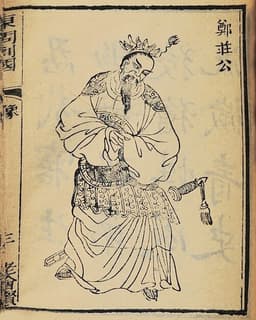
Duke Zhuang of Zheng
Emperor · Ancient
57.1Total

Napoleon Bonaparte
General · Modern
70.9Total
Basic Information
Born
-757
1769
Died
-701
1821
Era
Ancient
Modern
Nationality
Zheng
France
Occupation
Emperor
General
Civilization
Eastern
Western
Score Comparison
Military (10%)
74.7
94.0
Political (20%)
53.8
72.0
Influence (20%)
54.1
40.0
Legacy (20%)
48.3
80.0
Leadership (15%)
66.0
78.0
Strategy (15%)
60.7
90.0
TOTAL
57.1
70.9
Duke Zhuang of Zheng — Complete Timeline
707 BC
Battle of XugeWar
Duke Zhuang of Zheng defeated the Zhou royal army led by King Huan at Xuge. This battle shattered the prestige of the Zhou king, as a feudal lord openly defeated the Son of Heaven. Duke Zhuang became the first hegemon of the Spring and Autumn period.
Spring and AutumnZhengZhou Defeat
Impact: national
701 BC
Zheng succession crisisPolitical Action◆ Major
After Duke Zhuang's death, his sons fought over the succession, plunging Zheng into civil war. The state's power declined rapidly as internal strife allowed other states like Qi to rise as hegemons.
ZhengSuccession WarDecline
Impact: regionaldestructive
Napoleon Bonaparte — Complete Timeline
1799 AD
Coup of 18 BrumaireOther◆ Major
Napoleon Bonaparte, with support from his brother Lucien and key political figures, overthrew the Directory in a bloodless coup. He established the Consulate with himself as First Consul, effectively becoming the ruler of France. This event ended the French Revolution's most unstable period.
French RevolutionCoupRise to Power
Impact: regional
1804 AD
Promulgation of the Napoleonic CodeOther◆ Major
Napoleon enacted the Civil Code of the French, known as the Napoleonic Code, a comprehensive set of laws that replaced the fragmented feudal legal systems. The code established legal equality, protected property rights, and secularized law. It became the basis for legal systems in many European and world countries.
Legal ReformNapoleonic CodeCivil Law
Impact: globalconstructive
1805 AD
Battle of AusterlitzWar◆ Major
Napoleon's Grande Arm
Napoleonic WarsBattleDecisive Victory
Impact: global
1812 AD
Invasion of RussiaWar◆ Major
Napoleon led the Grande Arm
Napoleonic WarsInvasionDisaster
Impact: globaldestructive
1815 AD
Battle of WaterlooWar◆ Major
Napoleon's French army was defeated by the combined forces of the Duke of Wellington's Anglo-Allied army and Gebhard Leberecht von Bl
Napoleonic WarsBattleFinal Defeat
Impact: globaldestructive
Expert Analysis
duke-zhuang-of-zheng-vs-napoleon-bonaparte
# The Conqueror and the Consolidator
In the summer of 1805, Napoleon Bonaparte stood before his Grande Armée at Boulogne, ready to invade England. Across the Channel, no one doubted that this Corsican artilleryman—now Emperor of the French—might succeed where Philip II and Louis XIV had failed. More than twenty-five centuries earlier and half a world away, another ruler faced a different kind of test. Duke Zhuang of Zheng, a minor noble in the crumbling Zhou dynasty, had just done the unthinkable: he defeated the Son of Heaven himself at the Battle of Xuge in 707 BCE, shattering the mystical authority that had held China together for four centuries. Both men broke the old rules. But while Napoleon’s ambition consumed everything it touched, Duke Zhuang’s restraint built something that outlasted him—at least for a time.
Origins
Napoleon was born in 1769 on Corsica, an island that had passed from Italian to French control only a year earlier. His family were minor nobles, proud and poor, speaking Italian at home and learning French as a foreign language. The French Revolution, which erupted when he was twenty, offered a path that would never have existed under the old monarchy. Talent, not birth, now determined rank. Napoleon seized this opening with both hands.
Duke Zhuang of Zheng emerged from a very different world. He was born in 757 BCE, during the Spring and Autumn period of Chinese history, when the Zhou dynasty still nominally ruled but real power had fragmented among dozens of feudal states. Zheng was not a great power—it was a medium-sized state wedged between the giant kingdoms of Qi, Chu, and Jin. Duke Zhuang inherited a precarious position and a tradition of careful diplomacy from his father, Duke Wu. Where Napoleon grew up in an era that rewarded audacity, Duke Zhuang came of age in a world that prized patience.
Rise to Power
Napoleon’s ascent was meteoric. At twenty-four, he drove the British from Toulon. At twenty-six, he saved the revolutionary government from a royalist uprising. At twenty-seven, he conquered Italy. Each victory was a stepping stone, and he calculated each step with cold precision. By 1804, he crowned himself Emperor, not because he had inherited a throne, but because he had earned one through sheer will and military genius. His political score of 75.0 reflects a man who understood power but never fully mastered the art of keeping it.
Duke Zhuang’s rise was slower and more subtle. He spent his early reign consolidating Zheng’s position through alliances and marriages, avoiding the kind of dramatic confrontations that might destroy his state. His military score of 63.7 is modest by Napoleon’s standards, but it misses the point. Duke Zhuang’s strategy was not to conquer but to survive and influence. When he finally fought the Zhou royal army at Xuge in 707 BCE, he did not seek to destroy the king—only to humble him. After the victory, he let King Huan withdraw. He understood that breaking the Zhou dynasty entirely would create a vacuum far more dangerous than a weakened emperor.
Leadership & Governance
Napoleon governed as he conquered: with energy, brilliance, and an insatiable hunger for control. His Napoleonic Code reformed French law, standardizing justice across the nation and influencing legal systems worldwide. He built schools, roads, and canals. He made peace with the Catholic Church after the Revolution’s anti-clerical excesses. But he also centralized power to a degree that stifled local initiative, and his constant wars drained France of men and treasure. His leadership score of 80.0 and political score of 75.0 tell a story of a ruler who could inspire devotion but could never tolerate equals.
Duke Zhuang governed as a hegemon, not a tyrant. He maintained order among the smaller states of the central plain, acting as a mediator and protector. His leadership score of 86.0—higher than Napoleon’s—reflects a style based on consensus and respect rather than fear. He did not impose his will through constant war; he built coalitions. He understood that in a world of many competing states, the key to power was not destroying rivals but making them dependent on you. His political score of 81.0, higher than Napoleon’s, shows a ruler who mastered the art of managing people and institutions.
Triumph & Tragedy
Napoleon’s greatest moment was Austerlitz in 1805, where he destroyed the combined armies of Austria and Russia in a single day of tactical perfection. His worst disaster was the invasion of Russia in 1812, where he lost half a million men to winter, hunger, and guerrilla attacks. He never recovered from that blow. Exiled to Elba in 1814, he escaped and ruled for a Hundred Days before Waterloo ended his ambitions forever in 1815. He died in 1821 on Saint Helena, a prisoner, still dreaming of glory.
Duke Zhuang’s triumph was more subtle but more lasting. He made Zheng the first hegemon of the Spring and Autumn period, a position of influence that did not require formal empire. His tragedy came after his death in 701 BCE. His sons fought a bitter civil war over the succession, plunging Zheng into chaos. Within a generation, the state he had built fell apart, consumed by the very powers he had so carefully balanced. His legacy score of 69.6 is lower than Napoleon’s 78.0, but this is deceptive. Duke Zhuang’s model of hegemony—rule through influence rather than conquest—was adopted by later states like Qi and Jin, who used it to dominate China for centuries.
Character & Destiny
Napoleon was restless, ambitious, and incapable of contentment. “I live only for posterity,” he once said, but he also admitted, “Death is nothing, but to live defeated and without glory is to die every day.” His character drove him to constant action, constant war, constant expansion—until it broke him. He could not stop because stopping meant admitting that his vision was finite.
Duke Zhuang was cautious, calculating, and patient. He understood that power was not a prize to be seized but a relationship to be maintained. His character suited his era, an age when the greatest danger was not defeat in battle but the collapse of the entire political order. He built a system that worked while he lived, but he could not make it survive him. That was the tragedy not just of Duke Zhuang but of the Spring and Autumn period itself, where no state was strong enough to unify China.
Legacy
Napoleon is remembered as one of history’s greatest generals, a lawgiver, and a cautionary tale about the limits of ambition. His name appears on battlefields, codes, and legends across the world. His total score of 82.4 reflects a figure of immense impact, both for good and for ill.
Duke Zhuang is less famous outside China, but within Chinese history, he is remembered as the first hegemon, the ruler who showed that a medium-sized state could shape events without conquering the world. His total score of 72.8 is lower, but it measures a different kind of greatness—the greatness of the consolidator, the builder, the one who holds things together rather than tearing them apart.
Conclusion
Napoleon and Duke Zhuang faced the same fundamental question: what do you do when the old order crumbles? Napoleon answered by trying to build a new order on the ruins of the old, with himself at its center. Duke Zhuang answered by propping up the old order, using its authority to advance his own interests. One sought to conquer the world; the other sought to manage it. Both failed in the end—Napoleon on a distant island, Duke Zhuang in a succession crisis that undid everything he had built. But their failures teach us something about the nature of power itself. It is not enough to win battles. You must also know when to stop fighting.
Rankings
🥇
Napoleon BonaparteLeader
Mil: 94.0Pol: 72.0Inf: 40.0
70.9
🥈
Duke Zhuang of Zheng
Mil: 74.7Pol: 53.8Inf: 54.1
57.1
+13.8 behind
How This Comparison Works
Algorithm
Each figure is scored on 6 dimensions (0—100 scale) based on structured historical data: Military (10%), Political (20%), Influence (20%), Legacy (20%), Leadership (15%), Strategy (15%). The weighted total produces the final ranking.
Data Sources
Scores are computed from structured sub-indicators in the database. Scale factors adjust for era (Ancient ×0.85, Modern ×1.0) and civilization size (Eastern ×1.05, Other ×0.80) to account for differences in population and military scale.
Maximum 3 Figures
Comparisons are limited to 2—3 figures to ensure readability and statistical meaningfulness.
Error Margins
±5 points per dimension — Sub-scores are derived from historical records with inherent uncertainty. Two figures within 5 points on a dimension should be considered roughly equivalent in that area.
Total Score Accuracy
±3 points overall — The weighted combination of 6 dimensions produces a total score with approximately ±3 points of uncertainty. Differences of less than 3 points are not statistically significant— the figures are effectively tied.
Known Limitations
- Historical records are incomplete and uneven across civilizations
- Figures from oral-tradition societies may be underrepresented
- Occupation labels can misclassify multi-role figures
- Scores measure capability and impact, not moral character
- Quantitative scoring is a comparison tool, not absolute truth
Capability Radar
Military (10%) — Battles & Warfare
Battles
65
95
Win Rate
70
90
Expansion
55
95
Political (20%) — Governance & Reform
Reform
55
95
Diplomacy
75
80
Economy
60
85
Influence (20%) — Cultural & Global Reach
Cultural
45
85
Global
40
90
Legacy (20%) — Historical Impact
Historical
60
95
Longevity
50
90
Leadership (15%) — Power & Stability
Tenure
70
85
Stability
65
70
Strategy (15%) — Tactics & Innovation
Strategy
65
95
Tactics
60
98
Reform
40
92
Similar Comparisons
Comments & Discussion
DukeDestroyer6/17/2026
"Comparing Duke Zhuang to Napoleon is like comparing a tactical scalpel to a strategic sledgehammer. Duke Zhuang's victory at Xuge wasn't just a battlefield win—it was a masterclass in psychological warfare. By wounding King Huan but not killing him, he broke the Zhou mystique while preserving the illusion of order. Napoleon would have marched on to total conquest. Different tools for different worlds."
数据推土机6/17/2026
"这个比较的数据基础简直可笑。拿破仑统治了欧洲超过100万平方公里的领土,直接命令数十万大军。郑庄公?他的‘霸权’最多就是统治了几个县城的联盟,连个正经的官僚体系都没有。拿战国早期的城邦首领比近代帝国皇帝,这不叫历史比较,这叫企鹅比秃鹰。"
TogasAndTactics6/17/2026
"The real story here isn't battles—it's legitimacy. Napoleon crowned himself emperor in Notre Dame, hijacking both revolutionary and imperial symbols. Duke Zhuang, during the Battle at Xuge, faced the Zhou king directly—a high-stakes move that could have destroyed him if he'd overreached. By merely wounding the king and stopping hostilities, he secured de facto autonomy without provoking a holy war. That's not just restraint—that's genius."
风月史官6/17/2026
"读史至此,我倒觉得两人真正的分水岭不在战场而在身后。拿破仑流放圣赫勒拿,帝国崩溃,遗骸最终回到荣军院——却成了法国精神的象征。郑庄公呢?他死后二十年,郑国内乱,霸权烟消云散。一个留下神话,一个留下废墟。谁的遗产更重?恐怕取决于你更相信力量还是秩序。"
BrassTacksBuff6/17/2026
"Cut the romanticism. Duke Zhuang might be impressive for 700 BCE, but his 'military achievements' are skirmishes without logistics chains or national mobilization. Napoleon transformed warfare with corps systems, permanent commands, and meritocratic advancement. The Battle of Xuge involved maybe 20,000 men tops. Austerlitz had 73,000 under one commander who could coordinate across days of maneuvers. Apples and war-axes."