Loading...
Eannatum vs Napoleon Bonaparte
Napoleon Bonaparte leads by 11.2 pts · 2 figures compared
…
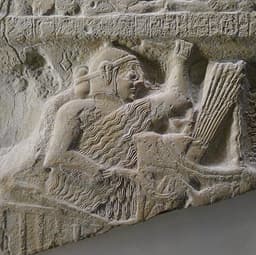
Eannatum
Emperor · Ancient
59.7Total

Napoleon Bonaparte
General · Modern
70.9Total
Basic Information
Born
-2450
1769
Died
-2400
1821
Era
Ancient
Modern
Nationality
Lagash
France
Occupation
Emperor
General
Civilization
Middle Eastern
Western
Score Comparison
Military (10%)
61.7
94.0
Political (20%)
68.0
72.0
Influence (20%)
56.4
40.0
Legacy (20%)
56.0
80.0
Leadership (15%)
68.0
78.0
Strategy (15%)
50.0
90.0
TOTAL
59.7
70.9
Eannatum — Complete Timeline
2450 BC
Victory over Umma at the Boundary CanalWar◆ Major
Eannatum defeated the forces of Umma in a battle near the boundary canal between Lagash and Umma. The victory was commemorated on the Stele of the Vultures, which shows vultures carrying away the heads of the defeated. This established Lagash's dominance over Umma.
BattleUmmaLagash
Creation of the Stele of the VulturesCultural
Eannatum, king of Lagash, commissioned the Stele of the Vultures, the first known historical document. The stele depicts his victory over Umma and records the boundary treaty between the two city-states. It is a key source for early Sumerian warfare and diplomacy.
Historical DocumentSteleSumerian Art
Impact: global
2440 BC
Subjugation of Elam and SubartuWar
Eannatum campaigned against Elam and Subartu, extending Lagash's influence beyond Sumer. Inscriptions record his victories and the tribute he exacted from these regions. This expansion made Lagash a major power in Mesopotamia during his reign.
Military CampaignElamSubartu
Impact: regional
Napoleon Bonaparte — Complete Timeline
1799 AD
Coup of 18 BrumaireOther◆ Major
Napoleon Bonaparte, with support from his brother Lucien and key political figures, overthrew the Directory in a bloodless coup. He established the Consulate with himself as First Consul, effectively becoming the ruler of France. This event ended the French Revolution's most unstable period.
French RevolutionCoupRise to Power
Impact: regional
1804 AD
Promulgation of the Napoleonic CodeOther◆ Major
Napoleon enacted the Civil Code of the French, known as the Napoleonic Code, a comprehensive set of laws that replaced the fragmented feudal legal systems. The code established legal equality, protected property rights, and secularized law. It became the basis for legal systems in many European and world countries.
Legal ReformNapoleonic CodeCivil Law
Impact: globalconstructive
1805 AD
Battle of AusterlitzWar◆ Major
Napoleon's Grande Arm
Napoleonic WarsBattleDecisive Victory
Impact: global
1812 AD
Invasion of RussiaWar◆ Major
Napoleon led the Grande Arm
Napoleonic WarsInvasionDisaster
Impact: globaldestructive
1815 AD
Battle of WaterlooWar◆ Major
Napoleon's French army was defeated by the combined forces of the Duke of Wellington's Anglo-Allied army and Gebhard Leberecht von Bl
Napoleonic WarsBattleFinal Defeat
Impact: globaldestructive
Expert Analysis
eannatum-vs-napoleon-bonaparte
# The Emperor and the King: Napoleon and Eannatum, Two Faces of Conquest
On a June evening in 1815, Napoleon Bonaparte stood on a muddy field near Waterloo, watching his Imperial Guard march into cannon fire for the last time. Nearly four thousand years earlier, another conqueror—Eannatum of Lagash—had ordered his scribes to carve into stone the first known record of war, a stele showing vultures tearing at the flesh of his enemies. Both men sought to etch their names into eternity. One failed and died in exile; the other succeeded so completely that his monument survives as humanity’s oldest historical document. What separates a legend from a footnote?
Origins
Napoleon was born in 1769 on the Mediterranean island of Corsica, a territory only recently annexed by France. His family belonged to the minor nobility—impoverished, proud, and resentful of French rule. Young Napoleone Buonaparte spoke Italian before French, and his childhood was shaped by the tension between provincial loyalty and imperial ambition. The French Revolution, which erupted when he was twenty, shattered the old order and opened paths that birth alone could never have granted.
Eannatum, by contrast, was born into the pinnacle of power around 2450 BCE in the city-state of Lagash, in what is now southern Iraq. He was a king’s son in a world where kings were gods’ representatives on earth. Sumer was a patchwork of warring city-states—Lagash, Umma, Ur, Uruk—each claiming divine favor, each irrigating the same narrow strip between the Tigris and Euphrates. Eannatum’s inheritance was not a revolution but a tradition: the duty to expand Lagash’s borders and appease its patron deity, Ningirsu.
Rise to Power
Napoleon’s ascent was a masterpiece of opportunism. As a young artillery officer, he distinguished himself at the Siege of Toulon in 1793, then crushed a royalist uprising in Paris with a “whiff of grapeshot” in 1795. By 1796, at twenty-six, he commanded the Army of Italy, where his lightning campaigns forced Austria to the negotiating table. Each victory was a stepping stone; each defeat—and there were few—a lesson. He understood that in revolutionary France, merit mattered more than lineage, and he wielded that truth like a sword.
Eannatum’s path was more straightforward but no less bloody. He inherited a throne, but he had to prove himself worthy of it. Sumerian kings were judged by their ability to protect and expand their city’s territory. The primary threat was Umma, Lagash’s perennial rival over the fertile boundary canal. In a battle near that canal around 2450 BCE, Eannatum led his army to victory, a triumph he later commemorated on the Stele of the Vultures. The stele shows him marching at the head of phalanx-like infantry—possibly the earliest depiction of disciplined formation warfare.
Leadership & Governance
Napoleon ruled with a blend of charisma, terror, and bureaucratic genius. His Napoleonic Code standardized French law, abolished feudal privileges, and established merit-based promotion. He created the Bank of France, reformed education, and negotiated the Concordat with the Catholic Church. Yet his governance was also autocratic: he suppressed dissent, censored the press, and crowned himself emperor in 1804. His military strategy—rapid marches, decisive battles, exploitation of interior lines—redefined warfare. At Austerlitz in 1805, he destroyed a larger Russo-Austrian army with a feigned retreat that remains a textbook maneuver.
Eannatum governed in a world without written law codes as we know them. His authority derived from religion and military prowess. The Stele of the Vultures records not only his victory but also the oath he imposed on Umma’s leaders, sworn before the gods, to respect the boundary. He extended Lagash’s influence far beyond Sumer, campaigning against Elam (in modern western Iran) and Subartu (in northern Mesopotamia). Inscriptions boast that he “subjugated” these lands, though the nature of that control was likely tributary rather than administrative. His governance was personal, ritualistic, and brutal by modern standards—the stele shows enemy dead being devoured by vultures.
Triumph & Tragedy
Napoleon’s greatest triumph was the Empire at its height in 1810-1811, when he controlled most of continental Europe. His greatest tragedy was the invasion of Russia in 1812. He marched with over 600,000 men; fewer than 100,000 returned. The disaster shattered his aura of invincibility and led to his first abdication in 1814. His return from exile on Elba in 1815—the Hundred Days—was a final, desperate gamble. Waterloo was a close-run thing, but it ended with his second abdication and exile to Saint Helena, where he died in 1821 at age fifty-one.
Eannatum’s triumphs were recorded in stone but lost to history’s broader narrative. He died around 2400 BCE, likely in his fifties, possibly in battle or from natural causes. The Stele of the Vultures survived his death by millennia, only to be shattered in antiquity. Its fragments were discovered in the 1880s at Tell Telloh (ancient Girsu). What remains is a partial record: we know he won battles, imposed oaths, and extended Lagash’s power. But we do not know if he faced a catastrophic defeat, a rebellion, or a quiet end. His tragedy is the silence of time.
Character & Destiny
Napoleon was restless, brilliant, and insatiable. “Power is my mistress,” he once said. He slept four hours a night, dictated multiple letters simultaneously, and believed he could shape history through sheer will. That confidence drove him to conquer Europe—and to overreach. His personality was a double-edged sword: the same ambition that made him emperor also made him unable to stop, to consolidate, to accept limits. His destiny was to rise higher than any man of his era and to fall further.
Eannatum is harder to read. The Stele of the Vultures shows a king who wanted to be remembered. He had his victories inscribed, his enemies named, his gods thanked. He understood that power required documentation. But his personality remains opaque—a figure of bronze and stone, not flesh and blood. His destiny was to be the first, but not the greatest. He founded a tradition of recorded history, but his own story is fragmentary.
Legacy
Napoleon’s legacy is everywhere. The Napoleonic Code influenced civil law across Europe and the Americas. His military innovations shaped Clausewitz and Jomini. His name became synonymous with ambition and tragedy. He is remembered as both a liberator who spread revolutionary ideals and a tyrant who drowned them in blood. His scores—Military 94, Political 75, Influence 82—reflect a man who transformed his world, for better and worse.
Eannatum’s legacy is quieter but more fundamental. He created the first historical document: the Stele of the Vultures, now in the Louvre. His scores—Military 63, Political 60, Influence 75—are lower, but they measure a different scale. He did not change the world; he recorded it. In doing so, he began the human project of writing down what we do, so that future generations might know. That is no small thing.
Conclusion
Napoleon and Eannatum stand at opposite ends of history’s arc: one at the dawn of recorded time, the other at the twilight of the age of kings. Napoleon tried to conquer the future and failed; Eannatum tried to preserve the past and succeeded. Both understood that power is fleeting, but memory is not. In the end, the Corsican emperor who shook the world died on a remote island, while the Sumerian king who carved a stone lives on in every history book. Perhaps the truest measure of a conqueror is not how much he takes, but how much he leaves behind.
Rankings
🥇
Napoleon BonaparteLeader
Mil: 94.0Pol: 72.0Inf: 40.0
70.9
🥈
Eannatum
Mil: 61.7Pol: 68.0Inf: 56.4
59.7
+11.2 behind
How This Comparison Works
Algorithm
Each figure is scored on 6 dimensions (0—100 scale) based on structured historical data: Military (10%), Political (20%), Influence (20%), Legacy (20%), Leadership (15%), Strategy (15%). The weighted total produces the final ranking.
Data Sources
Scores are computed from structured sub-indicators in the database. Scale factors adjust for era (Ancient ×0.85, Modern ×1.0) and civilization size (Eastern ×1.05, Other ×0.80) to account for differences in population and military scale.
Maximum 3 Figures
Comparisons are limited to 2—3 figures to ensure readability and statistical meaningfulness.
Error Margins
±5 points per dimension — Sub-scores are derived from historical records with inherent uncertainty. Two figures within 5 points on a dimension should be considered roughly equivalent in that area.
Total Score Accuracy
±3 points overall — The weighted combination of 6 dimensions produces a total score with approximately ±3 points of uncertainty. Differences of less than 3 points are not statistically significant— the figures are effectively tied.
Known Limitations
- Historical records are incomplete and uneven across civilizations
- Figures from oral-tradition societies may be underrepresented
- Occupation labels can misclassify multi-role figures
- Scores measure capability and impact, not moral character
- Quantitative scoring is a comparison tool, not absolute truth
Capability Radar
Military (10%) — Battles & Warfare
Battles
65
95
Win Rate
70
90
Expansion
60
95
Political (20%) — Governance & Reform
Reform
45
95
Diplomacy
50
80
Economy
40
85
Influence (20%) — Cultural & Global Reach
Cultural
55
85
Global
45
90
Legacy (20%) — Historical Impact
Historical
70
95
Longevity
60
90
Leadership (15%) — Power & Stability
Tenure
55
85
Stability
50
70
Strategy (15%) — Tactics & Innovation
Strategy
65
95
Tactics
60
98
Reform
40
92
Similar Comparisons
Comments & Discussion
No comments yet. Be the first to share your thoughts!