Loading...
Edgar Lungu vs Napoleon Bonaparte
Napoleon Bonaparte leads by 26.0 pts · 2 figures compared
…
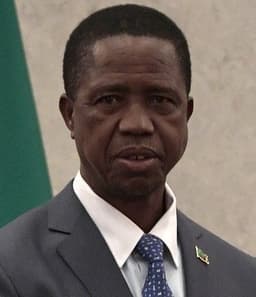
Edgar Lungu
Politician · Modern
44.9Total

Napoleon Bonaparte
General · Modern
70.9Total
Basic Information
Born
1956
1769
Died
—
1821
Era
Modern
Modern
Nationality
Zambia
France
Occupation
Politician
General
Civilization
Other
Western
Score Comparison
Military (10%)
38.0
94.0
Political (20%)
39.4
72.0
Influence (20%)
47.9
40.0
Legacy (20%)
38.3
80.0
Leadership (15%)
62.2
78.0
Strategy (15%)
42.9
90.0
TOTAL
44.9
70.9
Edgar Lungu — Complete Timeline
2015 AD
Elected President of ZambiaPolitical Action◆ Major
Edgar Lungu won the presidential by-election following the death of President Michael Sata. He defeated Hakainde Hichilema in a close race, becoming the 6th President of Zambia.
ElectionPresidency
Impact: national
2016 AD
Re-elected President of ZambiaPolitical Action◆ Major
Lungu won a full five-year term in the general election, again defeating Hakainde Hichilema. The election was marked by opposition allegations of irregularities and a disputed constitutional court ruling.
ElectionPresidency
Impact: national
2017 AD
Arrested Hakainde HichilemaPolitical Action◆ Major
Lungu's government arrested opposition leader Hakainde Hichilema on charges of treason after his convoy failed to give way to the presidential motorcade. Hichilema was held for several months before the charges were dropped.
Political RepressionOpposition
Impact: nationaldestructive
2021 AD
Lost Presidential Election to HichilemaPolitical Action
Lungu was defeated by Hakainde Hichilema in the general election, receiving 38.3% of the vote against Hichilema's 59%. He conceded defeat, marking the first peaceful transfer of power to an opposition candidate in Zambia since 1991.
ElectionDefeatDemocracy
Impact: national
Napoleon Bonaparte — Complete Timeline
1799 AD
Coup of 18 BrumaireOther◆ Major
Napoleon Bonaparte, with support from his brother Lucien and key political figures, overthrew the Directory in a bloodless coup. He established the Consulate with himself as First Consul, effectively becoming the ruler of France. This event ended the French Revolution's most unstable period.
French RevolutionCoupRise to Power
Impact: regional
1804 AD
Promulgation of the Napoleonic CodeOther◆ Major
Napoleon enacted the Civil Code of the French, known as the Napoleonic Code, a comprehensive set of laws that replaced the fragmented feudal legal systems. The code established legal equality, protected property rights, and secularized law. It became the basis for legal systems in many European and world countries.
Legal ReformNapoleonic CodeCivil Law
Impact: globalconstructive
1805 AD
Battle of AusterlitzWar◆ Major
Napoleon's Grande Arm
Napoleonic WarsBattleDecisive Victory
Impact: global
1812 AD
Invasion of RussiaWar◆ Major
Napoleon led the Grande Arm
Napoleonic WarsInvasionDisaster
Impact: globaldestructive
1815 AD
Battle of WaterlooWar◆ Major
Napoleon's French army was defeated by the combined forces of the Duke of Wellington's Anglo-Allied army and Gebhard Leberecht von Bl
Napoleonic WarsBattleFinal Defeat
Impact: globaldestructive
Expert Analysis
edgar-lungu-vs-napoleon-bonaparte
# The Emperor and the Everyman: Two Paths to Power in a World of Difference
On a June morning in 1815, Napoleon Bonaparte stood on a muddy field near Waterloo, watching his imperial guard fall before the red-coated lines of Wellington’s army. Less than two centuries later, on an August evening in 2021, Edgar Lungu sat in a modest house in Lusaka, watching election returns trickle in that would end his presidency. One man had commanded the fate of continents; the other, the hopes of a single southern African nation. What separates these two figures is not merely time or geography, but the entire architecture of how power is seized, held, and lost in radically different eras.
Origins
Napoleon was born in 1769 on the island of Corsica, a place only recently annexed by France. His family was minor nobility, scraping by on modest incomes. The French Revolution, which erupted when he was twenty, shattered the old order and opened doors that would have remained locked in any previous century. A young artillery officer with a gift for mathematics and ambition could rise faster than ever before. Napoleon devoured books on military strategy, absorbed the Enlightenment ideals of merit and law, and watched as the Revolution devoured its own children. He learned early that opportunity comes wrapped in chaos.
Edgar Lungu was born in 1956 in a rural Zambian village, the son of a farmer. His early life was shaped by the twilight of British colonialism and the birth of independent Zambia under Kenneth Kaunda. Lungu studied law, worked as a state advocate, and entered politics in the 1990s, when Zambia had already transitioned to multiparty democracy. His path was not forged in revolution but in the slow, grinding machinery of bureaucratic advancement. Where Napoleon grew up amid cannon fire and regicide, Lungu grew up amid committee meetings and party loyalty.
Rise to Power
Napoleon’s ascent was meteoric. At twenty-four, he drove the British out of Toulon. At twenty-six, he crushed a royalist uprising in Paris with a "whiff of grapeshot." By thirty, he had conquered Italy and Egypt, returning to France in 1799 to overthrow the Directory in a coup d’état. He became First Consul, then Emperor in 1804. His rise was a series of gambles, each one staking everything on the battlefield or in the council chamber. He understood that in revolutionary France, hesitation meant death.
Lungu’s rise was quieter, slower. He served as Minister of Defence, then Minister of Home Affairs, before becoming President in 2015 after the death of Michael Sata. He won a narrow by-election against Hakainde Hichilema, then secured a full term in 2016 amid allegations of irregularities. Lungu never seized power; he inherited it, piece by piece, through the patient accumulation of party support and state patronage. His turning point came not from a brilliant campaign but from the sudden vacancy of the highest office.
Leadership & Governance
Napoleon ruled with a blend of military genius and administrative reform. His 94.0 military score reflects campaigns that rewrote the rules of war—the lightning marches, the crushing of Austrian and Prussian armies, the creation of a continental empire. But he also governed: the Napoleonic Code standardized French law, abolished feudal privileges, and spread meritocratic ideals across Europe. He built roads, reformed education, and centralized the state. Yet his political score of 75.0 reveals the flaw: he could conquer but not consolidate. He alienated potential allies, placed his brothers on thrones where they failed, and refused to compromise.
Lungu governed in a very different key. His military score of 30.2 is irrelevant—Zambia has not fought a war in his lifetime. His political score of 54.1 reflects a leader who managed a fragile democracy under economic strain. He faced falling copper prices, rising debt, and a restive opposition. His arrest of Hichilema in 2017 on treason charges—after a convoy incident—was seen by critics as political repression. Lungu’s leadership style was cautious, defensive. He held power by balancing ethnic factions and rewarding loyalists, not by inspiring revolutions or rewriting constitutions.
Triumph & Tragedy
Napoleon’s greatest moment was Austerlitz in 1805, where he destroyed a combined Russian-Austrian army and forced the Holy Roman Empire to dissolve. His worst was the 1812 invasion of Russia, where 600,000 men marched east and fewer than 100,000 returned. Then came Leipzig in 1813, exile to Elba, the Hundred Days, and finally Waterloo in 1815. His tragedy was the tragedy of overreach: a man who could not stop, who believed his star would never set.
Lungu’s triumph was simply holding office. In 2016, against a well-funded opponent and amid tense elections, he won re-election. His tragedy was the 2021 election, when he received 38.3% of the vote against Hichilema’s 59%. He lost not on a battlefield but at the ballot box. The defeat was decisive, peaceful, and final. There was no coup, no exile to St. Helena—just a quiet transfer of power, the kind that marks the difference between a revolutionary age and a democratic one.
Character & Destiny
Napoleon was driven by an insatiable hunger for glory. "I am not a man," he once said, "but a thing." He saw himself as an instrument of destiny, a force of nature. His personality—arrogant, charismatic, ruthless—shaped every decision. He trusted his instincts, despised mediocrity, and demanded absolute loyalty. That same personality led him to reject peace offers, to invade Russia, and to fight at Waterloo when retreat might have saved his throne.
Lungu is harder to read. He seems a man of routine, not brilliance. His leadership score of 73.1 suggests competence, not charisma. He did not dream of conquering Europe; he dreamed of staying in State House. His decisions were shaped by the constraints of a weak economy, a divided party, and a constitution that limited his terms. Where Napoleon’s character was the engine of history, Lungu’s character was a product of his circumstances.
Legacy
Napoleon’s legacy is immense. He reshaped Europe’s borders, spread nationalism, and inspired legal systems from Brazil to Japan. His name is synonymous with military genius and hubris. He is remembered in statues, in the Arc de Triomphe, in the Napoleonic Code that governs millions. His influence score of 82.0 reflects a man who changed the world, for better and worse.
Lungu’s legacy is modest. He will be remembered as a transitional figure in Zambia’s democracy—a president who lost an election and stepped aside. His legacy score of 50.0 suggests a leader who did not fundamentally alter his nation’s trajectory. He is not a villain or a hero, just a politician who held power in difficult times.
Conclusion
Comparing Napoleon Bonaparte and Edgar Lungu is like comparing a hurricane to a drizzle. One reshaped continents; the other managed a small African state. Yet the comparison reveals something profound about history. Napoleon’s era rewarded audacity, violence, and grand ambition. Lungu’s era rewards patience, legal maneuvering, and the acceptance of limits. The difference is not in their souls but in their worlds. Napoleon could become emperor because the old order had collapsed; Lungu could only become president because the new order had stabilized. One man conquered with cannons; the other governed with constitutions. Both rose, both fell, but they fell into different centuries—and that made all the difference.
Rankings
🥇
Napoleon BonaparteLeader
Mil: 94.0Pol: 72.0Inf: 40.0
70.9
🥈
Edgar Lungu
Mil: 38.0Pol: 39.4Inf: 47.9
44.9
+26.0 behind
How This Comparison Works
Algorithm
Each figure is scored on 6 dimensions (0—100 scale) based on structured historical data: Military (10%), Political (20%), Influence (20%), Legacy (20%), Leadership (15%), Strategy (15%). The weighted total produces the final ranking.
Data Sources
Scores are computed from structured sub-indicators in the database. Scale factors adjust for era (Ancient ×0.85, Modern ×1.0) and civilization size (Eastern ×1.05, Other ×0.80) to account for differences in population and military scale.
Maximum 3 Figures
Comparisons are limited to 2—3 figures to ensure readability and statistical meaningfulness.
Error Margins
±5 points per dimension — Sub-scores are derived from historical records with inherent uncertainty. Two figures within 5 points on a dimension should be considered roughly equivalent in that area.
Total Score Accuracy
±3 points overall — The weighted combination of 6 dimensions produces a total score with approximately ±3 points of uncertainty. Differences of less than 3 points are not statistically significant— the figures are effectively tied.
Known Limitations
- Historical records are incomplete and uneven across civilizations
- Figures from oral-tradition societies may be underrepresented
- Occupation labels can misclassify multi-role figures
- Scores measure capability and impact, not moral character
- Quantitative scoring is a comparison tool, not absolute truth
Capability Radar
Military (10%) — Battles & Warfare
Battles
20
95
Win Rate
25
90
Expansion
27
95
Political (20%) — Governance & Reform
Reform
30
95
Diplomacy
35
80
Economy
25
85
Influence (20%) — Cultural & Global Reach
Cultural
15
85
Global
10
90
Legacy (20%) — Historical Impact
Historical
20
95
Longevity
10
90
Leadership (15%) — Power & Stability
Tenure
40
85
Stability
20
70
Strategy (15%) — Tactics & Innovation
Strategy
32
95
Tactics
34
98
Reform
35
92
Similar Comparisons
Comments & Discussion
L’Empereur des Canons6/17/2026
Sure, Lungu won an election, but Napoleon conquered Europe with sheer tactical genius. Lungu’s just a career lawyer who lucked into a presidency when Sata died. Napoleon redrew borders, codified civil law, and still has military academies studying his campaigns. Lungu’s legacy is a debt crisis. Comparing them is like comparing a lion to a housecat—both have teeth, but only one hunts empires.
统计之锤6/17/2026
数据根本不支持这种比较。拿破仑统治数千万人,指挥过60万大军,而伦古管理的赞比亚人口至今不到2000万。拿破仑打的是奥地利、普鲁士、俄罗斯,伦古连国内铜矿罢工都搞不定。量级差太多了,这不是贬低,是基本事实。强行并列,要么是故意混淆视听,要么根本不懂历史数据的意义。
The Corsican Pugilist6/17/2026
Look past the titles—both men exploited chaos to climb. Napoleon rode the French Revolution’s wreckage; Lungu surfed the death of Michael Sata and a broken opposition. Both centralized power fast: Napoleon crowned himself Emperor in 1804, Lungu controlled ZAFRA, the police, and the judiciary by 2015. One marched on Moscow, the other on Ndola. Same desperate grab for authority, different centuries.
无冕弄臣6/17/2026
把伦古比作拿破仑?简直是历史虚无主义。拿破仑至少是被法国人民三次公投选出的执政官,伦古的2016年选举被反对派指控舞弊,国际观察员也质疑过。拿破仑在滑铁卢战败后还写出《圣赫勒拿回忆录》重塑形象,伦古下台后连一句像样的告别演说都说不利索。真的,别糟蹋历史人物了。
Marshal of the Dust6/17/2026
Revisionist take: stop fetishizing Napoleon’s style over Lungu’s substance. Lungu never lost a war—because Zambia hasn’t fought one since 1975. His “defeat” was voter apathy, not a coalition of European powers. Napoleon bled France dry for his personal glory, leaving a million dead. Lungu bankrupted Zambia’s treasury, sure, but at least his ambition stayed inside one country’s borders. Smaller scale, smaller sins.