Loading...
Edi Rama vs Napoleon Bonaparte
Napoleon Bonaparte leads by 19.9 pts · 2 figures compared
…
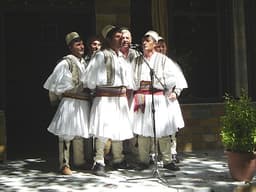
Edi Rama
Politician · Modern
51.0Total

Napoleon Bonaparte
General · Modern
70.9Total
Basic Information
Born
1964
1769
Died
—
1821
Era
Modern
Modern
Nationality
Albania
France
Occupation
Politician
General
Civilization
Western
Western
Score Comparison
Military (10%)
50.0
94.0
Political (20%)
68.0
72.0
Influence (20%)
53.3
40.0
Legacy (20%)
40.8
80.0
Leadership (15%)
53.2
78.0
Strategy (15%)
42.5
90.0
TOTAL
51.0
70.9
Edi Rama — Complete Timeline
2000 AD
Elected Mayor of TiranaPolitical Action◆ Major
Edi Rama was elected Mayor of Tirana, a position he held for three terms. He initiated a major urban renewal program, including painting buildings in bright colors, creating public spaces, and improving infrastructure, which gained international attention.
Urban RenewalLocal GovernmentTirana
constructive
2013 AD
Became Prime Minister of AlbaniaPolitical Action◆ Major
Edi Rama became Prime Minister after leading the Socialist Party to victory in the 2013 parliamentary elections. His government focused on economic reforms, EU integration, and anti-corruption measures.
ElectionGovernment FormationSocialist Party
Impact: nationalconstructive
2014 AD
Albania Granted EU Candidate StatusPolitical Action◆ Major
Under Rama's leadership, Albania was granted official candidate status for membership in the European Union. This was a significant step in the country's post-communist integration into European institutions.
European UnionIntegrationForeign Policy
Impact: nationalconstructive
2016 AD
Initiated Justice ReformReform◆ Major
Rama's government pushed through a comprehensive justice reform, including the vetting of judges and prosecutors to remove corrupt officials. The reform was a key condition for EU accession and aimed to strengthen the rule of law.
Justice ReformAnti-CorruptionEU Conditionality
Impact: nationalconstructive
Napoleon Bonaparte — Complete Timeline
1799 AD
Coup of 18 BrumaireOther◆ Major
Napoleon Bonaparte, with support from his brother Lucien and key political figures, overthrew the Directory in a bloodless coup. He established the Consulate with himself as First Consul, effectively becoming the ruler of France. This event ended the French Revolution's most unstable period.
French RevolutionCoupRise to Power
Impact: regional
1804 AD
Promulgation of the Napoleonic CodeOther◆ Major
Napoleon enacted the Civil Code of the French, known as the Napoleonic Code, a comprehensive set of laws that replaced the fragmented feudal legal systems. The code established legal equality, protected property rights, and secularized law. It became the basis for legal systems in many European and world countries.
Legal ReformNapoleonic CodeCivil Law
Impact: globalconstructive
1805 AD
Battle of AusterlitzWar◆ Major
Napoleon's Grande Arm
Napoleonic WarsBattleDecisive Victory
Impact: global
1812 AD
Invasion of RussiaWar◆ Major
Napoleon led the Grande Arm
Napoleonic WarsInvasionDisaster
Impact: globaldestructive
1815 AD
Battle of WaterlooWar◆ Major
Napoleon's French army was defeated by the combined forces of the Duke of Wellington's Anglo-Allied army and Gebhard Leberecht von Bl
Napoleonic WarsBattleFinal Defeat
Impact: globaldestructive
Expert Analysis
edi-rama-vs-napoleon-bonaparte
# The Emperor and the Artist: Two Men Who Reshaped the World from Opposite Ends of History
On a June morning in 1815, Napoleon Bonaparte stood on a muddy field near Waterloo, watching his Imperial Guard march into British cannon fire. He had commanded armies that reshaped a continent, codified laws that outlasted his empire, and crowned himself Emperor in the shadow of Notre-Dame. Two centuries later, in the summer of 2000, Edi Rama—a painter who had never held public office—stepped into the mayor’s office of Tirana, a crumbling Albanian capital where power cuts were routine and buildings were gray with neglect. One man sought to conquer the world; the other sought to paint it. Yet both were driven by the same fundamental question: How do you remake a society from scratch?
Origins
Napoleon was born in 1769 on the island of Corsica, a year after France had purchased the island from Genoa. His family was minor nobility, poor by French standards but proud, and young Napoleon grew up speaking Italian-accented French, an outsider in the country he would one day rule. The French Revolution shattered the old order when he was twenty, opening military careers to talent rather than birth. He absorbed the Enlightenment ideals of merit and reason, but also the Revolution’s brutal pragmatism—a lesson he never forgot.
Edi Rama was born in 1964 in Tirana, under the iron rule of Enver Hoxha’s communist dictatorship. His father was an artist, his mother a doctor, and the family lived in a world of secret police, state propaganda, and isolation so extreme that Albania built thousands of concrete bunkers to defend against an invasion that never came. When the regime collapsed in the early 1990s, Rama was already a painter, studying at the Academy of Arts and exhibiting his work abroad. He had no political experience, no military background, no revolutionary pedigree. He was, by his own admission, “an artist who stumbled into politics.”
Rise to Power
Napoleon’s ascent was explosive. At twenty-four, he cleared the streets of Paris of royalist insurgents with a “whiff of grapeshot”—a brutal, decisive act that caught the attention of the Directory. At twenty-six, he led a ragged army across the Alps into Italy and won six battles in a month. At thirty, he staged a coup and made himself First Consul. By thirty-five, he was Emperor. His rise was a product of war, ambition, and a revolutionary France that had destroyed every traditional path to power.
Rama’s rise was slower, more patient, and entirely political. After the fall of communism, he joined the Socialist Party, served as Minister of Culture under Prime Minister Fatos Nano, and then, in 2000, ran for mayor of Tirana. He won—barely—and took office in a city that had no functioning streetlights, no reliable water, and a population that had lost faith in public institutions. He was not a general; he had no army. His weapons were paintbrushes, building permits, and the stubborn belief that aesthetics could change a nation’s soul.
Leadership & Governance
Napoleon governed through force and law. His Napoleonic Code, introduced in 1804, standardized French law across conquered territories, abolishing feudalism, protecting property rights, and enshrining meritocracy—though not for women, whom he relegated to second-class status. He built roads, founded banks, established lycées, and centralized the state into an efficient machine. But he also suppressed dissent, censored the press, and used secret police to track enemies. His governance was a paradox: revolutionary in structure, authoritarian in spirit.
Rama governed through persuasion and reform. As mayor, he famously painted the facades of Tirana’s gray apartment blocks in bright colors—pink, yellow, blue—a project mocked by critics as superficial, but which transformed how Albanians saw their own city. He tore down illegal buildings, created public parks, and turned the main square from a parking lot into a pedestrian zone. As prime minister from 2013, he pushed Albania toward European Union membership, securing candidate status in 2014, and initiated a sweeping justice reform in 2016 that vetted every judge and prosecutor for corruption. His methods were democratic, incremental, and deeply contested. He was not a conqueror; he was a negotiator.
Triumph & Tragedy
Napoleon’s greatest triumph was Austerlitz in 1805, where he crushed a combined Russian and Austrian army in a battle so perfect it became a textbook example of military genius. His greatest tragedy was the invasion of Russia in 1812, where hubris, logistics, and winter destroyed the Grande Armée—600,000 men reduced to barely 100,000. He never recovered. Exiled to Elba, he escaped for a final, desperate campaign that ended at Waterloo in 1815. He died six years later on Saint Helena, a prisoner of the British, at age fifty-one.
Rama’s triumphs are quieter but real: a country that was Europe’s most isolated dictatorship is now a NATO member and an EU candidate. His tragedy is the unfinished business of reform: corruption remains endemic, emigration drains the population, and the justice reform he championed has moved slowly, mired in political battles. He has not faced a Waterloo—but he has also not achieved a Austerlitz. His legacy is still being written.
Character & Destiny
Napoleon was restless, brilliant, and incapable of stopping. “Power is my mistress,” he once said, and he pursued her with a relentless energy that exhausted everyone around him. His personality—arrogant, calculating, supremely confident—drove him to conquer, but also to overreach. He could not share power, could not delegate, could not accept limits. That same character that made him a genius also made him a tyrant, and ultimately, a prisoner.
Rama is more elusive. A painter who quotes philosophers and plays basketball, he combines the artist’s sensitivity with the politician’s cunning. He is pragmatic, patient, and aware of his country’s limitations. “Albania is a small country,” he has said, “but it can be a beautiful one.” He does not dream of empire; he dreams of a functioning state. Where Napoleon demanded the world, Rama asks only for a place at the European table.
Legacy
Napoleon’s legacy is monumental and contested. He reshaped Europe’s borders, spread nationalism, and inspired both admiration and revulsion. The Napoleonic Code influences legal systems from Louisiana to Egypt. His name is synonymous with ambition, genius, and catastrophic overreach. He is remembered in statues, museums, and the very structure of modern governance.
Rama’s legacy is smaller but no less significant for his people. He showed that a post-communist country could reform itself without violence, that an artist could govern with vision, that a small nation could aspire to join the West. Whether his reforms endure or fade, he has already changed how Albanians see themselves—and how the world sees Albania.
Conclusion
Napoleon and Rama are separated by two centuries, by scale, by the nature of their power. One commanded armies of hundreds of thousands; the other commands a cabinet of twenty ministers. One died in exile, the other still governs. Yet both faced the same fundamental challenge: how to take a broken society and remake it according to a vision. Napoleon chose war; Rama chose paint. Both left their mark—one on the map of Europe, the other on the face of a city. In the end, perhaps the difference is not in the size of the ambition, but in the willingness to accept that some battles are not worth fighting, and some colors are worth choosing.
Rankings
🥇
Napoleon BonaparteLeader
Mil: 94.0Pol: 72.0Inf: 40.0
70.9
🥈
Edi Rama
Mil: 50.0Pol: 68.0Inf: 53.3
51.0
+19.9 behind
How This Comparison Works
Algorithm
Each figure is scored on 6 dimensions (0—100 scale) based on structured historical data: Military (10%), Political (20%), Influence (20%), Legacy (20%), Leadership (15%), Strategy (15%). The weighted total produces the final ranking.
Data Sources
Scores are computed from structured sub-indicators in the database. Scale factors adjust for era (Ancient ×0.85, Modern ×1.0) and civilization size (Eastern ×1.05, Other ×0.80) to account for differences in population and military scale.
Maximum 3 Figures
Comparisons are limited to 2—3 figures to ensure readability and statistical meaningfulness.
Error Margins
±5 points per dimension — Sub-scores are derived from historical records with inherent uncertainty. Two figures within 5 points on a dimension should be considered roughly equivalent in that area.
Total Score Accuracy
±3 points overall — The weighted combination of 6 dimensions produces a total score with approximately ±3 points of uncertainty. Differences of less than 3 points are not statistically significant— the figures are effectively tied.
Known Limitations
- Historical records are incomplete and uneven across civilizations
- Figures from oral-tradition societies may be underrepresented
- Occupation labels can misclassify multi-role figures
- Scores measure capability and impact, not moral character
- Quantitative scoring is a comparison tool, not absolute truth
Capability Radar
Military (10%) — Battles & Warfare
Battles
29
95
Win Rate
32
90
Expansion
33
95
Political (20%) — Governance & Reform
Reform
55
95
Diplomacy
50
80
Economy
45
85
Influence (20%) — Cultural & Global Reach
Cultural
30
85
Global
30
90
Legacy (20%) — Historical Impact
Historical
25
95
Longevity
20
90
Leadership (15%) — Power & Stability
Tenure
60
85
Stability
40
70
Strategy (15%) — Tactics & Innovation
Strategy
37
95
Tactics
41
98
Reform
45
92
Similar Comparisons
Comments & Discussion
CannonCounter6/17/2026
Sure, Napoleon was a tactical genius, but let’s not pretend Waterloo wasn’t a disaster of his own making. He wasted time on a breakfast, ignored Grouchy’s indecisiveness, and sent the Guard in too late. That’s not a “mastermind”—that’s hubris. Edi Rama, by contrast, actually fixed Tirana’s power grid without losing a war. One guy conquered Italy; the other conquered bureaucracy. I know which skill set ages better.
油漆刷元帅6/17/2026
别把拿破仑当成神明崇拜了,他的法典确实牛,但滑铁卢的泥泞里死了四万法国人,这叫“重塑社会”?不如看看埃迪·拉马,他用十年时间把阿尔巴尼亚的涂鸦和垃圾变成城市色彩,人均GDP翻了三倍。拿破仑靠大炮改变欧洲,拉马靠油漆刷改变街道。谁更持久?历史会记住颜色,而不是硝烟。
DataDivider6/17/2026
Statistically, Napoleon’s reign saw France’s population drop by nearly a million due to war, while Edi Rama took Albania from a 75% poverty rate to 23% in two decades. That’s a 200% improvement versus a 15% decline. You can romanticize the Grande Armée all you want, but the metrics are clear: one man built a legacy on corpses, the other on kiosks and streetlights. Data doesn’t lie, even if history books do.
古典学老饕6/17/2026
拿破仑追求的是罗马式的永恒荣耀,但他忘了西塞罗的教训:帝国靠暴力建立,终将被暴力吞噬。埃迪·拉马更像一个现代的庇提亚斯,他用公共空间和色彩来重建城邦精神。你见过哪个画家成为市长后,能让公民对市政厅的税金感到骄傲?表面是画,实则是新共和国的logo。拿破仑征服了石头,拉马征服了人心。
Revisionist Rebel6/17/2026
Everybody’s comparing Napoleon’s legal code to Rama’s painting, but no one’s asking: Who did more for women’s rights? Napoleon’s Civil Code literally enshrined female subordination to husbands. Meanwhile, Rama appointed a female foreign minister and pushed anti-domestic violence laws in a country where blood feuds were common. Conquest is nice, but 200 years later, I’d rather live under the painter’s brush than the emperor’s pen.