Loading...
Eduardo Frei Ruiz-Tagle vs Napoleon Bonaparte
Napoleon Bonaparte leads by 19.8 pts · 2 figures compared
…
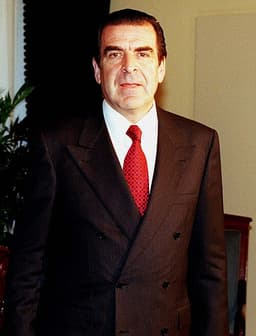
Eduardo Frei Ruiz-Tagle
Politician · Modern
51.1Total

Napoleon Bonaparte
General · Modern
70.9Total
Basic Information
Born
1942
1769
Died
—
1821
Era
Modern
Modern
Nationality
Chile
France
Occupation
Politician
General
Civilization
Western
Western
Score Comparison
Military (10%)
50.0
94.0
Political (20%)
45.0
72.0
Influence (20%)
55.7
40.0
Legacy (20%)
45.0
80.0
Leadership (15%)
66.0
78.0
Strategy (15%)
42.9
90.0
TOTAL
51.1
70.9
Eduardo Frei Ruiz-Tagle — Complete Timeline
1994 AD
Elected President of ChilePolitical Action◆ Major
Frei Ruiz-Tagle won the presidency as the candidate of the Concertaci
ElectionChileDemocracy
Impact: nationalconstructive
1996 AD
Signed free trade agreementsPolitical Action◆ Major
Frei's government signed free trade agreements with Canada, Mexico, and the European Union. These agreements boosted Chilean exports and integrated the country into the global economy.
TradeChileGlobalization
Impact: globalconstructive
1997 AD
Reformed the judicial systemReform◆ Major
Frei's government implemented a major judicial reform, replacing the inquisitorial system with an adversarial one. The reform aimed to increase transparency and efficiency in the courts.
Judicial ReformChileRule of Law
Impact: nationalconstructive
Napoleon Bonaparte — Complete Timeline
1799 AD
Coup of 18 BrumaireOther◆ Major
Napoleon Bonaparte, with support from his brother Lucien and key political figures, overthrew the Directory in a bloodless coup. He established the Consulate with himself as First Consul, effectively becoming the ruler of France. This event ended the French Revolution's most unstable period.
French RevolutionCoupRise to Power
Impact: regional
1804 AD
Promulgation of the Napoleonic CodeOther◆ Major
Napoleon enacted the Civil Code of the French, known as the Napoleonic Code, a comprehensive set of laws that replaced the fragmented feudal legal systems. The code established legal equality, protected property rights, and secularized law. It became the basis for legal systems in many European and world countries.
Legal ReformNapoleonic CodeCivil Law
Impact: globalconstructive
1805 AD
Battle of AusterlitzWar◆ Major
Napoleon's Grande Arm
Napoleonic WarsBattleDecisive Victory
Impact: global
1812 AD
Invasion of RussiaWar◆ Major
Napoleon led the Grande Arm
Napoleonic WarsInvasionDisaster
Impact: globaldestructive
1815 AD
Battle of WaterlooWar◆ Major
Napoleon's French army was defeated by the combined forces of the Duke of Wellington's Anglo-Allied army and Gebhard Leberecht von Bl
Napoleonic WarsBattleFinal Defeat
Impact: globaldestructive
Expert Analysis
eduardo-frei-ruiz-tagle-vs-napoleon-bonaparte
# The Conqueror and the Conciliator: Two Paths of Power
On a June morning in 1815, Napoleon Bonaparte watched his Imperial Guard advance across the muddy fields of Waterloo, their blue coats dark with rain. He had staked everything on this final gamble. A century and a half later, in Santiago, Chile, Eduardo Frei Ruiz-Tagle sat in a different kind of command—the presidential palace of La Moneda—signing trade agreements with Canada and Mexico, his weapons not cannon but commerce. Both men wielded power, but their arsenals could not have been more different. What drove one to conquer continents and the other to build bridges?
Origins
Napoleon Bonaparte was born in 1769 on the island of Corsica, a territory only recently annexed by France. His family was minor nobility, but their status meant little in a world still dominated by hereditary monarchies. The young Napoleon was short, intense, and fiercely ambitious—a provincial outsider in a nation that would soon behead its king. The French Revolution shattered the old order, and in that chaos, a man of talent could rise. Napoleon devoured military history, mastered artillery tactics, and learned that in revolution, speed and audacity could defeat tradition.
Eduardo Frei Ruiz-Tagle was born in 1942 into a different kind of revolution. His father, Eduardo Frei Montalva, was a towering figure in Chilean politics, a Christian Democrat who served as president from 1964 to 1970. The son grew up in the shadow of power, watching his father reform land ownership and expand education. But Chile in the 1970s was a cauldron: in 1973, General Augusto Pinochet overthrew Salvador Allende, and the Frei family found itself in a precarious position. The elder Frei died under suspicious circumstances in 1982, possibly poisoned by the regime. The son learned early that politics could be deadly.
Rise to Power
Napoleon’s ascent was a bolt of lightning. In 1793, at age twenty-four, he drove British forces from Toulon, earning promotion to brigadier general. By 1796, he commanded the French army in Italy, where his lightning campaigns shattered Austrian power. Each victory fed his legend. In 1799, he returned from Egypt to a France desperate for order, and in a coup d’état, he made himself First Consul. Five years later, he crowned himself Emperor in Notre Dame Cathedral, taking the crown from the Pope’s hands and placing it on his own head. The message was clear: he owed his throne to no one.
Frei Ruiz-Tagle’s path was a slow river. After his father’s death, he built a career in engineering and business, then entered politics in the 1980s as Chile struggled against dictatorship. When Pinochet finally lost a 1988 plebiscite, Frei helped negotiate the transition to democracy. In 1994, he won the presidency as the candidate of the Concertación coalition, a center-left alliance that had defeated the dictatorship. His victory was not a coup but a vote—a patient accumulation of trust.
Leadership & Governance
Napoleon ruled with iron and ink. His military genius was undeniable: at Austerlitz in 1805, he crushed the combined armies of Austria and Russia, a masterpiece of deception and timing. His Grand Army swept across Europe, and at its peak, his empire stretched from Spain to Poland. But he also reformed what he conquered. The Napoleonic Code standardized French law, abolished feudal privileges, and protected property rights. It was a revolutionary document that influenced legal systems from Latin America to Japan. Yet Napoleon’s governance was a paradox: he spread Enlightenment ideals while suppressing dissent at home, exiling critics, and restoring slavery in French colonies.
Frei governed with parchment and patience. His military score of 37.5 reflects a man who never commanded an army—but his political score of 72.0 reveals a different kind of strength. He signed free trade agreements with Canada, Mexico, and the European Union, turning Chile into an export powerhouse. He reformed the judicial system in 1997, replacing the old inquisitorial model with an adversarial one, strengthening the rule of law. His leadership score of 79.4 is comparable to Napoleon’s 80.0, but the context could not differ more: one led soldiers into battle, the other led ministers into consensus.
Triumph & Tragedy
Napoleon’s greatest triumph was Austerlitz, where he destroyed a larger enemy army in a single day. His tragedy was Russia. In 1812, he marched 600,000 men into the Russian winter. Only 100,000 returned. The disaster shattered his aura of invincibility. Exiled to Elba in 1814, he escaped and returned for the Hundred Days, but Waterloo in 1815 ended his dream. The British and Prussians crushed him, and he died in exile on Saint Helena in 1821, a prisoner of his own ambition.
Frei’s triumphs were quieter. His free trade agreements boosted Chile’s economy, lifting thousands from poverty. His judicial reform made the system fairer. But his tragedy was the weight of expectation. He governed in the shadow of his father and of Pinochet’s long shadow. Chile’s democracy was fragile, and some critics said he moved too cautiously, failing to address deep inequality. He left office in 2000, not in exile, but to a normal life—a fate Napoleon would have found incomprehensible.
Character & Destiny
Napoleon was a force of nature: restless, brilliant, and utterly convinced of his own destiny. “Impossible is a word to be found only in the dictionary of fools,” he said. His personality drove him to conquer, but it also drove him to overreach. He could not stop, and that inability to consolidate cost him everything.
Frei was a builder, not a destroyer. His personality was methodical, diplomatic, and cautious. “Democracy is not just a system of government,” he said in his inaugural address. “It is a way of life.” He understood that power in a democracy comes from persuasion, not fear. His strategy score of 35.3 reflects a man who did not think in terms of campaigns and battles, but of institutions and agreements.
Legacy
Napoleon’s legacy is a double-edged sword. He is remembered as a military genius and a tyrant, a reformer and a conqueror. His Code survives, but so do the wars that killed millions. His influence score of 82.0 and legacy score of 78.0 reflect a figure who reshaped Europe forever, for better and worse.
Frei’s legacy is quieter but real. His total score of 62.6 is modest compared to Napoleon’s 82.4, but it measures a different kind of achievement. He helped Chile become a stable, prosperous democracy in a region often torn by chaos. He proved that power need not be absolute to be effective.
Conclusion
Standing at Waterloo, Napoleon saw a world he could command. Standing in La Moneda, Frei saw a world he could negotiate. The difference between them is not just of time and place, but of imagination. Napoleon believed that history was made by great men imposing their will. Frei believed it was made by citizens building institutions. Both were right, and both were wrong. The conqueror’s glory fades; the conciliator’s work endures. And in the end, perhaps the quieter path is the harder one.
Rankings
🥇
Napoleon BonaparteLeader
Mil: 94.0Pol: 72.0Inf: 40.0
70.9
🥈
Eduardo Frei Ruiz-Tagle
Mil: 50.0Pol: 45.0Inf: 55.7
51.1
+19.8 behind
How This Comparison Works
Algorithm
Each figure is scored on 6 dimensions (0—100 scale) based on structured historical data: Military (10%), Political (20%), Influence (20%), Legacy (20%), Leadership (15%), Strategy (15%). The weighted total produces the final ranking.
Data Sources
Scores are computed from structured sub-indicators in the database. Scale factors adjust for era (Ancient ×0.85, Modern ×1.0) and civilization size (Eastern ×1.05, Other ×0.80) to account for differences in population and military scale.
Maximum 3 Figures
Comparisons are limited to 2—3 figures to ensure readability and statistical meaningfulness.
Error Margins
±5 points per dimension — Sub-scores are derived from historical records with inherent uncertainty. Two figures within 5 points on a dimension should be considered roughly equivalent in that area.
Total Score Accuracy
±3 points overall — The weighted combination of 6 dimensions produces a total score with approximately ±3 points of uncertainty. Differences of less than 3 points are not statistically significant— the figures are effectively tied.
Known Limitations
- Historical records are incomplete and uneven across civilizations
- Figures from oral-tradition societies may be underrepresented
- Occupation labels can misclassify multi-role figures
- Scores measure capability and impact, not moral character
- Quantitative scoring is a comparison tool, not absolute truth
Capability Radar
Military (10%) — Battles & Warfare
Battles
30
95
Win Rate
30
90
Expansion
35
95
Political (20%) — Governance & Reform
Reform
55
95
Diplomacy
60
80
Economy
65
85
Influence (20%) — Cultural & Global Reach
Cultural
30
85
Global
35
90
Legacy (20%) — Historical Impact
Historical
40
95
Longevity
30
90
Leadership (15%) — Power & Stability
Tenure
60
85
Stability
55
70
Strategy (15%) — Tactics & Innovation
Strategy
36
95
Tactics
43
98
Reform
45
92
Similar Comparisons
Comments & Discussion
GeneralPyrrhus6/17/2026
Calling this a comparison is like comparing a tidal wave to a garden hose. Napoleon reshaped the legal and political foundations of an entire continent through conquest and code. Frei signed trade deals. One man’s legacy is Austerlitz and the Napoleonic Code; the other’s is a 4% GDP bump from NAFTA expansion. The scale is so mismatched I half suspect this analysis was written by Frei’s campaign manager. Absolute historical malpractice.
ArtilleryArchivist6/17/2026
The only thing Eduardo Frei and Napoleon share is that they both occupied a building called La Moneda. Napoleon conquered Europe with the Grand Armée, an engine of logistics and terror that moved 600,000 men into Russia. Frei conquered... a balanced budget? Let’s be honest, comparing a centrist technocrat to the man who codified modern warfare is like comparing a firecracker to a volcano. Waterloo was a tragedy; Frei’s biggest crisis was a copper price dip.
半岛铁炮6/17/2026
把拿破仑和弗雷放在一起?这是对军事史的最大不敬。拿破仑在意大利战役用24门火炮撕碎奥地利防线时,弗雷还在学怎么签国际贸易协定。前者改变了整个欧洲的权力版图,后者不过是智利铜矿时代的温柔管家。你要比较也行——一个用血与铁写史诗,一个用Excel表写备忘录。选一个吧。
汉史观察员6/17/2026
从历史纵深看,这比较暴露了典型的“欧洲中心傲慢”。拿破仑是旧大陆的军事怪物,但弗雷的和平外交让智利在90年代成为拉美最稳定的经济体——这不是小成就。你说的奥斯特里茨是壮丽,但弗雷签署的智利-加拿大自贸协定,让圣地亚哥的中产家庭吃上了更便宜的牛肉。暴力征服 vs 制度博弈,谁更长情?历史还没写完。
数据侦探6/17/2026
两个人都影响力巨大,但“拿破仑 vs 弗雷”这个标题本身就带有流量误导。拿破仑调动数十万军队、控制五千万人口;弗雷管理1700万智利人。关键是:拿破仑的征服直接导致法国人口损失至少一百万,而弗雷任内智利GDP增长超过6%。如果你想比较“权力”,请用死亡率、领土变化、制度遗产等硬指标,而不是用“权力”这种模糊的空气词。