Loading...
Edward II of England vs John of England
John of England leads by 11.0 pts · 2 figures compared
…

Edward II of England
Emperor · Medieval
40.9Total
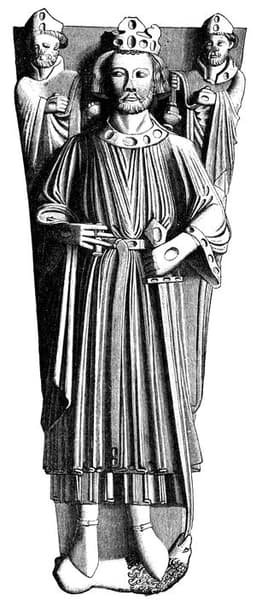
John of England
Emperor · Medieval
51.9Total
Basic Information
Born
1284
1166
Died
1327
1216
Era
Medieval
Medieval
Nationality
England
England
Occupation
Emperor
Emperor
Civilization
Western
Western
Score Comparison
Military (10%)
50.0
50.0
Political (20%)
35.0
39.4
Influence (20%)
46.3
62.0
Legacy (20%)
37.5
55.0
Leadership (15%)
39.0
45.0
Strategy (15%)
38.6
50.0
TOTAL
40.9
51.9
Edward II of England — Complete Timeline
1311 AD
Ordinances of 1311Political Action◆ Major
Under baronial pressure, Edward II agreed to the Ordinances of 1311, which limited royal power and exiled his favorite Piers Gaveston. This reform was later annulled, but it highlighted baronial discontent.
ReformBaronial OppositionGaveston
Impact: nationalconstructive
1312 AD
Execution of Piers GavestonPolitical Action◆ Major
Edward II's favorite Piers Gaveston was captured and executed by barons led by Thomas of Lancaster. This act deepened the rift between the king and the nobility, leading to further instability.
ExecutionFactionalismBaronial Revolt
Impact: nationaltragic
1314 AD
Battle of BannockburnWar◆ Major
Edward II led an English army against Robert the Bruce at the Battle of Bannockburn. The Scots decisively defeated the English, securing Scottish independence and humiliating Edward's reign.
BattleScotlandRobert the Bruce
Impact: regionaldestructive
1327 AD
Deposition and MurderPolitical Action◆ Major
Edward II was deposed by his wife Isabella of France and her lover Roger Mortimer. He was forced to abdicate in favor of his son Edward III, and later murdered at Berkeley Castle, likely on orders.
DepositionMurderIsabella
Impact: nationaltragic
John of England — Complete Timeline
1204 AD
Loss of NormandyWar◆ Major
King John lost the Duchy of Normandy to King Philip II of France after the fall of Ch
Territorial LossFranceAngevin Empire
Impact: regionaldestructive
1208 AD
Interdict on EnglandPolitical Action◆ Major
Pope Innocent III placed England under interdict after John refused to accept Stephen Langton as Archbishop of Canterbury. This suspended church services, causing widespread discontent and leading to John's excommunication.
Church ConflictPapal InterdictExcommunication
Impact: nationaldestructive
1215 AD
First Barons' WarWar◆ Major
After repudiating Magna Carta, John faced the First Barons' War, where rebel barons invited Prince Louis of France to take the English throne. John fought to retain control, leading to widespread devastation.
Civil WarBaronial RevoltFrench Invasion
Impact: nationaldestructive
Signing of Magna CartaPolitical Action
Under pressure from rebellious barons, John signed Magna Carta at Runnymede. The charter limited royal power, established legal rights, and influenced constitutional law, though John later repudiated it.
CharterConstitutionalBaronial Revolt
Impact: globalconstructive
1216 AD
Death from DysenteryOther◆ Major
John died of dysentery at Newark Castle during the First Barons' War. His death allowed his young son Henry III to succeed, and the war ended with the Treaty of Lambeth.
DeathDisease
Impact: nationaltragic
Expert Analysis
Origins
Edward II of England was born in 1284 as the fourth son of Edward I, but became heir after his older brothers died. He was raised in a martial court, but preferred rustic pursuits like rowing and thatching. His father despised his attachment to Piers Gaveston, a Gascon knight. John of England, born in 1166, was the youngest son of Henry II and Eleanor of Aquitaine. He was nicknamed 'Lackland' for lack of inheritance, and received a thorough education but was known for his cunning and cruelty. Both were shaped by expectations of their Plantagenet lineage.
Rise to Power
Edward II became king in 1307 upon his father's death. He immediately recalled Gaveston from exile, alienating the barons. His reign was defined by conflict with the nobility, culminating in the Ordinances of 1311, which stripped him of power. John became king in 1199 after Richard I's death, disputed by his nephew Arthur. He secured the throne by defeating Arthur and imprisoning him (Arthur died mysteriously in 1203). John's early reign saw the loss of Normandy in 1204, a blow to his prestige.
Leadership & Governance
Edward II's leadership was passive; he relied on favorites and failed to command respect. His military score of 50.0 was undermined by the disastrous Battle of Bannockburn in 1314, where he led a large army to defeat against Robert the Bruce. John was more active but equally ineffective: his political score of 39.4 reflects his oppressive taxation and arbitrary rule. John's governance included the Interdict of 1208-1213, when England was under papal sanction, and his repudiation of Magna Carta in 1215 sparked the First Barons' War. Both kings faced baronial revolts, but John's legacy includes the charter that limited royal power.
Triumph & Tragedy
Edward II's greatest success was surviving a baronial rebellion until 1326, but his tragedy was his deposition and murder in 1327, likely by a red-hot poker. His wife Isabella and her lover Roger Mortimer ruled in his stead. John's triumph was the signing of Magna Carta in 1215, which established legal principles, but he immediately violated it, leading to civil war. John's tragedy was losing Normandy and dying of dysentery in 1216, leaving his young son to salvage the realm. Both kings ended their reigns in failure, but John's actions had longer constitutional impact.
Character & Destiny
Edward II was indecisive, pleasure-loving, and stubborn, choosing favorites over nobles. His character led to isolation and violent death. John was paranoid, treacherous, and cruel; he alienated his barons and even the Church. His character provoked rebellion and a French invasion. Historical assessments: Edward II's total score of 40.9 reflects his weakness, while John's 51.9 shows slightly more influence, though both are considered among England's worst kings.
Legacy
Edward II's legacy is largely negative: his reign weakened the monarchy temporarily and led to the rise of Isabella and Mortimer. His deposition set a precedent for removing a king. John's legacy is monumental: Magna Carta became a symbol of liberty, influencing English law and later democracies. John's political and influence scores (39.4 and 62.0) show his mixed reputation. Edward's influence score (46.3) is lower, as his reign is mostly remembered for failure.
Conclusion
John of England had greater impact due to Magna Carta, which shaped constitutional government. Edward II's deposition was a personal tragedy but did not create enduring institutions. John scores 51.9 total to Edward's 40.9, a gap of 11 points. While both were flawed, John's legacy transcends his reign, making him more significant in history.
Rankings
🥇
John of EnglandLeader
Mil: 50.0Pol: 39.4Inf: 62.0
51.9
🥈
Edward II of England
Mil: 50.0Pol: 35.0Inf: 46.3
40.9
+11.0 behind
How This Comparison Works
Algorithm
Each figure is scored on 6 dimensions (0—100 scale) based on structured historical data: Military (10%), Political (20%), Influence (20%), Legacy (20%), Leadership (15%), Strategy (15%). The weighted total produces the final ranking.
Data Sources
Scores are computed from structured sub-indicators in the database. Scale factors adjust for era (Ancient ×0.85, Modern ×1.0) and civilization size (Eastern ×1.05, Other ×0.80) to account for differences in population and military scale.
Maximum 3 Figures
Comparisons are limited to 2—3 figures to ensure readability and statistical meaningfulness.
Error Margins
±5 points per dimension — Sub-scores are derived from historical records with inherent uncertainty. Two figures within 5 points on a dimension should be considered roughly equivalent in that area.
Total Score Accuracy
±3 points overall — The weighted combination of 6 dimensions produces a total score with approximately ±3 points of uncertainty. Differences of less than 3 points are not statistically significant— the figures are effectively tied.
Known Limitations
- Historical records are incomplete and uneven across civilizations
- Figures from oral-tradition societies may be underrepresented
- Occupation labels can misclassify multi-role figures
- Scores measure capability and impact, not moral character
- Quantitative scoring is a comparison tool, not absolute truth
Capability Radar
Military (10%) — Battles & Warfare
Battles
10
25
Win Rate
5
20
Expansion
0
10
Political (20%) — Governance & Reform
Reform
5
60
Diplomacy
5
20
Economy
5
25
Influence (20%) — Cultural & Global Reach
Cultural
10
45
Global
5
65
Legacy (20%) — Historical Impact
Historical
15
75
Longevity
10
70
Leadership (15%) — Power & Stability
Tenure
20
40
Stability
5
15
Strategy (15%) — Tactics & Innovation
Strategy
5
25
Tactics
5
30
Reform
0
15
Similar Comparisons
Comments & Discussion
No comments yet. Be the first to share your thoughts!