Loading...
Edward III of England vs Yang Guang
Edward III of England leads by 3.4 pts · 2 figures compared
…
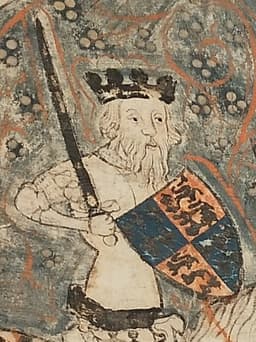
Edward III of England
Emperor · Medieval
60.9Total
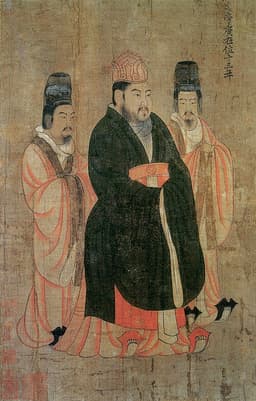
Yang Guang
Emperor · Medieval
57.5Total
Basic Information
Born
1312
569
Died
1377
618
Era
Medieval
Medieval
Nationality
England
China
Occupation
Emperor
Emperor
Civilization
Western
Eastern
Score Comparison
Military (10%)
72.0
47.5
Political (20%)
55.0
62.7
Influence (20%)
65.0
72.0
Legacy (20%)
40.0
40.0
Leadership (15%)
79.8
62.2
Strategy (15%)
72.0
60.0
TOTAL
60.9
57.5
Edward III of England — Complete Timeline
1337 AD
Start of the Hundred Years' WarWar
Edward III declared himself King of France, challenging Philip VI's claim. This began the Hundred Years' War, a prolonged conflict over the French throne and English territories in France.
WarFranceSuccession
Impact: global
1346 AD
Battle of CrécyWar◆ Major
Edward III's English army defeated a larger French force at the Battle of Cr
BattleLongbowFrance
Impact: regional
Siege of CalaisWar◆ Major
Edward III besieged the French port of Calais for nearly a year. The city surrendered, and Edward took control, making it an English stronghold for over two centuries.
SiegeCalaisFrance
Impact: regional
1356 AD
Battle of PoitiersWar◆ Major
Edward III's son, the Black Prince, defeated and captured King John II of France at the Battle of Poitiers. This victory led to the Treaty of Br
BattleCapture of KingTreaty
Impact: regional
1360 AD
Treaty of BrétignyPolitical Action◆ Major
Edward III signed the Treaty of Br
TreatyPeaceTerritorial Gains
Impact: regionalconstructive
Yang Guang — Complete Timeline
605 AD
Construction of the Grand CanalReform◆ Major
Emperor Yang Guang ordered the construction of the Grand Canal, linking the Yellow River and Yangtze River. The project mobilized millions of laborers and created a vital waterway for grain transport and trade, but the immense human cost led to widespread resentment and rebellion.
InfrastructureGrand CanalCorvée Labor
Impact: national
612 AD
Three Expeditions against GoguryeoWar◆ Major
Yang Guang launched three massive military campaigns against the Korean kingdom of Goguryeo. The first invasion in 612 ended in catastrophic defeat at the Battle of Salsu, with hundreds of thousands of Chinese soldiers killed. The repeated failures drained the treasury and sparked widespread revolts.
Goguryeo-Sui WarMilitary DisasterOverextension
Impact: regionaldestructive
613 AD
Rebellion of Yang XuanganWar◆ Major
While Yang Guang was campaigning against Goguryeo, the noble Yang Xuangan launched a major rebellion in the rear. The revolt was suppressed, but it exposed the fragility of Sui rule and encouraged further uprisings across the empire.
RebellionSui Dynasty Decline
Impact: nationaldestructive
618 AD
Assassination of Yang GuangPolitical Action
As rebellions engulfed the empire, Yang Guang was strangled to death in Jiangdu by his own guards led by Yuwen Huaji. His death marked the effective end of the Sui dynasty, which collapsed shortly after, leading to the rise of the Tang dynasty.
AssassinationSui CollapseDynastic Transition
Impact: nationaltragic
Expert Analysis
Origins
Edward III of England was born in 1312 at Windsor Castle, the son of Edward II and Isabella of France. His early life was marked by his father's weak rule and eventual deposition in 1327, when Edward III was crowned at age 14. He was influenced by his mother's affair with Roger Mortimer, who effectively ruled until Edward seized power in 1330. In contrast, Yang Guang was born in 569 AD as the second son of Emperor Wen of Sui. He was well-educated in Confucian classics and military arts. His father unified China after centuries of division, and Yang Guang played a role in campaigns against the Chen dynasty. His early career included serving as governor of Yangzhou, where he cultivated support among southern elites.
Rise to Power
Edward III's rise began with his overthrow of Mortimer in 1330, taking personal control of the government. He asserted his claim to the French throne in 1337 after the death of Charles IV, triggering the Hundred Years' War. His early victories, such as the naval Battle of Sluys in 1340, bolstered his prestige. Yang Guang's rise involved political maneuvering: he accused his older brother Yang Yong of treason, leading to his deposition in 600 AD. Yang Guang became crown prince and succeeded his father in 604 AD, possibly after a suspicious death. He then launched ambitious projects like the Grand Canal to consolidate his rule.
Leadership & Governance
Edward III's leadership style was hands-on and chivalric. He personally led campaigns and fostered a warrior ethos among his nobility. He established the Order of the Garter in 1348 to bind knights to his cause. His governance relied on parliament for war funding, which strengthened the Commons. Yang Guang, by contrast, was an autocratic reformer. He implemented the equal-field system and reformed the examination system for officials. However, his massive public works, like the Grand Canal (built from 605 to 609), mobilized millions of laborers, causing widespread suffering. His military score of 47.5 reflects his failed campaigns, while Edward's 72.0 shows effective warfare.
Triumph & Tragedy
Edward III's greatest triumph was the Treaty of Brétigny in 1360, which secured Aquitaine and a large ransom for the captured French king. His son's victory at Poitiers in 1356 was a high point. However, his later years saw the resumption of war and the loss of territories, as French forces under Bertrand du Guesclin regained ground. The Black Death (1348-1350) also devastated England, straining his resources. Yang Guang's grand achievement was the Grand Canal, which facilitated trade and transport for centuries. But his three disastrous invasions of Goguryeo (612-614) cost hundreds of thousands of lives and sparked rebellions. He was assassinated in 618, leading to the fall of the Sui dynasty.
Character & Destiny
Edward III was charismatic, ambitious, and a skilled diplomat. He inspired loyalty but also faced challenges from his sons, especially the Black Prince. His later reign saw decline due to illness and political infighting. Yang Guang was visionary but ruthless, obsessed with glory and legacy. His overreach and inability to heed warnings led to his downfall. Historical assessments label him a tyrant, though his canal project earned some praise. Edward's legacy is more mixed: he is remembered as a great warrior king who started a long war.
Legacy
Edward III's influence on English identity and military tactics is significant. The longbow at Crécy and Poitiers changed warfare. Parliament's role grew due to his need for funds. The Hundred Years' War shaped Anglo-French relations for centuries. Yang Guang's Grand Canal remained a vital artery for China until the 19th century. The Sui dynasty's collapse paved the way for the Tang dynasty, which built on his reforms. However, his reputation as a tyrant persisted. In terms of total score, Edward leads 60.9 to 57.5.
Conclusion
Edward III had greater impact on his nation's trajectory. His military leadership (72.0 vs 47.5) and strategic vision (72.0 vs 60.0) directly shaped England's rise as a European power. Yang Guang's achievements were monumental but unsustainable, leading to collapse. Edward's legacy endured through institutions and warfare, while Yang Guang's was overshadowed by failure. Thus, Edward III stands as the more effective ruler.
Rankings
🥇
Edward III of EnglandLeader
Mil: 72.0Pol: 55.0Inf: 65.0
60.9
🥈
Yang Guang
Mil: 47.5Pol: 62.7Inf: 72.0
57.5
+3.4 behind
How This Comparison Works
Algorithm
Each figure is scored on 6 dimensions (0—100 scale) based on structured historical data: Military (10%), Political (20%), Influence (20%), Legacy (20%), Leadership (15%), Strategy (15%). The weighted total produces the final ranking.
Data Sources
Scores are computed from structured sub-indicators in the database. Scale factors adjust for era (Ancient ×0.85, Modern ×1.0) and civilization size (Eastern ×1.05, Other ×0.80) to account for differences in population and military scale.
Maximum 3 Figures
Comparisons are limited to 2—3 figures to ensure readability and statistical meaningfulness.
Error Margins
±5 points per dimension — Sub-scores are derived from historical records with inherent uncertainty. Two figures within 5 points on a dimension should be considered roughly equivalent in that area.
Total Score Accuracy
±3 points overall — The weighted combination of 6 dimensions produces a total score with approximately ±3 points of uncertainty. Differences of less than 3 points are not statistically significant— the figures are effectively tied.
Known Limitations
- Historical records are incomplete and uneven across civilizations
- Figures from oral-tradition societies may be underrepresented
- Occupation labels can misclassify multi-role figures
- Scores measure capability and impact, not moral character
- Quantitative scoring is a comparison tool, not absolute truth
Capability Radar
Military (10%) — Battles & Warfare
Battles
85
55
Win Rate
80
40
Expansion
85
60
Political (20%) — Governance & Reform
Reform
70
75
Diplomacy
75
40
Economy
70
70
Influence (20%) — Cultural & Global Reach
Cultural
70
70
Global
70
65
Legacy (20%) — Historical Impact
Historical
80
75
Longevity
75
80
Leadership (15%) — Power & Stability
Tenure
85
60
Stability
65
20
Strategy (15%) — Tactics & Innovation
Strategy
90
50
Tactics
85
45
Reform
75
30
Similar Comparisons
Comments & Discussion
No comments yet. Be the first to share your thoughts!