Loading...
Edward IV of England vs Napoleon Bonaparte
Napoleon Bonaparte leads by 15.2 pts · 2 figures compared
…
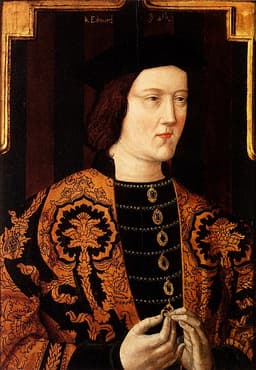
Edward IV of England
Emperor · Medieval
55.7Total

Napoleon Bonaparte
General · Modern
70.9Total
Basic Information
Born
1442
1769
Died
1483
1821
Era
Medieval
Modern
Nationality
England
France
Occupation
Emperor
General
Civilization
Western
Western
Score Comparison
Military (10%)
61.7
94.0
Political (20%)
45.0
72.0
Influence (20%)
60.0
40.0
Legacy (20%)
56.0
80.0
Leadership (15%)
53.2
78.0
Strategy (15%)
58.0
90.0
TOTAL
55.7
70.9
Edward IV of England — Complete Timeline
1461 AD
Battle of TowtonWar
Edward IV led the Yorkist army to a decisive victory over the Lancastrian forces at Towton in Yorkshire. This battle, the largest and bloodiest of the Wars of the Roses, secured Edward's claim to the throne and led to his coronation as king.
Wars of the RosesBattleVictory
Impact: national
Coronation of Edward IVPolitical Action◆ Major
Edward IV was crowned king of England at Westminster Abbey, formally establishing the Yorkist dynasty. His coronation followed the deposition of Henry VI and marked the beginning of a period of Yorkist rule.
CoronationDynastyYorkist
Impact: nationalconstructive
1464 AD
Marriage to Elizabeth WoodvillePolitical Action◆ Major
Edward IV secretly married Elizabeth Woodville, a Lancastrian widow, without consulting his council. This marriage elevated the Woodville family and alienated key allies like the Earl of Warwick, contributing to later political instability.
MarriagePoliticsWoodville
Impact: national
1471 AD
Battle of BarnetWar◆ Major
Edward IV defeated the Earl of Warwick at Barnet, killing Warwick and reclaiming the throne after a brief exile. This victory restored Yorkist control and ended the Lancastrian resurgence led by Warwick and Queen Margaret.
Wars of the RosesBattleRestoration
Impact: national
1475 AD
Treaty of PicquignyPolitical Action
Edward IV signed the Treaty of Picquigny with Louis XI of France, ending a brief invasion of France. The treaty secured a pension for Edward and a truce, but was seen as a diplomatic retreat from military ambitions.
DiplomacyFranceTruce
Impact: regional
Napoleon Bonaparte — Complete Timeline
1799 AD
Coup of 18 BrumaireOther◆ Major
Napoleon Bonaparte, with support from his brother Lucien and key political figures, overthrew the Directory in a bloodless coup. He established the Consulate with himself as First Consul, effectively becoming the ruler of France. This event ended the French Revolution's most unstable period.
French RevolutionCoupRise to Power
Impact: regional
1804 AD
Promulgation of the Napoleonic CodeOther◆ Major
Napoleon enacted the Civil Code of the French, known as the Napoleonic Code, a comprehensive set of laws that replaced the fragmented feudal legal systems. The code established legal equality, protected property rights, and secularized law. It became the basis for legal systems in many European and world countries.
Legal ReformNapoleonic CodeCivil Law
Impact: globalconstructive
1805 AD
Battle of AusterlitzWar◆ Major
Napoleon's Grande Arm
Napoleonic WarsBattleDecisive Victory
Impact: global
1812 AD
Invasion of RussiaWar◆ Major
Napoleon led the Grande Arm
Napoleonic WarsInvasionDisaster
Impact: globaldestructive
1815 AD
Battle of WaterlooWar◆ Major
Napoleon's French army was defeated by the combined forces of the Duke of Wellington's Anglo-Allied army and Gebhard Leberecht von Bl
Napoleonic WarsBattleFinal Defeat
Impact: globaldestructive
Expert Analysis
edward-iv-of-england-vs-napoleon-bonaparte
The Crown and the Eagle
On a muddy field in Yorkshire, in the snow of Palm Sunday 1461, a nineteen-year-old boy watched his enemies break and run. The Battle of Towton was the bloodiest ever fought on English soil, and Edward of York had won it. Less than four centuries later, on a frozen battlefield in Belarus, a thirty-three-year-old Corsican artilleryman watched the Russian winter swallow his *Grande Armée*. Napoleon Bonaparte had lost everything. Two men, both conquerors, both reformers, both undone by forces they could not control—yet one reshaped the world, while the other merely saved his kingdom. Why?
Origins
Napoleon Bonaparte was born in 1769 on Corsica, an island that had only recently become French. His family was minor nobility, poor enough that he spoke Italian-accented French throughout his life. He entered military school at nine, a small, angry outsider among the sons of old French aristocrats. The French Revolution, which erupted when he was twenty, shattered the old order and opened paths that birth alone could never have granted.
Edward of York was born in 1442 into the very heart of England’s Plantagenet dynasty. His father, Richard of York, was the wealthiest magnate in the realm and a claimant to the throne. Edward grew up in castles, not barracks, learning swordsmanship and chivalry rather than mathematics and artillery. The Wars of the Roses, which began when he was thirteen, were not a revolution but a family feud—a violent argument over which branch of the royal line should rule.
Napoleon’s world was one of ideas and ideologies: liberty, equality, the rights of man. Edward’s was one of oaths and bloodlines: whose grandfather was king, whose marriage was more legitimate. The Frenchman rose in a world where merit could overcome birth; the Englishman rose in a world where birth was everything.
Rise to Power
Napoleon’s ascent was meteoric. At twenty-four, he drove the British out of Toulon. At twenty-six, he suppressed a royalist uprising in Paris with a “whiff of grapeshot.” At twenty-seven, he conquered Italy. Each victory brought promotion, fame, and political leverage. By 1799, at thirty, he was First Consul of France. His path was a ladder of talent, and he climbed it alone.
Edward’s rise was different. He inherited a claim to the throne, but he had to seize it. In 1461, at eighteen, he led the Yorkist army at Towton, a battle so savage that chroniclers claimed 28,000 men died. The Lancastrian king Henry VI fled, and Edward was crowned at Westminster Abbey. His power came from military victory, yes, but also from the support of great noblemen like the Earl of Warwick, who had made him king and expected to rule through him.
Napoleon’s rise was individual; Edward’s was collaborative. One was a self-made emperor; the other was a king who had to share his rule.
Leadership & Governance
As emperor, Napoleon reorganized France. He created the Napoleonic Code, a legal system that enshrined equality before the law, property rights, and secular administration. He reformed education, established the Bank of France, and built roads and canals. His military genius was staggering—Austerlitz in 1805, Jena in 1806, Wagram in 1809—but his political wisdom was brittle. He appointed his brothers as puppet kings, alienated allies, and never learned to compromise.
Edward IV governed differently. He was a brilliant battlefield commander—Towton in 1461, Barnet in 1471, Tewkesbury in 1471—but his true skill lay in patronage and diplomacy. He restored royal finances by personally auditing accounts, cultivated the merchant class, and avoided foreign wars. When he invaded France in 1475, he accepted the Treaty of Picquigny, taking a pension from Louis XI instead of fighting. It was not glory, but it was peace.
Napoleon’s governance was a machine of revolution; Edward’s was a restoration of order. The Frenchman wanted to remake the world; the Englishman wanted to keep his throne.
Triumph & Tragedy
Napoleon’s greatest moment was Austerlitz in December 1805, where he destroyed a combined Russian and Austrian army. His empire stretched from Spain to Poland. His tragedy was the invasion of Russia in 1812. He marched with 600,000 men; fewer than 100,000 returned. The disaster broke his aura of invincibility, and by 1814, his enemies had captured Paris. He was exiled to Elba, escaped, ruled for a Hundred Days, and was finally defeated at Waterloo in June 1815.
Edward’s triumph was his restoration. After being driven into exile in 1470, he returned in 1471, defeated and killed the Earl of Warwick at Barnet, and crushed the last Lancastrian army at Tewkesbury. He died in 1483, still king, still in control. His tragedy was not defeat but legacy: he died suddenly at forty, leaving a twelve-year-old son who was deposed and probably murdered by his own uncle, Richard III.
Napoleon’s tragedy was spectacular; Edward’s was quiet. One fell from the top of the world; the other simply passed, and his house fell with him.
Character & Destiny
Napoleon was restless, ambitious, and endlessly energetic. He slept only four hours a night, dictated multiple letters simultaneously, and believed he could conquer anything. “Impossible is a word to be found only in the dictionary of fools,” he said. His character drove him to overreach—Spain, Russia, the Continental System—and his destiny was to create an empire and lose it.
Edward was pragmatic, sensual, and calculating. He married Elizabeth Woodville in 1464 for love, elevating a Lancastrian widow and angering his allies. He spent lavishly on clothes and books, but he also worked tirelessly to stabilize his kingdom. His character was that of a survivor, not a visionary. His destiny was to die in his bed, but to see his dynasty extinguished within two years.
Napoleon’s personality shaped his fate; Edward’s personality saved his reign but doomed his line.
Legacy
Napoleon’s legacy is immense. The Napoleonic Code influences legal systems across Europe and the world. He destroyed feudalism, spread nationalism, and inspired modern warfare. He is remembered as both a tyrant and a genius, a man who made France great and then destroyed it.
Edward IV’s legacy is smaller but real. He restored the English monarchy after civil war, reformed royal finances, and patronized the early Renaissance in England. He is remembered as a capable king, but not a transformative one. His scores—Military 71, Political 62, Influence 73—reflect a ruler who did his job well but changed little.
Conclusion
Napoleon Bonaparte and Edward IV both rose through war, ruled through will, and fell through the limits of their ambition and their age. One tried to conquer the world; the other tried to keep his throne. One changed Europe forever; the other kept England stable. In the end, Napoleon’s tragedy was that he could not stop, and Edward’s tragedy was that he stopped too soon. Both were kings of their time, but only one became a figure for all time—and that, perhaps, is the cruelest measure of all.
Rankings
🥇
Napoleon BonaparteLeader
Mil: 94.0Pol: 72.0Inf: 40.0
70.9
🥈
Edward IV of England
Mil: 61.7Pol: 45.0Inf: 60.0
55.7
+15.2 behind
How This Comparison Works
Algorithm
Each figure is scored on 6 dimensions (0—100 scale) based on structured historical data: Military (10%), Political (20%), Influence (20%), Legacy (20%), Leadership (15%), Strategy (15%). The weighted total produces the final ranking.
Data Sources
Scores are computed from structured sub-indicators in the database. Scale factors adjust for era (Ancient ×0.85, Modern ×1.0) and civilization size (Eastern ×1.05, Other ×0.80) to account for differences in population and military scale.
Maximum 3 Figures
Comparisons are limited to 2—3 figures to ensure readability and statistical meaningfulness.
Error Margins
±5 points per dimension — Sub-scores are derived from historical records with inherent uncertainty. Two figures within 5 points on a dimension should be considered roughly equivalent in that area.
Total Score Accuracy
±3 points overall — The weighted combination of 6 dimensions produces a total score with approximately ±3 points of uncertainty. Differences of less than 3 points are not statistically significant— the figures are effectively tied.
Known Limitations
- Historical records are incomplete and uneven across civilizations
- Figures from oral-tradition societies may be underrepresented
- Occupation labels can misclassify multi-role figures
- Scores measure capability and impact, not moral character
- Quantitative scoring is a comparison tool, not absolute truth
Capability Radar
Military (10%) — Battles & Warfare
Battles
70
95
Win Rate
75
90
Expansion
60
95
Political (20%) — Governance & Reform
Reform
60
95
Diplomacy
70
80
Economy
65
85
Influence (20%) — Cultural & Global Reach
Cultural
55
85
Global
45
90
Legacy (20%) — Historical Impact
Historical
65
95
Longevity
55
90
Leadership (15%) — Power & Stability
Tenure
65
85
Stability
55
70
Strategy (15%) — Tactics & Innovation
Strategy
70
95
Tactics
75
98
Reform
50
92
Similar Comparisons
Comments & Discussion
SirHackAlot6/17/2026
Napoleon's Code Civil rewrote Europe's legal foundation; Edward IV's only "reform" was a royal bookkeeping audit that fattened his own treasury. One man turned a chaotic continent into a meritocracy, the other just wanted to keep his crown and collect taxes. Comparing them is like stacking a hurricane against a drizzle—the scale is simply different.
CarnageCounter6/17/2026
Towton was brutal—28,000 dead in a single day, the worst in British history—but that's peanuts next to Borodino's 70,000 casualties in one battle. Napoleon marched 600,000 men into Russia; Edward's largest army maybe scraped 40,000. The sheer logistical reach of the Corsican dwarfed anything the Yorkist king could dream of. Different leagues entirely, and the numbers prove it.
雪花铁骑6/17/2026
拿破仑是踩着革命浪潮爬上来的平民英雄,爱德华四世不过是靠血缘抢王位的贵族纨绔。滑铁卢输得悲壮,陶顿赢得侥幸——你让爱德华指挥法军在俄罗斯过冬试试?他连面包都发不齐。一个改变了整个大陆的法律和政治,另一个只会打仗和娶错女人。高下立判,根本不用争。
历史炼金师6/17/2026
说拿破仑输给冬天很浪漫,但事实是他输给了自己的傲慢。远征莫斯科前,法军间谍早就警告过补给线过长,粮草运不到。爱德华四世至少知道怎么管理王室财政——他通过贸易和关税中兴了英格兰经济,而不是靠抢邻居填国库。拿破仑的"光芒"其实建立在无数尸骨上,爱德华的现实主义反而更持久。
古典刀笔吏6/17/2026
别忘了,爱德华四世47岁就死了,帝国都没来得及建就化成土了。拿破仑虽然53岁死在孤岛,但他那二十年已经在整个欧洲刻下烙印。爱德华的约克王朝在他死后十三年就灰飞烟灭,而拿破仑法典至今还是法国法律的骨架。历史不是比谁命长,是比谁的影子更长。拿破仑的影子现在还在欧洲议会里飘着呢。