Loading...
Edward V of England vs Maravarman Sundara Pandya
Maravarman Sundara Pandya leads by 4.5 pts · 2 figures compared
…
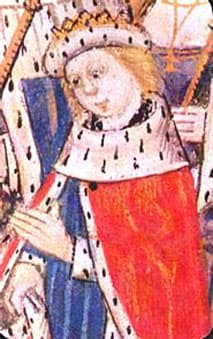
Edward V of England
Emperor · Medieval
47.5Total

Maravarman Sundara Pandya
Emperor · Medieval
52.0Total
Basic Information
Born
1470
1216
Died
1483
1240
Era
Medieval
Medieval
Nationality
England
India
Occupation
Emperor
Emperor
Civilization
Western
Indian
Score Comparison
Military (10%)
16.6
55.0
Political (20%)
68.0
42.3
Influence (20%)
45.5
51.8
Legacy (20%)
37.5
45.8
Leadership (15%)
70.4
65.0
Strategy (15%)
43.0
60.0
TOTAL
47.5
52.0
Edward V of England — Complete Timeline
1483 AD
Accession to the ThronePolitical Action◆ Major
Edward V became king of England at age 12 after the death of his father, Edward IV. His reign was brief and dominated by his uncle Richard, Duke of Gloucester, who acted as Lord Protector.
SuccessionMinor KingYorkist
Impact: national
Deposition by Richard IIIPolitical Action
Edward V was declared illegitimate by Parliament under the Titulus Regius, and his uncle Richard was crowned as Richard III. Edward and his brother Richard were placed in the Tower of London, where they disappeared.
DepositionPrinces in the TowerUsurpation
Impact: nationaltragic
Disappearance of the Princes in the TowerOther◆ Major
Edward V and his brother Richard, Duke of York, vanished from the Tower of London after being declared illegitimate. Their fate remains unknown, but they are widely believed to have been murdered, likely on orders of Richard III.
MysteryMurderPrinces in the Tower
Impact: nationaltragic
Maravarman Sundara Pandya — Complete Timeline
1216 AD
Overthrow of Chola supremacyWar
Maravarman Sundara Pandya led a successful campaign against the Chola king Kulothunga III. He defeated the Chola army and captured the Chola capital, ending Chola dominance in the region and establishing Pandya supremacy.
PandyaCholaSupremacy
Impact: regionalconstructive
1220 AD
Consolidation of Pandya rulePolitical Action◆ Major
After defeating the Cholas, Maravarman Sundara Pandya consolidated his rule over the Pandya kingdom. He expanded his territory and established a strong administration, laying the foundation for the later Pandya empire.
PandyaConsolidationAdministration
Impact: regionalconstructive
1240 AD
Death and successionPolitical Action
Maravarman Sundara Pandya died, and his son Jatavarman Sundara Pandya succeeded him. His death marked the end of the initial phase of Pandya resurgence, which would be continued by his son.
PandyaSuccessionDeath
Impact: regional
Expert Analysis
Origins
Edward V of England was born in 1470 in Westminster, the eldest son of King Edward IV and Elizabeth Woodville. His early years were marked by the political turmoil of the Wars of the Roses. After his father's temporary deposition in 1470, Edward was taken to the Tower of London for safety. He was educated in courtly and knightly arts, but his formative experiences were dominated by the rivalry between his Woodville relatives and his uncle Richard, Duke of Gloucester. In contrast, Maravarman Sundara Pandya was born into the Pandya dynasty in southern India, likely in the early 13th century. The Pandyas had long been overshadowed by the Chola Empire, and his upbringing was steeped in the martial traditions of Tamil kingship. He was groomed to restore Pandya fortunes, learning warfare and administration from his father, King Maravarman Kulasekara Pandya I.
Rise to Power
Edward V became king at age 12 on April 9, 1483, upon his father's sudden death. His reign lasted only 78 days. His uncle Richard, initially appointed Lord Protector, quickly moved against the Woodville faction. Edward's maternal relatives were arrested or executed, and Edward himself was placed in the Tower of London for 'protection.' On June 22, 1483, a sermon declared Edward IV's marriage invalid, making Edward illegitimate. Parliament passed the Titulus Regius, and Richard was crowned Richard III on July 6. Edward and his brother Richard, Duke of York, subsequently vanished, presumed murdered. Maravarman Sundara Pandya's rise was more conventional. He ascended the throne around 1216, inheriting a kingdom that had been subjugated by the Chola emperor Kulothunga III. Early in his reign, he faced challenges from the Cholas and their allies. His turning point came around 1218 when he led a military campaign against Kulothunga III. He defeated the Chola army in a pitched battle, captured the Chola capital of Gangaikonda Cholapuram, and forced the Chola king to flee. This victory effectively ended Chola supremacy and established Pandya dominance in the region.
Leadership & Governance
Edward V never actually governed. His political score of 68.0 reflects the potential of his council but not his own actions. His leadership score of 70.4 is hypothetical, based on his education and lineage. In contrast, Maravarman Sundara Pandya actively ruled for about 20 years. He consolidated his conquests by appointing loyal governors and building fortifications. He patronized Hindu temples and literature, earning a political score of 42.3. His military score of 55.0 is evidenced by his successful campaigns. However, his governance was less innovative than that of his successors; he focused on restoring Pandya authority rather than administrative reforms.
Triumph & Tragedy
Edward V's triumph was his accession to the throne at such a young age, symbolizing the continuation of the Yorkist line. His tragedy was his deposition and likely murder, along with his brother, ending his line. The Princes in the Tower remain one of history's greatest mysteries. Maravarman Sundara Pandya's greatest success was the overthrow of Chola supremacy, a feat that revived the Pandya dynasty. He captured the Chola capital and exacted tribute. However, his failure was the fragility of his gains; after his death around 1238, his son Jatavarman Sundara Pandya had to reconquer lost territories. The Pandya resurgence was not fully consolidated under Maravarman.
Character & Destiny
Edward V is a tragic figure—a child caught in a power struggle. His character is unknowable, but his destiny was sealed by the ambition of his uncle. Historians assess him as a victim of circumstances, with his potential unfulfilled. Maravarman Sundara Pandya was a determined warrior-king, who saw himself as the restorer of Pandya glory. His aggressive campaigns succeeded but also overextended his resources. His character combined military ambition with political pragmatism, but he lacked the administrative depth to secure his conquests permanently.
Legacy
Edward V's legacy is overshadowed by his disappearance. He is remembered primarily as one of the Princes in the Tower, a symbol of Richard III's alleged tyranny. His brief reign had no lasting political impact, and his influence score of 45.5 reflects the enduring intrigue rather than substantive change. Maravarman Sundara Pandya's legacy is more tangible. He broke Chola hegemony and set the stage for the Pandya empire's peak under his son. His military score of 55.0 and strategy score of 60.0 indicate effective campaigns. However, his influence score of 51.8 and legacy score of 45.8 show that his impact was limited to the region and time. The Pandya resurgence was significant but ultimately short-lived, as the Delhi Sultanate later invaded.
Conclusion
Maravarman Sundara Pandya had a greater impact than Edward V. While Edward's total score is 47.5 against Sundara's 52.0, the difference is not just numerical. Sundara actively shaped history by ending Chola supremacy, whereas Edward was a passive figure whose reign was a footnote. Sundara's military achievements changed the political landscape of southern India for decades. Edward's legacy is one of mystery and potential, but not of action. Therefore, Maravarman Sundara Pandya is the more consequential figure.
Rankings
🥇
Maravarman Sundara PandyaLeader
Mil: 55.0Pol: 42.3Inf: 51.8
52.0
🥈
Edward V of England
Mil: 16.6Pol: 68.0Inf: 45.5
47.5
+4.5 behind
How This Comparison Works
Algorithm
Each figure is scored on 6 dimensions (0—100 scale) based on structured historical data: Military (10%), Political (20%), Influence (20%), Legacy (20%), Leadership (15%), Strategy (15%). The weighted total produces the final ranking.
Data Sources
Scores are computed from structured sub-indicators in the database. Scale factors adjust for era (Ancient ×0.85, Modern ×1.0) and civilization size (Eastern ×1.05, Other ×0.80) to account for differences in population and military scale.
Maximum 3 Figures
Comparisons are limited to 2—3 figures to ensure readability and statistical meaningfulness.
Error Margins
±5 points per dimension — Sub-scores are derived from historical records with inherent uncertainty. Two figures within 5 points on a dimension should be considered roughly equivalent in that area.
Total Score Accuracy
±3 points overall — The weighted combination of 6 dimensions produces a total score with approximately ±3 points of uncertainty. Differences of less than 3 points are not statistically significant— the figures are effectively tied.
Known Limitations
- Historical records are incomplete and uneven across civilizations
- Figures from oral-tradition societies may be underrepresented
- Occupation labels can misclassify multi-role figures
- Scores measure capability and impact, not moral character
- Quantitative scoring is a comparison tool, not absolute truth
Capability Radar
Military (10%) — Battles & Warfare
Battles
8
45
Win Rate
11
50
Expansion
9
50
Political (20%) — Governance & Reform
Reform
51
35
Diplomacy
52
40
Economy
56
40
Influence (20%) — Cultural & Global Reach
Cultural
5
30
Global
5
20
Legacy (20%) — Historical Impact
Historical
15
40
Longevity
10
35
Leadership (15%) — Power & Stability
Tenure
46
55
Stability
58
45
Strategy (15%) — Tactics & Innovation
Strategy
14
45
Tactics
19
40
Reform
19
30
Similar Comparisons
Comments & Discussion
No comments yet. Be the first to share your thoughts!