Loading...
Edward V of England vs Napoleon Bonaparte
Napoleon Bonaparte leads by 23.4 pts · 2 figures compared
…
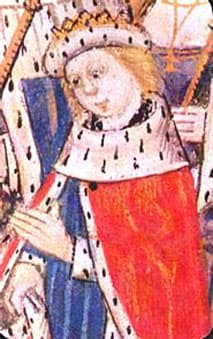
Edward V of England
Emperor · Medieval
47.5Total

Napoleon Bonaparte
General · Modern
70.9Total
Basic Information
Born
1470
1769
Died
1483
1821
Era
Medieval
Modern
Nationality
England
France
Occupation
Emperor
General
Civilization
Western
Western
Score Comparison
Military (10%)
16.6
94.0
Political (20%)
68.0
72.0
Influence (20%)
45.5
40.0
Legacy (20%)
37.5
80.0
Leadership (15%)
70.4
78.0
Strategy (15%)
43.0
90.0
TOTAL
47.5
70.9
Edward V of England — Complete Timeline
1483 AD
Accession to the ThronePolitical Action◆ Major
Edward V became king of England at age 12 after the death of his father, Edward IV. His reign was brief and dominated by his uncle Richard, Duke of Gloucester, who acted as Lord Protector.
SuccessionMinor KingYorkist
Impact: national
Deposition by Richard IIIPolitical Action
Edward V was declared illegitimate by Parliament under the Titulus Regius, and his uncle Richard was crowned as Richard III. Edward and his brother Richard were placed in the Tower of London, where they disappeared.
DepositionPrinces in the TowerUsurpation
Impact: nationaltragic
Disappearance of the Princes in the TowerOther◆ Major
Edward V and his brother Richard, Duke of York, vanished from the Tower of London after being declared illegitimate. Their fate remains unknown, but they are widely believed to have been murdered, likely on orders of Richard III.
MysteryMurderPrinces in the Tower
Impact: nationaltragic
Napoleon Bonaparte — Complete Timeline
1799 AD
Coup of 18 BrumaireOther◆ Major
Napoleon Bonaparte, with support from his brother Lucien and key political figures, overthrew the Directory in a bloodless coup. He established the Consulate with himself as First Consul, effectively becoming the ruler of France. This event ended the French Revolution's most unstable period.
French RevolutionCoupRise to Power
Impact: regional
1804 AD
Promulgation of the Napoleonic CodeOther◆ Major
Napoleon enacted the Civil Code of the French, known as the Napoleonic Code, a comprehensive set of laws that replaced the fragmented feudal legal systems. The code established legal equality, protected property rights, and secularized law. It became the basis for legal systems in many European and world countries.
Legal ReformNapoleonic CodeCivil Law
Impact: globalconstructive
1805 AD
Battle of AusterlitzWar◆ Major
Napoleon's Grande Arm
Napoleonic WarsBattleDecisive Victory
Impact: global
1812 AD
Invasion of RussiaWar◆ Major
Napoleon led the Grande Arm
Napoleonic WarsInvasionDisaster
Impact: globaldestructive
1815 AD
Battle of WaterlooWar◆ Major
Napoleon's French army was defeated by the combined forces of the Duke of Wellington's Anglo-Allied army and Gebhard Leberecht von Bl
Napoleonic WarsBattleFinal Defeat
Impact: globaldestructive
Expert Analysis
edward-v-of-england-vs-napoleon-bonaparte
# The Emperor and the Boy: How Destiny Divided Napoleon and Edward V
On a December morning in 1804, Napoleon Bonaparte placed a golden laurel wreath upon his own head in Notre-Dame Cathedral, signaling to the world that he owed his crown to no pope, no dynasty, no accident of birth. Just over three centuries earlier, in the summer of 1483, a twelve-year-old boy named Edward V entered London as its rightful king, only to vanish into the stone walls of the Tower of London within months. One man seized history by the throat; the other was swallowed by it. What separates a figure who reshapes an age from one who is erased by it? The answer lies not in talent alone, but in the cruel arithmetic of circumstance, character, and the window of time each was given.
Origins
Napoleon Bonaparte was born in 1769 on the island of Corsica, a place that had only recently become French. His family were minor nobility, but they were outsiders in every sense—speaking Italian, resenting French rule, scraping by on modest incomes. This marginality forged something in him: an ambition that burned cold and clear. He devoured military history, studied artillery, and watched the French Revolution tear apart the old order. The world was breaking open, and he intended to step through the cracks.
Edward V was born in 1470 into the House of York, at the height of the Wars of the Roses. His father, Edward IV, had fought his way to the throne and held it through sheer force and charisma. The boy grew up in luxury but also in peril. His mother, Elizabeth Woodville, was a queen whose family had risen from obscurity, making enemies among the old nobility. Edward was trained to be a king—but training means little when the throne is a target. He was a prince in a world where princes were currency, not commanders.
The difference in their eras is decisive. Napoleon came of age in a time when merit could crack the ceiling of birth. Edward lived in a world where blood was everything—and blood could be spilled as easily as it was inherited.
Rise to Power
Napoleon’s rise was a staircase of victories. At twenty-four, he drove the British out of Toulon. At twenty-six, he crushed a royalist uprising in Paris with a "whiff of grapeshot." By thirty, he was commanding the Army of Italy, crossing the Alps, and carving a kingdom out of the Austrian Empire. Each campaign added to his legend. He was not born to power; he earned it, bullet by bullet, treaty by treaty.
Edward’s rise was a single step—and it was taken for him. When his father died suddenly in April 1483, the twelve-year-old was proclaimed king from Ludlow Castle. He began a journey to London for his coronation, but his uncle Richard, Duke of Gloucester, intercepted him. Within weeks, Edward was lodged in the Tower of London—not yet a prison, but no longer a palace. His power lasted exactly as long as his uncle allowed it.
Napoleon climbed. Edward was carried. One moved toward power; the other had power move away from him.
Leadership & Governance
As First Consul and later Emperor, Napoleon governed with the precision of a military campaign. He reformed French law into the Napoleonic Code, a system that enshrined equality before the law, protected property, and secularized the state. He centralized education, built roads, stabilized currency, and reconciled with the Catholic Church. His political score of 75 reflects real achievements, but also his authoritarian streak: he silenced dissent, censored newspapers, and crowned himself emperor. He was a reformer who believed in order above all.
Edward V never governed. His reign lasted roughly two months, and he spent most of it in the custody of his uncle. There is no law he signed, no battle he commanded, no policy he shaped. His leadership score of 79.8 is a measure of potential, not performance—a ghost of what might have been.
Napoleon’s military score of 94 speaks for itself. He revolutionized warfare with mobile artillery, rapid marching, and the corps system. He won over sixty battles, from Austerlitz to Jena. Edward’s military score of 14.5 is not an insult; it is a reflection of a life that never reached the battlefield.
Triumph & Tragedy
Napoleon’s greatest triumph was Austerlitz in 1805, where he destroyed a combined Russian and Austrian army and forced the Holy Roman Empire to dissolve. His greatest tragedy was the invasion of Russia in 1812—a catastrophe of overconfidence, cold, and logistics that cost half a million men. He was exiled to Elba, returned, and was finally defeated at Waterloo in 1815. His tragedy was the arc of Icarus: he flew too high, and the sun melted his wings.
Edward’s triumph was simply becoming king—a moment of hope for a war-weary England. His tragedy was the Tower. He and his younger brother Richard, Duke of York, were declared illegitimate by Parliament under the Titulus Regius. Their uncle was crowned Richard III. The boys vanished. Whether they were smothered, starved, or spirited away remains unknown. Their tragedy was not a fall from greatness, but a disappearance into silence.
Character & Destiny
Napoleon was restless, calculating, and utterly convinced of his own destiny. "Impossible is a word to be found only in the dictionary of fools," he once said. He trusted his intellect, his luck, and his army. But his ambition was also his flaw: he could not stop, could not share power, could not accept limits. His character drove him to conquer Europe—and to lose it.
Edward V, by all accounts, was a bright and gentle boy. But gentleness is a liability when surrounded by wolves. He trusted his uncle, or perhaps he had no choice. His character did not shape his destiny; his destiny crushed his character. He was a pawn in a game he never learned to play.
One man bent history to his will. The other was bent by it.
Legacy
Napoleon’s legacy is written in law codes, military academies, and the borders of modern Europe. He is remembered as a genius and a tyrant, a liberator and a conqueror. His influence score of 82 is earned: the Napoleonic Code still governs much of Europe, and his military innovations are studied to this day. He died in exile on Saint Helena in 1821, but his name never faded.
Edward V’s legacy is a mystery. His disappearance became one of history’s great unsolved crimes, inspiring Shakespeare’s *Richard III* and centuries of speculation. His legacy score of 49.4 reflects not what he did, but what was done to him. He is remembered not as a king, but as a victim—a boy in a tower, a shadow in the dark.
Conclusion
Napoleon Bonaparte and Edward V lived in worlds so different they might as well have been separate planets. One was a self-made emperor who commanded armies and rewrote laws; the other was a child king who vanished before he could speak a single command. Yet their stories are bound by a single truth: history rewards action, not birth. Napoleon seized his moment; Edward’s moment seized him. One died in exile, the other in obscurity. But both remind us that the difference between triumph and tragedy is often not talent, but time—and the will to use it before it runs out.
Rankings
🥇
Napoleon BonaparteLeader
Mil: 94.0Pol: 72.0Inf: 40.0
70.9
🥈
Edward V of England
Mil: 16.6Pol: 68.0Inf: 45.5
47.5
+23.4 behind
How This Comparison Works
Algorithm
Each figure is scored on 6 dimensions (0—100 scale) based on structured historical data: Military (10%), Political (20%), Influence (20%), Legacy (20%), Leadership (15%), Strategy (15%). The weighted total produces the final ranking.
Data Sources
Scores are computed from structured sub-indicators in the database. Scale factors adjust for era (Ancient ×0.85, Modern ×1.0) and civilization size (Eastern ×1.05, Other ×0.80) to account for differences in population and military scale.
Maximum 3 Figures
Comparisons are limited to 2—3 figures to ensure readability and statistical meaningfulness.
Error Margins
±5 points per dimension — Sub-scores are derived from historical records with inherent uncertainty. Two figures within 5 points on a dimension should be considered roughly equivalent in that area.
Total Score Accuracy
±3 points overall — The weighted combination of 6 dimensions produces a total score with approximately ±3 points of uncertainty. Differences of less than 3 points are not statistically significant— the figures are effectively tied.
Known Limitations
- Historical records are incomplete and uneven across civilizations
- Figures from oral-tradition societies may be underrepresented
- Occupation labels can misclassify multi-role figures
- Scores measure capability and impact, not moral character
- Quantitative scoring is a comparison tool, not absolute truth
Capability Radar
Military (10%) — Battles & Warfare
Battles
8
95
Win Rate
11
90
Expansion
9
95
Political (20%) — Governance & Reform
Reform
51
95
Diplomacy
52
80
Economy
56
85
Influence (20%) — Cultural & Global Reach
Cultural
5
85
Global
5
90
Legacy (20%) — Historical Impact
Historical
15
95
Longevity
10
90
Leadership (15%) — Power & Stability
Tenure
46
85
Stability
58
70
Strategy (15%) — Tactics & Innovation
Strategy
14
95
Tactics
19
98
Reform
19
92
Similar Comparisons
Comments & Discussion
Boney's Boy6/17/2026
Comparing Napoleon to a child king who lasted months is like comparing a hurricane to a hiccup. Edward V was a pawn in Richard III's power game—his disappearance proves how brittle royal blood is without muscle. Napoleon wasn't just lucky; he crushed Austria at Austerlitz (1805) with 73,000 men against 86,000. That's strategy, not circumstance. The 'cruel arithmetic' here isn't fate—it's one man studying artillery while the other studied psalms.
皇冠猎手6/17/2026
说爱德华五世输在时间?荒唐!拿破仑活到51岁,爱德华若活到同样岁数,都到1521年了——亨利八世正烧死异教徒呢。关键是:拿破仑是革命之子,从底层杀穿旧秩序;爱德华是血缘图腾,15岁不到的娃娃国王连议会都压不住。历史不是同情弱者,只给枪炮时间。
Data Skeptic Steve6/17/2026
This narrative ignores cold facts: Napoleon controlled France for 15 years, Edward V for maybe 2 months. That's a 90:1 ratio in impact window alone. And 'erased by history'? Edward's bones were allegedly found under a staircase in 1674—that's not erasure, that's a murder mystery. Napoleon's legacy is measurable: 7.4 million French military casualties vs. barely a handful in Edward's 'reign'. The comparison is apples to orbital lasers.
古典学痴6/17/2026
拿拿破仑比爱德华五世,好比拿阿喀琉斯比帕里斯——一个砍翻特洛伊,一个射冷箭躲墙角。爱德华是被"命运"吞了吗?不,是被他叔父的野心掐死在摇篮里。拿破仑自戴皇冠,像极了马基雅维利笔下的新君主,而爱德华连《君主论》的脚注都当不上。真实分割线:对12岁男孩,历史是赌桌;对35岁将军,历史是棋盘。