Loading...
Emperor Jing of Han vs Napoleon Bonaparte
Napoleon Bonaparte leads by 21.7 pts · 2 figures compared
…
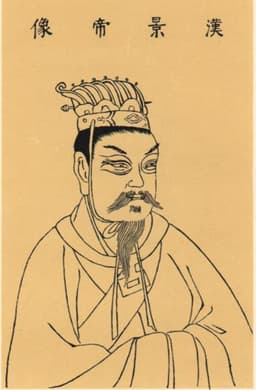
Emperor Jing of Han
Emperor · Ancient
49.2Total

Napoleon Bonaparte
General · Modern
70.9Total
Basic Information
Born
-188
1769
Died
-141
1821
Era
Ancient
Modern
Nationality
China
France
Occupation
Emperor
General
Civilization
Eastern
Western
Score Comparison
Military (10%)
30.0
94.0
Political (20%)
62.7
72.0
Influence (20%)
51.8
40.0
Legacy (20%)
47.5
80.0
Leadership (15%)
40.0
78.0
Strategy (15%)
60.0
90.0
TOTAL
49.2
70.9
Emperor Jing of Han — Complete Timeline
156 BC
Continuation of Tax ReductionsReform
Emperor Jing maintained the low tax rate of one-thirtieth set by his father, Emperor Wen, and further reduced labor service requirements. This policy sustained agricultural prosperity and popular support, contributing to the Rule of Wen and Jing.
Tax ReformAgricultureRule of Wen and Jing
Impact: nationalconstructive
154 BC
Suppression of the Rebellion of the Seven StatesWar
Seven feudal kingdoms led by Liu Pi of Wu rebelled against Emperor Jing's centralization policies. Emperor Jing appointed Zhou Yafu as commander, who defeated the rebels within three months. This victory crushed the power of the feudal lords and strengthened imperial authority.
RebellionCentralizationZhou Yafu
Impact: national
Execution of Chao CuoPolitical Action◆ Major
Emperor Jing ordered the execution of his advisor Chao Cuo to appease the rebelling seven states, despite Chao Cuo having advocated the centralization policies that triggered the rebellion. This act failed to stop the rebellion but demonstrated the emperor's willingness to sacrifice allies.
ExecutionPolitical SacrificeChao Cuo
Impact: nationaltragic
145 BC
Legal Code SimplificationReform
Emperor Jing ordered the simplification of the legal code, reducing the number of beatings in punishments and standardizing penalties. This reform aimed to prevent deaths from excessive beatings and continued the trend toward a more humane legal system begun by his father.
Legal ReformHumanitarianismPunishment
Impact: nationalprogressive
Napoleon Bonaparte — Complete Timeline
1799 AD
Coup of 18 BrumaireOther◆ Major
Napoleon Bonaparte, with support from his brother Lucien and key political figures, overthrew the Directory in a bloodless coup. He established the Consulate with himself as First Consul, effectively becoming the ruler of France. This event ended the French Revolution's most unstable period.
French RevolutionCoupRise to Power
Impact: regional
1804 AD
Promulgation of the Napoleonic CodeOther◆ Major
Napoleon enacted the Civil Code of the French, known as the Napoleonic Code, a comprehensive set of laws that replaced the fragmented feudal legal systems. The code established legal equality, protected property rights, and secularized law. It became the basis for legal systems in many European and world countries.
Legal ReformNapoleonic CodeCivil Law
Impact: globalconstructive
1805 AD
Battle of AusterlitzWar◆ Major
Napoleon's Grande Arm
Napoleonic WarsBattleDecisive Victory
Impact: global
1812 AD
Invasion of RussiaWar◆ Major
Napoleon led the Grande Arm
Napoleonic WarsInvasionDisaster
Impact: globaldestructive
1815 AD
Battle of WaterlooWar◆ Major
Napoleon's French army was defeated by the combined forces of the Duke of Wellington's Anglo-Allied army and Gebhard Leberecht von Bl
Napoleonic WarsBattleFinal Defeat
Impact: globaldestructive
Expert Analysis
emperor-jing-of-han-vs-napoleon-bonaparte
# The Conqueror and the Consolidator
On a June morning in 1815, Napoleon Bonaparte watched his Imperial Guard march toward the smoking ridges of Mont-Saint-Jean, their bearskin caps bobbing above the wheat fields. He had staked everything on one final, crushing blow against Wellington. Half a world away and two thousand years earlier, another ruler faced a different kind of crisis: Emperor Jing of Han sat in his palace at Chang'an, listening to reports that seven kingdoms had risen in rebellion, their armies marching toward his capital. One man would charge into battle, gambling his empire on a single stroke. The other would order the execution of his most trusted advisor to buy time. Both were masters of power, yet they walked radically different paths—and their fates reveal how deeply a ruler's character shapes the arc of history.
Origins
Napoleon was born in 1769 on the Mediterranean island of Corsica, a place that had only recently become French. His family was minor nobility, proud and impoverished, speaking Italian-accented French that would mark him as an outsider for life. The French Revolution erupted when he was a young artillery officer, and it tore away every barrier that birth had erected. In the chaos, talent became the only currency.
Emperor Jing of Han, born in 188 BCE, entered a world already stable. His father, Emperor Wen, had ruled for twenty-three years of peace, reducing taxes and softening the harsh Legalist laws inherited from the Qin dynasty. Jing grew up not in revolution but in renovation—the slow, careful work of building a dynasty's legitimacy. He was the son of an emperor, groomed from childhood to inherit a throne, not to seize one.
Their eras shaped them profoundly. Napoleon's France was a volcano; Jing's China was a garden that needed steady tending. One learned to ride the eruption; the other learned to prune.
Rise to Power
Napoleon's ascent was a series of calculated gambles. At twenty-four, he drove the British out of Toulon and became a brigadier general. At twenty-six, he saved the Directory from a royalist uprising with a "whiff of grapeshot"—a brutal artillery volley into a Parisian crowd. At thirty, he was First Consul of France. Each step required audacity, speed, and the willingness to shed blood.
Jing's path was quieter but no less treacherous. He ascended the throne in 156 BCE upon his father's death, inheriting a realm that was stable but fragile. The real challenge came in 154 BCE, when seven feudal kingdoms—led by Liu Pi of Wu—rose in revolt against his centralization policies. Jing's response was not to fight blindly but to think strategically. His advisor Chao Cuo had urged the crackdown that sparked the rebellion; now the rebels demanded Chao Cuo's head. Jing ordered his execution, sacrificing a loyal minister to buy time and split the rebel coalition. Then he appointed Zhou Yafu, a brilliant general, to crush the rebellion methodically. It was cold, calculating, and effective.
Leadership & Governance
Napoleon ruled through personal magnetism and relentless energy. He led his armies from the front, sharing their rations and their dangers. He rewrote French law with the Napoleonic Code, establishing principles of equality before the law and merit-based advancement that endure to this day. His political score of 75.0 reflects real achievements, but also real failures: he crowned himself emperor, silenced dissent, and placed family members on thrones across Europe. He believed he was destiny's instrument.
Jing governed through restraint and delegation. He continued his father's policy of one-thirtieth tax rates and further reduced labor service. In 145 BCE, he simplified the legal code, reducing the number of beatings in punishments and standardizing procedures. His leadership score of 75.8 and political score of 67.9 suggest a competent administrator rather than a visionary. But competence, in a dynasty's second generation, is vision. He understood that the Han's survival depended not on glory but on trust—the people's trust that the emperor would not bleed them dry.
Triumph & Tragedy
Napoleon's greatest moment came at Austerlitz in 1805, where he destroyed a combined Russian-Austrian army in a masterful trap. His military score of 94.0 and strategy score of 93.0 are unmatched. But his tragedy was the same as his triumph: he could not stop. He invaded Russia in 1812, lost his Grand Army to winter and hunger, and was exiled to Elba. He returned, raised another army, and was finally defeated at Waterloo in 1815. He died in 1821 on Saint Helena, a prisoner of the British, still insisting he had been fighting for liberty.
Jing's triumph was the suppression of the Seven States Rebellion in 154 BCE. It was not a glorious victory—no Austerlitz, no sweeping cavalry charges—but it preserved the Han dynasty. His tragedy was more subtle: he executed Chao Cuo, a loyal minister, to appease rebels who would never be appeased. The historian Sima Qian would later judge him harshly for this act. Jing never forgot it. He died in 141 BCE, having done his duty, but having also learned that even emperors must live with their compromises.
Character & Destiny
Napoleon was driven by ambition so vast it consumed everything around it. He once said, "I am not a man; I am a thing." He saw himself as an instrument of history, and he was—but history's instruments are broken when they are no longer useful. His personality demanded constant motion, constant victory. When victory stopped, so did he.
Jing was driven by duty. He was not charismatic; he did not inspire poems or paintings. But he understood that power is not about the ruler but about the system. His personality was suited to consolidation, not conquest. He did not want to be remembered; he wanted the Han to endure.
Legacy
Napoleon's legacy is global. The Napoleonic Code shaped civil law across Europe and the Americas. His military campaigns are still studied in war colleges. His influence score of 82.0 and legacy score of 78.0 reflect a man who changed the world, for better and worse. But his empire crumbled within a decade of his death.
Jing's legacy is quieter but deeper. His reign, combined with his father's, is remembered as the "Rule of Wen and Jing"—a golden age of peace and prosperity. The Han dynasty would last another three hundred years, and Chinese civilization would call itself "Han" forever. His legacy score of 68.3 is lower than Napoleon's, but it rests on something more durable: a dynasty that outlasted its founder.
Conclusion
Napoleon and Jing of Han were both builders, but they built different things. Napoleon built a monument to himself, a towering structure of glory and ambition that collapsed under its own weight. Jing built a foundation, buried and unseen, on which generations could stand. One conquered the world and lost himself; the other conquered his own ambition and found his dynasty. Perhaps the deepest lesson is this: the rulers who change history most dramatically are not always the ones who change it most lastingly. The conqueror's flame burns bright, but the consolidator's ember glows long after the fire is gone.
Rankings
🥇
Napoleon BonaparteLeader
Mil: 94.0Pol: 72.0Inf: 40.0
70.9
🥈
Emperor Jing of Han
Mil: 30.0Pol: 62.7Inf: 51.8
49.2
+21.7 behind
How This Comparison Works
Algorithm
Each figure is scored on 6 dimensions (0—100 scale) based on structured historical data: Military (10%), Political (20%), Influence (20%), Legacy (20%), Leadership (15%), Strategy (15%). The weighted total produces the final ranking.
Data Sources
Scores are computed from structured sub-indicators in the database. Scale factors adjust for era (Ancient ×0.85, Modern ×1.0) and civilization size (Eastern ×1.05, Other ×0.80) to account for differences in population and military scale.
Maximum 3 Figures
Comparisons are limited to 2—3 figures to ensure readability and statistical meaningfulness.
Error Margins
±5 points per dimension — Sub-scores are derived from historical records with inherent uncertainty. Two figures within 5 points on a dimension should be considered roughly equivalent in that area.
Total Score Accuracy
±3 points overall — The weighted combination of 6 dimensions produces a total score with approximately ±3 points of uncertainty. Differences of less than 3 points are not statistically significant— the figures are effectively tied.
Known Limitations
- Historical records are incomplete and uneven across civilizations
- Figures from oral-tradition societies may be underrepresented
- Occupation labels can misclassify multi-role figures
- Scores measure capability and impact, not moral character
- Quantitative scoring is a comparison tool, not absolute truth
Capability Radar
Military (10%) — Battles & Warfare
Battles
40
95
Win Rate
60
90
Expansion
20
95
Political (20%) — Governance & Reform
Reform
60
95
Diplomacy
55
80
Economy
70
85
Influence (20%) — Cultural & Global Reach
Cultural
40
85
Global
30
90
Legacy (20%) — Historical Impact
Historical
55
95
Longevity
50
90
Leadership (15%) — Power & Stability
Tenure
65
85
Stability
50
70
Strategy (15%) — Tactics & Innovation
Strategy
55
95
Tactics
45
98
Reform
30
92
Similar Comparisons
Comments & Discussion
CORSICAN THUNDER6/17/2026
Napoleon was a tactical genius on the battlefield, but he was a strategic disaster. He conquered half of Europe but divided it against him. Emperor Jing? He crushed the Seven Kingdoms rebellion by executing Chao Cuo—his own advisor—to buy time, then struck when ready. That's ruthless pragmatism. Napoleon’s ego bled his army dry in Russia; Jing kept his throne by knowing when to wait. Give me the quiet killer over the showboating genius any day.
军国铁血6/17/2026
拿破仑的远征莫斯科像一场豪赌,他输了整个大军。但汉景帝的七国之乱呢?他杀了晁错,让叛乱者自乱阵脚,然后一击制胜。这不是懦弱,是算计。拿破仑有战场直觉,但景帝有帝国本能。拿破仑用士兵填他的野心,景帝用谋略保住江山。历史总是偏爱喧嚣的失败者,但我选那个冷静的赢家。
DATA DETECTIVE6/17/2026
Let’s compare cold numbers: Emperor Jing reigned 16 years, population grew from roughly 30 million to 36 million, and he inherited a stable economy. Napoleon ruled just 10 years past his coup, and France’s GDP per capita actually fell 2% during his wars. Jing’s tax cuts and land reforms solidified a dynasty lasting 400 years. Napoleon’s Continental System wrecked trade. One built a line of succession; one built a tombstone. The data doesn’t lie.
儒生考据6/17/2026
汉武帝的祖父景帝,看起来平淡吧?但《史记》写他“省法令,薄赋敛”,让百姓喘气。而拿破仑呢?他那些法典被吹上天,但法国女性直到二战后才有选举权,景帝时期刑法已趋缓和。拿破仑把自由挂在嘴边,却恢复奴隶贸易。景帝不玩这些虚的,他就是让帝国慢慢变强。谁真正改变了普通人生活?答案很清楚。
CLASSICS PROFESSOR6/17/2026
You miss the deeper contrast. Napoleon was an Enlightenment child—rational, ambitious, reshaping society from above. Emperor Jing was a Confucian ruler—ritual, hierarchy, balancing factions. Napoleon rewrote the map of Europe with law codes; Jing rewrote Han governance by reducing corruption and trusting local officials. One man’s legacy is a museum; the other’s is a civilization’s foundation. I’ll take the subtler, longer game.
铁幕评史6/17/2026
别光吹拿破仑,他那套军事天才论全是神话。滑铁卢前一天,他还把主力浪费在夸目之战。而景帝在七国之乱中,根本没亲征,却调度杀了七王。拿破仑最后流放圣赫勒拿,像个笑话;景帝死了,汉朝又延续两百年。历史给了