Loading...
Emperor Kammu vs Napoleon Bonaparte
Napoleon Bonaparte leads by 6.0 pts · 2 figures compared
…
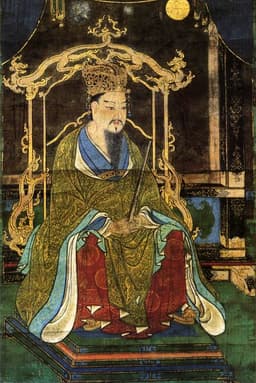
Emperor Kammu
Emperor · Medieval
64.9Total

Napoleon Bonaparte
General · Modern
70.9Total
Basic Information
Born
737
1769
Died
806
1821
Era
Medieval
Modern
Nationality
Japan
France
Occupation
Emperor
General
Civilization
Eastern
Western
Score Comparison
Military (10%)
21.2
94.0
Political (20%)
72.0
72.0
Influence (20%)
82.0
40.0
Legacy (20%)
68.0
80.0
Leadership (15%)
72.0
78.0
Strategy (15%)
36.8
90.0
TOTAL
64.9
70.9
Emperor Kammu — Complete Timeline
789 AD
Campaign against the EmishiWar◆ Major
Kammu launched a major military campaign to subdue the Emishi people in northern Honshu. The campaign was initially unsuccessful, with a defeat at the Battle of Koromo River, but later efforts under Sakanoue no Tamuramaro achieved victory.
Military CampaignEmishiExpansion
Impact: national
794 AD
Moved the capital to Heian-kyoPolitical Action
Emperor Kammu moved the imperial capital from Nara to Heian-kyo (modern Kyoto). This relocation was intended to escape the influence of powerful Buddhist monasteries in Nara and marked the beginning of the Heian period.
Capital MoveHeian PeriodJapan
Impact: nationalconstructive
800 AD
Patronage of Buddhist templesCultural
Kammu commissioned the construction of several Buddhist temples in Heian-kyo, including To-ji and Sai-ji. These temples were intended to protect the new capital and promote Buddhism as a state religion.
BuddhismArchitectureReligion
Impact: nationalconstructive
Napoleon Bonaparte — Complete Timeline
1799 AD
Coup of 18 BrumaireOther◆ Major
Napoleon Bonaparte, with support from his brother Lucien and key political figures, overthrew the Directory in a bloodless coup. He established the Consulate with himself as First Consul, effectively becoming the ruler of France. This event ended the French Revolution's most unstable period.
French RevolutionCoupRise to Power
Impact: regional
1804 AD
Promulgation of the Napoleonic CodeOther◆ Major
Napoleon enacted the Civil Code of the French, known as the Napoleonic Code, a comprehensive set of laws that replaced the fragmented feudal legal systems. The code established legal equality, protected property rights, and secularized law. It became the basis for legal systems in many European and world countries.
Legal ReformNapoleonic CodeCivil Law
Impact: globalconstructive
1805 AD
Battle of AusterlitzWar◆ Major
Napoleon's Grande Arm
Napoleonic WarsBattleDecisive Victory
Impact: global
1812 AD
Invasion of RussiaWar◆ Major
Napoleon led the Grande Arm
Napoleonic WarsInvasionDisaster
Impact: globaldestructive
1815 AD
Battle of WaterlooWar◆ Major
Napoleon's French army was defeated by the combined forces of the Duke of Wellington's Anglo-Allied army and Gebhard Leberecht von Bl
Napoleonic WarsBattleFinal Defeat
Impact: globaldestructive
Expert Analysis
emperor-kammu-vs-napoleon-bonaparte
# The Emperor and the Eagle
On a winter morning in 794, Emperor Kammu stood on a hill overlooking a valley in central Japan, watching workers lay the foundations of a new capital. He was a man in his fifties, dressed in silk robes, surrounded by courtiers who whispered about ghosts and Buddhist omens. Half a world away and a thousand years later, another man would stand on a similar hill—but this one would be in Egypt, and he would be a young artillery officer in a threadbare coat, watching the sun set over the pyramids and calculating, with cold precision, how many cannon he would need to destroy the Mamluk army. Between these two figures—one an emperor who moved a capital, the other a general who moved continents—lies a chasm of time, culture, and ambition that reveals something profound about power itself.
Origins
Emperor Kammu was born in 737, the son of a prince and a woman from a powerful Korean immigrant clan. He grew up in Nara, a capital city that smelled of incense and decay, where Buddhist monks had grown so powerful they could dictate imperial policy. The Japanese imperial court was a world of ritual, poetry, and endless intrigue, where a man could spend decades waiting for a chance to rule. Kammu was patient. He had to be.
Napoleon Bonaparte was born in 1769 on the island of Corsica, a place that had just been sold to France by the Republic of Genoa. His family were minor nobles, poor and resentful. As a boy, he spoke Corsican, not French, and his schoolmates mocked his accent. Where Kammu inherited a throne, Napoleon inherited a chip on his shoulder. Where Kammu learned to navigate a world of silken whispers, Napoleon learned to fight.
Rise to Power
Kammu ascended the throne in 781, at the age of forty-four. He had spent decades watching his predecessors fail—crushed by monkish influence, bankrupted by temple construction, paralyzed by factionalism. He knew that the only way to restore imperial authority was to break the Buddhist stranglehold on the court. So he did something unprecedented: he simply moved the capital. In 794, he relocated the imperial court from Nara to Heian-kyo, a new city built far from the great monasteries. It was a bloodless revolution, accomplished not with armies but with decrees and carpenters.
Napoleon’s rise was bloodier. In 1793, at the age of twenty-four, he recaptured the port of Toulon from British forces with a brilliant use of artillery. By 1796, he was commanding the Army of Italy, where he won a series of stunning victories against the Austrians. Where Kammu moved stones, Napoleon moved armies. Where Kammu waited decades for power, Napoleon seized it in a matter of years. In 1799, he staged a coup and became First Consul of France. He was thirty years old.
Leadership & Governance
Kammu’s reign was a study in careful reform. He centralized tax collection, reduced the power of the aristocracy, and patronized Buddhist temples that were loyal to the throne—but he did so cautiously, always aware that the old nobility could strike back. His greatest achievement was the capital itself: Heian-kyo, designed on a grid pattern modeled after the Chinese Tang capital, became the heart of Japanese civilization for over a thousand years. Yet Kammu was no military genius. In 789, he launched a campaign against the Emishi people in northern Honshu, and it failed badly. The imperial army was ambushed in the mountains; thousands died. Kammu never tried again.
Napoleon governed with a different kind of genius. The Napoleonic Code, enacted in 1804, standardized French law and influenced legal systems across Europe and the world. He reformed education, established the Bank of France, and built roads and canals. But his true genius was military: at Austerlitz in 1805, he destroyed a combined Russian and Austrian army with a strategy so perfect it is still studied in war colleges today. His leadership was charismatic, ruthless, and utterly personal. He led from the front, sharing the soldier’s mud and hunger, and his men adored him for it.
Triumph & Tragedy
Kammu’s triumph was the creation of Heian-kyo. For the next four centuries, Japan would enjoy a golden age of art, literature, and courtly refinement—the world of *The Tale of Genji* and cherry blossom poetry. But Kammu’s tragedy was that he could not fully tame the forces he had set in motion. The move to Heian-kyo weakened the Buddhist monasteries, but it also weakened the imperial army. Within a century, the emperor would become a figurehead, and real power would pass to the samurai clans.
Napoleon’s triumph was his empire: by 1810, he controlled or dominated most of Europe, from Spain to Poland. His tragedy was overreach. In 1812, he invaded Russia with 600,000 men; he returned with fewer than 100,000. The following year, the coalition armies crushed him at Leipzig. Exiled to Elba, he escaped, returned to France, and was finally defeated at Waterloo in 1815. He died six years later on Saint Helena, a British prisoner.
Character & Destiny
Kammu was a man of restraint, calculation, and patience. He understood that in Japan, power was not taken—it was accumulated, like interest. He moved the capital not because he was ambitious, but because he was cornered. Napoleon was the opposite: he was ambition incarnate. “I am not a man,” he once said, “but a thing.” He could not stop. He could not rest. His character drove him to conquer, and his character drove him to fail.
Their destinies reflected their worlds. Kammu lived in a civilization where legitimacy came from tradition, where change had to be gradual, where an emperor was a priest-king, not a warrior. Napoleon lived in a civilization where legitimacy came from victory, where a man could rise from nothing to rule an empire, where the only law was success.
Legacy
Kammu’s legacy is the city of Kyoto, which remained the imperial capital until 1868. He is remembered as a reformer, a builder, a man who saved the Japanese monarchy from extinction. His name is not famous outside Japan, but his work endures.
Napoleon’s legacy is everywhere: in the legal codes of Europe, in the shape of modern warfare, in the very idea of the “self-made man.” He is remembered as a genius and a tyrant, a liberator and a conqueror. His name is known in every language.
Conclusion
What drove these two men to such different outcomes? Not ability—both were brilliant in their own ways. Not opportunity—both seized the chances their eras gave them. What drove them was the shape of the world they were born into. Kammu’s world was a closed garden, where power grew slowly and died slowly. Napoleon’s world was a battlefield, where power could be won in a single afternoon and lost in another. One moved a capital. The other moved the world. Both did what their time demanded. And both, in the end, were prisoners of history.
Rankings
🥇
Napoleon BonaparteLeader
Mil: 94.0Pol: 72.0Inf: 40.0
70.9
🥈
Emperor Kammu
Mil: 21.2Pol: 72.0Inf: 82.0
64.9
+6.0 behind
How This Comparison Works
Algorithm
Each figure is scored on 6 dimensions (0—100 scale) based on structured historical data: Military (10%), Political (20%), Influence (20%), Legacy (20%), Leadership (15%), Strategy (15%). The weighted total produces the final ranking.
Data Sources
Scores are computed from structured sub-indicators in the database. Scale factors adjust for era (Ancient ×0.85, Modern ×1.0) and civilization size (Eastern ×1.05, Other ×0.80) to account for differences in population and military scale.
Maximum 3 Figures
Comparisons are limited to 2—3 figures to ensure readability and statistical meaningfulness.
Error Margins
±5 points per dimension — Sub-scores are derived from historical records with inherent uncertainty. Two figures within 5 points on a dimension should be considered roughly equivalent in that area.
Total Score Accuracy
±3 points overall — The weighted combination of 6 dimensions produces a total score with approximately ±3 points of uncertainty. Differences of less than 3 points are not statistically significant— the figures are effectively tied.
Known Limitations
- Historical records are incomplete and uneven across civilizations
- Figures from oral-tradition societies may be underrepresented
- Occupation labels can misclassify multi-role figures
- Scores measure capability and impact, not moral character
- Quantitative scoring is a comparison tool, not absolute truth
Capability Radar
Military (10%) — Battles & Warfare
Battles
10
95
Win Rate
10
90
Expansion
10
95
Political (20%) — Governance & Reform
Reform
75
95
Diplomacy
60
80
Economy
65
85
Influence (20%) — Cultural & Global Reach
Cultural
70
85
Global
60
90
Legacy (20%) — Historical Impact
Historical
75
95
Longevity
75
90
Leadership (15%) — Power & Stability
Tenure
70
85
Stability
60
70
Strategy (15%) — Tactics & Innovation
Strategy
10
95
Tactics
10
98
Reform
10
92
Similar Comparisons
Comments & Discussion
HEIAN-SPECTRE6/17/2026
Kammu moved a capital to escape Buddhist influence, but Napoleon *became* the state religion of France. One man built Heian-kyō to control monks; the other crowned himself emperor in Notre Dame and made the Pope his prop. Kammu played defense with geography—Napoleon rewrote Europe's geography. There's no comparison. One is a footnote, the other is a chapter.
忍者算术师6/17/2026
拿破仑打了60多场仗,胜率85%,而桓武天皇最出名的军事行动是征讨虾夷,打了好几年才勉强赢。数据不会骗人。你告诉我,一个靠搬家出名的人,怎么跟一个改写欧洲地图的人比?历史不是比谁更会选首都地址。
CANNON-PYRAMID6/17/2026
Napoleon in Egypt commanded 40,000 men, 13,000 horses, and 171 cannons across 400 ships. Kammu’s biggest logistical feat? Moving nobles from Nara to Kyoto. That’s not ambition—that’s expensive urban planning. One man calculated how to bomb the Pyramids; the other calculated where to put a garden. Context matters, but so does scale.
铜镜迷雾6/17/2026
别急着吹西方叙事。桓武天皇废佛迁都、打压僧侣势力,这本质上是一场意识形态革命。拿破仑也打压教会,但他最后跟教皇妥协了。一个是把佛教从国政里清出去,一个是被教皇加冕后转身跟教会讲和。谁更彻底?你品。
BIVOUAC-PHILOSOPHER6/17/2026
Here's the dirty secret of this comparison: it's not about who was "greater"—it's about what kind of power you value. Kammu centralized imperial authority in a ritualistic society where legitimacy required ancient bloodlines. Napoleon created meritocratic empire where anyone with talent could rise. Kammu's legacy lasted 1,000 years of imperial continuity. Napoleon's? 15 years of glory, then Waterloo. You pick your poison.