Loading...
Emperor Nintoku vs Napoleon Bonaparte
Napoleon Bonaparte leads by 18.8 pts · 2 figures compared
…
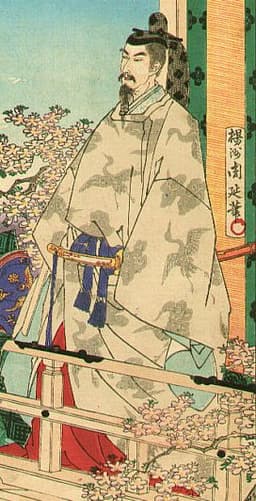
Emperor Nintoku
Emperor · Ancient
52.1Total

Napoleon Bonaparte
General · Modern
70.9Total
Basic Information
Born
290
1769
Died
399
1821
Era
Ancient
Modern
Nationality
Japan
France
Occupation
Emperor
General
Civilization
Eastern
Western
Score Comparison
Military (10%)
11.0
94.0
Political (20%)
43.7
72.0
Influence (20%)
54.9
40.0
Legacy (20%)
52.0
80.0
Leadership (15%)
78.0
78.0
Strategy (15%)
60.0
90.0
TOTAL
52.1
70.9
Emperor Nintoku — Complete Timeline
313 AD
Reign of Emperor NintokuPolitical Action
Emperor Nintoku's reign is traditionally dated from 313 to 399 AD and is considered a period of stability and prosperity for the Yamato state. He is credited with expanding agricultural infrastructure and consolidating the imperial line's authority.
StabilityYamato PeriodProsperity
Impact: nationalconstructive
330 AD
Promoted Agricultural DevelopmentReform
Emperor Nintoku is said to have ordered the construction of irrigation canals and rice paddies to boost agricultural output. These projects are recorded in the Nihon Shoki as having alleviated famine and strengthened the economic base of the Yamato court.
AgricultureInfrastructureEconomic Development
Impact: nationalconstructive
350 AD
Construction of Daisen KofunCultural◆ Major
Emperor Nintoku commissioned the construction of the Daisen Kofun in Sakai, Osaka, the largest keyhole-shaped burial mound in the world. The tomb measures 486 meters in length and is surrounded by three moats, reflecting the immense power and resources of the Yamato state.
ArchitectureKofun PeriodBurial Mound
Impact: globalconstructive
Napoleon Bonaparte — Complete Timeline
1799 AD
Coup of 18 BrumaireOther◆ Major
Napoleon Bonaparte, with support from his brother Lucien and key political figures, overthrew the Directory in a bloodless coup. He established the Consulate with himself as First Consul, effectively becoming the ruler of France. This event ended the French Revolution's most unstable period.
French RevolutionCoupRise to Power
Impact: regional
1804 AD
Promulgation of the Napoleonic CodeOther◆ Major
Napoleon enacted the Civil Code of the French, known as the Napoleonic Code, a comprehensive set of laws that replaced the fragmented feudal legal systems. The code established legal equality, protected property rights, and secularized law. It became the basis for legal systems in many European and world countries.
Legal ReformNapoleonic CodeCivil Law
Impact: globalconstructive
1805 AD
Battle of AusterlitzWar◆ Major
Napoleon's Grande Arm
Napoleonic WarsBattleDecisive Victory
Impact: global
1812 AD
Invasion of RussiaWar◆ Major
Napoleon led the Grande Arm
Napoleonic WarsInvasionDisaster
Impact: globaldestructive
1815 AD
Battle of WaterlooWar◆ Major
Napoleon's French army was defeated by the combined forces of the Duke of Wellington's Anglo-Allied army and Gebhard Leberecht von Bl
Napoleonic WarsBattleFinal Defeat
Impact: globaldestructive
Expert Analysis
emperor-nintoku-vs-napoleon-bonaparte
# The Emperor and the Conqueror: Two Paths to Immortality
On a misty morning in 1815, Napoleon Bonaparte stood on a muddy field near Waterloo, watching his dreams of empire dissolve into cannon smoke. Eighteen centuries earlier and half a world away, Emperor Nintoku of Japan was likely gazing over newly dug irrigation canals, watching water flow into rice paddies that would feed generations. One man built an empire that stretched from Madrid to Moscow; the other built a tomb. Both sought immortality. Only one understood what it truly meant.
Origins
Napoleon was born in 1769 on the Mediterranean island of Corsica, a place that had only recently become French. His family was minor nobility, struggling and ambitious. The son of a lawyer, he spoke Italian-accented French and was mocked by classmates at military school. This outsider status forged something in him—a hunger to prove himself, a belief that the world could be remade by sheer will. The French Revolution, erupting when he was twenty, shattered the old order and opened doors that would have remained closed to a Corsican upstart in the old regime.
Emperor Nintoku, born in 290 AD, emerged from a world where the rules were already carved in stone—or rather, in earth. He was the fourth son of Emperor Ōjin, raised in the Yamato court where lineage was destiny. Japan of the fourth century was a collection of warring clans unified under a sacred imperial line, but power was fragile. Nintoku’s path was not one of conquest but of consolidation. His era did not demand a revolutionary; it needed a steward.
Rise to Power
Napoleon’s ascent was a rocket trajectory. At age twenty-four, he crushed a royalist uprising in Paris with a “whiff of grapeshot.” At twenty-six, he led a ragged army across the Alps into Italy, winning battles that seemed impossible. By thirty, he was First Consul of France; by thirty-five, Emperor. Each victory fed the next. The siege of Toulon in 1793, the Italian campaign of 1796, the Egyptian expedition of 1798—these were not just military triumphs but political theater. Napoleon understood that in a revolutionary age, glory was currency.
Nintoku’s rise was the opposite: slow, ceremonial, almost invisible to history. He became emperor around 313 AD, probably in his twenties, but his reign is recorded not in battles but in rice yields. The *Nihon Shoki*, compiled centuries later, tells us he ascended after his older brothers either died or stepped aside. There were no dramatic coups, no sweeping campaigns—just the quiet assumption of a role that had existed for centuries and would continue for centuries more.
Leadership & Governance
Here the two men diverge like rivers flowing to different seas. Napoleon was a whirlwind. He reorganized French law into the Napoleonic Code, streamlined the bureaucracy, established the Bank of France, and created a system of lycées that educated a generation. His military reforms were equally radical: the corps system, fast marches, artillery concentration, and the cultivation of merit over birth. At his peak in 1807, he controlled most of Europe. He gave France order, efficiency, and glory—but at a terrible cost in blood.
Nintoku governed on an entirely different scale. His reign, traditionally dated from 313 to 399, was a period of stability and prosperity. The key event was not a battle but an irrigation project. Around 330 AD, he ordered the construction of canals and rice paddies to boost agricultural output. This was not glamorous work—digging ditches does not inspire songs—but it fed people. Where Napoleon built an empire of conquest, Nintoku built an empire of sustenance. His military score of 41.5 reflects a ruler who did not need to fight because he kept his kingdom at peace.
Triumph & Tragedy
Napoleon’s greatest triumph was Austerlitz in 1805, where he destroyed a combined Russian and Austrian army with tactical brilliance that still studied in military academies. His greatest tragedy was the invasion of Russia in 1812, where 600,000 men marched east and fewer than 100,000 returned. The pattern repeated: overreach, hubris, and the cold arithmetic of attrition. Waterloo was merely the final act.
Nintoku’s triumph was the Daisen Kofun, the largest keyhole-shaped burial mound in the world, built around 350 AD in Sakai, Osaka. This tomb, 486 meters long and surrounded by three moats, is a monument not to victory but to permanence. It required decades of labor and the coordination of thousands of workers. Its tragedy is that we know almost nothing about the man buried inside. No epic poems, no dramatic last words—just the silent earth.
Character & Destiny
Napoleon was a man of boundless energy and insatiable ambition. “Impossible is a word to be found only in the dictionary of fools,” he once said. He slept four hours a night, dictated letters to multiple secretaries simultaneously, and personally led charges on the battlefield. His character drove his destiny—the Corsican outsider who conquered Europe, then lost it all because he could not stop. Exiled to Saint Helena, he spent his final years rewriting his own legend.
Nintoku’s character is a mystery wrapped in legend. Japanese tradition portrays him as a benevolent ruler who exempted his people from taxes for three years after seeing a kitchen without smoke—a sign of poverty. He was patient, paternal, and profoundly aware of his role as a link in an unbroken chain. His destiny was not to conquer but to endure.
Legacy
Napoleon’s legacy is everywhere and nowhere. The Napoleonic Code influences legal systems from Louisiana to Lebanon. His military tactics are still taught. His name adorns streets, bridges, and brandy. Yet his empire crumbled within a decade of his death. He left France exhausted, diminished, and haunted by the memory of glory.
Nintoku’s legacy is physical and quiet. The Daisen Kofun still stands in Sakai, a green hill in a modern city, now a UNESCO World Heritage site. The irrigation canals he ordered may still flow. His reign is remembered as a golden age of peace, and the imperial line he belonged to continues to this day. His legacy score of 55.0, lower than Napoleon’s 78.0, reflects a different kind of immortality—not fame, but continuity.
Conclusion
Napoleon Bonaparte and Emperor Nintoku represent two answers to the same human question: How does one leave a mark on history? Napoleon chose the path of fire—conquest, revolution, and the thunder of cannons. Nintoku chose the path of water—irrigation, stability, and the slow shaping of the land. One built an empire that burned brightly and vanished. The other built a tomb that still stands, silent and green, after sixteen centuries. Perhaps the conqueror’s tragedy is that he never understood what Nintoku knew: that the greatest power is not the ability to destroy, but the patience to endure.
Rankings
🥇
Napoleon BonaparteLeader
Mil: 94.0Pol: 72.0Inf: 40.0
70.9
🥈
Emperor Nintoku
Mil: 11.0Pol: 43.7Inf: 54.9
52.1
+18.8 behind
How This Comparison Works
Algorithm
Each figure is scored on 6 dimensions (0—100 scale) based on structured historical data: Military (10%), Political (20%), Influence (20%), Legacy (20%), Leadership (15%), Strategy (15%). The weighted total produces the final ranking.
Data Sources
Scores are computed from structured sub-indicators in the database. Scale factors adjust for era (Ancient ×0.85, Modern ×1.0) and civilization size (Eastern ×1.05, Other ×0.80) to account for differences in population and military scale.
Maximum 3 Figures
Comparisons are limited to 2—3 figures to ensure readability and statistical meaningfulness.
Error Margins
±5 points per dimension — Sub-scores are derived from historical records with inherent uncertainty. Two figures within 5 points on a dimension should be considered roughly equivalent in that area.
Total Score Accuracy
±3 points overall — The weighted combination of 6 dimensions produces a total score with approximately ±3 points of uncertainty. Differences of less than 3 points are not statistically significant— the figures are effectively tied.
Known Limitations
- Historical records are incomplete and uneven across civilizations
- Figures from oral-tradition societies may be underrepresented
- Occupation labels can misclassify multi-role figures
- Scores measure capability and impact, not moral character
- Quantitative scoring is a comparison tool, not absolute truth
Capability Radar
Military (10%) — Battles & Warfare
Battles
34
95
Win Rate
37
90
Expansion
39
95
Political (20%) — Governance & Reform
Reform
40
95
Diplomacy
30
80
Economy
50
85
Influence (20%) — Cultural & Global Reach
Cultural
60
85
Global
30
90
Legacy (20%) — Historical Impact
Historical
70
95
Longevity
80
90
Leadership (15%) — Power & Stability
Tenure
87
85
Stability
70
70
Strategy (15%) — Tactics & Innovation
Strategy
41
95
Tactics
45
98
Reform
45
92
Similar Comparisons
Comments & Discussion
Tombstone Tourist6/17/2026
Comparing Nintoku to Napoleon is like comparing a garden hose to a hurricane. One built the world’s most over-engineered dirt pile—the Mozu Tombs, swallowing 5 million cubic feet of earth—while the other reshaped Europe’s legal codes and borders. Nintoku’s “immortality” was just a landlord’s vanity; Napoleon’s survived in laws still cited today. Give me the Little Corporal’s ambition over a glorified grave-digger any day.
数据考古学家6/17/2026
说仁德靠灌溉渠?那纯粹是七世纪《日本书纪》的皇室宣传,比拿破仑的战报还不可信。他那个大仙陵古坟,占地比三个足球场还大,要征多少民夫?少了十万人都干不完。拿破仑起码有《民法典》撑腰,仁德就是个黄土地主,靠着后人编的孝道教典洗白。别拿神话当历史。
Legionary Lens6/17/2026
Napoleon fights Nintoku? One’s a tactical meteor, the other a stationary crater. At Austerlitz, Napoleon split an allied army with one feint; Nintoku’s entire reign lacks a single recorded battle. His “conquest” was scribes assigning him a reign to fill a timeline. I’d bet on a Corsican with a cannon over a Yamato ghost every time. Nintoku’s tomb doesn’t even have a body—just propaganda.
宫本考据狂6/17/2026
拿破仑是革命造出来的火药桶,仁德却是天皇血统的装饰品。拿破仑从科西嘉乡下小子打到巴黎,靠的是能力和运气;仁德是应神天皇的四子,纯粹投胎赢家。他修的那土馒头,再大也掩盖不了权力的空洞。比较这两人?一个用剑写历史,一个用铁锹。少拿封建图腾比战略天才。
Clockwork Causality6/17/2026
Let’s cut the romance: Napoleon lost at Waterloo; Nintoku never fought at all. One’s a tragic hero of gunpowder and hubris, the other a blank slate of folk tales. The analysis credits Nintoku with “understanding immortality” through infrastructure, but history’s written by victors—and Nintoku’s victory was outliving his brothers. Napoleon’s legacy is scrutinized; Nintoku’s is a mound of guesswork. Give me a real man over a myth.
春秋笔法6/17/2026
比来比去,核心就一点:仁德的“不朽”靠的是死后九百年才写成的传说,拿破仑的实打实影响至今。拿破仑输了滑铁卢,还留下一个欧洲;仁德赢了什么?一场没记载的和平?一套灌溉系统?到明治维新前,日本农民还在饿肚子。别美化一个