Loading...
Emperor Taizu of Liao vs Napoleon Bonaparte
Napoleon Bonaparte leads by 4.1 pts · 2 figures compared
…
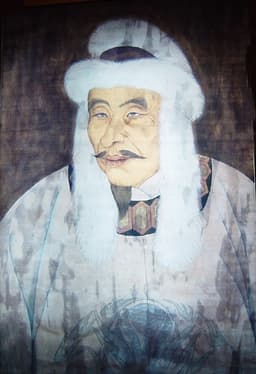
Emperor Taizu of Liao
Emperor · Medieval
66.8Total

Napoleon Bonaparte
General · Modern
70.9Total
Basic Information
Born
872
1769
Died
926
1821
Era
Medieval
Modern
Nationality
China
France
Occupation
Emperor
General
Civilization
Eastern
Western
Score Comparison
Military (10%)
76.0
94.0
Political (20%)
78.0
72.0
Influence (20%)
72.0
40.0
Legacy (20%)
40.0
80.0
Leadership (15%)
80.0
78.0
Strategy (15%)
75.0
90.0
TOTAL
66.8
70.9
Emperor Taizu of Liao — Complete Timeline
907 AD
Founding of the Liao DynastyPolitical Action
Abaoji, a Khitan chieftain, unified the Khitan tribes and proclaimed himself emperor, founding the Liao dynasty. This established the first major steppe-based dynasty to rule parts of northern China.
Dynasty FoundingUnification
Impact: regionalconstructive
916 AD
Establishment of the Dual Administration SystemReform◆ Major
Emperor Taizu established a dual administration system, with separate institutions for Khitan and Chinese subjects. This allowed the Liao to effectively govern both nomadic and agricultural populations, a model later adopted by other conquest dynasties.
Government ReformAdministration
Impact: regionalconstructive
920 AD
Creation of the Khitan ScriptCultural◆ Major
Emperor Taizu ordered the creation of a Khitan script, based on Chinese characters, to write the Khitan language. This script was used for official documents and inscriptions, promoting Khitan culture and administration.
Writing SystemCultural Development
Impact: regionalconstructive
926 AD
Conquest of the Bohai KingdomWar◆ Major
Emperor Taizu led a campaign that conquered the Bohai Kingdom in Manchuria. This victory expanded Liao territory eastward and eliminated a rival state, securing the Liao's eastern frontier.
ConquestExpansion
Impact: regionalconstructive
Death of Emperor TaizuPolitical Action
Emperor Taizu died during a campaign against the Bohai Kingdom. His death led to a succession struggle among his sons, but his son Yel
DeathSuccession
Impact: national
Napoleon Bonaparte — Complete Timeline
1799 AD
Coup of 18 BrumaireOther◆ Major
Napoleon Bonaparte, with support from his brother Lucien and key political figures, overthrew the Directory in a bloodless coup. He established the Consulate with himself as First Consul, effectively becoming the ruler of France. This event ended the French Revolution's most unstable period.
French RevolutionCoupRise to Power
Impact: regional
1804 AD
Promulgation of the Napoleonic CodeOther◆ Major
Napoleon enacted the Civil Code of the French, known as the Napoleonic Code, a comprehensive set of laws that replaced the fragmented feudal legal systems. The code established legal equality, protected property rights, and secularized law. It became the basis for legal systems in many European and world countries.
Legal ReformNapoleonic CodeCivil Law
Impact: globalconstructive
1805 AD
Battle of AusterlitzWar◆ Major
Napoleon's Grande Arm
Napoleonic WarsBattleDecisive Victory
Impact: global
1812 AD
Invasion of RussiaWar◆ Major
Napoleon led the Grande Arm
Napoleonic WarsInvasionDisaster
Impact: globaldestructive
1815 AD
Battle of WaterlooWar◆ Major
Napoleon's French army was defeated by the combined forces of the Duke of Wellington's Anglo-Allied army and Gebhard Leberecht von Bl
Napoleonic WarsBattleFinal Defeat
Impact: globaldestructive
Expert Analysis
emperor-taizu-of-liao-vs-napoleon-bonaparte
# The Conqueror and the Unifier: Napoleon and Emperor Taizu of Liao
On a June morning in 1815, Napoleon Bonaparte watched his legions advance across the muddy fields of Waterloo, confident that victory would seal his empire. Less than a thousand years earlier and half a world away, a Khitan chieftain named Yelü Abaoji stood on the Mongolian steppe, gazing at the scattered tents of rival tribes he had just united under a single banner. One man would see his life end in exile on a remote Atlantic island; the other would die in his saddle, still leading his people forward. What drove these two founders of empires down such different paths? The answer lies not merely in their talents, but in the worlds they sought to conquer.
Origins
Napoleon was born in 1769 on the Mediterranean island of Corsica, a place that had only recently become French. His family was minor nobility, but their world was one of European courts, Enlightenment ideas, and the crumbling ancien régime. He attended military school in mainland France, where his foreign accent marked him as an outsider. This sense of being an outsider—neither fully French nor fully Corsican—would fuel a relentless ambition to prove himself.
Yelü Abaoji was born in 872 into a different universe entirely: the vast grasslands of Inner Asia, where the Khitan people lived as nomadic herders. His father was a tribal chieftain, but power among the Khitan was fluid and contested. Abaoji grew up riding horses, leading raids, and learning the brutal politics of steppe confederations. Where Napoleon studied artillery and philosophy, Abaoji studied the movements of herds and the shifting loyalties of clans. Their origins shaped not just their skills, but their fundamental understanding of power.
Rise to Power
Napoleon’s ascent was meteoric and theatrical. In 1793, at age twenty-four, he drove British forces from the port of Toulon, catching the eye of revolutionary leaders. By 1796, he commanded the Army of Italy, where his lightning campaigns stunned the Austrian Empire. His brilliance on the battlefield was matched by an instinct for propaganda: he knew that a victory was not complete until it was celebrated in newspapers and paintings. The coup of 18 Brumaire in 1799 placed him at the head of France, and by 1804, he crowned himself Emperor in Notre-Dame Cathedral.
Abaoji’s path was slower, more methodical. In 907, after years of maneuvering, he unified the eight Khitan tribes and proclaimed himself emperor, founding the Liao dynasty. He did not seize power in a dramatic coup; he built it through marriage alliances, feasts, and the patient elimination of rivals. Where Napoleon relied on the momentum of revolution, Abaoji relied on the traditions of the steppe. He understood that a Khitan leader could not simply command—he had to persuade, to embody the will of the tribe.
Leadership & Governance
Napoleon ruled through charisma and terror. His military genius—scoring a 94 in strategy—was undeniable: he reorganized armies, perfected the use of artillery, and moved troops with a speed that left enemies bewildered. But his political wisdom, though scoring a 75, was flawed. The Napoleonic Code unified French law and spread ideals of meritocracy across Europe, yet his insatiable need for conquest bled France dry. He appointed brothers and marshals as kings of conquered lands, creating a fragile empire held together by his personal presence.
Abaoji’s genius was different. His military score of 76.5 is lower than Napoleon’s, but his political score of 76.5 matches it. In 916, he established a dual administration system: one set of institutions for the nomadic Khitan, another for the sedentary Chinese subjects he conquered. This was not mere bureaucracy; it was a profound understanding that an empire of the steppe and an empire of the farm could not be ruled the same way. He also ordered the creation of a Khitan script in 920, giving his people a written identity. Where Napoleon imposed French culture, Abaoji preserved difference under a single crown.
Triumph & Tragedy
Napoleon’s greatest moment was Austerlitz in 1805, where he crushed the combined armies of Russia and Austria in a single day. His worst was the invasion of Russia in 1812: six hundred thousand men marched east; fewer than a hundred thousand returned. The disaster broke his aura of invincibility. Exiled to Elba, he escaped and ruled for a Hundred Days, only to fall at Waterloo in 1815. He died in 1821 on Saint Helena, a prisoner of the British.
Abaoji’s triumph came in 926, when he conquered the Bohai Kingdom in Manchuria, expanding Liao territory eastward. His tragedy was less dramatic but equally final: he died the same year, during the campaign, at age fifty-four. His death triggered a succession struggle among his sons, but the dynasty he founded survived for over two centuries. He did not live to see his empire crumble; he died at its height.
Character & Destiny
Napoleon was restless, brilliant, and incapable of stopping. “I am a creature of circumstances,” he once said, but he created those circumstances. His personality—arrogant, driven, romantic—pushed him to conquer Europe, but also to overreach. He could not sit still; peace bored him. This restlessness was his genius and his doom.
Abaoji was pragmatic and adaptive. He learned from his Chinese subjects without becoming Chinese. He adopted Buddhism but kept Khitan shamanism. He built cities but never forgot the horse. His personality was that of a unifier, not a conqueror: he brought tribes together, created systems, and thought about how to rule, not just how to win. He died in the saddle, doing what he had always done.
Legacy
Napoleon’s legacy is a paradox. He spread nationalism, legal reform, and the metric system across Europe, but also left a trail of corpses. He is remembered as both a hero and a tyrant, a figure of awe and warning. His scores in influence (82) and legacy (78) reflect this complexity.
Abaoji’s legacy is quieter but more stable. The Liao dynasty ruled northern China for two centuries, and his dual administration system influenced later Mongol and Manchu rulers. He is remembered as a founder, not a destroyer. His scores in leadership (81.7) and strategy (78.9) show a different kind of greatness: not the flash of lightning, but the slow growth of a tree.
Conclusion
Standing on the deck of the ship that carried him to Saint Helena, Napoleon reportedly said, “What a novel my life has been.” Abaoji never had time for such reflection. One man wrote his story in the blood of battles and the ink of codes; the other carved his into the grasslands of Asia. Napoleon’s empire shattered within a decade of his death; Abaoji’s endured for centuries. Perhaps the difference is this: Napoleon wanted to be remembered, while Abaoji wanted his people to endure. One sought glory; the other sought stability. History, in its strange balance, has given both what they wanted—but at very different costs.
Rankings
🥇
Napoleon BonaparteLeader
Mil: 94.0Pol: 72.0Inf: 40.0
70.9
🥈
Emperor Taizu of Liao
Mil: 76.0Pol: 78.0Inf: 72.0
66.8
+4.1 behind
How This Comparison Works
Algorithm
Each figure is scored on 6 dimensions (0—100 scale) based on structured historical data: Military (10%), Political (20%), Influence (20%), Legacy (20%), Leadership (15%), Strategy (15%). The weighted total produces the final ranking.
Data Sources
Scores are computed from structured sub-indicators in the database. Scale factors adjust for era (Ancient ×0.85, Modern ×1.0) and civilization size (Eastern ×1.05, Other ×0.80) to account for differences in population and military scale.
Maximum 3 Figures
Comparisons are limited to 2—3 figures to ensure readability and statistical meaningfulness.
Error Margins
±5 points per dimension — Sub-scores are derived from historical records with inherent uncertainty. Two figures within 5 points on a dimension should be considered roughly equivalent in that area.
Total Score Accuracy
±3 points overall — The weighted combination of 6 dimensions produces a total score with approximately ±3 points of uncertainty. Differences of less than 3 points are not statistically significant— the figures are effectively tied.
Known Limitations
- Historical records are incomplete and uneven across civilizations
- Figures from oral-tradition societies may be underrepresented
- Occupation labels can misclassify multi-role figures
- Scores measure capability and impact, not moral character
- Quantitative scoring is a comparison tool, not absolute truth
Capability Radar
Military (10%) — Battles & Warfare
Battles
75
95
Win Rate
80
90
Expansion
85
95
Political (20%) — Governance & Reform
Reform
90
95
Diplomacy
80
80
Economy
75
85
Influence (20%) — Cultural & Global Reach
Cultural
65
85
Global
60
90
Legacy (20%) — Historical Impact
Historical
75
95
Longevity
70
90
Leadership (15%) — Power & Stability
Tenure
85
85
Stability
70
70
Strategy (15%) — Tactics & Innovation
Strategy
85
95
Tactics
70
98
Reform
90
92
Similar Comparisons
Comments & Discussion
SteppeConqueror6/17/2026
Military historian here, and the real comparison isn’t tactics—it's logistics. Napoleon’s Grand Armée starved in Russia because supply lines broke in the cold. Abaoji won because he brought his supply lines with him on horseback. Steppe mobility let Khitan armies live off herds, not magazines. Napoleon could move fast for a month, max. Abaoji could ride six and still have milk. That’s why one unified all North China and the other froze in retreat.
铁骑之辩6/17/2026
你们总盯着战阵与火炮,却忽略了马镫的意义。没有高桥马镫,拿破仑的胸甲骑兵都是舞步表演。辽太祖把铁制马镫标准化,让每个骑兵都能在马背上射箭砍杀,相当于给冷兵器时代装上了传动轴。拿破仑的战术革命靠的是火药和纪律,但阿保机靠的是把马和人熔成一个战争机器。谁更底层?答案写在草原的骨血里。
DataSkeptic6/17/2026
Let’s kill the myth: Napoleon didn’t unify Europe. He temporarily controlled it like a loan shark collecting debts. Abaoji actually *unified* disparate Khitan tribes into a dynasty that lasted 200+ years. Napoleon’s empire cracked inside a decade. If we measure founder success by longevity of state institutions, Abaoji wins easily—the Liao dynasty created dual administration systems that even the Mongols borrowed. Napoleon left a legal code, sure, but also a continent in fire.
塞外史官6/17/2026
别用法国的启蒙王冠来压草原的狼烟。拿破仑的“伟大”是建立在欧洲话语霸权上的叙事包装。辽太祖阿保机做了一件拿破仑连想都不敢想的事:主动采用汉人官僚制度的同时,保留了部落军事民主制。他不是被同化,而是驯化了两种文明。拿破仑呢?他入侵俄罗斯时连芬兰的冬季道路都懒得学。真正的统治智慧,不是征服别人,而是控制系统。
RevisionistStrike6/17/2026
The comparison is rigged from the start—Europeans love their “genius vs. barbarian” framing. Napoleon lost, twice. Abaoji died leading his people on campaign, not hiding in exile. Napoleon’s “tactical brilliance” at Austerlitz is taught worldwide; Abaoji’s defeat of the Bohai kingdom using psychological warfare and false retreats is ignored. We need to decolonize military history. Khitan steppe warfare wasn’t “primitive”—it was a different, equally sophisticated system. The imbalance is our bias
古册今说6/17/2026
论创立帝国,拿破仑靠的是时代红利——法国大革命打碎了旧阶级,一个外省炮兵上尉才能逆袭。辽太祖阿保机面对的,是九世纪混乱