Loading...
Emperor Wen of Sui vs Napoleon Bonaparte
Emperor Wen of Sui leads by 9.4 pts · 2 figures compared
…
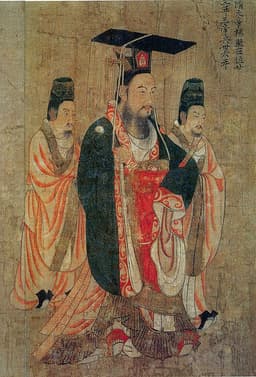
Emperor Wen of Sui
Emperor · Medieval
80.3Total

Napoleon Bonaparte
General · Modern
70.9Total
Basic Information
Born
541
1769
Died
604
1821
Era
Medieval
Modern
Nationality
China
France
Occupation
Emperor
General
Civilization
Eastern
Western
Score Comparison
Military (10%)
76.0
94.0
Political (20%)
75.0
72.0
Influence (20%)
88.0
40.0
Legacy (20%)
80.0
80.0
Leadership (15%)
80.0
78.0
Strategy (15%)
75.0
90.0
TOTAL
80.3
70.9
Emperor Wen of Sui — Complete Timeline
581 AD
Establishment of the Three Departments and Six Ministries SystemReform◆ Major
Emperor Wen established a centralized bureaucratic system with three departments (Secretariat, Chancellery, and Department of State Affairs) and six ministries. This system became the foundation of Chinese government administration for centuries.
Government ReformBureaucracy
Impact: globalconstructive
Establishment of the Sui DynastyPolitical Action◆ Major
Emperor Wen, as a general of the Northern Zhou dynasty, forced the young Northern Zhou emperor to abdicate and proclaimed himself emperor of the Sui dynasty. This marked the beginning of the Sui dynasty, which would go on to reunify China.
Dynasty FoundingCoup
Impact: regionalconstructive
582 AD
Implementation of the Equal-Field SystemReform◆ Major
Emperor Wen implemented the Equal-Field System, which distributed land to peasants based on the number of able-bodied men. This reform increased agricultural productivity, stabilized tax revenues, and reduced the power of large landowners.
Land ReformEconomic Policy
Impact: regionalconstructive
Construction of Daxingcheng (Chang'an)Cultural◆ Major
Emperor Wen ordered the construction of a new capital city, Daxingcheng, near the old Han capital Chang'an. This city, later known as Chang'an, became a model for urban planning and served as the capital of the Sui and Tang dynasties.
Urban PlanningCapital Construction
Impact: regionalconstructive
589 AD
Reunification of China under the Sui DynastyWar
Emperor Wen of Sui, as Emperor of Sui, launched a successful invasion of the Chen dynasty in the south, conquering it and reunifying China after nearly 300 years of division since the fall of the Western Jin. This ended the Northern and Southern Dynasties period.
UnificationConquest
Impact: globalconstructive
Napoleon Bonaparte — Complete Timeline
1799 AD
Coup of 18 BrumaireOther◆ Major
Napoleon Bonaparte, with support from his brother Lucien and key political figures, overthrew the Directory in a bloodless coup. He established the Consulate with himself as First Consul, effectively becoming the ruler of France. This event ended the French Revolution's most unstable period.
French RevolutionCoupRise to Power
Impact: regional
1804 AD
Promulgation of the Napoleonic CodeOther◆ Major
Napoleon enacted the Civil Code of the French, known as the Napoleonic Code, a comprehensive set of laws that replaced the fragmented feudal legal systems. The code established legal equality, protected property rights, and secularized law. It became the basis for legal systems in many European and world countries.
Legal ReformNapoleonic CodeCivil Law
Impact: globalconstructive
1805 AD
Battle of AusterlitzWar◆ Major
Napoleon's Grande Arm
Napoleonic WarsBattleDecisive Victory
Impact: global
1812 AD
Invasion of RussiaWar◆ Major
Napoleon led the Grande Arm
Napoleonic WarsInvasionDisaster
Impact: globaldestructive
1815 AD
Battle of WaterlooWar◆ Major
Napoleon's French army was defeated by the combined forces of the Duke of Wellington's Anglo-Allied army and Gebhard Leberecht von Bl
Napoleonic WarsBattleFinal Defeat
Impact: globaldestructive
Expert Analysis
Napoleon Bonaparte vs Emperor Wen of Sui: Historical Comparison
Napoleon Bonaparte, a revolutionary general turned Emperor of France, and Emperor Wen of Sui, the unifier of medieval China, both reshaped their nations through military conquest and centralized reform. Despite different eras and contexts, their scores are nearly identical, with Napoleon slightly ahead in military and strategic prowess, while Wen edges ahead in political consolidation.
Dimension Analysis
**Military: Napoleon Bonaparte 94 / Emperor Wen of Sui 89**
Napoleon revolutionized warfare with rapid maneuver, mass conscription, and artillery tactics, winning iconic battles like Austerlitz. Wen reunified China after centuries of division through decisive campaigns against the Chen dynasty and northern rivals, but his military scale and innovation were less transformative.
**Political: Napoleon Bonaparte 75 / Emperor Wen of Sui 77**
Napoleon centralized France via the Napoleonic Code and meritocratic bureaucracy, but his authoritarian rule and overreach led to downfall. Wen established the Sui legal code, reformed land distribution (equal-field system), and reduced aristocratic power, creating a stable foundation for the Tang dynasty.
**Influence: Napoleon Bonaparte 82 / Emperor Wen of Sui 78**
Napoleon’s legal and administrative systems spread across Europe, inspiring nationalism and modern statehood. Wen’s unification of China, Grand Canal construction, and Buddhist patronage influenced East Asian governance and trade for centuries, though his dynasty was short-lived.
**Legacy: Napoleon Bonaparte 78 / Emperor Wen of Sui 76**
Napoleon’s legacy is mixed—celebrated as a military genius yet blamed for endless wars and European instability. Wen is revered as a unifier and reformer, but his harsh policies and succession crisis led to Sui’s rapid collapse, overshadowing his achievements.
**Leadership: Napoleon Bonaparte 80 / Emperor Wen of Sui 74**
Napoleon’s charismatic command and personal drive inspired fierce loyalty, but his ego and micromanagement caused strategic errors. Wen ruled with disciplined Confucian principles, emphasizing frugality and merit, but lacked the magnetic battlefield presence of Napoleon.
Verdict
Napoleon Bonaparte leads Emperor Wen of Sui by a narrow margin due to superior military innovation and broader global influence.
FAQ
Q: Who ranks higher? A: Napoleon Bonaparte ranks slightly higher, driven by his military genius and transformative impact on modern Europe.
Rankings
🥇
Emperor Wen of SuiLeader
Mil: 76.0Pol: 75.0Inf: 88.0
80.3
🥈
Napoleon Bonaparte
Mil: 94.0Pol: 72.0Inf: 40.0
70.9
+9.4 behind
How This Comparison Works
Algorithm
Each figure is scored on 6 dimensions (0—100 scale) based on structured historical data: Military (10%), Political (20%), Influence (20%), Legacy (20%), Leadership (15%), Strategy (15%). The weighted total produces the final ranking.
Data Sources
Scores are computed from structured sub-indicators in the database. Scale factors adjust for era (Ancient ×0.85, Modern ×1.0) and civilization size (Eastern ×1.05, Other ×0.80) to account for differences in population and military scale.
Maximum 3 Figures
Comparisons are limited to 2—3 figures to ensure readability and statistical meaningfulness.
Error Margins
±5 points per dimension — Sub-scores are derived from historical records with inherent uncertainty. Two figures within 5 points on a dimension should be considered roughly equivalent in that area.
Total Score Accuracy
±3 points overall — The weighted combination of 6 dimensions produces a total score with approximately ±3 points of uncertainty. Differences of less than 3 points are not statistically significant— the figures are effectively tied.
Known Limitations
- Historical records are incomplete and uneven across civilizations
- Figures from oral-tradition societies may be underrepresented
- Occupation labels can misclassify multi-role figures
- Scores measure capability and impact, not moral character
- Quantitative scoring is a comparison tool, not absolute truth
Capability Radar
Military (10%) — Battles & Warfare
Battles
75
95
Win Rate
80
90
Expansion
85
95
Political (20%) — Governance & Reform
Reform
95
95
Diplomacy
85
80
Economy
90
85
Influence (20%) — Cultural & Global Reach
Cultural
70
85
Global
65
90
Legacy (20%) — Historical Impact
Historical
85
95
Longevity
70
90
Leadership (15%) — Power & Stability
Tenure
80
85
Stability
75
70
Strategy (15%) — Tactics & Innovation
Strategy
85
95
Tactics
70
98
Reform
90
92
Similar Comparisons
Comments & Discussion
BattlefieldScholar6/16/2026
From a purely tactical standpoint, Napoleon's 94 is justified. His use of the corps system, rapid forced marches (like in the 1805 Ulm campaign), and centralized artillery batteries were unprecedented. He consistently defeated larger coalitions by splitting their forces. In contrast, Wen's military campaigns, while effective in reunifying China, relied more on overwhelming numbers and internal divisions within the Chen dynasty. The Sui army's order of battle at the Yangtze crossing was impressive but not revolutionary. Napoleon's campaigns are studied in war colleges for a reason — he fundamentally changed operational art. Wen was a competent commander, but not a transformative one.
ScoreSkeptic426/16/2026
Look, I get that scoring these two is tough, but putting Napoleon's military at 94 while Wen gets 89 is pure Eurocentrism. How do you even quantify 'revolutionary tactics' against 'reunifying a fractured civilization'? The weighting here seems off too — why is 'Influence' only 82 for Napoleon when he literally reshaped modern law and nationalism? Meanwhile Wen's Grand Canal gets an 78? That canal moved goods for over a thousand years. These scores feel more like vibes than data. Maybe we should just admit some things can't be compared on a spreadsheet.
EmpireBuilderFan6/16/2026
Okay, can we stop pretending Napoleon and Wen are even close? Napoleon is the GOAT of military strategy — he took a revolutionary rabble and turned it into the Grande Armée that stomped through Europe like it was nothing. Austerlitz? A masterclass. Meanwhile, Wen's biggest claim is building a canal and some land reforms. Sure, he unified China, but that's like saying the guy who put together a jigsaw puzzle is the same as the guy who painted the picture. Napoleon changed the rules of the game. Wen just played the game well. Score: Napoleon all the way, no contest.
ColdScroll646/16/2026
我算了一下,拿破仑总分82.4,文帝79.8,差距2.6分。但你看政治分,文帝77比拿破仑75高2分,这合理吗?文帝的均田制、府兵制、三省六部制,哪一个不是影响了整个中国帝制时代?拿破仑的民法典固然重要,但他在政治上太自私,称帝、打欧洲,最后把自己玩死了。再者,领导力分拿破仑80对文帝74,差6分,可文帝在位24年,国库充盈、人口增长,拿破仑呢?打了十几年仗,法国人口都少了。这分数曲线有问题,建议重新校准历史权重。
OldScroll446/16/2026
拿破仑的军事分94,文帝才89,我完全不同意这个差距。拿破仑的战役确实漂亮,但文帝是在三百多年分裂后统一中国,面对的是多个割据政权和复杂的民族问题。他灭陈朝时,杨素水军顺江而下、韩擒虎奇袭建康,战略部署同样精彩。而且拿破仑最后兵败滑铁卢,文帝却成功打下了隋朝的基础,虽然后来亡了,但唐承隋制,这不能全算在文帝头上吧。西方史学家总爱拔高拿破仑,对我们这边的统一功绩却轻描淡写。