Loading...
Emperor Wu of Han vs King Gwanggaeto
Emperor Wu of Han leads by 11.8 pts · 2 figures compared
…
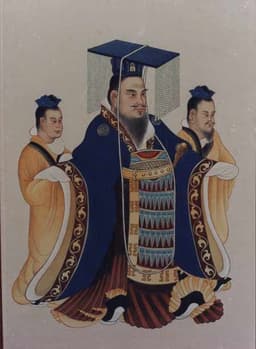
Emperor Wu of Han
Emperor · Ancient
71.3Total

King Gwanggaeto
Emperor · Ancient
59.5Total
Basic Information
Born
-156
374
Died
-87
413
Era
Ancient
Ancient
Nationality
China
Korea
Occupation
Emperor
Emperor
Civilization
Eastern
Eastern
Score Comparison
Military (10%)
78.5
75.0
Political (20%)
72.0
45.0
Influence (20%)
65.0
55.0
Legacy (20%)
70.0
55.0
Leadership (15%)
80.0
72.0
Strategy (15%)
69.1
70.0
TOTAL
71.3
59.5
Emperor Wu of Han — Complete Timeline
138 BC
Establishment of the Silk RoadPolitical Action
Emperor Wu dispatched Zhang Qian on a diplomatic mission to the Western Regions, initiating direct contact between China and Central Asian states. This led to the establishment of the Silk Road trade network, facilitating cultural and economic exchange.
Silk RoadDiplomacyTrade
Impact: globalconstructive
136 BC
Promotion of Confucianism as State DoctrineCultural
Emperor Wu established the Imperial Academy and made Confucian texts the basis for civil service examinations. This elevated Confucianism to the official state ideology, shaping Chinese governance and education for two millennia.
ConfucianismEducationBureaucracy
Impact: globalconstructive
133 BC
Campaigns against the XiongnuWar◆ Major
Emperor Wu launched a series of large-scale military campaigns against the Xiongnu confederation, pushing them north of the Gobi Desert. These wars secured the Hexi Corridor and opened the way for trade with Central Asia.
XiongnuExpansionSilk Road
Impact: regional
117 BC
Salt and Iron MonopoliesReform◆ Major
Emperor Wu nationalized the salt and iron industries, placing them under state control to generate revenue for his military campaigns. This policy increased central government power and became a model for later dynasties.
Economic ReformMonopolyRevenue
Impact: national
111 BC
Annexation of the Nanyue KingdomWar◆ Major
Emperor Wu's forces conquered the Nanyue kingdom in modern-day southern China and northern Vietnam. This expanded Han territory to the South China Sea and incorporated the region into the empire.
ExpansionNanyueVietnam
Impact: regional
King Gwanggaeto — Complete Timeline
391 AD
Ascended to the Throne of GoguryeoPolitical Action◆ Major
Gwanggaeto became king of Goguryeo, one of the Three Kingdoms of Korea. His reign marked the beginning of a period of aggressive territorial expansion.
AccessionGoguryeoKorea
Impact: regional
396 AD
Conquered Baekje and Silla TerritoriesWar◆ Major
Gwanggaeto led military campaigns that conquered large parts of Baekje and brought Silla under Goguryeo's protection. These victories expanded Goguryeo's control over the Korean Peninsula.
ConquestGoguryeoThree Kingdoms
Impact: regional
400 AD
Defeated Japanese InvasionsWar◆ Major
Gwanggaeto repelled Japanese (Wa) forces that had invaded the Korean Peninsula in support of Baekje. His victory secured Goguryeo's dominance and is recorded on the Gwanggaeto Stele.
DefenseGoguryeoJapan
Impact: regionalconstructive
410 AD
Expanded into ManchuriaWar◆ Major
Gwanggaeto extended Goguryeo's territory into Manchuria, conquering the Xianbei and other nomadic tribes. This expansion made Goguryeo a major power in Northeast Asia.
ExpansionManchuriaGoguryeo
Impact: regional
414 AD
Erected the Gwanggaeto SteleCultural◆ Major
After his death, a large stele was erected in his honor at the site of his tomb in Ji'an, China. The stele's inscription details his military campaigns and achievements, serving as a key historical source.
MonumentInscriptionGoguryeo
Impact: regional
Expert Analysis
Origins
Emperor Wu of Han (born 156 BCE, personal name Liu Che) was the seventh emperor of the Han dynasty, the son of Emperor Jing and Empress Wang. As a younger son, he was not initially heir, but political maneuvering placed him on the throne at age seven. He received a rigorous education in Confucian classics, which later shaped his state ideology. In contrast, King Gwanggaeto (born 374 CE, personal name Go Dam-deok) was the nineteenth monarch of Goguryeo, one of the Three Kingdoms of Korea. He inherited a kingdom already powerful but surrounded by rivals: Baekje, Silla, and Chinese commanderies. His father, King Gogukyang, had stabilized the realm, but Gwanggaeto's upbringing was martial, focused on cavalry warfare and tribal alliances. While Wu grew up in a sophisticated imperial court, Gwanggaeto learned in a frontier warrior culture.
Rise to Power
Emperor Wu ascended in 141 BCE at age fifteen, but real power initially lay with his grandmother, Empress Dowager Dou, and his mother. He asserted control after their deaths in 135 and 126 BCE. His first major act was to convene a court debate on Confucianism versus Legalism, leading to the appointment of Confucian scholars. He then launched diplomatic missions: in 138 BCE, he sent Zhang Qian to the Western Regions, a journey that lasted thirteen years and opened the Silk Road. This gave him intelligence on Central Asia and allies against the Xiongnu. Gwanggaeto became king in 391 CE at age seventeen, immediately facing a coalition of Baekje and Japanese (Wa) forces. His first campaign in 392 CE recaptured fortresses lost to Baekje. By 396 CE, he had conquered ten Baekje cities and forced their king to submit. His decisive victory over Wa forces in 400 CE at the battle of Gyeongju secured Silla as a protectorate. Both rulers took power young and used military success to consolidate authority.
Leadership & Governance
Emperor Wu centralized power through bureaucratic reforms. He established the Imperial Academy in 124 BCE, which trained officials in Confucian texts and created a civil service examination system. He also nationalized salt and iron in 117 BCE, creating state monopolies that funded his wars. His governance was interventionist: he raised taxes, confiscated noble lands, and appointed eunuchs to oversee provinces. This efficiency came at a cost: peasant revolts broke out in 99 BCE. Gwanggaeto, by contrast, ruled through a feudal system of tribal chieftains. He did not impose centralized bureaucracy but instead relied on personal loyalty and military command. His governance was expansionist: he annexed territories and installed vassal kings. While Wu's leadership scored 80.0 in the dataset, Gwanggaeto's scored 72.0, reflecting Wu's more sophisticated administrative apparatus. Wu's political score of 72.0 versus Gwanggaeto's 45.0 shows the gap in state-building.
Triumph & Tragedy
Emperor Wu's greatest triumph was the expansion of Han territory. He annexed the Nanyue kingdom in 111 BCE, pushing the border to the South China Sea. His campaigns against the Xiongnu (133–89 BCE) pushed them north of the Gobi, securing the northern frontier. The Silk Road, established by 115 BCE, brought diplomatic and economic links to Central Asia. His greatest failure was the economic strain: the salt and iron monopolies enriched the state but impoverished peasants, leading to a population decline from 60 million to 45 million by his death. His later years saw paranoia: he executed his heir apparent and many officials in a witchcraft scandal. Gwanggaeto's triumphs were military: he conquered Baekje in 396 CE, annexed Manchuria by 410 CE, and defeated Wa forces in 400 CE. His territory became the largest in Korean history. His tragedy was early death at age forty (in 413 CE), leaving an unfinished expansion. His son, Jangsu, continued his work but faced rebellions. Gwanggaeto's military score of 75.0 and strategy of 70.0 compare to Wu's 78.5 and 69.1, showing both were formidable commanders.
Character & Destiny
Emperor Wu was ambitious, ruthless, and intellectually curious. He personally directed campaigns, wrote poetry, and sought immortality through Taoist alchemy. His character led to both great achievements and brutal purges. Historical assessments by Sima Qian (who was castrated by Wu) are critical, but later Confucian historians praised his promotion of learning. Gwanggaeto was a warrior king: the Gwanggaeto Stele (erected 414 CE) describes him as "a sage king" who expanded territory through "force of arms." He was decisive in battle but left little administrative legacy. His character was shaped by the need to survive against Chinese and Japanese threats. Both rulers died relatively young (Wu at 69, Gwanggaeto at 40), but Wu's longer reign (54 years vs. 22 years) allowed more sustained impact.
Legacy
Emperor Wu's legacy is immense: he made Confucianism the state ideology, which lasted until 1911. The Silk Road connected China to the West for centuries. His territorial expansions defined the Han dynasty's borders. However, his monopolies and wars weakened the dynasty, leading to a crisis after his death. Gwanggaeto's legacy is more limited to Korea: he is celebrated as a national hero who defended against Japan and expanded Goguryeo. The Gwanggaeto Stele is a key historical source. His influence score of 55.0 versus Wu's 65.0 reflects the global reach of the Silk Road versus regional Korean impact. Legacy scores: Wu 70.0, Gwanggaeto 55.0.
Conclusion
Emperor Wu of Han had greater impact than King Gwanggaeto. His total score of 71.3 versus 59.5 reflects broader influence: Wu's policies shaped Chinese civilization for millennia, while Gwanggaeto's achievements were primarily military and regional. Wu's establishment of the Silk Road and Confucian bureaucracy created systems that endured, whereas Gwanggaeto's territorial gains were later lost. While Gwanggaeto was a brilliant commander (military 75.0), Wu combined military (78.5) with political innovation (72.0). The data supports Wu as the more consequential ruler.
Rankings
🥇
Emperor Wu of HanLeader
Mil: 78.5Pol: 72.0Inf: 65.0
71.3
🥈
King Gwanggaeto
Mil: 75.0Pol: 45.0Inf: 55.0
59.5
+11.8 behind
How This Comparison Works
Algorithm
Each figure is scored on 6 dimensions (0—100 scale) based on structured historical data: Military (10%), Political (20%), Influence (20%), Legacy (20%), Leadership (15%), Strategy (15%). The weighted total produces the final ranking.
Data Sources
Scores are computed from structured sub-indicators in the database. Scale factors adjust for era (Ancient ×0.85, Modern ×1.0) and civilization size (Eastern ×1.05, Other ×0.80) to account for differences in population and military scale.
Maximum 3 Figures
Comparisons are limited to 2—3 figures to ensure readability and statistical meaningfulness.
Error Margins
±5 points per dimension — Sub-scores are derived from historical records with inherent uncertainty. Two figures within 5 points on a dimension should be considered roughly equivalent in that area.
Total Score Accuracy
±3 points overall — The weighted combination of 6 dimensions produces a total score with approximately ±3 points of uncertainty. Differences of less than 3 points are not statistically significant— the figures are effectively tied.
Known Limitations
- Historical records are incomplete and uneven across civilizations
- Figures from oral-tradition societies may be underrepresented
- Occupation labels can misclassify multi-role figures
- Scores measure capability and impact, not moral character
- Quantitative scoring is a comparison tool, not absolute truth
Capability Radar
Military (10%) — Battles & Warfare
Battles
85
85
Win Rate
80
90
Expansion
90
90
Political (20%) — Governance & Reform
Reform
80
65
Diplomacy
85
70
Economy
75
60
Influence (20%) — Cultural & Global Reach
Cultural
90
75
Global
85
55
Legacy (20%) — Historical Impact
Historical
95
80
Longevity
95
70
Leadership (15%) — Power & Stability
Tenure
85
75
Stability
70
70
Strategy (15%) — Tactics & Innovation
Strategy
85
85
Tactics
75
80
Reform
70
70
Similar Comparisons
Comments & Discussion
No comments yet. Be the first to share your thoughts!