Loading...
This comparison has not been analyzed yet.
One-time AI generation (~1 minute). Scores and timeline are already available below.
Empress Jingu vs Maeonius
Maeonius leads by 13.0 pts · 2 figures compared
…

Empress Jingu
Emperor · Ancient
43.7Total
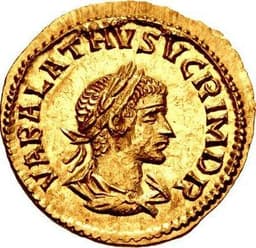
Maeonius
Emperor · Ancient
56.7Total
Basic Information
Born
169
230
Died
269
267
Era
Ancient
Ancient
Nationality
Japan
Palmyrene Empire
Occupation
Emperor
Emperor
Civilization
Eastern
Middle Eastern
Score Comparison
Military (10%)
55.0
38.2
Political (20%)
33.6
63.6
Influence (20%)
51.8
56.5
Legacy (20%)
44.2
56.0
Leadership (15%)
33.6
63.5
Strategy (15%)
41.0
57.1
TOTAL
43.7
56.7
Empress Jingu — Complete Timeline
200 AD
Conquest of the Three Korean KingdomsWar◆ Major
According to the Nihon Shoki, Empress Jingu led a naval expedition to the Korean peninsula and conquered the kingdoms of Silla, Baekje, and Goguryeo. This legendary campaign is said to have established Japanese dominance in Korea for several centuries, though archaeological evidence is lacking.
Korean CampaignLegendary ConquestYamato
Impact: regional
210 AD
Returned from Korea with TributePolitical Action
After her legendary conquest, Empress Jingu is said to have returned to Japan with tribute from the Korean kingdoms, including gold, silver, and textiles. This event is recorded as a triumph that enriched the Yamato court and solidified her reputation as a warrior ruler.
TributeDiplomacyWealth
Impact: nationalconstructive
Regency for Emperor OjinPolitical Action
Empress Jingu is said to have served as regent for her son, Emperor Ojin, after her husband's death. Her regency is credited with maintaining stability and continuing the expansion of Yamato influence, though the historical accuracy of her rule is disputed.
RegencySuccessionYamato
Impact: nationalconstructive
Maeonius — Complete Timeline
267 AD
Murder of OdaenathusPolitical Action◆ Major
Maeonius assassinated his cousin Odaenathus, the King of Palmyra and ruler of the Palmyrene Empire, during a celebration. The motive was likely personal ambition or jealousy. Maeonius then proclaimed himself emperor but was killed by soldiers shortly after, ending his brief reign.
AssassinationPalmyrene EmpireUsurpation
Impact: regionaldestructive
This comparison has not been analyzed yet.
One-time AI generation (~1 minute). Scores and timeline are already available below.
Rankings
🥇
MaeoniusLeader
Mil: 38.2Pol: 63.6Inf: 56.5
56.7
🥈
Empress Jingu
Mil: 55.0Pol: 33.6Inf: 51.8
43.7
+13.0 behind
How This Comparison Works
Algorithm
Each figure is scored on 6 dimensions (0—100 scale) based on structured historical data: Military (10%), Political (20%), Influence (20%), Legacy (20%), Leadership (15%), Strategy (15%). The weighted total produces the final ranking.
Data Sources
Scores are computed from structured sub-indicators in the database. Scale factors adjust for era (Ancient ×0.85, Modern ×1.0) and civilization size (Eastern ×1.05, Other ×0.80) to account for differences in population and military scale.
Maximum 3 Figures
Comparisons are limited to 2—3 figures to ensure readability and statistical meaningfulness.
Error Margins
±5 points per dimension — Sub-scores are derived from historical records with inherent uncertainty. Two figures within 5 points on a dimension should be considered roughly equivalent in that area.
Total Score Accuracy
±3 points overall — The weighted combination of 6 dimensions produces a total score with approximately ±3 points of uncertainty. Differences of less than 3 points are not statistically significant— the figures are effectively tied.
Known Limitations
- Historical records are incomplete and uneven across civilizations
- Figures from oral-tradition societies may be underrepresented
- Occupation labels can misclassify multi-role figures
- Scores measure capability and impact, not moral character
- Quantitative scoring is a comparison tool, not absolute truth
Capability Radar
Military (10%) — Battles & Warfare
Battles
20
37
Win Rate
25
43
Expansion
30
44
Political (20%) — Governance & Reform
Reform
5
45
Diplomacy
15
47
Economy
5
54
Influence (20%) — Cultural & Global Reach
Cultural
30
70
Global
20
76
Legacy (20%) — Historical Impact
Historical
35
74
Longevity
40
73
Leadership (15%) — Power & Stability
Tenure
20
43
Stability
10
53
Strategy (15%) — Tactics & Innovation
Strategy
15
45
Tactics
15
49
Reform
5
52
Similar Comparisons
Comments & Discussion
No comments yet. Be the first to share your thoughts!