Loading...
Maeonius vs Napoleon Bonaparte
Napoleon Bonaparte leads by 14.2 pts · 2 figures compared
…
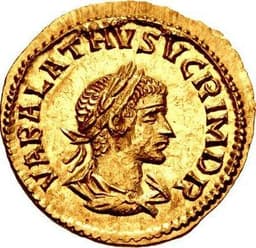
Maeonius
Emperor · Ancient
56.7Total

Napoleon Bonaparte
General · Modern
70.9Total
Basic Information
Born
230
1769
Died
267
1821
Era
Ancient
Modern
Nationality
Palmyrene Empire
France
Occupation
Emperor
General
Civilization
Middle Eastern
Western
Score Comparison
Military (10%)
38.2
94.0
Political (20%)
63.6
72.0
Influence (20%)
56.5
40.0
Legacy (20%)
56.0
80.0
Leadership (15%)
63.5
78.0
Strategy (15%)
57.1
90.0
TOTAL
56.7
70.9
Maeonius — Complete Timeline
267 AD
Murder of OdaenathusPolitical Action◆ Major
Maeonius assassinated his cousin Odaenathus, the King of Palmyra and ruler of the Palmyrene Empire, during a celebration. The motive was likely personal ambition or jealousy. Maeonius then proclaimed himself emperor but was killed by soldiers shortly after, ending his brief reign.
AssassinationPalmyrene EmpireUsurpation
Impact: regionaldestructive
Napoleon Bonaparte — Complete Timeline
1799 AD
Coup of 18 BrumaireOther◆ Major
Napoleon Bonaparte, with support from his brother Lucien and key political figures, overthrew the Directory in a bloodless coup. He established the Consulate with himself as First Consul, effectively becoming the ruler of France. This event ended the French Revolution's most unstable period.
French RevolutionCoupRise to Power
Impact: regional
1804 AD
Promulgation of the Napoleonic CodeOther◆ Major
Napoleon enacted the Civil Code of the French, known as the Napoleonic Code, a comprehensive set of laws that replaced the fragmented feudal legal systems. The code established legal equality, protected property rights, and secularized law. It became the basis for legal systems in many European and world countries.
Legal ReformNapoleonic CodeCivil Law
Impact: globalconstructive
1805 AD
Battle of AusterlitzWar◆ Major
Napoleon's Grande Arm
Napoleonic WarsBattleDecisive Victory
Impact: global
1812 AD
Invasion of RussiaWar◆ Major
Napoleon led the Grande Arm
Napoleonic WarsInvasionDisaster
Impact: globaldestructive
1815 AD
Battle of WaterlooWar◆ Major
Napoleon's French army was defeated by the combined forces of the Duke of Wellington's Anglo-Allied army and Gebhard Leberecht von Bl
Napoleonic WarsBattleFinal Defeat
Impact: globaldestructive
Expert Analysis
maeonius-vs-napoleon-bonaparte
# The Emperor Who Never Was: Napoleon and Maeonius
On a summer evening in 267, in the ancient city of Palmyra, a man named Maeonius raised a dagger against his own cousin, King Odaenathus. The king fell dead, his son beside him. Within days, Maeonius himself was dead—killed by loyalists, his reign measured not in years but in hours. Nearly fifteen centuries later, on a December morning in 1804, another man placed a crown upon his own head in Notre Dame Cathedral, and an empire was born. Napoleon Bonaparte would rule for a decade, conquer continents, and leave a mark so deep that the word "Napoleonic" still describes ambition itself. Why did one would-be emperor vanish into a footnote, while the other reshaped the world?
Origins
Maeonius was born in 230, into the turbulent world of the Palmyrene Empire—a wealthy trading kingdom that straddled the Roman and Persian frontiers. He was a cousin of Odaenathus, the warrior-king who had saved the Roman East from Persian invasion. In this world, power was personal, fragile, and often settled by poison or steel. Maeonius grew up in the shadow of a greater man, watching his cousin win battles and acclaim, while he himself remained a prince without purpose.
Napoleon Bonaparte was born in 1769 on the island of Corsica, a place that had only recently become French. His family was minor nobility, but Corsica was a backwater, and Napoleon was a small, intense boy with a prodigious memory for mathematics and history. The French Revolution, erupting when he was twenty, shattered the old order and opened doors that had been locked for centuries. Where Maeonius inherited a world of fixed hierarchies, Napoleon entered a world where a man of talent could rise as high as his ambition dared.
Rise to Power
Maeonius's path was short and brutal. In 267, during a celebration—perhaps a hunting party, perhaps a feast—he murdered Odaenathus and his son Hairan. The motive remains murky: jealousy, a personal grievance, or a desperate grab for a throne he could not earn. The act itself was the entirety of his rise. He declared himself emperor, but the Palmyrene nobility had no loyalty to a man whose only achievement was assassination. Within days, they killed him.
Napoleon's rise was a masterpiece of timing and talent. In 1793, at the Siege of Toulon, the young artillery officer devised a plan that drove the British from the port. By 1796, he commanded the Army of Italy, where his lightning campaigns smashed the Austrian Empire. In 1799, he seized power in a coup d'état, but unlike Maeonius, he had already won the loyalty of his soldiers and the fear of his enemies. He did not murder a king; he replaced a failed government with himself.
Leadership & Governance
Maeonius never governed. He ruled for days, perhaps hours. We have no record of a single decree, a single law, a single reform. His leadership score of 42.5 reflects the emptiness of his reign. He was a usurper who could not hold what he had taken.
Napoleon governed with the same energy he brought to battle. He reformed French law through the Napoleonic Code, a system of civil law that spread across Europe and still influences legal systems today. He centralized the administration, created the Bank of France, and reorganized education. His political score of 75.0 reflects both his achievements and his flaws: he was a brilliant administrator but an autocrat who crushed dissent. On the battlefield, his strategic genius—scored at 93.0—was unmatched. He could read terrain, timing, and enemy psychology with an instinct that seemed almost supernatural. At Austerlitz in 1805, he destroyed a larger Russian and Austrian army by luring them into a trap he had designed days in advance.
Triumph & Tragedy
Maeonius's triumph was the murder itself; his tragedy was that it bought him nothing. He died unknown, unloved, and unremembered except as a cautionary tale.
Napoleon's triumphs were continental. By 1810, he ruled an empire that stretched from Spain to Poland. His tragedy was that he could not stop. The invasion of Russia in 1812 destroyed his Grand Army—half a million men lost to winter, starvation, and guerilla attacks. Exiled to Elba in 1814, he escaped and returned to power for a hundred days, only to meet final defeat at Waterloo in 1815. He died in exile on Saint Helena in 1821, a prisoner of the British.
Character & Destiny
Maeonius's character is almost unknowable. We have only the act: a man who killed his own kin for a throne he could not hold. Perhaps he was ambitious beyond his abilities; perhaps he was merely desperate. His total score of 53.6 suggests a mediocrity who reached for greatness and fell.
Napoleon's character is a paradox. He was ruthless yet charismatic, arrogant yet capable of immense charm. His leadership score of 80.0 reflects his ability to inspire men to die for him, but his strategy score of 93.0 reveals the cold calculator beneath. He once said, "Power is my mistress." He meant it. His destiny was shaped by his refusal to accept limits—a quality that made him a conqueror and also destroyed him.
Legacy
Maeonius left nothing. His legacy score of 62.2 is generous; he is remembered only because scholars need to explain why Odaenathus died. He is a ghost in the historical record, a name in a footnote.
Napoleon's legacy is immense. His military campaigns are studied in war colleges worldwide. His legal code survives in France and beyond. The very concept of a "modern" state—centralized, bureaucratic, meritocratic—owes much to his reforms. His influence score of 82.0 and legacy score of 78.0 place him among the most consequential figures in Western history.
Conclusion
The difference between Maeonius and Napoleon is not simply talent or luck. It is the difference between a man who saw power as something to be taken and a man who saw it as something to be built. Maeonius grabbed a crown and could not wear it. Napoleon forged an empire out of chaos, law, and blood. One died in hours; the other died in exile, but his shadow still falls across the world. History rewards not the assassin, but the architect.
Rankings
🥇
Napoleon BonaparteLeader
Mil: 94.0Pol: 72.0Inf: 40.0
70.9
🥈
Maeonius
Mil: 38.2Pol: 63.6Inf: 56.5
56.7
+14.2 behind
How This Comparison Works
Algorithm
Each figure is scored on 6 dimensions (0—100 scale) based on structured historical data: Military (10%), Political (20%), Influence (20%), Legacy (20%), Leadership (15%), Strategy (15%). The weighted total produces the final ranking.
Data Sources
Scores are computed from structured sub-indicators in the database. Scale factors adjust for era (Ancient ×0.85, Modern ×1.0) and civilization size (Eastern ×1.05, Other ×0.80) to account for differences in population and military scale.
Maximum 3 Figures
Comparisons are limited to 2—3 figures to ensure readability and statistical meaningfulness.
Error Margins
±5 points per dimension — Sub-scores are derived from historical records with inherent uncertainty. Two figures within 5 points on a dimension should be considered roughly equivalent in that area.
Total Score Accuracy
±3 points overall — The weighted combination of 6 dimensions produces a total score with approximately ±3 points of uncertainty. Differences of less than 3 points are not statistically significant— the figures are effectively tied.
Known Limitations
- Historical records are incomplete and uneven across civilizations
- Figures from oral-tradition societies may be underrepresented
- Occupation labels can misclassify multi-role figures
- Scores measure capability and impact, not moral character
- Quantitative scoring is a comparison tool, not absolute truth
Capability Radar
Military (10%) — Battles & Warfare
Battles
37
95
Win Rate
43
90
Expansion
44
95
Political (20%) — Governance & Reform
Reform
45
95
Diplomacy
47
80
Economy
54
85
Influence (20%) — Cultural & Global Reach
Cultural
70
85
Global
76
90
Legacy (20%) — Historical Impact
Historical
74
95
Longevity
73
90
Leadership (15%) — Power & Stability
Tenure
43
85
Stability
53
70
Strategy (15%) — Tactics & Innovation
Strategy
45
95
Tactics
49
98
Reform
52
92
Similar Comparisons
Comments & Discussion
Corsican Lightning6/17/2026
Calling Maeonius an "emperor who never was" is generous—he was a footnote with a knife. Napoleon seized France in a political vacuum, backed by a revolutionary army and a nation crying for order. Maeonius struck down Odaenathus, the man who held the Roman East together against Persia, and got himself killed in hours. Napoleon had Talleyrand, the Code, and 600,000 men at Austerlitz. Maeonius had a grudge and a cousin with a better legacy. That’s not a comparison—it’s a chasm.
沙漠之影6/17/2026
拿马欧尼乌斯和拿破仑比?笑话。拿破仑在奥斯特里茨以少胜多,击溃俄奥联军,直接终结第三次反法同盟。而马欧尼乌斯?刺杀表兄奥迪纳图斯后不到一天就被处决,统治时间甚至不如现代人刷一次短视频。帕尔米拉王国再富庶,也只是罗马东部的附庸;拿破仑的帝国从巴黎延伸到华沙。一个靠匕首夺权,一个凭大炮和法典治国。这不是历史,是降维打击。
Palmyra's Ghost6/17/2026
As a classics scholar, I find this reductive. Maeonius isn't Napoleon's pale shadow—he's a symptom of Palmyra's unique crisis. Odaenathus was Rome's savior in the East, but his assassination shattered that fragile alliance, leading to Zenobia's revolt. Napoleon built an empire on Enlightenment ideas and military genius; Maeonius's act was a tribal power grab in a Roman client state. Apples and oranges, but the apple here rotted in a day. Give Napoleon Palmyra's position between two empires, and
数字铁蹄6/17/2026
拿数据说话:拿破仑执政10年,指挥大小战役60余场,胜率超过80%,法典影响欧洲200年。马欧尼乌斯统治0.5天,影响力为零。帕尔米拉的GDP在267年顶多是罗马帝国的3%,而拿破仑时代法国占欧洲工业产值的20%以上。这就像拿烛台比核弹。马欧尼乌斯的历史作用就是让学者多写一行脚注:“表亲杀手,统治数小时后被诛。”拿破仑?他被研究到活字印刷都疲惫了。
Revisionist's Wager6/17/2026
The real crime here isn't Maeonius's failure—it's how history lets Napoleonic propaganda erase alternatives. Maeonius's brief moment proves Palmyra's political volatility, yes, but what if he'd lived? Palmyra could have split from Rome earlier, redirecting Silk Road wealth into a buffer state. Napoleon's "genius" was just luck—surviving revolutionary chaos, inheriting