Loading...
Empress Jingu vs Napoleon Bonaparte
Napoleon Bonaparte leads by 27.2 pts · 2 figures compared
…
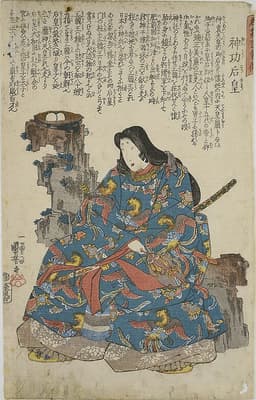
Empress Jingu
Emperor · Ancient
43.7Total

Napoleon Bonaparte
General · Modern
70.9Total
Basic Information
Born
169
1769
Died
269
1821
Era
Ancient
Modern
Nationality
Japan
France
Occupation
Emperor
General
Civilization
Eastern
Western
Score Comparison
Military (10%)
55.0
94.0
Political (20%)
33.6
72.0
Influence (20%)
51.8
40.0
Legacy (20%)
44.2
80.0
Leadership (15%)
33.6
78.0
Strategy (15%)
41.0
90.0
TOTAL
43.7
70.9
Empress Jingu — Complete Timeline
200 AD
Conquest of the Three Korean KingdomsWar◆ Major
According to the Nihon Shoki, Empress Jingu led a naval expedition to the Korean peninsula and conquered the kingdoms of Silla, Baekje, and Goguryeo. This legendary campaign is said to have established Japanese dominance in Korea for several centuries, though archaeological evidence is lacking.
Korean CampaignLegendary ConquestYamato
Impact: regional
210 AD
Returned from Korea with TributePolitical Action
After her legendary conquest, Empress Jingu is said to have returned to Japan with tribute from the Korean kingdoms, including gold, silver, and textiles. This event is recorded as a triumph that enriched the Yamato court and solidified her reputation as a warrior ruler.
TributeDiplomacyWealth
Impact: nationalconstructive
Regency for Emperor OjinPolitical Action
Empress Jingu is said to have served as regent for her son, Emperor Ojin, after her husband's death. Her regency is credited with maintaining stability and continuing the expansion of Yamato influence, though the historical accuracy of her rule is disputed.
RegencySuccessionYamato
Impact: nationalconstructive
Napoleon Bonaparte — Complete Timeline
1799 AD
Coup of 18 BrumaireOther◆ Major
Napoleon Bonaparte, with support from his brother Lucien and key political figures, overthrew the Directory in a bloodless coup. He established the Consulate with himself as First Consul, effectively becoming the ruler of France. This event ended the French Revolution's most unstable period.
French RevolutionCoupRise to Power
Impact: regional
1804 AD
Promulgation of the Napoleonic CodeOther◆ Major
Napoleon enacted the Civil Code of the French, known as the Napoleonic Code, a comprehensive set of laws that replaced the fragmented feudal legal systems. The code established legal equality, protected property rights, and secularized law. It became the basis for legal systems in many European and world countries.
Legal ReformNapoleonic CodeCivil Law
Impact: globalconstructive
1805 AD
Battle of AusterlitzWar◆ Major
Napoleon's Grande Arm
Napoleonic WarsBattleDecisive Victory
Impact: global
1812 AD
Invasion of RussiaWar◆ Major
Napoleon led the Grande Arm
Napoleonic WarsInvasionDisaster
Impact: globaldestructive
1815 AD
Battle of WaterlooWar◆ Major
Napoleon's French army was defeated by the combined forces of the Duke of Wellington's Anglo-Allied army and Gebhard Leberecht von Bl
Napoleonic WarsBattleFinal Defeat
Impact: globaldestructive
Expert Analysis
empress-jingu-vs-napoleon-bonaparte
# The Conqueror and the Regent: Napoleon and Empress Jingu
On a June morning in 1815, Napoleon Bonaparte watched his elite Imperial Guard march for the last time across a muddy field at Waterloo. The man who had crowned himself Emperor of Europe was about to become a prisoner of the Atlantic. Eighteen centuries earlier, on the shores of Kyushu, a different kind of leader—a pregnant empress—allegedly raised a fleet to invade a foreign land, returning not in defeat but with tribute. What connects these two figures, separated by time and culture, is the raw ambition to conquer. What separates them is everything else: how they rose, how they ruled, and what they left behind.
Origins
Napoleon Bonaparte was born in 1769 on the Mediterranean island of Corsica, a place that had just become French. His family was minor nobility—poor, proud, and resentful of French domination. This bitterness shaped him. He spoke French with an Italian accent, and his early heroes were not French kings but Corsican freedom fighters. He was an outsider who would later remake France in his own image.
Empress Jingu, by contrast, emerged from legend. Born in 169, she belonged to Japan’s Yamato court, a world of Shinto rituals, clan rivalries, and divine ancestry. Her husband, Emperor Chuai, was a mortal ruler; Jingu, according to the *Nihon Shoki*, was possessed by gods who commanded her to invade Korea. Her era was ancient, pre-literate, and steeped in myth. Where Napoleon’s world was defined by gunpowder, bureaucracy, and the Enlightenment, Jingu’s was one of bronze mirrors, horse-riding warriors, and oracles.
Rise to Power
Napoleon’s ascent was a masterpiece of timing and talent. The French Revolution had shattered the old order, creating a vacuum for ambitious men. At age 24, he captured Toulon from British forces in 1793, earning a general’s star. By 1796, he was leading the Italian campaign, winning battles against Austrian armies with speed and audacity that stunned Europe. His 1799 coup d’état made him First Consul, and by 1804, he crowned himself Emperor—taking the crown from the Pope’s hands and placing it on his own head.
Jingu’s path was different. She did not seize power; she inherited it through tragedy. When Emperor Chuai died during a campaign, likely in 200, Jingu was pregnant with his heir. Rather than surrender authority to rival clans, she claimed divine mandate. The gods, she said, had promised her victory over Korea. She led a naval expedition to the peninsula—an unprecedented act for a woman in ancient Japan—and returned claiming the submission of the Three Korean Kingdoms. She then ruled as regent for her son, Emperor Ojin, until his maturity.
Leadership & Governance
Napoleon governed with a combination of military genius and administrative brilliance. His 94.0 military score reflects his near-perfect record on the battlefield: Austerlitz in 1805, Jena in 1806, Wagram in 1809. But his 75.0 political score hints at his limitations. He created the Napoleonic Code, a legal system that influenced civil law across Europe. He centralized the French state, built roads, reformed education, and promoted merit over birth. Yet he could not stop himself from overreaching—invading Spain, then Russia, then Europe itself.
Jingu’s leadership, with a political score of 51.8 and a strategy score of 53.6, appears modest by comparison. But these numbers reflect our lack of reliable data. According to the *Nihon Shoki*, she managed a smooth transition of power, secured tribute from Korea, and maintained stability during a 70-year regency. Her military score of 32.9 suggests that her “conquest” was likely a raid or diplomatic mission rather than a full-scale war. She governed not through armies but through legitimacy—by embodying the divine will and protecting her son’s throne.
Triumph & Tragedy
Napoleon’s greatest triumph was Austerlitz, where he crushed the combined armies of Russia and Austria. His greatest tragedy was the 1812 invasion of Russia, where 600,000 men marched east and fewer than 100,000 returned. The disaster was self-inflicted: hubris, poor logistics, and a refusal to negotiate. His final defeat at Waterloo in 1815 was a masterpiece of errors—bad generalship, bad weather, and bad luck.
Jingu’s triumph was her return from Korea with tribute, a feat that established Japan’s early claims to continental influence. Her tragedy is harder to define. She may never have existed. Modern historians doubt the conquest entirely; archaeological evidence for Japanese control of Korea in the 3rd century is thin. Her story is more myth than history, a legend crafted to legitimize the Yamato dynasty. Her tragedy is not defeat but obscurity—the blurring of fact into folklore.
Character & Destiny
Napoleon’s character was a storm: restless, brilliant, paranoid, and insatiable. “Impossible is not a word in my dictionary,” he once said. His destiny was to embody the revolutionary age he helped create—and to be destroyed by its limits. He trusted no one, centralized everything, and could not share power. His personality drove his rise and his fall.
Jingu’s character is opaque, filtered through centuries of hagiography. She appears patient, pious, and determined. Her destiny was to serve as a bridge—between her husband’s death and her son’s maturity, between mortal rule and divine command. She did not seek personal glory; she sought survival for her lineage. Her personality, as recorded, was the opposite of Napoleon’s: steady where he was explosive, communal where he was individual.
Legacy
Napoleon’s legacy is enormous. His 82.0 influence score and 78.0 legacy score understate his impact. He reshaped Europe’s borders, spread nationalism, and inspired modern warfare. The Napoleonic Code survives in dozens of countries. His name is synonymous with ambition and genius—and with overreach.
Empress Jingu’s legacy is smaller but enduring. Her 74.8 influence score reflects her place in Japan’s imperial mythology. She is enshrined in Shinto rituals, celebrated in festivals, and invoked as a model of female leadership. The *Nihon Shoki*’s account of her conquest was used for centuries to justify Japanese claims to Korea. She is a symbol, not a historical actor.
Conclusion
Napoleon and Jingu are mirrors of each other across time. One conquered with cannons, the other with prayers. One left a code of laws, the other a code of legends. Their differences are not merely personal but civilizational: Napoleon’s world was modern, secular, and individualistic; Jingu’s was ancient, sacred, and communal. What drove Napoleon was the hunger to be remembered. What drove Jingu was the duty to preserve. In the end, both succeeded—but only one knew he was fighting for history. The other was simply living it.
Rankings
🥇
Napoleon BonaparteLeader
Mil: 94.0Pol: 72.0Inf: 40.0
70.9
🥈
Empress Jingu
Mil: 55.0Pol: 33.6Inf: 51.8
43.7
+27.2 behind
How This Comparison Works
Algorithm
Each figure is scored on 6 dimensions (0—100 scale) based on structured historical data: Military (10%), Political (20%), Influence (20%), Legacy (20%), Leadership (15%), Strategy (15%). The weighted total produces the final ranking.
Data Sources
Scores are computed from structured sub-indicators in the database. Scale factors adjust for era (Ancient ×0.85, Modern ×1.0) and civilization size (Eastern ×1.05, Other ×0.80) to account for differences in population and military scale.
Maximum 3 Figures
Comparisons are limited to 2—3 figures to ensure readability and statistical meaningfulness.
Error Margins
±5 points per dimension — Sub-scores are derived from historical records with inherent uncertainty. Two figures within 5 points on a dimension should be considered roughly equivalent in that area.
Total Score Accuracy
±3 points overall — The weighted combination of 6 dimensions produces a total score with approximately ±3 points of uncertainty. Differences of less than 3 points are not statistically significant— the figures are effectively tied.
Known Limitations
- Historical records are incomplete and uneven across civilizations
- Figures from oral-tradition societies may be underrepresented
- Occupation labels can misclassify multi-role figures
- Scores measure capability and impact, not moral character
- Quantitative scoring is a comparison tool, not absolute truth
Capability Radar
Military (10%) — Battles & Warfare
Battles
20
95
Win Rate
25
90
Expansion
30
95
Political (20%) — Governance & Reform
Reform
5
95
Diplomacy
15
80
Economy
5
85
Influence (20%) — Cultural & Global Reach
Cultural
30
85
Global
20
90
Legacy (20%) — Historical Impact
Historical
35
95
Longevity
40
90
Leadership (15%) — Power & Stability
Tenure
20
85
Stability
10
70
Strategy (15%) — Tactics & Innovation
Strategy
15
95
Tactics
15
98
Reform
5
92
Similar Comparisons
Comments & Discussion
神代扇子6/17/2026
你知道《日本书纪》里Jingu怀孕还亲自上船指挥吗?她不只借了潮汐之利,还用了“和魂”安抚当地豪族。Napoleon在1812年连俄国冬天都没算进去。Jingu的统治靠的是神权与外交双线操控,武勇之外还有母性政治的智慧。这点,拿剑的波拿巴永远学不会。
BonaparteAfficionado6/17/2026
Waterloo was Napoleon’s masterpiece of strategic failure. He split his forces, waited too long for Grouchy, and attacked a ridgeline head-on against Wellington’s reverse-slope defense. Jingu at least had divine backup from the gods in the *Nihon Shoki*; Napoleon had only his own ego. Give me a regent who listens to kami over a general who trusts his marshals.
资料来源狂6/17/2026
说是“征服”,但Jingu的所谓“征韩”根本没有任何同期史书记载或韩国出土文物证明。日本最早的史料《古事记》抄本来自八世纪,比传说年代晚了五百年。Napoleon至少留下了战报、法典和实测地图。拿神话人物去比拿破仑?这本身就是对历史比较法的不尊重。
Historian6646/17/2026
Napoleon’s Grande Armée was a meritocratic machine that spread legal reform across Europe. Jingu’s campaign, if it happened, probably involved a few hundred boats and local skirmishes. One left the Napoleonic Code and modern warfare doctrine; the other left a shrine in Fukuoka. Scale matters when you’re comparing conquerors.