Loading...
Enriquillo vs Julius Caesar
Julius Caesar leads by 39.5 pts · 2 figures compared
…
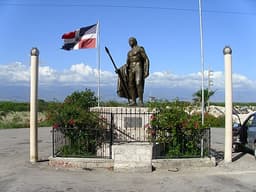
Enriquillo
Revolutionary · Medieval
43.3Total

Julius Caesar
General · Ancient
82.8Total
Basic Information
Born
1498
-100
Died
1535
-44
Era
Medieval
Ancient
Nationality
Taino
Roman Republic
Occupation
Revolutionary
General
Civilization
Other
Western
Score Comparison
Military (10%)
50.0
88.0
Political (20%)
29.3
78.0
Influence (20%)
47.9
85.0
Legacy (20%)
41.7
82.0
Leadership (15%)
47.3
80.0
Strategy (15%)
43.7
85.0
TOTAL
43.3
82.8
Enriquillo — Complete Timeline
1519 AD
Led Taino Rebellion on HispaniolaWar◆ Major
Enriquillo organized and led a rebellion of Taino people against Spanish colonial rule in the Bahoruco Mountains of Hispaniola. The rebellion lasted 14 years, with Enriquillo using guerrilla tactics to resist Spanish attempts to suppress the uprising.
Taino RebellionGuerrilla WarfareResistance
Impact: regional
1533 AD
Negotiated Peace Treaty with SpanishPolitical Action
After 14 years of rebellion, Enriquillo negotiated a peace treaty with Spanish authorities. The treaty granted the Taino rebels land and freedom from forced labor, though it required them to settle in a designated area. This was a rare negotiated settlement in the Spanish colonies.
TreatyDiplomacyTaino Rights
Impact: regionalconstructive
Received Royal Pardon from Spanish CrownPolitical Action◆ Major
As part of the peace agreement, Enriquillo received a royal pardon from the Spanish crown. He was granted the title of 'Don' and allowed to govern his community, though under Spanish oversight. This marked the end of his armed resistance.
PardonSpanish CrownTaino Leadership
Impact: regional
Julius Caesar — Complete Timeline
58 BC
Gallic WarsWar◆ Major
Caesar, as proconsul of Gaul, launched a series of campaigns that conquered all of Gaul (modern France, Belgium, and parts of Switzerland). He fought numerous battles, including against the Helvetii, the Belgae, and the Gallic chieftain Vercingetorix. The wars brought immense wealth and a loyal army to Caesar.
Gallic WarsConquestRoman Expansion
Impact: regional
49 BC
Crossing the RubiconPolitical Action◆ Major
Caesar led Legio XIII across the Rubicon River into Italy, defying the Roman Senate's order to disband his army. This act triggered a civil war against Pompey and the Optimates, ultimately leading to Caesar's dictatorship and the end of the Roman Republic.
Roman Civil WarEnd of RepublicPower Struggle
Impact: global
48 BC
Battle of PharsalusWar◆ Major
Caesar's outnumbered army defeated the larger forces of Pompey the Great at Pharsalus in Greece. Caesar's tactical use of a reserve line to counter Pompey's cavalry charge proved decisive. Pompey fled to Egypt, where he was assassinated, leaving Caesar as the undisputed master of the Roman world.
Roman Civil WarBattleDecisive Victory
Impact: regional
44 BC
Appointment as Dictator for LifePolitical Action◆ Major
The Roman Senate appointed Caesar dictator perpetuo (dictator for life), granting him unprecedented personal power. This move concentrated military, legislative, and judicial authority in one person, effectively ending the Roman Republic's traditional system of checks and balances and alarming many senators.
DictatorshipEnd of RepublicPower Consolidation
Impact: regionaldestructive
Assassination on the Ides of MarchPolitical Action◆ Major
A group of Roman senators, led by Marcus Junius Brutus and Gaius Cassius Longinus, stabbed Caesar to death at a meeting of the Senate in the Theatre of Pompey. The assassination was intended to restore the Republic, but instead triggered another civil war that led to the rise of the Roman Empire.
AssassinationRoman PoliticsEnd of Republic
Impact: globaldestructive
Expert Analysis
enriquillo-vs-julius-caesar
# The General and the Cacique: Two Paths Through History's Storm
On a winter morning in 44 BCE, Julius Caesar walked into the Senate chamber in Rome, ignoring a soothsayer's warning. Within minutes, he lay bleeding from twenty-three stab wounds, the Republic he had remade collapsing around his corpse. Nearly fifteen centuries later and an ocean away, another rebel leader—Enriquillo, a Taino cacique—emerged from the mountains of Hispaniola to sign a peace treaty with the Spanish empire that had tried to destroy his people. One man died at the height of his power, his ambition having consumed him. The other lived to see his enemies grant him a royal pardon and the title of "Don." Both defied the established order. Both changed the world that knew them. But their stories diverged in ways that reveal the deepest currents of history itself.
Origins
Julius Caesar was born into the chaos of a dying republic. His family, the Julii, claimed descent from the goddess Venus, but they were patricians in name only—strapped for cash and hungry for relevance. Rome in the first century BCE was a warrior state tearing itself apart: slave revolts, street gangs, civil wars. Caesar learned early that in such a world, power belonged to those who seized it. He grew up surrounded by marble temples and bloody politics, a boy who memorized speeches while hearing the clash of swords in the Forum.
Enriquillo's world was older and more fragile. Born around 1498, he was a member of the Taino people, who had lived on Hispaniola for centuries before a Spanish ship appeared on the horizon. His name itself suggests a hybrid identity—some scholars believe he was raised by Spanish missionaries, given a European education, and taught to read and write in a language his ancestors never knew. By the time he became a cacique, the Taino population had collapsed from perhaps 300,000 to fewer than 30,000, devastated by disease, enslavement, and murder. Enriquillo inherited not a republic in crisis but a civilization in its death throes.
Rise to Power
Caesar's ascent was a masterpiece of calculated risk. He borrowed fortunes to buy political favor, formed the First Triumvirate with Pompey and Crassus, and then spent eight years conquering Gaul—killing a million people and enslaving another million in the process. His Commentaries on the Gallic Wars were propaganda disguised as history, but they worked. When the Senate ordered him to disband his army, he crossed the Rubicon River in 49 BCE with a single legion, uttering the famous words, "The die is cast." Civil war followed. Within four years, Caesar was dictator for life.
Enriquillo's rise was born of desperation. In 1519, after enduring years of forced labor in Spanish gold mines and seeing his people worked to death, he fled into the Bahoruco Mountains with a small band of followers. He was not a conqueror but a survivor. His rebellion lasted fourteen years—an eternity in a conflict where the Spanish possessed guns, horses, and steel, while the Taino had bows, stones, and the knowledge of their own land. Enriquillo's strategy was not to defeat the Spanish in open battle but to make the cost of ruling Hispaniola unbearable. He raided settlements, freed slaves, and vanished into the jungle. The Spanish called him a bandit. His people called him a savior.
Leadership & Governance
Caesar governed as he conquered: with audacity and speed. He reformed the Roman calendar, granted citizenship to provincials, initiated public works programs, and packed the Senate with his supporters. He was a military genius who could inspire legions to march through blizzards and across rivers, but his political wisdom was brittle. He pardoned his enemies and expected gratitude; instead, they plotted his death. His reforms were brilliant, but they rested on his personal authority alone—a throne built on sand.
Enriquillo governed differently. As a cacique, his authority came from consensus, not command. He led by persuasion and example, holding his rebel community together through years of hunger and hardship. When the Spanish finally offered terms in 1533, he negotiated a treaty that granted the Taino their own settlements and freedom from forced labor. It was not independence—the Spanish crown still claimed sovereignty—but it was survival. Enriquillo accepted a royal pardon and the title of "Don," understanding that a living compromise was better than a heroic death.
Triumph & Tragedy
Caesar's greatest triumph was his swift conquest of Gaul, which added a vast territory to the Roman world and made him the richest man in the Republic. His greatest tragedy was his failure to understand that the Republic could not contain a man of his ambition. The Ides of March was not a betrayal by strangers but by friends—Brutus, his protégé, among them. Caesar's last words, according to tradition, were "Et tu, Brute?"—a question that echoes through history as the ultimate verdict on unchecked power.
Enriquillo's triumph was the peace treaty of 1533, which secured a future for his people when all seemed lost. His tragedy was that the treaty was not honored. Within a generation, the Taino were all but extinct, their language and religion erased, their bones mixed into the soil of a colony that would become the Dominican Republic. Enriquillo died in 1535, probably of smallpox, a disease that had come with the Spanish and would finish what the swords had started.
Character & Destiny
Caesar was driven by an insatiable hunger for glory. He believed he was destined to rule Rome, and he was right—but destiny is a double-edged sword. His arrogance blinded him to the knives in the Senate chamber. He had conquered the world but could not conquer his own ambition.
Enriquillo was driven by the need to protect his people. He fought not for personal power but for collective survival. This made him more cautious, more pragmatic, and ultimately more successful in the short term—but it also meant he accepted a compromise that history would betray. His character was that of a steward, not a conqueror, and in the end, the forces arrayed against him were too vast for any single leader to overcome.
Legacy
Caesar's legacy is the Roman Empire itself. Every emperor who followed claimed his name, his authority, his divine lineage. His reforms shaped Western law, government, and military strategy for two millennia. The word "Caesar" became synonymous with ruler—Kaiser, Tsar, Qaysar. He is remembered as the man who destroyed the Republic and built the world's greatest empire, a figure of genius and hubris whose life became a warning and a template.
Enriquillo's legacy is quieter but no less profound. He is a symbol of indigenous resistance, a hero to the Dominican Republic and to Taino descendants who still remember their ancestors. His name appears on streets, schools, and statues across the Caribbean. But his story is also a tragedy—a reminder that resistance, however heroic, does not always prevail. He fought for a world that was already dying, and he knew it.
Conclusion
Standing on opposite shores of history, Caesar and Enriquillo embody two fundamental human responses to crisis: the drive to dominate and the drive to endure. Caesar remade the world in his image and was destroyed by his own creation. Enriquillo fought to preserve a world that was being destroyed around him and found a fragile peace in the ruins. One changed the course of Western civilization; the other became a footnote to it, remembered only by those who refuse to forget. Their stories ask us a question that has no easy answer: Is it better to die for glory, or to live for survival? The answer, perhaps, depends on which side of history you are standing.
Rankings
🥇
Julius CaesarLeader
Mil: 88.0Pol: 78.0Inf: 85.0
82.8
🥈
Enriquillo
Mil: 50.0Pol: 29.3Inf: 47.9
43.3
+39.5 behind
How This Comparison Works
Algorithm
Each figure is scored on 6 dimensions (0—100 scale) based on structured historical data: Military (10%), Political (20%), Influence (20%), Legacy (20%), Leadership (15%), Strategy (15%). The weighted total produces the final ranking.
Data Sources
Scores are computed from structured sub-indicators in the database. Scale factors adjust for era (Ancient ×0.85, Modern ×1.0) and civilization size (Eastern ×1.05, Other ×0.80) to account for differences in population and military scale.
Maximum 3 Figures
Comparisons are limited to 2—3 figures to ensure readability and statistical meaningfulness.
Error Margins
±5 points per dimension — Sub-scores are derived from historical records with inherent uncertainty. Two figures within 5 points on a dimension should be considered roughly equivalent in that area.
Total Score Accuracy
±3 points overall — The weighted combination of 6 dimensions produces a total score with approximately ±3 points of uncertainty. Differences of less than 3 points are not statistically significant— the figures are effectively tied.
Known Limitations
- Historical records are incomplete and uneven across civilizations
- Figures from oral-tradition societies may be underrepresented
- Occupation labels can misclassify multi-role figures
- Scores measure capability and impact, not moral character
- Quantitative scoring is a comparison tool, not absolute truth
Capability Radar
Military (10%) — Battles & Warfare
Battles
25
95
Win Rate
30
92
Expansion
10
97
Political (20%) — Governance & Reform
Reform
15
90
Diplomacy
30
85
Economy
10
82
Influence (20%) — Cultural & Global Reach
Cultural
35
88
Global
20
94
Legacy (20%) — Historical Impact
Historical
40
95
Longevity
30
96
Leadership (15%) — Power & Stability
Tenure
40
75
Stability
25
60
Strategy (15%) — Tactics & Innovation
Strategy
40
94
Tactics
35
96
Reform
10
88
Similar Comparisons
Comments & Discussion
No comments yet. Be the first to share your thoughts!