Loading...
Eric XIV of Sweden vs King Abdullah II of Jordan
King Abdullah II of Jordan leads by 8.9 pts · 2 figures compared
…

Eric XIV of Sweden
Emperor · Modern
45.1Total
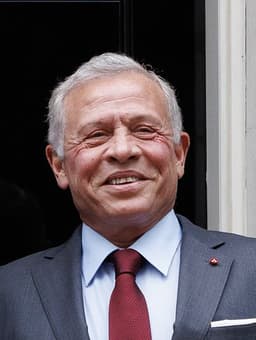
King Abdullah II of Jordan
Emperor · Modern
54.0Total
Basic Information
Born
1533
1962
Died
1577
—
Era
Modern
Modern
Nationality
Sweden
Jordan
Occupation
Emperor
Emperor
Civilization
Western
Middle Eastern
Score Comparison
Military (10%)
25.0
20.0
Political (20%)
45.1
72.0
Influence (20%)
49.4
58.0
Legacy (20%)
40.8
42.5
Leadership (15%)
48.4
80.0
Strategy (15%)
60.0
41.0
TOTAL
45.1
54.0
Eric XIV of Sweden — Complete Timeline
1561 AD
Coronation of Eric XIVPolitical Action◆ Major
Eric XIV was crowned King of Sweden in Uppsala, succeeding his father Gustav Vasa. His coronation marked the beginning of a reign characterized by centralization of power, expansion of the nobility's privileges, and increasing paranoia.
CoronationSuccession
Impact: national
1567 AD
Murder of the Sture FamilyPolitical Action◆ Major
In a paranoid rage, Eric XIV personally killed the nobleman Nils Sture and ordered the execution of several members of the Sture family, including the elderly Svante Sture. This act of violence against the aristocracy deepened his isolation and led to rebellion.
MurderNobilityParanoia
Impact: nationaltragic
1568 AD
Deposition of Eric XIVPolitical Action
Eric XIV was deposed by his half-brothers John and Charles, who led a rebellion against his increasingly erratic rule. He was imprisoned at Gripsholm Castle, and John III was proclaimed king.
DepositionRebellionImprisonment
Impact: nationaldestructive
1577 AD
Death by PoisoningOther
Eric XIV died in prison at
DeathPoisoningImprisonment
Impact: nationaltragic
King Abdullah II of Jordan — Complete Timeline
1999 AD
Assumed the throne of JordanPolitical Action◆ Major
Abdullah II became King of Jordan on February 7, 1999, upon the death of his father King Hussein. His accession was unexpected as he was not the original heir, but Hussein changed the succession line shortly before his death.
SuccessionMonarchy
Impact: national
2000 AD
Launch of economic reforms and privatizationReform◆ Major
King Abdullah II initiated a series of economic reforms including privatization of state-owned enterprises, trade liberalization, and creation of special economic zones. These policies aimed to attract foreign investment and modernize Jordan's economy.
Economic ReformPrivatizationDevelopment
Impact: nationalconstructive
2011 AD
Jordanian role in the Arab Spring protestsPolitical Action◆ Major
King Abdullah II responded to widespread protests in Jordan during the Arab Spring by dismissing governments, enacting constitutional reforms, and promising political liberalization. He avoided the regime collapse seen in other Arab countries.
Arab SpringReformProtests
Impact: national
Syrian refugee crisis responseOther◆ Major
Under King Abdullah II's leadership, Jordan hosted over 1.3 million Syrian refugees fleeing the Syrian civil war. The influx strained Jordan's resources and infrastructure, leading to international aid agreements and humanitarian challenges.
RefugeesSyrian Civil WarHumanitarian
Impact: regional
2021 AD
Failed coup attempt and Prince Hamzah affairPolitical Action◆ Major
King Abdullah II placed his half-brother Prince Hamzah under house arrest, accusing him of involvement in a foreign-backed plot to destabilize Jordan. The incident exposed internal royal family tensions and was resolved through mediation.
Coup AttemptRoyal FamilySecurity
Impact: nationaldestructive
Expert Analysis
Origins
Eric XIV of Sweden was born in 1533 to King Gustav Vasa and his first wife, Catherine of Saxe-Lauenburg. He received a humanist education, studying multiple languages and sciences, but his upbringing was marked by his father's authoritarian rule and the execution of his mother's alleged lover. Eric's early life instilled in him a sense of entitlement and suspicion.
King Abdullah II of Jordan was born in 1962 to King Hussein and Princess Muna al-Hussein. He was educated in the United Kingdom and the United States, attending Sandhurst and Oxford. Unlike Eric, Abdullah was not the original heir; his uncle Hassan was crown prince until King Hussein changed the succession in his final days. Abdullah's background in the military and international relations prepared him for a modern constitutional role.
Rise to Power
Eric XIV ascended the Swedish throne in 1560 after his father's death. His coronation in Uppsala was a display of ambition, as he introduced an absolute monarchy style, distancing himself from the nobility. His early reign saw the establishment of a centralized administration and an aggressive foreign policy, including wars with Denmark and Russia.
King Abdullah II assumed the throne unexpectedly in 1999 upon his father's death. He quickly consolidated power by replacing senior officials and launching economic reforms. His rise was smooth compared to Eric's, as he inherited a stable kingdom with a clear succession, despite the initial surprise of his appointment.
Leadership & Governance
Eric XIV's leadership was characterized by paranoia and erratic decision-making. He personally murdered several nobles in the 1567 Sture murders, believing they were plotting against him. His governance involved centralization but also alienated the nobility, leading to rebellion. He scored 48.4 in leadership, reflecting his inability to maintain support.
King Abdullah II, in contrast, scored 80.0 in leadership. He has maintained stability through political reforms, including constitutional changes during the Arab Spring. He navigated the Syrian refugee crisis by hosting over 1.3 million refugees, balancing humanitarian needs with security. His governance is consultative, though still authoritarian.
Triumph & Tragedy
Eric XIV's greatest success was his initial centralization of power and expansion of royal authority, but his triumph was overshadowed by his deposition in 1568 after his half-brothers rebelled. His tragedy was his death in prison, likely poisoned on orders of his brother John III. His paranoia destroyed his rule.
King Abdullah II's triumphs include maintaining Jordan's stability amid regional turmoil and economic reforms that attracted foreign investment. However, his tragedy is the failed coup attempt involving his half-brother Prince Hamzah in 2021, exposing internal divisions. He has also faced criticism for limited political freedoms.
Character & Destiny
Eric XIV was intelligent but mentally unstable, with historians noting his paranoia and violent outbursts. His character led directly to his downfall; he alienated allies and created enemies. His total score of 45.1 reflects a reign of unfulfilled potential.
King Abdullah II is pragmatic and cautious, a modern monarch who adapts to circumstances. His character has allowed him to survive the Arab Spring and maintain power. He scored 54.0 overall, with high political and leadership scores, though his military and strategy scores are lower.
Legacy
Eric XIV's legacy is that of a cautionary tale: a ruler whose mental instability led to his overthrow. He is remembered for the Sture murders and his tragic end. His reign had little lasting impact on Sweden's governance.
King Abdullah II's legacy is still being written, but he is likely to be remembered as a stabilizer in a turbulent region. His management of the Syrian refugee crisis and economic reforms have had significant impact. He has modernized Jordan while preserving the monarchy.
Conclusion
King Abdullah II has had a greater impact than Eric XIV. While Eric's reign was a failure, Abdullah has successfully navigated crises for over two decades. His leadership score of 80.0 versus Eric's 48.4 and total score of 54.0 versus 45.1 demonstrate his effectiveness. Abdullah's legacy of stability and reform outweighs Eric's brief and chaotic rule.
Rankings
🥇
King Abdullah II of JordanLeader
Mil: 20.0Pol: 72.0Inf: 58.0
54.0
🥈
Eric XIV of Sweden
Mil: 25.0Pol: 45.1Inf: 49.4
45.1
+8.9 behind
How This Comparison Works
Algorithm
Each figure is scored on 6 dimensions (0—100 scale) based on structured historical data: Military (10%), Political (20%), Influence (20%), Legacy (20%), Leadership (15%), Strategy (15%). The weighted total produces the final ranking.
Data Sources
Scores are computed from structured sub-indicators in the database. Scale factors adjust for era (Ancient ×0.85, Modern ×1.0) and civilization size (Eastern ×1.05, Other ×0.80) to account for differences in population and military scale.
Maximum 3 Figures
Comparisons are limited to 2—3 figures to ensure readability and statistical meaningfulness.
Error Margins
±5 points per dimension — Sub-scores are derived from historical records with inherent uncertainty. Two figures within 5 points on a dimension should be considered roughly equivalent in that area.
Total Score Accuracy
±3 points overall — The weighted combination of 6 dimensions produces a total score with approximately ±3 points of uncertainty. Differences of less than 3 points are not statistically significant— the figures are effectively tied.
Known Limitations
- Historical records are incomplete and uneven across civilizations
- Figures from oral-tradition societies may be underrepresented
- Occupation labels can misclassify multi-role figures
- Scores measure capability and impact, not moral character
- Quantitative scoring is a comparison tool, not absolute truth
Capability Radar
Military (10%) — Battles & Warfare
Battles
45
10
Win Rate
40
10
Expansion
40
5
Political (20%) — Governance & Reform
Reform
50
60
Diplomacy
25
75
Economy
35
55
Influence (20%) — Cultural & Global Reach
Cultural
30
40
Global
15
50
Legacy (20%) — Historical Impact
Historical
35
35
Longevity
20
30
Leadership (15%) — Power & Stability
Tenure
30
70
Stability
10
65
Strategy (15%) — Tactics & Innovation
Strategy
45
20
Tactics
50
15
Reform
55
30
Similar Comparisons
Comments & Discussion
No comments yet. Be the first to share your thoughts!