Loading...
Esarhaddon vs Napoleon Bonaparte
Napoleon Bonaparte leads by 8.7 pts · 2 figures compared
…
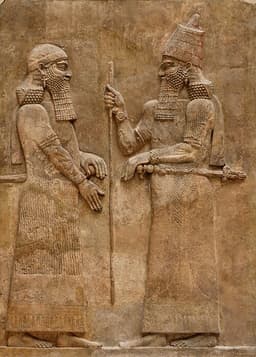
Esarhaddon
Emperor · Ancient
62.2Total

Napoleon Bonaparte
General · Modern
70.9Total
Basic Information
Born
-681
1769
Died
-669
1821
Era
Ancient
Modern
Nationality
Assyria
France
Occupation
Emperor
General
Civilization
Middle Eastern
Western
Score Comparison
Military (10%)
72.0
94.0
Political (20%)
59.3
72.0
Influence (20%)
61.0
40.0
Legacy (20%)
56.0
80.0
Leadership (15%)
66.0
78.0
Strategy (15%)
70.0
90.0
TOTAL
62.2
70.9
Esarhaddon — Complete Timeline
680 BC
Rebuilding of BabylonReform◆ Major
Esarhaddon reversed his father Sennacherib's destruction of Babylon. He ordered the reconstruction of the city, its temples, and the Esagila. He returned the statue of Marduk and granted Babylon privileges, seeking to heal the religious rift caused by his father.
BabylonReconstructionReconciliation
Impact: regionalconstructive
679 BC
Campaign Against the CimmeriansWar
Esarhaddon defeated the Cimmerian invaders in the region of Hubushna (Anatolia). The Cimmerians had been threatening Assyrian vassals. This victory secured the northern frontier of the Assyrian Empire for a time.
CimmeriansAnatoliaDefense
Impact: regional
672 BC
Vassal Treaties of EsarhaddonPolitical Action◆ Major
Esarhaddon imposed loyalty oaths on his subjects, officials, and vassal states, requiring them to swear allegiance to his chosen heir Ashurbanipal. These treaties were inscribed on tablets and included curses for violation. They ensured a smooth succession.
TreatiesSuccessionAshurbanipal
Impact: regional
671 BC
Conquest of EgyptWar◆ Major
Esarhaddon led the Assyrian army across the Sinai desert and defeated the Kushite Pharaoh Taharqa. He captured Memphis and took the Egyptian royal family hostage. This was the first time an Assyrian king ruled Egypt, though control was brief.
EgyptConquestTaharqa
Impact: regional
Napoleon Bonaparte — Complete Timeline
1799 AD
Coup of 18 BrumaireOther◆ Major
Napoleon Bonaparte, with support from his brother Lucien and key political figures, overthrew the Directory in a bloodless coup. He established the Consulate with himself as First Consul, effectively becoming the ruler of France. This event ended the French Revolution's most unstable period.
French RevolutionCoupRise to Power
Impact: regional
1804 AD
Promulgation of the Napoleonic CodeOther◆ Major
Napoleon enacted the Civil Code of the French, known as the Napoleonic Code, a comprehensive set of laws that replaced the fragmented feudal legal systems. The code established legal equality, protected property rights, and secularized law. It became the basis for legal systems in many European and world countries.
Legal ReformNapoleonic CodeCivil Law
Impact: globalconstructive
1805 AD
Battle of AusterlitzWar◆ Major
Napoleon's Grande Arm
Napoleonic WarsBattleDecisive Victory
Impact: global
1812 AD
Invasion of RussiaWar◆ Major
Napoleon led the Grande Arm
Napoleonic WarsInvasionDisaster
Impact: globaldestructive
1815 AD
Battle of WaterlooWar◆ Major
Napoleon's French army was defeated by the combined forces of the Duke of Wellington's Anglo-Allied army and Gebhard Leberecht von Bl
Napoleonic WarsBattleFinal Defeat
Impact: globaldestructive
Expert Analysis
esarhaddon-vs-napoleon-bonaparte
# The Emperor and the King: Napoleon and Esarhaddon Across the Ages
On a June morning in 1815, Napoleon Bonaparte watched his army disintegrate on the muddy fields of Waterloo, his dream of European domination crushed by the Duke of Wellington and Prussian reinforcements. Two and a half millennia earlier and thousands of miles away, another conqueror stood before the gates of Memphis, having accomplished what no Assyrian king had ever achieved: the conquest of Egypt. Esarhaddon, ruler of the Neo-Assyrian Empire, had crossed the Sinai desert and humbled the Pharaoh Taharqa. One man would die in exile on a remote Atlantic island; the other would return to his capital to rebuild a city his own father had destroyed. What separates these two figures, born worlds apart in time and culture, is not merely the distance of centuries but the fundamental architecture of their ambitions.
Origins
Napoleon Bonaparte emerged from the Corsican gentry in 1769, a year after the island passed from Genoa to France. He was an outsider in the nation he would come to rule—his Italian-accented French and provincial origins marked him as different. The French Revolution, which erupted when he was twenty, shattered the old order and created a world where talent, not birth, could propel a man to the throne. It was a uniquely modern opportunity, born of Enlightenment ideals and revolutionary chaos.
Esarhaddon was born into the blood-soaked palace of Sennacherib, king of Assyria, around 681 BC. His father had destroyed Babylon, killed thousands, and ruled through terror. Esarhaddon was not the eldest son—his brothers were murdered in a palace coup, and he himself had to fight for the succession. Ancient Mesopotamia offered no revolutionary ladder; power was inherited through blood and maintained through iron. Where Napoleon’s world was being remade by ideas, Esarhaddon’s was held together by fear and divine mandate.
Rise to Power
Napoleon’s ascent was breathtaking. At twenty-four, he cleared the streets of Paris with a “whiff of grapeshot,” suppressing a royalist uprising. By twenty-six, he commanded armies in Italy, winning battles that forced Austria to sue for peace. He was a general who led from the front, whose charisma electrified his troops, and whose strategic brilliance—scoring a 93 on the military strategy scale—redefined warfare. In 1799, at thirty, he seized power in a coup and became First Consul. Five years later, he crowned himself Emperor.
Esarhaddon’s path was narrower and more treacherous. His father Sennacherib was assassinated by two of his own sons—Esarhaddon’s brothers—in 681 BC. Esarhaddon, then a prince, had to flee for his life. He gathered an army, marched on Nineveh, and defeated his brothers in a six-week civil war. His rise was not a revolution but a restoration. He inherited an empire that already stretched from the Mediterranean to the Persian Gulf, and his task was not to create but to consolidate.
Leadership & Governance
Napoleon’s genius lay in his ability to combine military conquest with institutional reform. The Napoleonic Code, established in 1804, standardized French law, abolished feudal privileges, and enshrined meritocracy. He built schools, roads, and a centralized bureaucracy that outlasted his empire. His political score of 75 reflects a man who understood power but also its limits—he could reorganize a nation but could not pacify a continent.
Esarhaddon governed through a different logic. His political score of 64.9, lower than Napoleon’s, masks a subtle achievement: he rebuilt Babylon, the city his father had destroyed, and returned its gods to their temples. This was not mercy but strategy. By restoring Babylon, he pacified a rebellious province and presented himself as a pious king, not a destroyer. In 672 BC, he imposed the Vassal Treaties, demanding loyalty oaths from all subjects to secure the succession of his son Ashurbanipal. His military score of 66.3 reflects effective campaigning rather than Napoleonic brilliance—he conquered Egypt but could not hold it, withdrawing after Taharqa’s forces regrouped.
Triumph & Tragedy
Napoleon’s greatest triumph was the Battle of Austerlitz in 1805, where he crushed the combined armies of Russia and Austria, a masterpiece of tactical deception. His tragedy was the invasion of Russia in 1812—a catastrophic campaign that lost half a million men and broke the myth of his invincibility. Exiled to Elba, he returned for a Hundred Days, only to meet final defeat at Waterloo. He died in 1821 on Saint Helena, a prisoner of the British.
Esarhaddon’s triumph was the conquest of Egypt in 671 BC. He marched his army across the Sinai, defeated Taharqa at Memphis, and proclaimed himself “king of Egypt.” But his tragedy was equally stark: Assyrian control was brief. Within two years, Taharqa returned from the south, and Esarhaddon died on campaign, possibly of illness, while trying to reconquer the province. His empire would survive for another generation, but his personal achievement—the first Assyrian to rule the Nile—proved ephemeral.
Character & Destiny
Napoleon was driven by an insatiable ambition that bordered on megalomania. “I am not a man,” he once said, “but a thing.” He saw himself as an instrument of destiny, a force of history that could reshape the world. This self-conception propelled him to extraordinary heights but also blinded him to the limits of power. He could not stop, could not consolidate, could not accept that even he could be defeated.
Esarhaddon was more pragmatic, a survivor who had seen his brothers murder their father and understood the fragility of power. He rebuilt what his father had destroyed, secured his succession, and campaigned not for glory but for stability. His leadership score of 74.1 reflects a ruler who knew when to fight and when to build. He was not a revolutionary but a restorer, and his destiny was to maintain, not transform.
Legacy
Napoleon’s legacy is immense. The Napoleonic Code influenced legal systems across Europe and the world. He reshaped the map of Europe, ended the Holy Roman Empire, and spread nationalist ideas that would later consume the continent. His influence score of 82 and legacy score of 78 reflect a man whose shadow still falls on modern politics, law, and military strategy.
Esarhaddon’s legacy is quieter but no less real. He appears in the Bible as the king who deported Manasseh of Judah. His conquest of Egypt is remembered in Assyrian annals and Babylonian chronicles. His influence score of 72.5 and legacy score of 68.7 reflect a ruler who mattered in his time but whose world has long since crumbled. Unlike Napoleon, he left no code, no enduring institution—only the memory of a king who rebuilt what his father destroyed and conquered what no Assyrian had conquered before.
Conclusion
Standing at the edge of their respective eras, Napoleon and Esarhaddon reveal the different shapes of power. Napoleon’s world was one of rapid change, where a Corsican outsider could become emperor and redraw the map of Europe. Esarhaddon’s world was one of ancient cycles—empires rose and fell, cities were destroyed and rebuilt, and kings ruled by the will of gods who were as capricious as the men who served them. One man’s ambition burned so bright it consumed him; the other’s ambition was tempered by the knowledge that even kings are mortal. Both conquered, both built, both fell—but they fell into different histories, one remembered globally, the other preserved in clay tablets and biblical verses. The difference is not in their achievements but in the worlds that remembered them.
Rankings
🥇
Napoleon BonaparteLeader
Mil: 94.0Pol: 72.0Inf: 40.0
70.9
🥈
Esarhaddon
Mil: 72.0Pol: 59.3Inf: 61.0
62.2
+8.7 behind
How This Comparison Works
Algorithm
Each figure is scored on 6 dimensions (0—100 scale) based on structured historical data: Military (10%), Political (20%), Influence (20%), Legacy (20%), Leadership (15%), Strategy (15%). The weighted total produces the final ranking.
Data Sources
Scores are computed from structured sub-indicators in the database. Scale factors adjust for era (Ancient ×0.85, Modern ×1.0) and civilization size (Eastern ×1.05, Other ×0.80) to account for differences in population and military scale.
Maximum 3 Figures
Comparisons are limited to 2—3 figures to ensure readability and statistical meaningfulness.
Error Margins
±5 points per dimension — Sub-scores are derived from historical records with inherent uncertainty. Two figures within 5 points on a dimension should be considered roughly equivalent in that area.
Total Score Accuracy
±3 points overall — The weighted combination of 6 dimensions produces a total score with approximately ±3 points of uncertainty. Differences of less than 3 points are not statistically significant— the figures are effectively tied.
Known Limitations
- Historical records are incomplete and uneven across civilizations
- Figures from oral-tradition societies may be underrepresented
- Occupation labels can misclassify multi-role figures
- Scores measure capability and impact, not moral character
- Quantitative scoring is a comparison tool, not absolute truth
Capability Radar
Military (10%) — Battles & Warfare
Battles
75
95
Win Rate
85
90
Expansion
80
95
Political (20%) — Governance & Reform
Reform
75
95
Diplomacy
80
80
Economy
70
85
Influence (20%) — Cultural & Global Reach
Cultural
60
85
Global
65
90
Legacy (20%) — Historical Impact
Historical
70
95
Longevity
60
90
Leadership (15%) — Power & Stability
Tenure
70
85
Stability
65
70
Strategy (15%) — Tactics & Innovation
Strategy
85
95
Tactics
80
98
Reform
70
92
Similar Comparisons
Comments & Discussion
📜 DesertCorsair6/17/2026
Napoleon was a revolutionary who rode the chaos of modernity to power; Esarhaddon was a dynastic survivor who had to bury his own brothers to secure his throne. Big difference: one’s legitimacy came from the people, the other from bloodline and divine mandate. Esarhaddon didn't just conquer Egypt—he *ruled* it with a local puppet administration, something Napoleon bungled badly in Spain. Give me the Assyrian pragmatist over the French adventurer any day.
📊 DataSkeptic_486/17/2026
The comparison is cute but statistically lazy. Esarhaddon’s conquest of Egypt was ephemeral—Assyrian control lasted barely a decade before Taharqa’s son reasserted Nubian power. Napoleon’s Egyptian campaign actually had more enduring impact: sparked modern Egyptology (Rosetta Stone), introduced printing presses, and reshaped Ottoman governance. One man’s footprint is in monuments and sand; the other’s in institutions and ideas. QED.
🏛️ 亚述考古迷6/17/2026
拿拿破仑跟埃萨尔哈东比?后者可是在七个月内征服了埃及,而拿破仑在阿卡(Acre)城下就折戟沉沙了!更关键的是,埃萨尔哈东懂得“分而治之”——他把埃及分成十二个行政区,提拔本地贵族当傀儡,这比拿破仑试图用“启蒙”一套强加给埃及的殖民思路聪明十倍。真要论治理水平,这位亚述王甩拿破仑几条地中海。
📖 废土史官6/17/2026
你们都在吹征服,可我偏看结局。拿破仑最后被关在圣赫勒拿,老死于大西洋孤岛;埃萨尔哈东呢?在进军埃及的路上病死了,可他的帝国还撑了五十年!两人都是“龙兴”又“龙亡”,但亚述王至少死在战场上,留下个完整王朝,而拿破仑把法国拖进两次复辟。一个是光荣地倒下,一个是狼狈地溃散。
Historian5066/17/2026
Forget the charisma contest—look at their logistics. Esarhaddon marched an army across the Sinai desert with water-laden camels and supply depots organized by his Nubian allies. Napoleon tried the same in Russia and lost 400,000 men to frostbite. The Assyrian mastered the art of desert warfare; the Corsican was a brilliant tactician but a terrible logistician. Give me the guy who showed up with enough arrows *and* water, not just grand speeches.