Loading...
Etienne Macdonald vs Fahri Koruturk
Etienne Macdonald leads by 2.9 pts · 2 figures compared
…
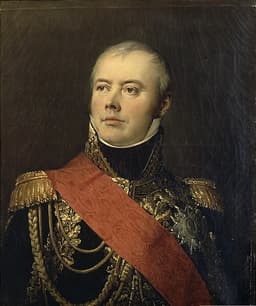
Etienne Macdonald
General · Modern
53.8Total

Fahri Koruturk
General · Modern
50.9Total
Basic Information
Born
1765
1903
Died
1840
1987
Era
Modern
Modern
Nationality
France
Turkey
Occupation
General
General
Civilization
Western
Middle Eastern
Score Comparison
Military (10%)
67.5
22.6
Political (20%)
42.2
68.0
Influence (20%)
54.1
54.1
Legacy (20%)
46.7
42.5
Leadership (15%)
65.0
68.0
Strategy (15%)
57.5
41.0
TOTAL
53.8
50.9
Etienne Macdonald — Complete Timeline
1809 AD
Battle of WagramWar◆ Major
Macdonald commanded a corps at Wagram. He led a massive infantry assault that broke the Austrian center, earning him the baton of Marshal of the Empire on the battlefield.
Napoleonic WarsBattlePromotion
Impact: regional
1812 AD
Battle of the BerezinaWar◆ Major
Macdonald commanded the X Corps during the retreat from Russia. His corps covered the crossing of the Berezina River, suffering heavy losses but allowing the main army to escape.
Napoleonic WarsRetreatBerezina
Impact: regional
1813 AD
Battle of LeipzigWar◆ Major
Macdonald commanded a corps at Leipzig. His forces were routed by the Allies, and he was wounded while trying to rally his troops during the French defeat.
Napoleonic WarsBattleDefeatWounded
Impact: global
Battle of the KatzbachWar◆ Major
Macdonald commanded the French Army of the Bober at the Katzbach. His forces were defeated by Bl
Napoleonic WarsBattleDefeat
Impact: regional
1815 AD
Grand Chancellor of the Legion of HonourPolitical Action
Macdonald served as Grand Chancellor of the Legion of Honour under the Bourbon Restoration. He administered the order and maintained its prestige.
Legion of HonourBourbon RestorationAdministration
Impact: national
Fahri Koruturk — Complete Timeline
1957 AD
Commanded the Turkish Naval ForcesPolitical Action
Koruturk served as the Commander of the Turkish Naval Forces from 1957 to 1960. He oversaw the modernization of the navy and its integration into NATO structures during the Cold War.
Military CommandNavy
Impact: nationalconstructive
1973 AD
Appointed as President of TurkeyPolitical Action◆ Major
Fahri Koruturk was elected as the sixth President of Turkey by the Grand National Assembly. He served from 1973 to 1980, a period marked by political instability and violence between leftist and rightist factions. His presidency ended with the 1980 military coup.
PresidencyTurkish Politics
Impact: national
Expert Analysis
Origins
**Etienne Macdonald** (1765-1840) was born to a Scottish Jacobite exile in Sedan, France. His father, Neil MacEachain, had fled after the failed 1745 uprising. Macdonald entered the French army in 1784 as a sub-lieutenant in the Irish Legion, benefiting from the French tradition of foreign regiments. His modest noble lineage and Scottish heritage shaped his identity, but he fully embraced the French revolutionary cause.
**Fahri Koruturk** (1903-1987) was born in Istanbul, then part of the Ottoman Empire. He graduated from the Turkish Naval Academy in 1923, just after the Republic's founding. His early career was shaped by Atatürk's reforms and the modernization of the Turkish armed forces. Koruturk served on various ships and attended military schools, developing expertise in naval warfare and international relations.
Rise to Power
Macdonald rose rapidly during the French Revolutionary Wars. He was promoted to general of brigade in 1794 and general of division in 1796. His breakthrough came in 1799 when he commanded the French army in Italy, winning the Battle of Trebbia (scored 67.5 in military). However, his career stalled under Napoleon's early empire due to his association with General Moreau. It was only at Wagram in 1809 that Macdonald redeemed himself: his massive infantry assault (8,000 men in a single column) broke the Austrian center, earning him the marshal's baton on the field.
Koruturk's rise was methodical. He became a rear admiral in 1950, then commander of the Turkish Naval Forces in 1957. His political ascent began after the 1960 coup; he served as ambassador to the Soviet Union (1960-1964) and later as a senator. In 1973, the Grand National Assembly elected him as the sixth President of Turkey, a position he held until 1980. His rise was less dramatic than Macdonald's but reflected his steady competence.
Leadership & Governance
Macdonald's leadership style was aggressive and direct. At Wagram, he personally led the charge, a tactic that earned him the marshal's baton but also exposed him to danger. He was known for his loyalty to subordinates, but his strategic acumen was limited: his score of 57.5 in strategy reflects his inability to adapt to changing circumstances, as seen at the Katzbach (1813) where his army was routed by Blücher. Politically, Macdonald was naive: he served Napoleon loyally but also accepted Bourbon restoration, earning a political score of only 42.2.
Koruturk's leadership was diplomatic and institutional. As president, he oversaw a period of intense political violence between leftists and nationalists. He attempted to mediate but lacked the authority to impose order. His political score of 68.0 reflects his ability to navigate the complex parliamentary system, but his military score of 22.6 indicates he was not a combat commander. He focused on modernizing the navy and strengthening NATO ties, but his governance was constrained by the 1961 constitution.
Triumph & Tragedy
Macdonald's greatest triumph was Wagram (1809), where his decisive assault earned him the marshalate. His leadership score of 65.0 was evident in that moment. However, his tragedy came at Leipzig (1813): his corps was routed, and he was wounded while trying to rally his men. The disaster at the Katzbach (1813) further marred his reputation, as his army suffered heavy casualties. His legacy score of 46.7 reflects his mixed record.
Koruturk's triumph was his peaceful transition of power in 1980, despite the political chaos. He stepped down after his term, allowing the military to seize power in a coup. His influence score of 54.1 stems from his role as a figurehead during a turbulent era. However, his tragedy was his inability to prevent the violence: over 5,000 people died in political clashes during his presidency. His legacy score of 42.5 indicates he is not widely remembered.
Character & Destiny
Macdonald was courageous but impulsive. His decision to charge at Wagram succeeded, but similar tactics at the Katzbach failed catastrophically. He was loyal to Napoleon even after defeats, but his political flexibility (serving both Napoleon and the Bourbons) suggests pragmatism. His destiny was shaped by his dependence on Napoleon's favor.
Koruturk was cautious and institutional. He avoided controversial decisions, preferring to act as a ceremonial president. His character was suited to a stable democracy, but Turkey's instability overwhelmed his abilities. His destiny was to be a caretaker during a crisis he could not resolve.
Legacy
Macdonald is remembered as a capable but not exceptional marshal. His name appears in French military history but not prominently. He influenced the development of infantry tactics through his massed column attack, but his legacy score of 46.7 places him below many contemporaries. His influence score of 54.1 is moderate.
Koruturk's legacy is limited. He is one of many Turkish presidents during a chaotic period. His tenure saw no major reforms, and he is often overshadowed by his successor, Kenan Evren. His legacy score of 42.5 reflects his obscurity.
Conclusion
Etienne Macdonald had a greater impact than Fahri Koruturk, as reflected in his total score of 53.8 versus 50.9. While Koruturk achieved political stability in a difficult time, his influence was confined to Turkey and his presidency was largely reactive. Macdonald, despite his flaws, directly influenced the outcome of major Napoleonic battles and contributed to French military history. His role at Wagram was a turning point in the Napoleonic Wars, whereas Koruturk's presidency was a footnote in Turkey's political evolution. Thus, Macdonald's impact on European history outweighs Koruturk's on Turkish history.
Rankings
🥇
Etienne MacdonaldLeader
Mil: 67.5Pol: 42.2Inf: 54.1
53.8
🥈
Fahri Koruturk
Mil: 22.6Pol: 68.0Inf: 54.1
50.9
+2.9 behind
How This Comparison Works
Algorithm
Each figure is scored on 6 dimensions (0—100 scale) based on structured historical data: Military (10%), Political (20%), Influence (20%), Legacy (20%), Leadership (15%), Strategy (15%). The weighted total produces the final ranking.
Data Sources
Scores are computed from structured sub-indicators in the database. Scale factors adjust for era (Ancient ×0.85, Modern ×1.0) and civilization size (Eastern ×1.05, Other ×0.80) to account for differences in population and military scale.
Maximum 3 Figures
Comparisons are limited to 2—3 figures to ensure readability and statistical meaningfulness.
Error Margins
±5 points per dimension — Sub-scores are derived from historical records with inherent uncertainty. Two figures within 5 points on a dimension should be considered roughly equivalent in that area.
Total Score Accuracy
±3 points overall — The weighted combination of 6 dimensions produces a total score with approximately ±3 points of uncertainty. Differences of less than 3 points are not statistically significant— the figures are effectively tied.
Known Limitations
- Historical records are incomplete and uneven across civilizations
- Figures from oral-tradition societies may be underrepresented
- Occupation labels can misclassify multi-role figures
- Scores measure capability and impact, not moral character
- Quantitative scoring is a comparison tool, not absolute truth
Capability Radar
Military (10%) — Battles & Warfare
Battles
65
10
Win Rate
60
10
Expansion
55
5
Political (20%) — Governance & Reform
Reform
20
40
Diplomacy
40
50
Economy
25
35
Influence (20%) — Cultural & Global Reach
Cultural
25
20
Global
30
15
Legacy (20%) — Historical Impact
Historical
40
25
Longevity
30
20
Leadership (15%) — Power & Stability
Tenure
45
55
Stability
35
50
Strategy (15%) — Tactics & Innovation
Strategy
60
15
Tactics
55
15
Reform
30
20
Similar Comparisons
Comments & Discussion
No comments yet. Be the first to share your thoughts!