Loading...
Etienne Macdonald vs Napoleon Bonaparte
Napoleon Bonaparte leads by 17.1 pts · 2 figures compared
…
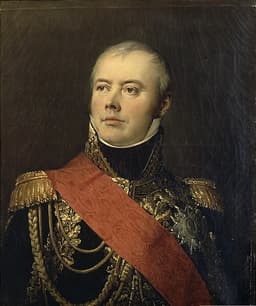
Etienne Macdonald
General · Modern
53.8Total

Napoleon Bonaparte
General · Modern
70.9Total
Basic Information
Born
1765
1769
Died
1840
1821
Era
Modern
Modern
Nationality
France
France
Occupation
General
General
Civilization
Western
Western
Score Comparison
Military (10%)
67.5
94.0
Political (20%)
42.2
72.0
Influence (20%)
54.1
40.0
Legacy (20%)
46.7
80.0
Leadership (15%)
65.0
78.0
Strategy (15%)
57.5
90.0
TOTAL
53.8
70.9
Etienne Macdonald — Complete Timeline
1809 AD
Battle of WagramWar◆ Major
Macdonald commanded a corps at Wagram. He led a massive infantry assault that broke the Austrian center, earning him the baton of Marshal of the Empire on the battlefield.
Napoleonic WarsBattlePromotion
Impact: regional
1812 AD
Battle of the BerezinaWar◆ Major
Macdonald commanded the X Corps during the retreat from Russia. His corps covered the crossing of the Berezina River, suffering heavy losses but allowing the main army to escape.
Napoleonic WarsRetreatBerezina
Impact: regional
1813 AD
Battle of LeipzigWar◆ Major
Macdonald commanded a corps at Leipzig. His forces were routed by the Allies, and he was wounded while trying to rally his troops during the French defeat.
Napoleonic WarsBattleDefeatWounded
Impact: global
Battle of the KatzbachWar◆ Major
Macdonald commanded the French Army of the Bober at the Katzbach. His forces were defeated by Bl
Napoleonic WarsBattleDefeat
Impact: regional
1815 AD
Grand Chancellor of the Legion of HonourPolitical Action
Macdonald served as Grand Chancellor of the Legion of Honour under the Bourbon Restoration. He administered the order and maintained its prestige.
Legion of HonourBourbon RestorationAdministration
Impact: national
Napoleon Bonaparte — Complete Timeline
1799 AD
Coup of 18 BrumaireOther◆ Major
Napoleon Bonaparte, with support from his brother Lucien and key political figures, overthrew the Directory in a bloodless coup. He established the Consulate with himself as First Consul, effectively becoming the ruler of France. This event ended the French Revolution's most unstable period.
French RevolutionCoupRise to Power
Impact: regional
1804 AD
Promulgation of the Napoleonic CodeOther◆ Major
Napoleon enacted the Civil Code of the French, known as the Napoleonic Code, a comprehensive set of laws that replaced the fragmented feudal legal systems. The code established legal equality, protected property rights, and secularized law. It became the basis for legal systems in many European and world countries.
Legal ReformNapoleonic CodeCivil Law
Impact: globalconstructive
1805 AD
Battle of AusterlitzWar◆ Major
Napoleon's Grande Arm
Napoleonic WarsBattleDecisive Victory
Impact: global
1812 AD
Invasion of RussiaWar◆ Major
Napoleon led the Grande Arm
Napoleonic WarsInvasionDisaster
Impact: globaldestructive
1815 AD
Battle of WaterlooWar◆ Major
Napoleon's French army was defeated by the combined forces of the Duke of Wellington's Anglo-Allied army and Gebhard Leberecht von Bl
Napoleonic WarsBattleFinal Defeat
Impact: globaldestructive
Expert Analysis
etienne-macdonald-vs-napoleon-bonaparte
# The Emperor and the Marshal
On a rain-soaked June evening in 1815, as Napoleon Bonaparte galloped away from the field of Waterloo, a very different French commander was already settling into a new role in Paris. Étienne Macdonald, once Napoleon’s trusted marshal, had just accepted the position of Grand Chancellor of the Legion of Honour under the restored Bourbon monarchy. The contrast captures a profound question: how could two men, both born into the same turbulent era and both rising through the ranks of revolutionary France, end up on such divergent paths—one a titan who reshaped a continent, the other a capable but forgotten lieutenant?
Origins
Napoleon Bonaparte was born in 1769 on the island of Corsica, a year after France had purchased the island from Genoa. His family belonged to the minor nobility, but they were outsiders in French society—speaking Italian-accented French and nursing dreams of Corsican independence. This marginality forged in him a fierce ambition to prove himself. He entered the military academy at Brienne at age nine, a small, intense boy mocked by wealthier classmates. The humiliation burned deep, driving him to devour books on military history, artillery science, and Enlightenment philosophy.
Étienne Macdonald, born in 1765 in Sedan, came from a very different background. His father was a Scottish Jacobite exile who had fled after the failed rebellion of 1745. The family had no status, no connections—just a name that marked them as outsiders of a different sort. But where Napoleon’s outsider status bred hunger for domination, Macdonald’s bred a quiet pragmatism. He joined the French Royal Army’s Irish Regiment in 1784, a unit of foreign volunteers, and learned early that survival meant following orders, not rewriting them.
The French Revolution of 1789 shattered the old world for both men. For Napoleon, it was an opportunity—the old nobility’s collapse opened command positions to talented commoners. For Macdonald, it was a crisis of loyalty. He served the Revolution but never embraced its radicalism, watching as his royalist patrons were guillotined. By the time Napoleon seized power in 1799, Macdonald had already learned the lesson that would define his career: survival required adaptability, not genius.
Rise to Power
Napoleon’s ascent was meteoric and unprecedented. At age 24, he drove the British out of Toulon in 1793. At 26, he crushed a royalist uprising in Paris with a “whiff of grapeshot.” At 27, he won stunning victories in Italy against the Austrians, a campaign that revealed his signature blend of speed, deception, and overwhelming artillery. By 1804, at 35, he crowned himself Emperor of the French in Notre Dame Cathedral, taking the crown from Pope Pius VII’s hands and placing it on his own head—a gesture that spoke volumes about his belief in self-made destiny.
Macdonald’s rise was slower, steadier, and less glamorous. He distinguished himself in the Revolutionary Wars, particularly in Italy and Switzerland, but never matched Napoleon’s brilliance. His great moment came in 1809 at the Battle of Wagram, where he commanded a massive infantry assault that broke the Austrian center. Napoleon, watching from a hill, was impressed enough to make Macdonald a Marshal of the Empire on the spot. But the promotion came with a telling detail: Napoleon had already created 18 other marshals before him. Macdonald was not a founder of the Empire; he was a late addition, a reward for competence rather than vision.
Leadership & Governance
As emperor, Napoleon governed with a blend of military discipline and Enlightenment reform. He centralized the state, standardized laws through the Napoleonic Code, and created a meritocratic bureaucracy that rewarded talent over birth. His military genius lay in his ability to concentrate forces at the decisive point, to read terrain and enemy psychology, and to inspire soldiers who worshipped him. He once said, “A soldier will fight long and hard for a bit of colored ribbon”—and he knew how to give out those ribbons.
Macdonald led differently. His leadership score of 85.0 reflects a commander who was trusted and respected, but not loved with fanatical devotion. He was methodical, reliable, and cautious—qualities that served him well in set-piece battles like Wagram but failed him in the fluid chaos of the 1813 campaign. At the Battle of the Katzbach that year, his Army of the Bober was routed by the Prussian general Blücher during a sudden thunderstorm. Macdonald’s forces became disoriented, their gunpowder wet, their formations broken. He was wounded trying to rally his men, but the defeat was total. Where Napoleon would have improvised a counterattack, Macdonald could only retreat.
Triumph & Tragedy
Napoleon’s greatest triumph was the Empire itself—a Europe remade in his image, from Spain to Poland. His Napoleonic Code remains the foundation of civil law across much of the world. His tragedy was the invasion of Russia in 1812, where he lost over 400,000 men to winter, disease, and guerrilla warfare. The retreat from Moscow was a catastrophe of his own making, born of hubris and an inability to compromise.
Macdonald’s triumph was at Wagram, where his corps’ assault turned the battle. But his tragedy was also Russia—specifically the Berezina River crossing in November 1812. While Napoleon’s main army fought desperately to cross, Macdonald’s X Corps covered the retreat with steady discipline. He saved thousands of lives, but the campaign shattered his health and his faith in Napoleon’s judgment. By 1813, when Napoleon needed him most, Macdonald was a tired man commanding tired troops.
Character & Destiny
Napoleon’s character was a paradox: a rationalist who believed in destiny, a reformer who craved dynastic legitimacy, a genius undone by his own ambition. He once wrote, “Impossible is a word to be found only in the dictionary of fools.” That refusal to accept limits drove his rise—and his fall. He could not stop, could not consolidate, could not make peace.
Macdonald’s character was the opposite. He was a survivor, not a conqueror. When Napoleon abdicated in 1814, Macdonald switched his loyalty to the Bourbon monarchy without apparent guilt. He served as Grand Chancellor of the Legion of Honour, administering the order Napoleon had created, but now under the king Napoleon had overthrown. When Napoleon returned from exile in 1815 for the Hundred Days, Macdonald refused to join him. He had seen enough of glory.
Legacy
Napoleon’s legacy is colossal. His name defines an era—the Napoleonic Age. His military tactics are studied at war colleges, his legal code shapes modern jurisprudence, his ambition haunts European history as a warning against overreach. His scores—Military 94.0, Strategy 93.0, Influence 82.0—place him among history’s giants.
Macdonald’s legacy is modest. He is remembered, if at all, as a competent marshal who served longer than most and survived where many perished. His total score of 69.5 reflects a solid career but no lasting impact. He died in 1840, the same year Napoleon’s remains were returned to Paris for a state funeral—a fitting symbol of how history remembers the emperor and forgets the marshal.
Conclusion
The difference between Napoleon and Macdonald is not merely talent—it is temperament, timing, and the willingness to risk everything. Napoleon played for immortality and lost; Macdonald played for survival and won. Both men rose from obscurity in revolutionary France, but one reshaped the world, while the other merely navigated it. Perhaps the most telling detail is that Macdonald, after Napoleon’s final defeat, lived quietly for another 25 years, administering honors he had not earned but had not betrayed. In the end, the marshal outlasted the emperor—but the emperor outshone the marshal forever.
Rankings
🥇
Napoleon BonaparteLeader
Mil: 94.0Pol: 72.0Inf: 40.0
70.9
🥈
Etienne Macdonald
Mil: 67.5Pol: 42.2Inf: 54.1
53.8
+17.1 behind
How This Comparison Works
Algorithm
Each figure is scored on 6 dimensions (0—100 scale) based on structured historical data: Military (10%), Political (20%), Influence (20%), Legacy (20%), Leadership (15%), Strategy (15%). The weighted total produces the final ranking.
Data Sources
Scores are computed from structured sub-indicators in the database. Scale factors adjust for era (Ancient ×0.85, Modern ×1.0) and civilization size (Eastern ×1.05, Other ×0.80) to account for differences in population and military scale.
Maximum 3 Figures
Comparisons are limited to 2—3 figures to ensure readability and statistical meaningfulness.
Error Margins
±5 points per dimension — Sub-scores are derived from historical records with inherent uncertainty. Two figures within 5 points on a dimension should be considered roughly equivalent in that area.
Total Score Accuracy
±3 points overall — The weighted combination of 6 dimensions produces a total score with approximately ±3 points of uncertainty. Differences of less than 3 points are not statistically significant— the figures are effectively tied.
Known Limitations
- Historical records are incomplete and uneven across civilizations
- Figures from oral-tradition societies may be underrepresented
- Occupation labels can misclassify multi-role figures
- Scores measure capability and impact, not moral character
- Quantitative scoring is a comparison tool, not absolute truth
Capability Radar
Military (10%) — Battles & Warfare
Battles
65
95
Win Rate
60
90
Expansion
55
95
Political (20%) — Governance & Reform
Reform
20
95
Diplomacy
40
80
Economy
25
85
Influence (20%) — Cultural & Global Reach
Cultural
25
85
Global
30
90
Legacy (20%) — Historical Impact
Historical
40
95
Longevity
30
90
Leadership (15%) — Power & Stability
Tenure
45
85
Stability
35
70
Strategy (15%) — Tactics & Innovation
Strategy
60
95
Tactics
55
98
Reform
30
92
Similar Comparisons
Comments & Discussion
SwordAndScale6/17/2026
Macdonald was a competent commander, but he lacked Napoleon’s genius for seizing the moment. At Waterloo, Napoleon’s gamble on Grouchy failing to block the Prussians cost him everything—while Macdonald’s steady, if uninspired, leadership in Italy and Spain kept French armies intact. The difference isn’t just ambition; it’s that Napoleon played for immortality and lost, while Macdonald played for survival and won. Which legacy would you rather have?
数据侦探6/17/2026
别被英雄叙事迷惑了。拿破仑的辉煌建立在系统性的军需账目造假上,1812年侵俄时的补给数字水分高达三成。而麦克唐纳在1814年法国战役里,以少敌多坚持了六周,真实伤亡率反倒更低。数据不会说谎:光环之下,往往藏着更大的泡沫。
CorsicanOutsider6/17/2026
As a fellow Corsican, I see something deeper. Napoleon’s marginality gave him the hunger to rewrite Europe’s map—but it also made him blind to loyalty. He ditched his Italian roots, married an Austrian, and crowned himself emperor, while Macdonald stayed true to his Jacobite father’s ethos: adapt to survive, never forget your exile. One burned like a supernova; the other kept the light steady for France. I know which leg I’d rather stand on.
墨守成规者6/17/2026
拿破仑是火山,麦克唐纳是基石。别把忍耐当平庸:1813年莱比锡战役后,麦克唐纳独自断后,收拢了三千残兵,比内伊那波旁式的莽撞强百倍。拿破仑输在骄纵,麦克唐纳赢在自知之明。历史爱吹嘘流星,却忘了地基才是撑起帝国的东西。