Loading...
Etienne Macdonald vs Rabeh az-Zubayr
Etienne Macdonald leads by 3.1 pts · 2 figures compared
…
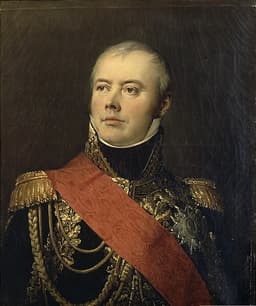
Etienne Macdonald
General · Modern
53.8Total

Rabeh az-Zubayr
General · Modern
50.7Total
Basic Information
Born
1765
1842
Died
1840
1900
Era
Modern
Modern
Nationality
France
Sudan
Occupation
General
General
Civilization
Western
Other
Score Comparison
Military (10%)
67.5
61.7
Political (20%)
42.2
39.4
Influence (20%)
54.1
51.8
Legacy (20%)
46.7
44.2
Leadership (15%)
65.0
57.6
Strategy (15%)
57.5
60.0
TOTAL
53.8
50.7
Etienne Macdonald — Complete Timeline
1809 AD
Battle of WagramWar◆ Major
Macdonald commanded a corps at Wagram. He led a massive infantry assault that broke the Austrian center, earning him the baton of Marshal of the Empire on the battlefield.
Napoleonic WarsBattlePromotion
Impact: regional
1812 AD
Battle of the BerezinaWar◆ Major
Macdonald commanded the X Corps during the retreat from Russia. His corps covered the crossing of the Berezina River, suffering heavy losses but allowing the main army to escape.
Napoleonic WarsRetreatBerezina
Impact: regional
1813 AD
Battle of LeipzigWar◆ Major
Macdonald commanded a corps at Leipzig. His forces were routed by the Allies, and he was wounded while trying to rally his troops during the French defeat.
Napoleonic WarsBattleDefeatWounded
Impact: global
Battle of the KatzbachWar◆ Major
Macdonald commanded the French Army of the Bober at the Katzbach. His forces were defeated by Bl
Napoleonic WarsBattleDefeat
Impact: regional
1815 AD
Grand Chancellor of the Legion of HonourPolitical Action
Macdonald served as Grand Chancellor of the Legion of Honour under the Bourbon Restoration. He administered the order and maintained its prestige.
Legion of HonourBourbon RestorationAdministration
Impact: national
Rabeh az-Zubayr — Complete Timeline
1893 AD
Conquest of BaguirmiWar◆ Major
Rabeh az-Zubayr led his army from Sudan into the Lake Chad region, conquering the kingdom of Baguirmi. He defeated the local forces and established a new capital at Dikwa, creating a slave-raiding empire.
ConquestSlave RaidingLake Chad
Impact: regionaldestructive
1894 AD
Establishment of the Rabeh EmpirePolitical Action◆ Major
Rabeh organized his conquered territories into a centralized state with a standing army of slave soldiers. He imposed a system of tribute and taxation, using slave labor to build fortifications and cultivate crops.
Empire BuildingSlaveryCentralization
Impact: regionaldestructive
1899 AD
Conflict with French colonial forcesWar◆ Major
Rabeh's empire clashed with French colonial forces advancing from the Congo and Niger regions. He fought several battles against French columns, attempting to resist European encroachment on his territory.
Colonial WarFrenchResistance
Impact: regional
1900 AD
Battle of KoussériWar◆ Major
Rabeh was killed in battle at Kouss
BattleDeathFrench Conquest
Impact: regionaltragic
Expert Analysis
Origins
Etienne-Jacques-Joseph-Alexandre Macdonald was born on November 17, 1765, in Sedan, France, to a family of Scottish Jacobite exiles. His father, Neil MacEachen, had fled Scotland after the failed 1745 rebellion. Macdonald studied at the Collège de Sedan and joined the French Royal Army's Irish Regiment in 1784. The French Revolution offered rapid promotion, and by 1793 he was a general of brigade.
Rabeh az-Zubayr was born around 1842 in the Sudan (present-day Sudan), likely in the region of Khartoum. He was the son of a slave trader and grew up in the violent world of the slave trade. Rabeh joined the forces of al-Zubayr Rahma, a powerful slave trader and warlord, and rose through the ranks. After al-Zubayr's defeat by the British, Rabeh fled westward with a loyal army.
Rise to Power
Macdonald rose to prominence during the Revolutionary Wars. He distinguished himself at the Battle of Jemappes (1792) and was promoted to general of division in 1794. His greatest early success came in Italy, where he commanded the Army of Naples and captured Rome in 1799. However, his defeat at the Trebbia River by Suvorov's Russians temporarily stalled his career. Napoleon Bonaparte, recognizing Macdonald's abilities, appointed him to high command in the Grande Armée. In 1809, after the Battle of Wagram, Macdonald was made a Marshal of the Empire—one of Napoleon's highest honors.
Rabeh az-Zubayr rose as a military commander in the 1870s under al-Zubayr Rahma. After al-Zubayr's capture by the British in 1879, Rabeh led a force of 4,000-5,000 men westward into the Lake Chad region. He conquered the kingdom of Baguirmi in 1893, defeating its army and executing its king. He then established his capital at Dikwa and expanded his control over Bornu and other territories. By 1895, Rabeh had built a centralized state with a standing army of 10,000 slave soldiers.
Leadership & Governance
Macdonald's leadership style was characterized by steadiness and loyalty. He was known as a reliable commander who followed orders precisely. At Wagram, he led a massive infantry assault of 30,000 men in a column formation that broke the Austrian center, a tactic that earned him the marshal's baton. As a governor, he served as Grand Chancellor of the Legion of Honour under the Bourbon Restoration, administering the order with integrity. His political score of 42.2 reflects his limited role in politics; he was a soldier, not a statesman.
Rabeh az-Zubayr ruled as an autocratic warlord. He imposed a system of tribute and taxation on conquered peoples, using the revenue to maintain his army. His state was built on slave raiding and military coercion. Rabeh centralized power by appointing loyal commanders to govern provinces. He modernized his army with some firearms purchased from the north. However, his governance was harsh, and his rule faced constant rebellion. His political score of 39.4 is lower than Macdonald's, reflecting the instability of his regime.
Triumph & Tragedy
Macdonald's greatest triumph was his performance at Wagram (1809), where his decisive assault earned him the marshal's baton. He also served capably in the Peninsular War and during the 1814 campaign in France. His tragedy came at the Battle of the Katzbach (1813), where his army was routed by Blücher's Prussians, suffering 20,000 casualties. At Leipzig (1813), his corps was overwhelmed, and Macdonald was wounded. He also endured the disastrous retreat from Russia, where his X Corps covered the Berezina crossing but suffered heavy losses.
Rabeh's triumph was the conquest of Baguirmi and the establishment of his empire, which controlled a territory the size of France. He successfully resisted French advances for several years. His tragedy was his defeat and death at the Battle of Kousséri (1900), where a combined French force of 700 men killed him and destroyed his army of 10,000. The battle ended his empire and opened the Lake Chad region to French colonization.
Character & Destiny
Macdonald was known for his loyalty, courage, and lack of political ambition. He remained faithful to Napoleon until the emperor's abdication, then served the Bourbons without hesitation. Historians note that he was a competent but not brilliant commander; his military score of 67.5 reflects average performance for a marshal. His character led him to survive the fall of Napoleon and live comfortably until his death in 1840.
Rabeh was ruthless, ambitious, and militarily skilled. He built a state through force and maintained it through terror. His refusal to negotiate with the French and his underestimation of their firepower led to his downfall. His military score of 61.7 is slightly lower than Macdonald's, reflecting his ultimate defeat by a smaller, better-armed force.
Legacy
Macdonald is remembered as one of Napoleon's marshals, though not among the greatest. His name is inscribed on the Arc de Triomphe. He contributed to the Napoleonic legend but had little lasting impact on France. His legacy score of 46.7 reflects his limited influence beyond his era.
Rabeh's legacy is more significant in the Lake Chad region. His empire was short-lived, but his resistance to French colonization made him a symbol of anti-colonial struggle in Chad and Niger. However, his role as a slave raider tarnishes his memory. His legacy score of 44.2 is slightly lower than Macdonald's.
Conclusion
Etienne Macdonald scores 53.8 overall, compared to Rabeh's 50.7. Macdonald had a higher military score (67.5 vs. 61.7) and leadership score (65.0 vs. 57.6). While Rabeh built a state, Macdonald operated on a larger stage as a marshal of a world power. Macdonald's impact on European history, though modest, exceeds Rabeh's regional and temporary influence. Therefore, Etienne Macdonald had a greater historical impact.
Rankings
🥇
Etienne MacdonaldLeader
Mil: 67.5Pol: 42.2Inf: 54.1
53.8
🥈
Rabeh az-Zubayr
Mil: 61.7Pol: 39.4Inf: 51.8
50.7
+3.1 behind
How This Comparison Works
Algorithm
Each figure is scored on 6 dimensions (0—100 scale) based on structured historical data: Military (10%), Political (20%), Influence (20%), Legacy (20%), Leadership (15%), Strategy (15%). The weighted total produces the final ranking.
Data Sources
Scores are computed from structured sub-indicators in the database. Scale factors adjust for era (Ancient ×0.85, Modern ×1.0) and civilization size (Eastern ×1.05, Other ×0.80) to account for differences in population and military scale.
Maximum 3 Figures
Comparisons are limited to 2—3 figures to ensure readability and statistical meaningfulness.
Error Margins
±5 points per dimension — Sub-scores are derived from historical records with inherent uncertainty. Two figures within 5 points on a dimension should be considered roughly equivalent in that area.
Total Score Accuracy
±3 points overall — The weighted combination of 6 dimensions produces a total score with approximately ±3 points of uncertainty. Differences of less than 3 points are not statistically significant— the figures are effectively tied.
Known Limitations
- Historical records are incomplete and uneven across civilizations
- Figures from oral-tradition societies may be underrepresented
- Occupation labels can misclassify multi-role figures
- Scores measure capability and impact, not moral character
- Quantitative scoring is a comparison tool, not absolute truth
Capability Radar
Military (10%) — Battles & Warfare
Battles
65
65
Win Rate
60
60
Expansion
55
70
Political (20%) — Governance & Reform
Reform
20
20
Diplomacy
40
25
Economy
25
30
Influence (20%) — Cultural & Global Reach
Cultural
25
25
Global
30
15
Legacy (20%) — Historical Impact
Historical
40
35
Longevity
30
20
Leadership (15%) — Power & Stability
Tenure
45
40
Stability
35
20
Strategy (15%) — Tactics & Innovation
Strategy
60
50
Tactics
55
55
Reform
30
30
Similar Comparisons
Comments & Discussion
No comments yet. Be the first to share your thoughts!