Loading...
Eumenes of Cardia vs Napoleon Bonaparte
Napoleon Bonaparte leads by 17.2 pts · 2 figures compared
…
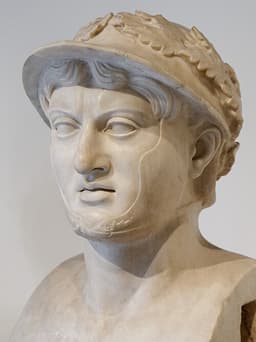
Eumenes of Cardia
General · Ancient
53.7Total

Napoleon Bonaparte
General · Modern
70.9Total
Basic Information
Born
-362
1769
Died
-316
1821
Era
Ancient
Modern
Nationality
Macedon
France
Occupation
General
General
Civilization
Western
Western
Score Comparison
Military (10%)
85.0
94.0
Political (20%)
33.6
72.0
Influence (20%)
54.9
40.0
Legacy (20%)
47.5
80.0
Leadership (15%)
50.7
78.0
Strategy (15%)
70.0
90.0
TOTAL
53.7
70.9
Eumenes of Cardia — Complete Timeline
336 BC
Appointment as Alexander's secretaryPolitical Action◆ Major
Eumenes was appointed as Alexander the Great's personal secretary (chief scribe) after the death of Philip II. This position gave him intimate knowledge of imperial administration and access to Alexander's inner circle.
Alexander the GreatAdministrationCourt
Impact: nationalconstructive
321 BC
Command at the Battle of the HellespontWar
Eumenes defeated Craterus and Neoptolemus at the Battle of the Hellespont. Craterus, Alexander's most trusted general, was killed in the battle. This victory established Eumenes as a major military commander in the Wars of the Diadochi.
Wars of the DiadochiCraterusBattle
Impact: regional
319 BC
Siege of NoraWar◆ Major
After being declared an outlaw by Antipater, Eumenes was besieged by Antigonus Monophthalmus at the fortress of Nora in Cappadocia. He held out for over a year, negotiating a truce that allowed him to escape and continue his campaign.
Wars of the DiadochiSiegeAntigonus
Impact: regional
316 BC
Battle of GabieneWar◆ Major
Eumenes fought Antigonus Monophthalmus at Gabiene. Though the battle was tactically indecisive, Eumenes' own Silver Shields mutinied and handed him over to Antigonus, who had him executed. This ended his campaign.
Wars of the DiadochiAntigonusExecution
Impact: regionaltragic
Execution by AntigonusPolitical Action◆ Major
After being betrayed by his own troops at Gabiene, Eumenes was executed by Antigonus Monophthalmus. His death removed the last major supporter of the Argead royal house and consolidated Antigonus's power in Asia.
Wars of the DiadochiExecutionAntigonus
Impact: regionaltragic
Napoleon Bonaparte — Complete Timeline
1799 AD
Coup of 18 BrumaireOther◆ Major
Napoleon Bonaparte, with support from his brother Lucien and key political figures, overthrew the Directory in a bloodless coup. He established the Consulate with himself as First Consul, effectively becoming the ruler of France. This event ended the French Revolution's most unstable period.
French RevolutionCoupRise to Power
Impact: regional
1804 AD
Promulgation of the Napoleonic CodeOther◆ Major
Napoleon enacted the Civil Code of the French, known as the Napoleonic Code, a comprehensive set of laws that replaced the fragmented feudal legal systems. The code established legal equality, protected property rights, and secularized law. It became the basis for legal systems in many European and world countries.
Legal ReformNapoleonic CodeCivil Law
Impact: globalconstructive
1805 AD
Battle of AusterlitzWar◆ Major
Napoleon's Grande Arm
Napoleonic WarsBattleDecisive Victory
Impact: global
1812 AD
Invasion of RussiaWar◆ Major
Napoleon led the Grande Arm
Napoleonic WarsInvasionDisaster
Impact: globaldestructive
1815 AD
Battle of WaterlooWar◆ Major
Napoleon's French army was defeated by the combined forces of the Duke of Wellington's Anglo-Allied army and Gebhard Leberecht von Bl
Napoleonic WarsBattleFinal Defeat
Impact: globaldestructive
Expert Analysis
eumenes-of-cardia-vs-napoleon-bonaparte
# The Conqueror and the Secretary
On a June morning in 1815, Napoleon Bonaparte watched his Imperial Guard march toward the smoking ridges of Mont-Saint-Jean, their bearskin caps like a dark tide against the green slopes. He had staked everything on one hammer blow. Four thousand miles away and two thousand years earlier, another man—a Greek from Cardia—watched his own elite troops, the Silver Shields, advance across the dust-choked plain of Gabiene. Both men commanded the finest soldiers of their age. Both faced betrayal. But one would die in exile on a remote Atlantic island, while the other would be executed by his own men, his corpse abandoned to the vultures. Why does history remember Napoleon as a titan and Eumenes as little more than a footnote? The answer lies not in their talents—which were formidable in both cases—but in the raw material of destiny each was given.
Origins
Napoleon Bonaparte was born in 1769 on Corsica, an island that had just passed from Genoese to French control. His family were minor nobles, but they were nobles nonetheless, and they scraped together enough money to send young Napoleon to military school in mainland France. There, he was mocked for his accent, his poverty, and his small stature. He devoured books on military history and artillery, and he cultivated a burning ambition that would later consume entire armies. Corsica was his wound and his fuel: he felt himself an outsider in France, yet he would remake France in his own image.
Eumenes of Cardia was born around 362 BC in a Greek city on the coast of Asia Minor. His father was a wagoner—a man who drove carts for a living. In the rigid hierarchy of ancient Greece, this was not merely poverty; it was near-invisibility. Eumenes had no army, no noble blood, no land. What he had was a sharp mind and the patronage of Philip II of Macedon, who recognized his intelligence and made him a secretary. When Philip was assassinated in 336 BC, Eumenes found himself serving a new master: Alexander the Great. He was the keeper of the king’s diary, the man who recorded the conquest of the known world. He watched, he learned, and he waited.
Rise to Power
Napoleon’s rise was a cannonball trajectory. In 1793, at the age of twenty-four, he drove the British out of Toulon and was promoted to brigadier general. In 1795, he saved the revolutionary government from a royalist uprising with a “whiff of grapeshot”—his cannons firing into the mob on the streets of Paris. By 1796, he was commanding the Army of Italy. He moved with a speed that stunned his enemies, winning battles at Lodi, Arcole, and Rivoli. In 1799, he seized power in a coup d’état, becoming First Consul. By 1804, he crowned himself Emperor of the French. It took him eleven years from his first command to the throne of Europe.
Eumenes had no such path. For a decade, he served Alexander as a secretary, not a general. He was a Greek among Macedonians, a scribe among warriors. The Macedonian nobles sneered at him. When Alexander died in 323 BC, his empire immediately fractured. The generals—the Diadochi—carved up the provinces like wolves over a carcass. Eumenes received Cappadocia, a wild region in central Anatolia that had never been fully conquered. He had no army, no treasury, no reputation as a soldier. Yet he did what Napoleon would have understood: he improvised. He raised troops from the local population and trained them. He formed alliances. And in 321 BC, at the Battle of the Hellespont, he faced the most formidable of Alexander’s generals: Craterus, the man Alexander had called his “most loyal friend.” Eumenes won. Craterus died on the field. The secretary had become a general.
Leadership & Governance
Napoleon governed as he fought: with speed, clarity, and absolute control. The Napoleonic Code, enacted in 1804, standardized French law, abolished feudal privileges, and established merit-based advancement. He reformed education, created the Bank of France, and built roads and canals that tied his empire together. He was a master of propaganda, presenting himself as the man who had saved the Revolution while quietly dismantling its democratic elements. His military genius lay in his ability to concentrate overwhelming force at the decisive point, to move armies faster than his enemies could react, and to inspire his soldiers with personal courage and grand promises.
Eumenes governed from a tent. He never held a stable capital. He was a strategist, not an administrator. His military style was cautious, patient, and psychological. He understood that the Macedonian soldiers were loyal to the memory of Alexander, not to any living general. So he set up an empty throne in his camp, draped with Alexander’s robes and crowned with his diadem. He held councils before it. He claimed to receive divine guidance from his dead king. This was not superstition; it was statecraft. He was telling his troops: “I am not a usurper. I am Alexander’s instrument.” It worked for years, but it was a fragile foundation.
Triumph & Tragedy
Napoleon’s greatest triumph was Austerlitz in 1805, where he destroyed the combined armies of Russia and Austria in a single day. His greatest tragedy was the invasion of Russia in 1812, where he lost half a million men to winter, hunger, and the Russian scorched-earth retreat. He was exiled to Elba in 1814, escaped in 1815, and was finally defeated at Waterloo. His end was lonely and bitter: a prisoner on Saint Helena, dictating his memoirs, dying of stomach cancer in 1821 at the age of fifty-one.
Eumenes’ greatest triumph was the Hellespont, where he defeated Craterus and proved that a secretary could outfight a king’s general. His tragedy was Gabiene in 316 BC. The battle against Antigonus Monophthalmus was tactically indecisive, but Eumenes’ own Silver Shields—his elite troops—betrayed him. They had been fighting for years, far from home, and they were tired. Antigonus offered them a deal: surrender Eumenes, and they would be spared. They took it. They seized their own commander and handed him over. Antigonus executed him. Eumenes was fifty-four.
Character & Destiny
Napoleon was driven by an insatiable hunger for glory. “I live only for posterity,” he once said, and he meant it. He believed that history would judge him by his victories and his laws, and he was right. But his arrogance was his undoing. He could not stop. He could not consolidate. He pushed into Russia, into Spain, into the endless war that bled France dry.
Eumenes was driven by survival. He knew he was a foreigner, an upstart, a man without a tribe. He fought not for empire but for his life. He was brilliant, adaptable, and utterly alone. His character was that of a chess player in a knife fight: he saw ten moves ahead, but his opponents were stronger and more ruthless. He had no homeland to fall back on, no dynasty to protect him. He was a man with no roots, and when the wind shifted, he was blown away.
Legacy
Napoleon reshaped Europe. His legal code remains the basis of civil law in much of the world. His military innovations influenced warfare for a century. He is remembered as a genius and a tyrant, a liberator and a conqueror. His name is synonymous with ambition.
Eumenes is remembered by scholars of the Diadochi, by students of ancient warfare, by those who wonder what might have been. He was the only one of Alexander’s successors who had no Macedonian blood, no royal claim, no army of his own—yet he came closer than anyone to holding the empire together. He failed because he was betrayed, not because he was beaten. His legacy is a question: What would have happened if the Silver Shields had stood firm?
Conclusion
Napoleon and Eumenes both rose from obscurity to command armies and shape history. Napoleon had a nation behind him, a revolution to ride, and a continent to conquer. Eumenes had only his wits and the memory of a dead king. Napoleon’s tragedy was that he could not stop conquering. Eumenes’ tragedy was that he never had a place to stop. In the end, the difference between them is the difference between a man who built an empire and a man who tried to hold one together with his bare hands. One left a legacy of stone and law. The other left a story of what one man can accomplish when he has nothing—and what he can lose when he has no one.
Rankings
🥇
Napoleon BonaparteLeader
Mil: 94.0Pol: 72.0Inf: 40.0
70.9
🥈
Eumenes of Cardia
Mil: 85.0Pol: 33.6Inf: 54.9
53.7
+17.2 behind
How This Comparison Works
Algorithm
Each figure is scored on 6 dimensions (0—100 scale) based on structured historical data: Military (10%), Political (20%), Influence (20%), Legacy (20%), Leadership (15%), Strategy (15%). The weighted total produces the final ranking.
Data Sources
Scores are computed from structured sub-indicators in the database. Scale factors adjust for era (Ancient ×0.85, Modern ×1.0) and civilization size (Eastern ×1.05, Other ×0.80) to account for differences in population and military scale.
Maximum 3 Figures
Comparisons are limited to 2—3 figures to ensure readability and statistical meaningfulness.
Error Margins
±5 points per dimension — Sub-scores are derived from historical records with inherent uncertainty. Two figures within 5 points on a dimension should be considered roughly equivalent in that area.
Total Score Accuracy
±3 points overall — The weighted combination of 6 dimensions produces a total score with approximately ±3 points of uncertainty. Differences of less than 3 points are not statistically significant— the figures are effectively tied.
Known Limitations
- Historical records are incomplete and uneven across civilizations
- Figures from oral-tradition societies may be underrepresented
- Occupation labels can misclassify multi-role figures
- Scores measure capability and impact, not moral character
- Quantitative scoring is a comparison tool, not absolute truth
Capability Radar
Military (10%) — Battles & Warfare
Battles
75
95
Win Rate
70
90
Expansion
60
95
Political (20%) — Governance & Reform
Reform
30
95
Diplomacy
65
80
Economy
35
85
Influence (20%) — Cultural & Global Reach
Cultural
45
85
Global
35
90
Legacy (20%) — Historical Impact
Historical
55
95
Longevity
40
90
Leadership (15%) — Power & Stability
Tenure
50
85
Stability
40
70
Strategy (15%) — Tactics & Innovation
Strategy
85
95
Tactics
80
98
Reform
40
92
Similar Comparisons
Comments & Discussion
BronzeFist6/17/2026
The real irony here is military historians ranking Napoleon over Eumenes when the Diadochi wars were *harder* than anything Napoleon faced. Eumenes fought Alexander’s veterans on their own terms, with no royal blood and a broken alliance system. Napoleon had France’s entire industrial base and a unified command. Put Eumenes in 1805—he’d have crushed Austerlitz. Put Napoleon in 320 BC—he’d be dead by year two.
兵书毒舌6/17/2026
拿破仑吹子总爱提奥斯特里茨,却选择性遗忘格拉尼库斯河畔的波斯人也是远程加骑兵。欧迈尼斯在欧瑞尼亚用四千人拖住安提柯两万精锐——这放到近代就是内伊在滑铁卢被侧击前打出完美的拖延战。拿破仑也就欺负下反法同盟那帮F级协调,让他接手亚历山大死后那摊烂摊子?三个月内被佩尔狄卡斯背刺四次。
SilverGuardian6/17/2026
You’re all missing the command structure difference. Napoleon was his own chief of staff; Eumenes had to constantly negotiate with Silver Shields who remembered *they* conquered Persia. In 316 BC, when Eumenes’ own troops mutinied over baggage trains, Napoleon never faced that level of strategic instability. His marshals were ambitious but didn’t literally sell him for a camel and a satrap’s pardon. That’s not just survival—that’s herding cats with bronze swords.
史海镖客6/17/2026
说拿破仑更伟大的,请回答:欧迈尼斯在卡帕多细亚败光主力后,用三个月重建军队并打赢奥里尼亚战役。拿破仑从莱比锡逃回巴黎后干了什么?滑铁卢的追击战打得像毕业论文查重——全是复制粘贴以前的套路。欧迈尼斯用希腊雇佣兵打马其顿方阵,资源只有拿破仑的零头,这仗换苏沃洛夫来都得翻车。
StatCounter6/17/2026
Every time we compare dead empires, ignore the bureaucratic edge. Napoleon inherited a centralized state with tax collection, conscription, and the metric system. Eumenes ran his war off plundered Persian treasuries and personal charisma with no fixed logistics base. One managed France’s GDP; the other managed a war chest the size of Delaware. That’s not just different eras—that’s different games.