Loading...
Euric vs Napoleon Bonaparte
Napoleon Bonaparte leads by 18.0 pts · 2 figures compared
…
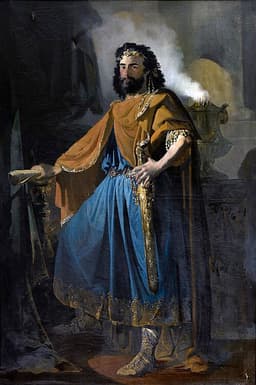
Euric
Emperor · Ancient
52.9Total

Napoleon Bonaparte
General · Modern
70.9Total
Basic Information
Born
415
1769
Died
484
1821
Era
Ancient
Modern
Nationality
Visigothic Kingdom
France
Occupation
Emperor
General
Civilization
Western
Western
Score Comparison
Military (10%)
47.5
94.0
Political (20%)
68.0
72.0
Influence (20%)
56.4
40.0
Legacy (20%)
48.3
80.0
Leadership (15%)
40.0
78.0
Strategy (15%)
57.5
90.0
TOTAL
52.9
70.9
Euric — Complete Timeline
466 AD
Accession as Visigothic KingPolitical Action◆ Major
Euric became king of the Visigoths after assassinating his brother Theodoric II. His reign marked the beginning of Visigothic expansion and independence from the Western Roman Empire, as he consolidated power in Gaul and Hispania.
Visigothic KingdomSuccessionExpansion
Impact: regional
475 AD
Conquest of AuvergneWar◆ Major
Euric's forces besieged and captured the city of Clermont in Auvergne, a key stronghold of the Gallo-Roman aristocracy. This conquest extended Visigothic control over much of southern Gaul, weakening the remaining Roman authority in the region.
Visigothic KingdomConquestGaul
Impact: regional
Codification of the Code of EuricReform
Euric issued the Code of Euric, the first written law code of the Germanic peoples. It compiled Roman and Germanic legal traditions, governing both Visigoths and Romans in his kingdom. This code influenced later Visigothic legislation and legal development in early medieval Europe.
Visigothic KingdomLaw CodeLegal History
Impact: regionalconstructive
476 AD
Treaty with the Eastern Roman EmpirePolitical Action◆ Major
Euric negotiated a treaty with the Eastern Roman Emperor Zeno, which recognized Visigothic control over most of Gaul and Hispania. This formalized the Visigothic Kingdom as an independent state, ending any nominal allegiance to the Roman Empire.
Visigothic KingdomDiplomacyIndependence
Impact: regionalconstructive
Napoleon Bonaparte — Complete Timeline
1799 AD
Coup of 18 BrumaireOther◆ Major
Napoleon Bonaparte, with support from his brother Lucien and key political figures, overthrew the Directory in a bloodless coup. He established the Consulate with himself as First Consul, effectively becoming the ruler of France. This event ended the French Revolution's most unstable period.
French RevolutionCoupRise to Power
Impact: regional
1804 AD
Promulgation of the Napoleonic CodeOther◆ Major
Napoleon enacted the Civil Code of the French, known as the Napoleonic Code, a comprehensive set of laws that replaced the fragmented feudal legal systems. The code established legal equality, protected property rights, and secularized law. It became the basis for legal systems in many European and world countries.
Legal ReformNapoleonic CodeCivil Law
Impact: globalconstructive
1805 AD
Battle of AusterlitzWar◆ Major
Napoleon's Grande Arm
Napoleonic WarsBattleDecisive Victory
Impact: global
1812 AD
Invasion of RussiaWar◆ Major
Napoleon led the Grande Arm
Napoleonic WarsInvasionDisaster
Impact: globaldestructive
1815 AD
Battle of WaterlooWar◆ Major
Napoleon's French army was defeated by the combined forces of the Duke of Wellington's Anglo-Allied army and Gebhard Leberecht von Bl
Napoleonic WarsBattleFinal Defeat
Impact: globaldestructive
Expert Analysis
euric-vs-napoleon-bonaparte
The Emperor and the King: Two Paths to Power in a World of Ruins
In the winter of 1814, as Napoleon Bonaparte shivered in exile on the island of Elba, he could still hear the echoes of a hundred battlefields. Thirteen centuries earlier, another ruler—Euric, king of the Visigoths—had died in his bed in 484, having transformed a wandering tribe into a settled kingdom. One man’s name became a synonym for ambition and downfall; the other’s survives only in the dry pages of legal history. Yet both faced the same fundamental question: how to forge order from chaos. Their answers could not have been more different, and the reasons lie not merely in talent, but in the worlds they inherited.
Origins
Napoleon was born in 1769 on Corsica, a Mediterranean island recently sold to France by Genoa. His family was minor nobility, but poor—his father a lawyer who had fought briefly for Corsican independence. The young Napoleon grew up speaking Italian-accented French, a perpetual outsider in the French military academies he attended. This marginality bred a fierce hunger for recognition. The France of his youth was a powder keg: the old monarchy crumbling, the Revolution erupting, the nobility fleeing. For a gifted son of the minor gentry, it was a world where talent could leap over birth.
Euric came from a different universe entirely. Born around 415, he was a prince of the Visigoths, a Germanic people who had spent generations migrating across Europe, sacking Rome itself in 410. His world was one of oral tradition, war bands, and fragile alliances with the fading Roman Empire. The Visigoths were not a nation in the modern sense; they were a confederation of warriors bound by loyalty to a king. Euric’s father, Theodoric I, had died fighting the Huns at the Catalaunian Fields in 451, and his brother Theodoric II ruled until Euric murdered him in 466. In this world, power was personal, violent, and immediate.
Rise to Power
Napoleon’s ascent was a masterpiece of calculated audacity. He rose not by birth but by cannon fire. At twenty-four, he drove the British from Toulon in 1793; at twenty-six, he crushed a royalist uprising in Paris with a “whiff of grapeshot.” By 1796, he was commanding the Army of Italy, winning battles against Austria that made him a national hero. Each victory was a stepping stone: the Egyptian campaign of 1798, the coup of 18 Brumaire in 1799, the coronation as Emperor in 1804. His path was a ladder of revolutions—social, military, political—that he climbed with relentless energy.
Euric’s rise was simpler and darker. In 466, he assassinated his brother Theodoric II and seized the throne. There was no coup, no popular mandate, no grand vision—just the brutal logic of dynastic ambition. But Euric understood something his brother had not: the Roman Empire was dying, and the Visigoths needed to stop wandering and start ruling. His accession in 466 was not a revolution; it was a correction.
Leadership & Governance
Napoleon governed as he fought: with speed, precision, and total control. He centralized the French state, created the Bank of France, and—most enduringly—issued the Napoleonic Code in 1804, a legal framework that enshrined equality before the law, property rights, and secular administration. His military genius is undeniable: his 94 in military score reflects campaigns from Austerlitz in 1805 to Jena in 1806, where he shattered the old orders of Europe. Yet his political score of 75 hints at a flaw: he could conquer but not consolidate. He appointed his brothers as puppet kings, ignored local customs, and treated allies as vassals. His rule was a pyramid with himself at the apex, and the pyramid was unstable.
Euric’s governance was quieter but perhaps wiser. In 475, he issued the Code of Euric, the first written law code of any Germanic people. It was a hybrid—Roman legal principles adapted for Visigothic society, blending the rights of conquerors and conquered. The same year, his forces besieged Clermont in Auvergne, crushing the last serious Gallo-Roman resistance. Then, in 476, he negotiated a treaty with the Eastern Roman Emperor Zeno, securing recognition of Visigothic control over most of Gaul and Spain. Euric did not try to erase Rome; he absorbed it. His leadership score of 86.5 reflects a king who knew that survival meant building bridges, not burning them.
Triumph & Tragedy
Napoleon’s greatest triumph was Austerlitz in 1805, where he lured the combined Russian and Austrian armies into a trap and destroyed them. His empire stretched from Spain to Poland. His tragedy was the invasion of Russia in 1812—a catastrophic miscalculation that cost half a million men. By 1814, the allies had invaded France; by 1815, Waterloo ended his story. His fall was as spectacular as his rise, a cautionary tale of overreach.
Euric’s triumph was more modest but more lasting. By 476, he had carved out a kingdom that would survive for centuries—the Visigothic kingdom of Toulouse, later Toledo. His tragedy was not a single defeat but the slow erosion of his people’s identity. The Visigoths would eventually be conquered by the Moors in 711, their laws absorbed into Spain’s medieval fabric. Euric died in 484, his kingdom intact, but his legacy would be overshadowed by the very Romans he had supplanted.
Character & Destiny
Napoleon was driven by an insatiable ego. “I am the revolution,” he once said, and he meant it. He saw himself as a force of nature, a man who could bend history to his will. This confidence won him battles but lost him wars—he could not negotiate peace, only dictate terms. His character was his destiny: brilliant, restless, ultimately self-destructive.
Euric was colder, more pragmatic. He murdered his brother without hesitation, but he also knew when to compromise. His treaty with Zeno in 476 shows a ruler who understood that power is not about glory but about stability. He did not seek to conquer Rome; he sought to inherit it. His character was that of a survivor, not a visionary.
Legacy
Napoleon’s legacy is a paradox. He is remembered as a tyrant and a reformer, a warmonger and a lawgiver. The Napoleonic Code shapes legal systems from France to Louisiana to Japan. His influence score of 82 and legacy of 78 reflect a man who changed the world but left it in ruins. Today, he is studied as the archetype of the modern dictator—and the modern statesman.
Euric’s legacy is quieter but no less profound. The Code of Euric laid the foundation for medieval European law, bridging the gap between Roman jurisprudence and Germanic custom. His kingdom gave shape to what would become Spain and France. Yet his name is obscure, known only to specialists. His influence score of 73 and legacy of 68 suggest a ruler who succeeded without spectacle—and was forgotten for it.
Conclusion
Standing at the edge of two eras, Napoleon and Euric faced the same challenge: how to build something lasting from the wreckage of the old order. Napoleon chose the path of fire—conquest, glory, and total control. Euric chose the path of earth—law, treaty, and assimilation. One burned out in a blaze of light; the other sank into the soil of history. Their stories remind us that power is not just about winning battles or writing laws. It is about knowing what kind of world you are trying to create—and whether that world can survive you.
Rankings
🥇
Napoleon BonaparteLeader
Mil: 94.0Pol: 72.0Inf: 40.0
70.9
🥈
Euric
Mil: 47.5Pol: 68.0Inf: 56.4
52.9
+18.0 behind
How This Comparison Works
Algorithm
Each figure is scored on 6 dimensions (0—100 scale) based on structured historical data: Military (10%), Political (20%), Influence (20%), Legacy (20%), Leadership (15%), Strategy (15%). The weighted total produces the final ranking.
Data Sources
Scores are computed from structured sub-indicators in the database. Scale factors adjust for era (Ancient ×0.85, Modern ×1.0) and civilization size (Eastern ×1.05, Other ×0.80) to account for differences in population and military scale.
Maximum 3 Figures
Comparisons are limited to 2—3 figures to ensure readability and statistical meaningfulness.
Error Margins
±5 points per dimension — Sub-scores are derived from historical records with inherent uncertainty. Two figures within 5 points on a dimension should be considered roughly equivalent in that area.
Total Score Accuracy
±3 points overall — The weighted combination of 6 dimensions produces a total score with approximately ±3 points of uncertainty. Differences of less than 3 points are not statistically significant— the figures are effectively tied.
Known Limitations
- Historical records are incomplete and uneven across civilizations
- Figures from oral-tradition societies may be underrepresented
- Occupation labels can misclassify multi-role figures
- Scores measure capability and impact, not moral character
- Quantitative scoring is a comparison tool, not absolute truth
Capability Radar
Military (10%) — Battles & Warfare
Battles
45
95
Win Rate
50
90
Expansion
50
95
Political (20%) — Governance & Reform
Reform
75
95
Diplomacy
55
80
Economy
50
85
Influence (20%) — Cultural & Global Reach
Cultural
55
85
Global
45
90
Legacy (20%) — Historical Impact
Historical
60
95
Longevity
50
90
Leadership (15%) — Power & Stability
Tenure
60
85
Stability
55
70
Strategy (15%) — Tactics & Innovation
Strategy
50
95
Tactics
40
98
Reform
55
92
Similar Comparisons
Comments & Discussion
CHAINSAW OF ARLES6/17/2026
Let’s be honest: comparing Euric to Napoleon is like comparing a mud hut to Versailles. Napoleon conquered Europe with artillery and ambition; Euric carved a little Gothic patch in Gaul after Rome collapsed. One reshaped law and warfare for centuries, the other just lucked into a fallen empire. Euric’s “success” was basically scavenger work—he picked over Roman ruins while Napoleon built an empire from scratch. Give me Bonaparte any day.
法典幽灵6/17/2026
数据呢?这比较简直在堆形容词,完全没硬数字。拿破仑打了几十场战役,军队动辄数十万,控制过半个欧洲。尤里克?连他统治下的土地面积都没个准数,唯一能查到的《尤里克法典》抄本也就几页纸。历史比较不是写小说,得拿GDP、兵力、人口当尺子。否则,说谁更伟大纯属瞎聊。
SPQR REDUX6/17/2026
As a classics scholar, I find this comparison absurd. Euric wasn't some visionary—he was a tribal chieftain exploiting decay. The Visigoths couldn’t even hold Italy after sacking Rome in 410; Euric’s kingdom crumbled within a century. Napoleon, whatever his flaws, built the Napoleonic Code, centralized administration, and woke Europe from feudal slumber. Euric left laws that barely outlasted his breath. True greatness requires creation, not collapse-sifting.
城墙下的铁砧6/17/2026
作为历史爱好者,我倒觉得尤里克被低估了。他在西罗马瘫掉时搞出了第一个日耳曼王国法律体系,这可不只是捡破烂。拿破仑法典确实牛,但那是站在罗马法巨人肩上;尤里克却是从零给蛮族部族立规矩。好比两人打地基,一个用水泥,一个用泥巴,都撑起了房子。别光吹波拿巴,尤里克在废墟里点灯,也够硬核。
REVISIONIST SCYTHE6/17/2026
得了吧,拿破仑就是个自恋小个子,把法国当玩具,最后害死几百万人。尤里克至少务实:他稳住了高卢南部,没搞什么欧洲霸权梦。拿破仑1796年军事政变、1804年称帝,反复无常;尤里克从463年掌权到484年,二十多年稳定统治,法典落地。别被拿破仑的传记神话洗脑—尤里克才是从混乱里捞出真东西的工匠,不是表演家。