Loading...
Evika Silina vs Napoleon Bonaparte
Napoleon Bonaparte leads by 31.4 pts · 2 figures compared
…
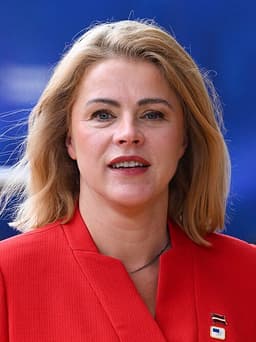
Evika Silina
Politician · Modern
39.5Total

Napoleon Bonaparte
General · Modern
70.9Total
Basic Information
Born
1975
1769
Died
—
1821
Era
Modern
Modern
Nationality
Latvia
France
Occupation
Politician
General
Civilization
Western
Western
Score Comparison
Military (10%)
14.2
94.0
Political (20%)
43.7
72.0
Influence (20%)
47.9
40.0
Legacy (20%)
35.8
80.0
Leadership (15%)
51.9
78.0
Strategy (15%)
28.6
90.0
TOTAL
39.5
70.9
Evika Silina — Complete Timeline
2023 AD
Economic Reform EffortsReform
Silina's government pursued economic reforms including tax changes and measures to address inflation and energy costs. The reforms aimed to improve Latvia's competitiveness and fiscal stability.
EconomyTax ReformEnergy
Impact: nationalconstructive
Appointed Prime Minister of LatviaPolitical Action◆ Major
Silina became Prime Minister of Latvia, leading a coalition government formed by the New Unity party, the Union of Greens and Farmers, and the Progressives. She succeeded Kri
Prime MinisterCoalitionGovernment Formation
Impact: nationalconstructive
Continued Support for UkrainePolitical Action
Silina's government maintained Latvia's strong support for Ukraine, including military aid and hosting Ukrainian refugees. Latvia consistently advocated for EU sanctions against Russia.
UkraineForeign PolicySanctions
Impact: regionalconstructive
Napoleon Bonaparte — Complete Timeline
1799 AD
Coup of 18 BrumaireOther◆ Major
Napoleon Bonaparte, with support from his brother Lucien and key political figures, overthrew the Directory in a bloodless coup. He established the Consulate with himself as First Consul, effectively becoming the ruler of France. This event ended the French Revolution's most unstable period.
French RevolutionCoupRise to Power
Impact: regional
1804 AD
Promulgation of the Napoleonic CodeOther◆ Major
Napoleon enacted the Civil Code of the French, known as the Napoleonic Code, a comprehensive set of laws that replaced the fragmented feudal legal systems. The code established legal equality, protected property rights, and secularized law. It became the basis for legal systems in many European and world countries.
Legal ReformNapoleonic CodeCivil Law
Impact: globalconstructive
1805 AD
Battle of AusterlitzWar◆ Major
Napoleon's Grande Arm
Napoleonic WarsBattleDecisive Victory
Impact: global
1812 AD
Invasion of RussiaWar◆ Major
Napoleon led the Grande Arm
Napoleonic WarsInvasionDisaster
Impact: globaldestructive
1815 AD
Battle of WaterlooWar◆ Major
Napoleon's French army was defeated by the combined forces of the Duke of Wellington's Anglo-Allied army and Gebhard Leberecht von Bl
Napoleonic WarsBattleFinal Defeat
Impact: globaldestructive
Expert Analysis
evika-silina-vs-napoleon-bonaparte
# The Emperor and the Prime Minister: Two Paths to Power in Europe
On a June morning in 1815, Napoleon Bonaparte watched his empire crumble in the mud of Waterloo, his dreams of continental dominion dissolving into exile. Two centuries later, in September 2023, Evika Siliņa stood before the Saeima in Riga, taking the oath as Prime Minister of Latvia—a nation Napoleon had once marched through on his way to Russia. These two figures, separated by time, scale, and ambition, could hardly seem more different. Yet both rose to lead their nations in moments of profound change. What drove one to conquer half a continent and the other to steer a small Baltic state through the turbulence of modern geopolitics? The answer lies not merely in opportunity, but in the very nature of power itself.
Origins
Napoleon was born in 1769 on Corsica, an island recently annexed by France. His family was minor nobility, but their world was one of Mediterranean poverty and fierce independence. The young Napoleon arrived at French military school speaking Italian with a thick accent, mocked by classmates for his provincial origins. That outsider status forged a hunger that never left him. He devoured history and military strategy, absorbing the lessons of Caesar and Alexander, while the French Revolution tore the old order apart. By his mid-twenties, he had witnessed the fall of a king and the rise of the mob. Chaos was his classroom.
Evika Siliņa was born in 1975 in Riga, then part of the Soviet Union. Her Latvia was a place of gray apartment blocks, state-controlled news, and the quiet endurance of occupation. She came of age in the 1980s as the Soviet empire began to crack. In 1991, when she was sixteen, Latvia regained its independence. She grew up not in revolution but in reconstruction—learning how to build institutions from scratch, how to negotiate with former occupiers, how to make a tiny country matter in a world dominated by giants. Her education was in law, not war; her battlefield was the committee room, not the plain.
Rise to Power
Napoleon’s ascent was a masterpiece of opportunism. In 1795, when royalist rebels threatened the revolutionary government in Paris, a young artillery officer was called upon to defend the Tuileries. He did so with a "whiff of grapeshot"—cannon fire that scattered the insurgents in minutes. At twenty-six, he was a general. Two years later, he led a ragged army into Italy and stunned Europe with a campaign of breathtaking speed and audacity. By 1799, he had seized control of France itself, not through election but through a coup d’état. He crowned himself Emperor in 1804, taking the crown from the Pope’s hands and placing it on his own head. Power came to him as a natural right.
Siliņa’s rise was quieter, a slow climb through the ranks of Latvia’s post-Soviet politics. She studied law at the University of Latvia, worked in private practice, then entered government service. She served as a parliamentary secretary, then as Minister of Welfare, where she managed social policy during the COVID-19 pandemic. In 2023, when Prime Minister Krišjānis Kariņš resigned, her New Unity party chose her as his successor. She became prime minister not by conquest but by coalition—negotiating with the Union of Greens and Farmers, balancing regional interests, and securing a majority of fifty-three votes out of one hundred. Her path was one of patience, not seizure.
Leadership & Governance
Napoleon ruled as a military genius and a political reformer. His military score of 94 reflects campaigns that rewrote the rules of war—the lightning marches across Italy, the crushing victory at Austerlitz in 1805, the disastrous invasion of Russia in 1812. He commanded armies of hundreds of thousands, personally directing battles that decided the fate of nations. His political score of 75 is more modest, yet his Napoleonic Code modernized legal systems across Europe, establishing principles of equality before the law and secular governance. He was a dictator who built schools, roads, and a centralized state. But he could not stop conquering. Each victory demanded another, until the continent united against him.
Siliņa governs a nation of 1.8 million people with no army capable of challenging a great power. Her military score of 30.9 reflects Latvia’s reliance on NATO for defense. Her political score of 63.8 and leadership score of 75.8 measure a different kind of skill: managing a coalition government, maintaining support for Ukraine while hosting refugees, and addressing inflation and energy costs through tax reforms. Her strategy score of 57.5 is not about battlefield tactics but about navigating the European Union, balancing relations with Russia, and keeping her small country secure. She does not command armies; she manages budgets and alliances.
Triumph & Tragedy
Napoleon’s greatest moment was Austerlitz in 1805, where he destroyed the combined armies of Austria and Russia, ending the Holy Roman Empire and cementing his domination of Europe. His worst was Waterloo in 1815, where a combination of Prussian reinforcements, British resilience, and his own misjudgments ended his reign. He died in 1821 on Saint Helena, a British prison island in the South Atlantic, dictating memoirs to justify his legacy.
Siliņa’s triumphs are quieter. She took office in a time of war on Europe’s borders, inflation at home, and energy crises. Her government maintained Latvia’s support for Ukraine, a moral and strategic stand. Her tragedies are not battles lost but compromises made—the slow grind of coalition politics, the impossibility of satisfying every voter. She has not faced a Waterloo, but she faces daily the challenge of governing a small nation in a dangerous world.
Character & Destiny
Napoleon was driven by an insatiable ego. "Impossible is not a word in my dictionary," he once said. He believed his destiny was to reshape Europe, and his personality—brilliant, ruthless, charismatic—made that possible. But the same qualities that lifted him also destroyed him. He could not stop, could not compromise, could not accept limits. His total score of 82.4 reflects a life of extraordinary achievement and catastrophic failure.
Siliņa, with a total score of 58.8, embodies a different kind of leadership. She works within systems, not against them. Her personality is pragmatic, not visionary. She does not dream of empires; she dreams of stable energy prices and functional schools. Destiny for her is not a grand narrative but a series of practical decisions. Where Napoleon saw the world as a chessboard to be conquered, she sees it as a network to be navigated.
Legacy
Napoleon’s legacy is immense. He reshaped Europe’s borders, spread the ideals of the French Revolution, and inspired both nationalism and militarism for centuries. His name is synonymous with ambition and genius. Today, he is remembered in statues, museums, and the Napoleonic Code that still governs legal systems from France to Louisiana.
Siliņa’s legacy is still being written. She may be remembered as a steady hand in a turbulent time, or as a footnote in Latvia’s post-Soviet journey. Her influence score of 66 suggests she matters, but not on a global scale. In a century, Napoleon will still be studied in military academies. Siliņa may be a name in Latvian history books, honored by her country but unknown beyond it.
Conclusion
The difference between Napoleon and Siliņa is not just one of scale but of era. Napoleon lived in an age when a single man could reshape continents with will and violence. Siliņa lives in an age of networks, institutions, and interdependence. One conquered; the other governs. One dreamed of glory; the other seeks stability. Both rose to lead their nations, but the nature of power itself has changed. Perhaps the true lesson is not that great men make history, but that history makes the kind of leaders it needs. Napoleon needed a world of empires to conquer. Siliņa needs a world of allies to maintain. And in that quiet difference lies the story of Europe itself.
Rankings
🥇
Napoleon BonaparteLeader
Mil: 94.0Pol: 72.0Inf: 40.0
70.9
🥈
Evika Silina
Mil: 14.2Pol: 43.7Inf: 47.9
39.5
+31.4 behind
How This Comparison Works
Algorithm
Each figure is scored on 6 dimensions (0—100 scale) based on structured historical data: Military (10%), Political (20%), Influence (20%), Legacy (20%), Leadership (15%), Strategy (15%). The weighted total produces the final ranking.
Data Sources
Scores are computed from structured sub-indicators in the database. Scale factors adjust for era (Ancient ×0.85, Modern ×1.0) and civilization size (Eastern ×1.05, Other ×0.80) to account for differences in population and military scale.
Maximum 3 Figures
Comparisons are limited to 2—3 figures to ensure readability and statistical meaningfulness.
Error Margins
±5 points per dimension — Sub-scores are derived from historical records with inherent uncertainty. Two figures within 5 points on a dimension should be considered roughly equivalent in that area.
Total Score Accuracy
±3 points overall — The weighted combination of 6 dimensions produces a total score with approximately ±3 points of uncertainty. Differences of less than 3 points are not statistically significant— the figures are effectively tied.
Known Limitations
- Historical records are incomplete and uneven across civilizations
- Figures from oral-tradition societies may be underrepresented
- Occupation labels can misclassify multi-role figures
- Scores measure capability and impact, not moral character
- Quantitative scoring is a comparison tool, not absolute truth
Capability Radar
Military (10%) — Battles & Warfare
Battles
25
95
Win Rate
25
90
Expansion
27
95
Political (20%) — Governance & Reform
Reform
30
95
Diplomacy
40
80
Economy
35
85
Influence (20%) — Cultural & Global Reach
Cultural
10
85
Global
15
90
Legacy (20%) — Historical Impact
Historical
15
95
Longevity
10
90
Leadership (15%) — Power & Stability
Tenure
15
85
Stability
30
70
Strategy (15%) — Tactics & Innovation
Strategy
31
95
Tactics
32
98
Reform
36
92
Similar Comparisons
Comments & Discussion
数字暴徒6/17/2026
把萨利尼亚跟拿破仑放一起比?笑死我了。一个用六万具尸体铺平欧洲地图,另一个靠欧盟补贴和移民配额搞政治正确。萨利尼亚连里加市中心的纪念喷泉都管不好,拿破仑可是从莫斯科到马德里都立过雕像。数据不会撒谎:拿破仑打了60场战役,萨利尼亚开了60场记者会。这就是所谓"现代领导力"?给我省省吧。
镀金法老6/17/2026
说实话,拿两位比较的人怕不是历史课都在睡觉。拿破仑是革命之子,活火山一样的男人,把整个欧洲烧成灰烬然后重新锻造。萨利尼亚?她是苏联体制的产物,拉脱维亚官僚系统的完美继承人。区别不在个人能力——拿破仑能在一小时内决定欧洲边界,萨利尼亚需要三个月和三个委员会才能决定垃圾桶该放街左边还是右边。这不是谁更厉害的问题,是火焰和灰烬的本质区别。
Historian8056/17/2026
The real tragedy isn't the comparison—it's that we've forgotten scale. Napoleon read Plutarch as a schoolboy and modeled himself on Caesar; Siliņa probably studies McKinsey reports. He thought in terms of civilization's destiny; she thinks in quarterly approval ratings. I'm not saying one is better—but let's be honest: when Siliņa gives a speech, does it echo across millennia? No. She governs a postage stamp. Napoleon reshaped the entire continental chessboard. Comparing them is like comparing A
Chronicler31356/17/2026
Napoleon actually fired his cannons across the same Baltic plains Siliņa now governs. Here's the difference: He conquered half a continent with blood and iron; she administers a NATO buffer state with EU subsidies. I'd bet every franc in my bicorne that Siliņa couldn't march a brigade to the Dnieper, but she doesn't need to—modern Latvian power is measured in Excel spreadsheets and gas pipeline access, not cavalry charges. The empire builder versus the bureaucrat. Both wield power; one's just qu