Loading...
Ferdinand Foch vs Reinhard Scheer
Ferdinand Foch leads by 15.0 pts · 2 figures compared
…
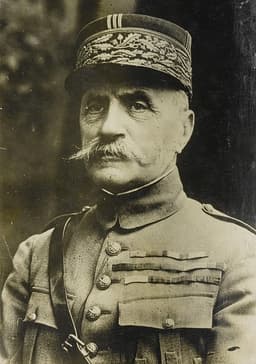
Ferdinand Foch
General · Modern
70.8Total

Reinhard Scheer
General · Modern
55.8Total
Basic Information
Born
1851
1863
Died
1929
1928
Era
Modern
Modern
Nationality
France
Germany
Occupation
General
General
Civilization
Western
Western
Score Comparison
Military (10%)
78.0
50.0
Political (20%)
72.0
42.2
Influence (20%)
75.0
55.0
Legacy (20%)
65.0
58.0
Leadership (15%)
68.0
64.5
Strategy (15%)
70.0
65.4
TOTAL
70.8
55.8
Ferdinand Foch — Complete Timeline
1914 AD
First Battle of the MarneWar
As commander of the French Ninth Army, Foch's forces held the line and counterattacked at the First Battle of the Marne, helping to halt the German advance on Paris. This battle saved France from early defeat.
World War IWestern FrontDefense
Impact: global
1918 AD
Hundred Days OffensiveWar
Foch planned and directed the Allied Hundred Days Offensive, a series of coordinated attacks that broke the German lines and forced the German army to retreat. The offensive led directly to the Armistice.
World War IWestern FrontOffensive
Impact: global
Appointed Allied Supreme CommanderPolitical Action◆ Major
Foch was appointed Supreme Commander of the Allied Armies on the Western Front, coordinating the forces of France, Britain, the United States, and other allies. This unified command was crucial for the final Allied offensives.
World War ICommandAllied Unity
Impact: globalconstructive
Accepted the German ArmisticePolitical Action
Foch, as Allied Supreme Commander, accepted the German armistice delegation in a railway carriage at Compi
World War IArmisticePeace
Impact: global
Reinhard Scheer — Complete Timeline
1916 AD
Battle of JutlandWar
Scheer commanded the German High Seas Fleet at the Battle of Jutland, the largest naval battle of World War I. His fleet inflicted heavier losses on the British Grand Fleet but was forced to retreat. Scheer's tactical handling prevented a decisive British victory but failed to break the blockade.
World War INavalJutland
Impact: global
1917 AD
Unrestricted U-boat Warfare DecisionPolitical Action
Scheer, as Chief of the Naval Staff, advocated for the resumption of unrestricted U-boat warfare in January 1917. He argued it would starve Britain into submission within six months. This decision led to the entry of the United States into World War I in April 1917.
World War INavalU-boat
Impact: globaldestructive
1919 AD
Scuttling of the High Seas FleetOther◆ Major
Scheer, as Chief of the Naval Staff, ordered the scuttling of the German High Seas Fleet at Scapa Flow on 21 June 1919. This was to prevent the fleet from being divided among the Allies under the Treaty of Versailles. 52 ships were sunk, the largest loss of naval vessels in a single day.
World War INavalScapa Flow
Impact: globaltragic
Expert Analysis
Origins
Ferdinand Foch was born on 2 October 1851 in Tarbes, France, into a devout Catholic family. His father was a civil servant. Foch attended the Jesuit school in Metz and later the École Polytechnique, graduating in 1873. He joined the artillery and served in the Franco-Prussian War, an experience that shaped his strategic thinking. He later taught at the École Supérieure de Guerre, where he developed his theories on offensive warfare.
Reinhard Scheer was born on 30 September 1863 in Obernkirchen, Principality of Schaumburg-Lippe (now Germany). His father was a schoolteacher. Scheer entered the Imperial German Navy in 1879 as a cadet. He rose through the ranks, serving on various ships and in staff positions. He commanded the battleship SMS Elsass and later served as Chief of Staff of the High Seas Fleet. His background was purely naval, with no experience in joint operations.
Rise to Power
Foch's rise came during World War I. In 1914, as commander of the French Ninth Army, he played a key role in the First Battle of the Marne (5-12 September 1914), where his forces held the line despite heavy losses. His ability to coordinate with British forces brought him to prominence. He became commander of the French Northern Army Group in 1915 and later Chief of the French General Staff in 1917. On 26 March 1918, he was appointed Supreme Commander of the Allied Armies on the Western Front, a unified command that proved decisive.
Scheer's rise culminated in his appointment as commander of the High Seas Fleet in January 1916. He had previously commanded the II Battle Squadron and served as Chief of Staff to the fleet. His aggressive tactical doctrine led to the Battle of Jutland (31 May-1 June 1916), the largest naval battle of the war. Scheer's fleet inflicted heavier losses on the British Grand Fleet but failed to break the blockade. After Jutland, he became Chief of the Naval Staff in August 1918, advocating for unrestricted submarine warfare.
Leadership & Governance
Foch's leadership style was centralized and decisive. As Supreme Commander, he coordinated the armies of France, Britain, the United States, and others. He planned the Hundred Days Offensive (August-November 1918), a series of coordinated attacks that broke the German lines. He used combined arms tactics, integrating infantry, artillery, tanks, and aircraft. Foch's governance extended to diplomacy; he insisted on harsh armistice terms, including the occupation of the Rhineland.
Scheer led the High Seas Fleet with aggressive tactics. At Jutland, he executed a plan to lure out a portion of the British fleet and destroy it. However, when faced with the entire Grand Fleet, he ordered a retreat. His leadership was criticized for failing to achieve a decisive victory. As Chief of the Naval Staff, he pushed for unrestricted U-boat warfare, which brought the United States into the war. His governance of the fleet ended with the scuttling at Scapa Flow in 1919, an act of defiance against the Allies.
Triumph & Tragedy
Foch's greatest triumph was the Hundred Days Offensive, which forced Germany to seek an armistice. He accepted the German surrender on 11 November 1918 in a railway carriage at Compiègne. However, his tragedy was the failure to secure a lasting peace; the Treaty of Versailles, which he considered too lenient, led to conditions that sparked World War II. He famously said, "This is not a peace. It is an armistice for twenty years."
Scheer's triumph was the Battle of Jutland, where his fleet sank more British ships (14 vs. 11) and inflicted higher casualties (8,645 vs. 6,094). He achieved tactical success but failed to break the British blockade or shift the strategic balance. His tragedy was the scuttling of the High Seas Fleet at Scapa Flow, a desperate act that ended the fleet's existence. He also bears responsibility for the unrestricted U-boat campaign, which ultimately failed and drew the United States into the war.
Character & Destiny
Foch was known for his unwavering will and strategic vision. He was a devout Catholic and a man of strong convictions. His character was shaped by the French defeat in 1870; he was determined to prevent a repeat. His destiny was to lead the Allies to victory, but his inflexibility on armistice terms contributed to future conflict. Historians rate his leadership score at 68.0, reflecting his effectiveness but also his limitations in peacetime.
Scheer was aggressive and risk-taking, but also pragmatic. He accepted the strategic reality of British naval superiority after Jutland. His character is often described as determined but narrow-minded, focused on naval tactics rather than overall strategy. His destiny was to command a fleet that was ultimately scuttled, a symbol of Germany's defeat. His military score of 50.0 reflects his tactical competence but strategic failure.
Legacy
Foch's legacy is that of the Allied Supreme Commander who won World War I. He is remembered as a master of combined arms and coordination. His statue stands near the Arc de Triomphe. The Foch doctrine of offensive warfare influenced French military thinking until 1940. His total score of 70.8 reflects his significant impact on the war's outcome.
Scheer's legacy is tied to the Battle of Jutland, which remains a subject of debate. He is remembered as a capable fleet commander who fought a tactical draw but lost strategically. The scuttling at Scapa Flow is a symbol of German naval pride and defeat. His influence on naval warfare is limited; his total score of 55.8 underscores his lesser historical impact.
Conclusion
Ferdinand Foch had a greater impact than Reinhard Scheer. Foch's role as Supreme Commander directly led to the Allied victory in World War I, ending a conflict that had killed millions. Scheer's actions, while tactically notable, did not alter the war's outcome. Foch's strategic coordination across nations was a precursor to modern coalition warfare, while Scheer's naval strategy failed to challenge British dominance. The score gap of 15.0 points reflects this disparity: Foch's total of 70.8 versus Scheer's 55.8. Foch's legacy is that of a war-winner; Scheer's is that of a competent but ultimately unsuccessful admiral.
Rankings
🥇
Ferdinand FochLeader
Mil: 78.0Pol: 72.0Inf: 75.0
70.8
🥈
Reinhard Scheer
Mil: 50.0Pol: 42.2Inf: 55.0
55.8
+15.0 behind
How This Comparison Works
Algorithm
Each figure is scored on 6 dimensions (0—100 scale) based on structured historical data: Military (10%), Political (20%), Influence (20%), Legacy (20%), Leadership (15%), Strategy (15%). The weighted total produces the final ranking.
Data Sources
Scores are computed from structured sub-indicators in the database. Scale factors adjust for era (Ancient ×0.85, Modern ×1.0) and civilization size (Eastern ×1.05, Other ×0.80) to account for differences in population and military scale.
Maximum 3 Figures
Comparisons are limited to 2—3 figures to ensure readability and statistical meaningfulness.
Error Margins
±5 points per dimension — Sub-scores are derived from historical records with inherent uncertainty. Two figures within 5 points on a dimension should be considered roughly equivalent in that area.
Total Score Accuracy
±3 points overall — The weighted combination of 6 dimensions produces a total score with approximately ±3 points of uncertainty. Differences of less than 3 points are not statistically significant— the figures are effectively tied.
Known Limitations
- Historical records are incomplete and uneven across civilizations
- Figures from oral-tradition societies may be underrepresented
- Occupation labels can misclassify multi-role figures
- Scores measure capability and impact, not moral character
- Quantitative scoring is a comparison tool, not absolute truth
Capability Radar
Military (10%) — Battles & Warfare
Battles
85
75
Win Rate
80
55
Expansion
60
20
Political (20%) — Governance & Reform
Reform
50
30
Diplomacy
85
35
Economy
40
20
Influence (20%) — Cultural & Global Reach
Cultural
60
40
Global
80
45
Legacy (20%) — Historical Impact
Historical
85
65
Longevity
70
50
Leadership (15%) — Power & Stability
Tenure
65
40
Stability
55
30
Strategy (15%) — Tactics & Innovation
Strategy
90
70
Tactics
75
80
Reform
70
60
Similar Comparisons
Comments & Discussion
No comments yet. Be the first to share your thoughts!