Loading...
This comparison has not been analyzed yet.
One-time AI generation (~1 minute). Scores and timeline are already available below.
Ferdinand I of Bohemia vs Louis III of Hesse
Ferdinand I of Bohemia leads by 10.5 pts · 2 figures compared
…
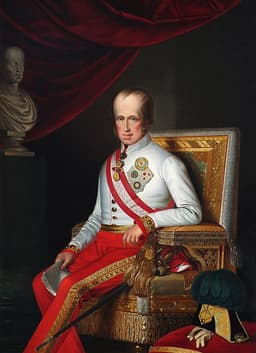
Ferdinand I of Bohemia
Emperor · Modern
55.1Total
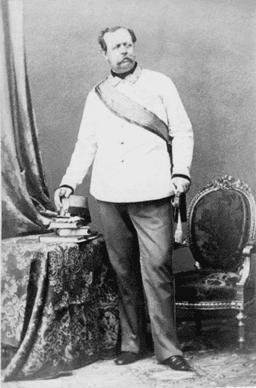
Louis III of Hesse
Emperor · Modern
44.6Total
Basic Information
Born
1503
1806
Died
1564
1877
Era
Modern
Modern
Nationality
Bohemia
Hesse-Darmstadt
Occupation
Emperor
Emperor
Civilization
Western
Western
Score Comparison
Military (10%)
47.5
11.2
Political (20%)
62.7
37.9
Influence (20%)
57.2
48.6
Legacy (20%)
49.2
38.3
Leadership (15%)
68.0
67.0
Strategy (15%)
41.7
60.0
TOTAL
55.1
44.6
Ferdinand I of Bohemia — Complete Timeline
1526 AD
Establishment of the Habsburg MonarchyPolitical Action
Ferdinand I inherited the crowns of Bohemia and Hungary after the death of Louis II. He consolidated these territories under Habsburg rule, creating a powerful Central European monarchy that would last until 1918.
Dynastic UnionTerritorial ExpansionHabsburg
Impact: regional
1527 AD
Coronation as King of BohemiaPolitical Action
Ferdinand I was crowned King of Bohemia in Prague, establishing Habsburg rule over the kingdom. This coronation followed the death of Louis II at Moh
CoronationHabsburg DynastyBohemia
Impact: regional
1555 AD
Peace of AugsburgPolitical Action
Ferdinand I played a key role in negotiating the Peace of Augsburg, which ended religious conflicts in the Holy Roman Empire. The treaty established the principle of cuius regio, eius religio, allowing princes to choose the religion of their territories.
Religious PeaceTreatyHoly Roman Empire
Impact: globalconstructive
Louis III of Hesse — Complete Timeline
1848 AD
Accepted Liberal ReformsReform◆ Major
Louis III agreed to a series of liberal reforms, including the abolition of feudal privileges, freedom of the press, and the establishment of a more democratic parliament. These reforms were later partially reversed.
Reforms1848 Revolution
Impact: regionalprogressive
Became Grand Duke of HessePolitical Action◆ Major
Louis III succeeded his father Louis II as Grand Duke of Hesse-Darmstadt during the 1848 revolutions. He was more pragmatic than his father and accepted some liberal reforms to stabilize his rule.
SuccessionHesse-Darmstadt
Impact: regional
1866 AD
Supported Prussia in Austro-Prussian WarPolitical Action◆ Major
Louis III sided with Prussia during the Austro-Prussian War. After Prussia's victory, Hesse-Darmstadt was forced to cede some territories but was allowed to remain independent, unlike Hesse-Kassel.
Austro-Prussian WarPrussian Alliance
Impact: regional
1871 AD
Joined German EmpirePolitical Action◆ Major
Louis III led Hesse-Darmstadt into the newly formed German Empire under Prussian leadership. He became a constituent prince of the empire, losing much of his sovereignty but preserving his throne.
German UnificationEmpire
Impact: regional
This comparison has not been analyzed yet.
One-time AI generation (~1 minute). Scores and timeline are already available below.
Rankings
🥇
Ferdinand I of BohemiaLeader
Mil: 47.5Pol: 62.7Inf: 57.2
55.1
🥈
Louis III of Hesse
Mil: 11.2Pol: 37.9Inf: 48.6
44.6
+10.5 behind
How This Comparison Works
Algorithm
Each figure is scored on 6 dimensions (0—100 scale) based on structured historical data: Military (10%), Political (20%), Influence (20%), Legacy (20%), Leadership (15%), Strategy (15%). The weighted total produces the final ranking.
Data Sources
Scores are computed from structured sub-indicators in the database. Scale factors adjust for era (Ancient ×0.85, Modern ×1.0) and civilization size (Eastern ×1.05, Other ×0.80) to account for differences in population and military scale.
Maximum 3 Figures
Comparisons are limited to 2—3 figures to ensure readability and statistical meaningfulness.
Error Margins
±5 points per dimension — Sub-scores are derived from historical records with inherent uncertainty. Two figures within 5 points on a dimension should be considered roughly equivalent in that area.
Total Score Accuracy
±3 points overall — The weighted combination of 6 dimensions produces a total score with approximately ±3 points of uncertainty. Differences of less than 3 points are not statistically significant— the figures are effectively tied.
Known Limitations
- Historical records are incomplete and uneven across civilizations
- Figures from oral-tradition societies may be underrepresented
- Occupation labels can misclassify multi-role figures
- Scores measure capability and impact, not moral character
- Quantitative scoring is a comparison tool, not absolute truth
Capability Radar
Military (10%) — Battles & Warfare
Battles
25
35
Win Rate
20
40
Expansion
35
45
Political (20%) — Governance & Reform
Reform
55
20
Diplomacy
65
30
Economy
50
20
Influence (20%) — Cultural & Global Reach
Cultural
40
10
Global
45
10
Legacy (20%) — Historical Impact
Historical
55
20
Longevity
50
10
Leadership (15%) — Power & Stability
Tenure
60
30
Stability
45
40
Strategy (15%) — Tactics & Innovation
Strategy
30
44
Tactics
20
47
Reform
40
53
Similar Comparisons
Comments & Discussion
No comments yet. Be the first to share your thoughts!