Loading...
Ferdinand I of Bohemia vs Napoleon Bonaparte
Napoleon Bonaparte leads by 15.8 pts · 2 figures compared
…
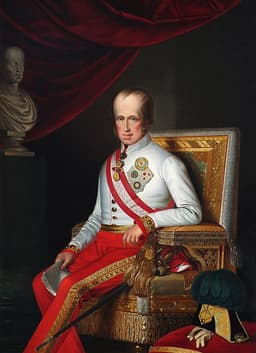
Ferdinand I of Bohemia
Emperor · Modern
55.1Total

Napoleon Bonaparte
General · Modern
70.9Total
Basic Information
Born
1503
1769
Died
1564
1821
Era
Modern
Modern
Nationality
Bohemia
France
Occupation
Emperor
General
Civilization
Western
Western
Score Comparison
Military (10%)
47.5
94.0
Political (20%)
62.7
72.0
Influence (20%)
57.2
40.0
Legacy (20%)
49.2
80.0
Leadership (15%)
68.0
78.0
Strategy (15%)
41.7
90.0
TOTAL
55.1
70.9
Ferdinand I of Bohemia — Complete Timeline
1526 AD
Establishment of the Habsburg MonarchyPolitical Action
Ferdinand I inherited the crowns of Bohemia and Hungary after the death of Louis II. He consolidated these territories under Habsburg rule, creating a powerful Central European monarchy that would last until 1918.
Dynastic UnionTerritorial ExpansionHabsburg
Impact: regional
1527 AD
Coronation as King of BohemiaPolitical Action
Ferdinand I was crowned King of Bohemia in Prague, establishing Habsburg rule over the kingdom. This coronation followed the death of Louis II at Moh
CoronationHabsburg DynastyBohemia
Impact: regional
1555 AD
Peace of AugsburgPolitical Action
Ferdinand I played a key role in negotiating the Peace of Augsburg, which ended religious conflicts in the Holy Roman Empire. The treaty established the principle of cuius regio, eius religio, allowing princes to choose the religion of their territories.
Religious PeaceTreatyHoly Roman Empire
Impact: globalconstructive
Napoleon Bonaparte — Complete Timeline
1799 AD
Coup of 18 BrumaireOther◆ Major
Napoleon Bonaparte, with support from his brother Lucien and key political figures, overthrew the Directory in a bloodless coup. He established the Consulate with himself as First Consul, effectively becoming the ruler of France. This event ended the French Revolution's most unstable period.
French RevolutionCoupRise to Power
Impact: regional
1804 AD
Promulgation of the Napoleonic CodeOther◆ Major
Napoleon enacted the Civil Code of the French, known as the Napoleonic Code, a comprehensive set of laws that replaced the fragmented feudal legal systems. The code established legal equality, protected property rights, and secularized law. It became the basis for legal systems in many European and world countries.
Legal ReformNapoleonic CodeCivil Law
Impact: globalconstructive
1805 AD
Battle of AusterlitzWar◆ Major
Napoleon's Grande Arm
Napoleonic WarsBattleDecisive Victory
Impact: global
1812 AD
Invasion of RussiaWar◆ Major
Napoleon led the Grande Arm
Napoleonic WarsInvasionDisaster
Impact: globaldestructive
1815 AD
Battle of WaterlooWar◆ Major
Napoleon's French army was defeated by the combined forces of the Duke of Wellington's Anglo-Allied army and Gebhard Leberecht von Bl
Napoleonic WarsBattleFinal Defeat
Impact: globaldestructive
Expert Analysis
ferdinand-i-of-bohemia-vs-napoleon-bonaparte
# The Emperor and the Consolidator
On a June evening in 1815, Napoleon Bonaparte stood on a muddy field near Waterloo, watching his Imperial Guard—the invincible backbone of his armies—crumble before British and Prussian fire. Less than three centuries earlier, in 1526, another ruler faced a very different kind of battlefield: a negotiating table in Prague, where Ferdinand of Habsburg quietly accepted the crowns of Bohemia and Hungary. One man conquered through cannon and cavalry; the other through marriage, treaty, and patience. Both shaped Europe profoundly, yet their paths could hardly have been more different.
Origins
Napoleon was born in 1769 on the Mediterranean island of Corsica, a place only recently annexed by France. His family were minor nobles with Italian roots, speaking Corsican dialect in a home where French was a foreign tongue. The world into which he arrived was one of revolution—not yet the French Revolution, but the restless energy of an age questioning old hierarchies. He was short, intense, and hungry for recognition in a society where talent could now challenge birth.
Ferdinand I, born in 1503 in Alcalá de Henares, Spain, was the grandson of Ferdinand of Aragon and Isabella of Castile, and brother to Emperor Charles V. His cradle was the center of European power. Where Napoleon had to claw his way upward, Ferdinand was born into the Habsburg dynasty—a family that understood that conquest was best achieved through strategic marriages and legal inheritances. His education was steeped in governance, diplomacy, and the delicate art of preserving Catholic unity in a continent tearing itself apart over religion.
Rise to Power
Napoleon’s ascent was a story of brilliant opportunism. A young artillery officer during the French Revolution, he first made his name in 1793 at the Siege of Toulon, where his tactical genius turned a faltering siege into a decisive victory. By 1796, at age twenty-six, he commanded the Army of Italy and stunned Europe with lightning campaigns that shattered Austrian dominance. His rise was meteoric, propelled by military victories that made him a national hero. In 1799, he seized power in a coup d'état, and by 1804 he crowned himself Emperor of the French.
Ferdinand’s path was slower and quieter. In 1526, King Louis II of Hungary and Bohemia died at the Battle of Mohács, leaving no heir. Ferdinand, who had married Louis’s sister Anna, pressed his claim not with an army but with legal documents and dynastic agreements. By the end of that year, he had established the Habsburg Monarchy in Central Europe, and in 1527 he was crowned King of Bohemia in Prague. There was no grand battlefield triumph—only the patient weaving of family ties into political reality.
Leadership & Governance
Napoleon ruled through sheer force of will and military genius, earning a military score of 94 and strategy of 93—among the highest in history. His campaigns from Austerlitz in 1805 to the invasion of Russia in 1812 displayed dazzling tactical brilliance. Yet his political score of 75 reflects the instability of his empire: he was a reformer who created the Napoleonic Code, modernized administration, and spread revolutionary ideals, but he also centralized power so completely that his system collapsed when he fell.
Ferdinand governed with a political score of 87, far surpassing Napoleon in statecraft. He did not conquer—he consolidated. His greatest achievement came in 1555 with the Peace of Augsburg, a treaty he helped negotiate that ended decades of religious war in the Holy Roman Empire by establishing the principle that each ruler would determine the religion of their territory. It was a pragmatic, imperfect peace that held for generations. His leadership score of 82 matched Napoleon’s 80, but his was a leadership of patience, compromise, and institutional building rather than battlefield charisma.
Triumph & Tragedy
Napoleon’s triumph was Austerlitz in 1805, where he destroyed a combined Russian and Austrian army in what many consider his masterpiece. His tragedy was the 1812 invasion of Russia—a catastrophic campaign where 600,000 men marched east and fewer than 100,000 returned. The disaster shattered his aura of invincibility, leading to his first abdication in 1814 and final defeat at Waterloo in 1815.
Ferdinand’s triumph was subtler: the Peace of Augsburg, which stabilized an empire that might have torn itself apart. His tragedy was the impossibility of his task—trying to hold together a patchwork of kingdoms, languages, and faiths while the Reformation deepened divisions. He died in 1564 having laid foundations that would last centuries, but never seeing the unity he sought.
Character & Destiny
Napoleon was driven by an insatiable ambition that matched his genius. “I am not a man, but a thing,” he once said. “I have a mission to fulfill.” His character was his destiny: the same boldness that conquered Europe also blinded him to limits. He could not stop, and so he fell.
Ferdinand was cautious, methodical, and patient. He understood that power in Central Europe meant building alliances, not breaking them. “Let others wage war,” a Habsburg motto ran, “but you, happy Austria, marry.” Ferdinand lived that philosophy. His destiny was not glory but endurance—the slow accumulation of lands and titles that would make the Habsburgs the dominant force in Europe for four centuries.
Legacy
Napoleon’s legacy is explosive and immediate. His military tactics are still studied, his legal code shapes modern Europe, and his name evokes both admiration and caution. He scored 82 in influence and 78 in legacy—a figure who changed the world in a decade.
Ferdinand’s legacy is quieter but deeper. He scored 73 in influence and 68 in legacy, yet the Habsburg Empire he consolidated lasted until 1918. The Peace of Augsburg established principles of religious coexistence that echo in modern secular states. He built a structure, not a moment.
Conclusion
Standing today in Prague’s castle, where Ferdinand was crowned, or on the fields of Waterloo, where Napoleon fell, one feels the weight of two very different kinds of greatness. Napoleon was lightning—bright, terrifying, and gone. Ferdinand was stone—unremarkable, patient, and enduring. Both were necessary. The one reminds us of what human ambition can achieve and destroy; the other, of what careful statecraft can preserve. In the end, Europe needed both the emperor who conquered and the consolidator who stayed.
Rankings
🥇
Napoleon BonaparteLeader
Mil: 94.0Pol: 72.0Inf: 40.0
70.9
🥈
Ferdinand I of Bohemia
Mil: 47.5Pol: 62.7Inf: 57.2
55.1
+15.8 behind
How This Comparison Works
Algorithm
Each figure is scored on 6 dimensions (0—100 scale) based on structured historical data: Military (10%), Political (20%), Influence (20%), Legacy (20%), Leadership (15%), Strategy (15%). The weighted total produces the final ranking.
Data Sources
Scores are computed from structured sub-indicators in the database. Scale factors adjust for era (Ancient ×0.85, Modern ×1.0) and civilization size (Eastern ×1.05, Other ×0.80) to account for differences in population and military scale.
Maximum 3 Figures
Comparisons are limited to 2—3 figures to ensure readability and statistical meaningfulness.
Error Margins
±5 points per dimension — Sub-scores are derived from historical records with inherent uncertainty. Two figures within 5 points on a dimension should be considered roughly equivalent in that area.
Total Score Accuracy
±3 points overall — The weighted combination of 6 dimensions produces a total score with approximately ±3 points of uncertainty. Differences of less than 3 points are not statistically significant— the figures are effectively tied.
Known Limitations
- Historical records are incomplete and uneven across civilizations
- Figures from oral-tradition societies may be underrepresented
- Occupation labels can misclassify multi-role figures
- Scores measure capability and impact, not moral character
- Quantitative scoring is a comparison tool, not absolute truth
Capability Radar
Military (10%) — Battles & Warfare
Battles
25
95
Win Rate
20
90
Expansion
35
95
Political (20%) — Governance & Reform
Reform
55
95
Diplomacy
65
80
Economy
50
85
Influence (20%) — Cultural & Global Reach
Cultural
40
85
Global
45
90
Legacy (20%) — Historical Impact
Historical
55
95
Longevity
50
90
Leadership (15%) — Power & Stability
Tenure
60
85
Stability
45
70
Strategy (15%) — Tactics & Innovation
Strategy
30
95
Tactics
20
98
Reform
40
92
Similar Comparisons
Comments & Discussion
CannonballCritic6/17/2026
People comparing Ferdinand to Napoleon are missing the point entirely. Napoleon reshaped Europe by force, military genius, and sheer audacity—Waterloo was just his final defeat. Ferdinand? He inherited power through a marriage contract and a document. One built an empire with blood and valor; the other just showed up with a Habsburg last name. This isn't a comparison; it's a contrast between action and passivity.
数据侦探6/17/2026
历史上拿破仑的战争记录显示他直接指挥了超过60场战役,而斐迪南一世几乎没有亲自上过战场。把这两个人放在一起比较,就像拿猎鹰对比家鸽——名字都带翅膀,但生存技能天差地别。数据不会骗人:拿破仑改变了欧洲政治版图的实质,斐迪南只是延续了哈布斯堡的联姻策略。别再拿外交技巧当借口,胜利需要的是刀剑而非婚书。
ResPublicaReader6/17/2026
What this analysis misses is that consolidation matters as much as conquest. Napoleon's empire collapsed within a decade, while Ferdinand's Habsburg inheritance laid foundations for Central European stability for centuries. Military brilliance is flashy, but marriage and treaty built the Austrian Empire that outlasted Napoleon's entire legacy. Call me boring, but I'll take the negotiator who builds something lasting over the general who burns bright then fades.
传统学究6/17/2026
从古典政治学视角看,拿破仑和斐迪南一世代表两种截然不同的统治类型:前者是马基雅维利式的"狮子",后者是"狐狸"。但关键在于,斐迪南的合法性来源于继承法和中世纪政治传统,而非个人魅力或军事暴力。现代人迷恋拿破仑的戏剧性,却忘了稳定的王权需要世系而非战功。实际上,斐迪南的婚姻外交比拿破仑的征战更符合古典政治学的"善治"理想。
History's_Mirror6/17/2026
You're all forgetting the elephant in the room: Napoleon was a self-made emperor who changed laws, economies, and national identities across Europe. Ferdinand I presided over religious fragmentation and Ottoman threats without a single revolutionary reform. The Habsburgs' longevity was about luck and geography, not genius. If we're measuring impact on human history, Napoleon's Civil Code affects billions today; Ferdinand's marriage contracts are footnotes. Stop romanticizing dynastic inertia.